What if that towering palm in your backyard is less of a tropical feature and more of a structural liability waiting for the next coastal southerly? Many Illawarra homeowners love the coastal aesthetic but quickly grow weary of the relentless maintenance. You're likely tired of clearing messy fruit and spiked fronds that attract pests, or perhaps you're losing sleep whenever the wind picks up. When it comes to palm tree removal Illawarra residents often find that these fibrous giants are far more complex to manage than standard hardwood trees.
We understand the frustration of trying to decipher whether you're following Wollongong's strict replacement rules or Shellharbour's specific species exemptions. This guide simplifies the process by explaining why palm removal requires specialised arborist expertise and how to navigate local council regulations safely. We'll explore the unique biology of palms, the safety protocols required for high-risk removals, and the current permit requirements across the region to ensure your property remains both compliant and secure.
Key Takeaways
- Understand why the unique fibrous biology of palms makes them a technical engineering challenge rather than simple garden maintenance.
- Learn how to navigate the specific permit requirements and exempt species lists for Wollongong and Shellharbour councils to ensure legal compliance.
- Discover why professional palm tree removal Illawarra services are essential for safely managing invasive species like the Cocos palm in coastal conditions.
- Compare the long-term financial costs of ongoing maintenance against the safety and aesthetic benefits of a complete removal.
- Identify the specialised equipment and methodical techniques required to protect your property during complex removals on tight residential blocks.
Understanding Palm Tree Removal in the Illawarra: More Than Just a Trim
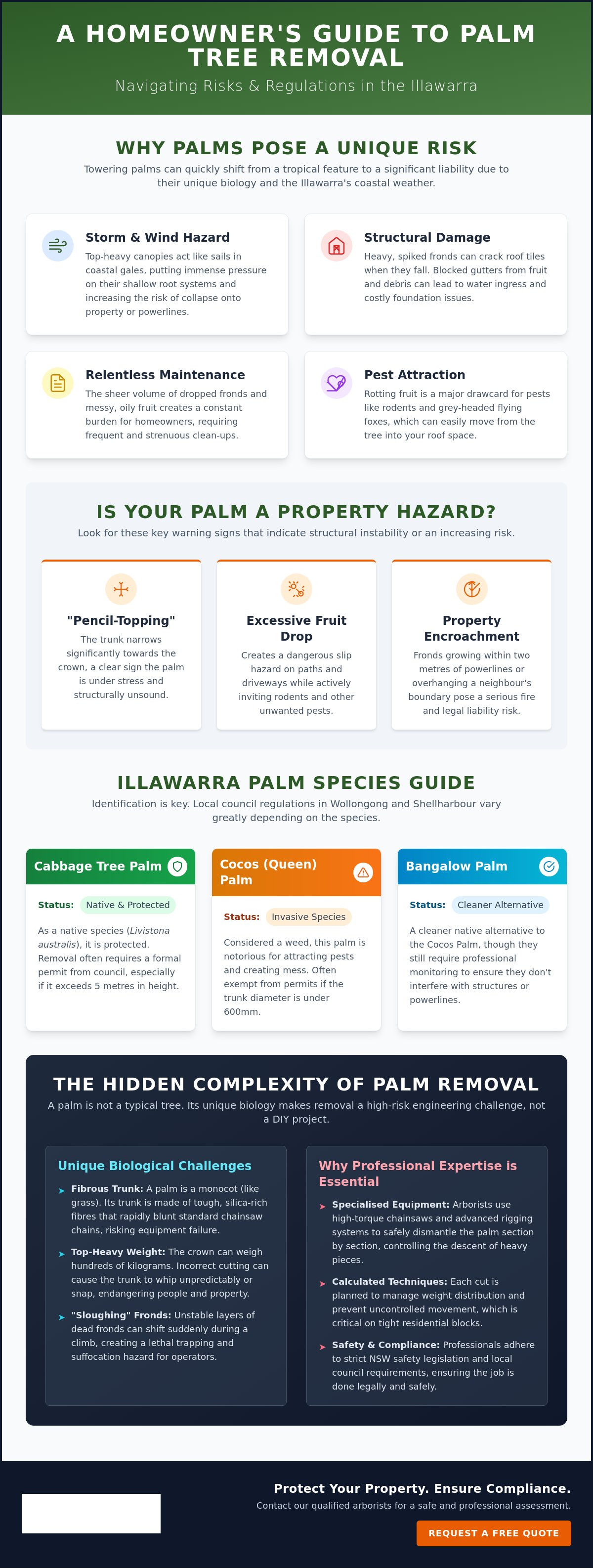
Palms define the skyline from Stanwell Park down to Kiama, yet they are far more than just garden ornaments. Unlike typical hardwood trees, members of the Arecaceae family of palms possess a unique biological structure that makes them particularly vulnerable to the Illawarra’s coastal elements. The combination of shallow root systems and top-heavy canopies creates a high-risk scenario during Wollongong’s frequent coastal storms. When a gale hits the coast, a mature palm acts like a sail, putting immense pressure on its base and surrounding structures. This structural reality means that palm tree removal Illawarra is often a matter of property safety rather than simple aesthetics.
Beyond the risk of a total collapse, the sheer volume of organic debris produced by certain species is a constant burden for homeowners. Heavy, spiked fronds can easily crack roofing tiles during high winds, while oily fruit drops frequently clog local guttering and drainage systems. This isn't just a weekend chore; blocked downpipes lead to water ingress and expensive foundation issues during the heavy rainfall events common to our region. Professional intervention ensures these risks are managed before they turn into emergency repairs.
Common Palm Species Found in Wollongong and Shellharbour
Identifying your palm species is the first step in determining your legal obligations. The Cabbage Tree Palm (Livistona australis) is native to our region and holds a protected status. Removing these typically requires a formal permit from Wollongong City Council if they exceed five metres in height. In contrast, the Cocos Palm, also known as the Queen Palm, is an invasive species that thrives in the NSW climate. These are notorious for attracting grey-headed flying foxes and creating a significant mess on driveways. Because they are considered a weed, Shellharbour City Council often lists them as exempt from permit requirements if the trunk diameter is 600mm or less. Bangalow Palms offer a cleaner native alternative, though they still require monitoring to ensure they don't interfere with nearby structures.
Signs Your Palm Tree Has Become a Property Hazard
A palm doesn't always show distress in the same way a traditional tree might. You should look for "pencil-topping," where the trunk narrows significantly toward the crown. This thinning indicates the plant is no longer receiving adequate nutrients and has become structurally unsound. Excessive fruit production is another warning sign. It doesn't just create a slip hazard; it actively invites rodents and bats into your roof space. Finally, check for encroachment. If fronds are within two metres of powerlines or overhanging a neighbour's boundary, the risk of fire or legal liability increases significantly. Addressing these issues through professional palm tree removal Illawarra services is the most reliable way to secure your property perimeter.
The Hidden Complexity of Palm Biology and Removal Safety
A palm tree isn't a tree in the botanical sense; it's a monocot, more closely related to grasses and lilies than to an oak or a gum. This distinction is critical for safe palm tree removal Illawarra. Instead of solid rings of wood, a palm trunk consists of thousands of fibrous vascular bundles. These fibres are incredibly tough and silica-rich, which acts as an abrasive that blunts standard chainsaw chains within minutes. Attempting to cut through a mature palm without high-torque machinery and sharpened speciality chains often results in equipment failure or dangerous kickbacks.
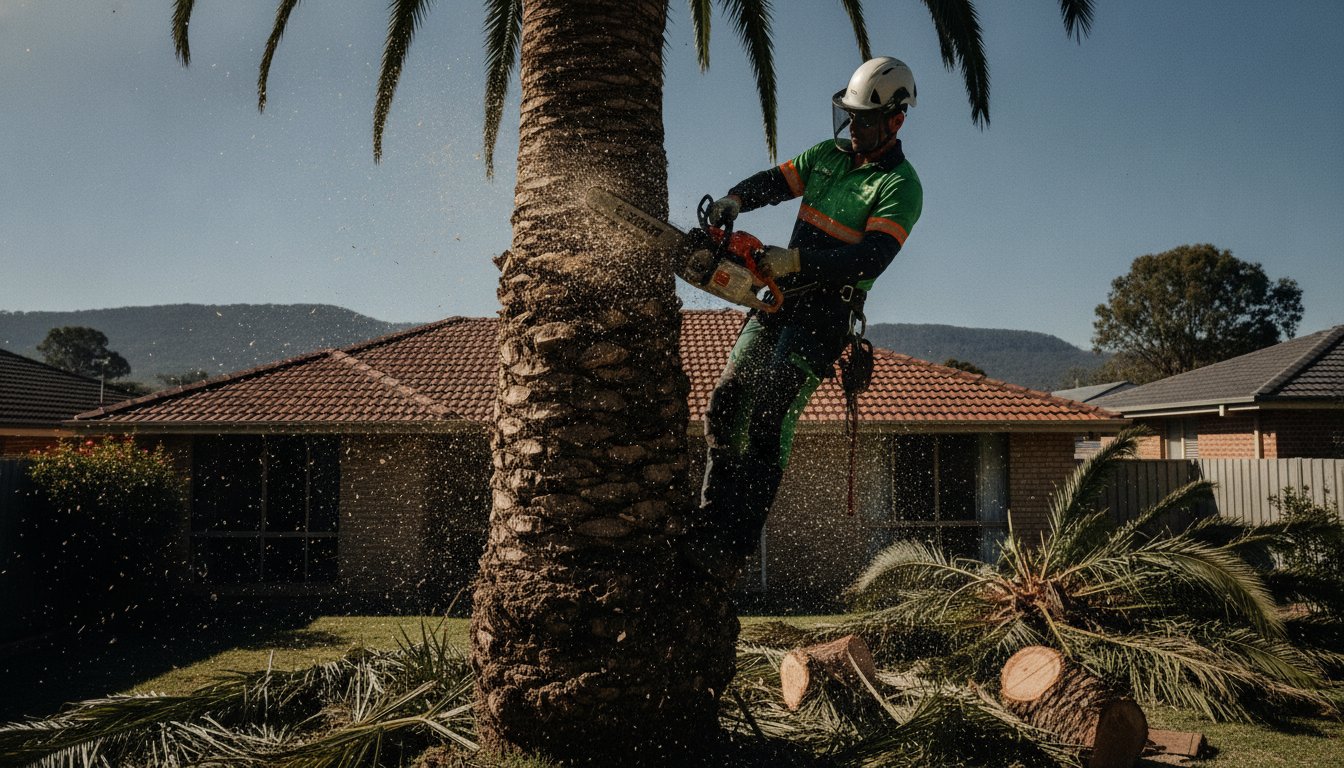
The weight distribution of a palm also presents unique engineering challenges. A mature crown can weigh several hundred kilograms, concentrated at the very top of a flexible, slender column. During a controlled sectional take-down, the removal of each piece must be calculated to prevent the trunk from whipping or snapping. There's also the lethal risk of "sloughing" fronds or "dead skirts," which are unstable layers of old foliage. If these heavy, spiked layers shift during a climb, they can trap and suffocate an inexperienced operator against the trunk. This high-risk work is why NSW tree removal legislation and local safety standards require strict adherence to professional protocols.
Specialised Equipment Used by Professional Arborists
To manage these complexities, we utilise high-torque chainsaws specifically designed to slice through wet, stringy fibres without clogging. We also deploy advanced rigging systems to lower heavy crown sections slowly. This is essential on tight residential blocks in Wollongong where there's no room for error. Our team wears specialised PPE to protect against the toxic sap and sharp spikes found on species like the Phoenix palm, which can cause severe skin irritations and infections.
Why DIY Palm Removal is a High-Risk Gamble
Many property owners underestimate the unpredictability of a palm's internal health. A trunk may appear solid on the outside while the centre's a hollowed-out mass of rot or termite damage. Without the professional experience to sound out these defects, a DIY attempt can lead to an unplanned collapse. Unlike hardwoods which have predictable fracture points, palm trunks are composed of longitudinal fibres that shred and pull apart irregularly when under tension. If an accident occurs, most standard home insurance policies won't cover damage caused by non-professional high-risk tree work. For a safe and insured resolution, it's always best to consult a specialist in palm tree removal Illawarra.
Deciding Between Palm Maintenance and Complete Removal
Deciding between ongoing maintenance and a permanent solution involves balancing your property's aesthetics with long-term safety and budget. While many residents value the tropical silhouette of a mature palm, the recurring expense of professional pruning and fruit removal can eventually outweigh the one-off cost of a palm tree removal Illawarra. It's also vital to consider the impact beneath the surface. Palm roots grow in a dense, spreading mat rather than a deep taproot system. This root architecture can exert steady pressure on underground plumbing, crack swimming pool shells, or lift expensive sandstone paving around outdoor entertaining areas.
Pest management is another factor that often tips the scales toward removal. The heavy clusters of fruit produced by species like the Cocos palm are a primary food source for grey-headed flying foxes and rodents. If your palm is located near your house, this fruit drop can lead to persistent pest issues and unpleasant odours as the organic matter ferments on the ground. Evaluating whether the shade and style of the palm justify these maintenance burdens is a standard part of our professional assessment process.
The Benefits of Palm Skinning and Trimming
Professional skinning, or "shaving", is an excellent way to restore the appearance of a healthy palm. This technique involves removing the old, rough leaf bases to reveal the smoother trunk beneath. Beyond the visual improvement, removing the dead "petticoat" of fronds is a critical step in pest management. These dry layers are prime nesting sites for rodents and cockroaches. Clearing the crown and removing developing fruit stalks also reduces the attraction for bats, which can leave messy droppings on your cars and decks. We suggest scheduling these services before the Illawarra's peak storm season to reduce the wind profile of the crown and prevent fronds from becoming airborne projectiles.
When Removal is the Only Responsible Option
Maintenance has its limits, especially when a palm's structural integrity is compromised. If you spot shelf-like fungal growth near the base, your palm may be suffering from Ganoderma. This aggressive fungus rots the internal fibres, making the tree a significant hazard that could fail during a coastal gale without warning. Removal is also the most practical choice during land clearing Illawarra projects where old palms obstruct new building footprints or driveways. When a palm shows signs of irreversible health decline or poses a risk to public footpaths, professional removal is the only way to eliminate the liability permanently and ensure your property remains compliant with local safety standards.
Navigating Local Council Regulations and Permit Exemptions
Understanding the legal framework behind palm tree removal Illawarra is just as critical as the physical task itself. Each local government area, from Wollongong to Kiama, operates under a specific Development Control Plan (DCP) that dictates which trees are protected. Generally, councils maintain an "Exempt Tree" list. These are species you can remove without formal approval because they're considered invasive or unsuitable for urban environments. The Cocos Palm (Queen Palm) is a prime example. In Shellharbour, for instance, a Cocos Palm with a trunk diameter of 600mm or less is currently exempt from permit requirements. However, if that same palm exceeds those dimensions or is a protected native species like the Cabbage Tree Palm, you must obtain written consent before any work begins.
Proximity to your home also plays a role in your removal rights. Many councils apply a "3-metre rule," which may allow for the removal of certain trees if they're within three metres of an approved residential dwelling. It's vital to remember that this rule often excludes detached garages, sheds, or decks. Because regulations are updated frequently, such as Wollongong's July 1, 2023 policy requiring mandatory replacement planting, guessing the law is a significant risk. We recommend that you request a professional council compliance check before booking any service to avoid potential litigation.
How to Apply for a Tree Removal Permit in Wollongong
If your palm isn't on the exempt list, you'll need to lodge a Tree Management Application through the Wollongong City Council online portal. This process requires a clear site plan and a detailed justification for the removal. A professional Arborist Report is often the most important document in this package. It provides the technical evidence council officers need to approve the request, such as proof of structural instability or property damage. Typical turnaround times for council inspections in the Illawarra region range from two to four weeks, so it's best to plan your project well in advance of any planned construction or storm seasons.
Understanding Your Liability and the Law
The penalties for illegal tree removal in NSW are severe. Under state legislation, property owners can face significant fines reaching tens of thousands of dollars for unauthorised work on protected species. Beyond council fines, the Trees (Disputes Between Neighbours) Act 2006 governs how boundary disputes are resolved. If a neighbour's palm is dropping heavy fronds onto your roof or damaging your pipes, there's a specific legal path to follow. Engaging a licensed arborist doesn't just ensure the job is done safely; it provides a layer of legal protection by ensuring all work is performed in full compliance with current Australian Standards and local environmental laws.
Professional Palm Removal: How Arborcare Protects Your Property
Our methodical approach to palm tree removal Illawarra is designed to mitigate every possible risk to your property assets. On the tight residential blocks common in Dapto and Wollongong, there's often very little clearance between a mature palm and a neighbouring roofline or fence. We don't rely on guesswork. Every removal follows a disciplined sequence of sectional dismantling, ensuring each heavy piece is controlled from the canopy to the ground. This level of precision is backed by our strict adherence to Australian Standards (AS4373-2007), which dictates the safety and technical protocols for all professional arboriculture work.
One of the most overlooked aspects of palm work is the cleanup. As we've discussed, palm trunks and fronds are incredibly heavy and don't break down like standard garden waste. If left behind, they quickly become a breeding ground for cockroaches and rodents. We provide a full site cleanup, removing all fibrous material so your garden is ready for immediate use. Our goal is to leave your property in a better, safer condition than we found it, without leaving you to deal with the heavy, stringy mess that a standard chainsaw often leaves behind.
The Arborcare Difference: Local Expertise
We bring a deep understanding of the Illawarra's unique environmental challenges, from the salt-laden winds of the coast to the specific soil conditions found in the Escarpment foothills. This local knowledge allows us to predict how a palm will behave during a removal, especially when dealing with the high-velocity wind patterns common to our region. For those moments when a storm causes an immediate hazard, we provide a 24/7 emergency response for storm-damaged palms. This ensures you have access to a qualified local expert when your property's safety is most at risk. For more information on our broader capabilities, you can explore our tree removal Wollongong pillar page.
Reclaiming Your Garden Space After Removal
A palm removal isn't truly complete until the ground is level and the root ball is managed. We highly recommend stump grinding as the final step in the process. Because palm roots form a dense, matted ball, leaving the stump to rot naturally can take years and often leads to a sunken patch of lawn or a persistent pest haven. Our state-of-the-art grinding equipment turns that stubborn root mass into fine mulch. If you're looking to improve your garden's health, we also offer mulching options to turn your palm waste into garden-safe ground cover. To secure your property and eliminate the stress of a hazardous palm, book a professional palm assessment today.
Secure Your Property with Professional Palm Management
Managing palms in our unique coastal environment is a technical task that goes far beyond simple garden maintenance. By understanding the specific fibrous biology of these plants and the evolving permit requirements of Wollongong and Shellharbour councils, you can make informed decisions that protect your home's structural integrity. Choosing professional palm tree removal Illawarra ensures that invasive species or hazardous growth are managed without risk to your underground utilities, roofing tiles, or neighbouring boundaries.
Our team consists of fully licensed and insured arborists who utilise specialised equipment for high-access palm work and complex removals. We've proudly served the Illawarra for years, delivering methodical solutions that prioritise property safety and site cleanliness. Don't let a hazardous palm become a liability during the next coastal storm. You can Request a Free Palm Removal Quote from Our Expert Arborists to ensure your land remains safe and compliant. We look forward to helping you reclaim your outdoor space with confidence and peace of mind.
Frequently Asked Questions
Do I need a permit for palm tree removal in Wollongong?
You generally need a permit from Wollongong City Council if the palm exceeds five metres in height or has a trunk diameter of 30cm or more at ground level. Since July 1, 2023, the council has also mandated that a replacement tree must be planted on the property for every tree removed under a permit. Some invasive species are exempt from these rules, so it is vital to verify the current status of your specific palm before beginning work.
How much does palm tree removal cost in the Illawarra?
The total cost depends on the palm's height, species, and proximity to hazards like powerlines or swimming pools. Large palms in tight residential spaces require complex rigging and specialised equipment, which influences the final quote. Because palms are incredibly heavy and fibrous, disposal fees also play a significant role in the pricing. We provide detailed, itemised quotes for every palm tree removal Illawarra project to ensure homeowners understand the technical requirements involved.
Are Cocos palms considered weeds in NSW?
Cocos palms, or Queen palms, are classified as environmental weeds in many regions of New South Wales because they escape gardens and outcompete native plants. They pose a risk to local wildlife, particularly grey-headed flying foxes that can become entangled in the flower sheaths. Due to their invasive nature, councils like Shellharbour often list them as exempt species, which can simplify the legal process for homeowners looking to clear them from their property.
Can I remove a palm tree myself if it is under a certain height?
While you can technically remove very small palms, any specimen over head height presents a significant safety risk to an untrained person. Palms are deceptively heavy and their fibrous trunks don't behave like standard timber when cut. The risk of the trunk splitting or the heavy crown falling unpredictably makes DIY removal a dangerous gamble. Professional arborists use specialised high-torque saws and safety harnesses to manage these risks effectively.
What happens to the stump after a palm is removed?
We recommend stump grinding as the most effective way to clear the site after the main trunk is gone. Palm root balls are dense, matted structures that do not break down quickly and can remain in the ground for many years. Leaving the stump creates a persistent trip hazard and provides a perfect habitat for pests like termites or cockroaches. Grinding the stump below the surface allows you to immediately reclaim the space for new planting or turf.
Will a palm tree grow back if I just cut the top off?
A palm tree will not grow back once the growing tip, or apical meristem, is removed from the top of the trunk. Unlike many other trees, palms only have one point of growth. If you cut the top off, the plant is functionally dead and the remaining trunk will slowly rot in place. This is why "lopping" is never a viable maintenance strategy for palms; it is simply the first stage of a complete removal.
How do I know if my palm tree is dead or just dormant?
Palms don't go dormant like deciduous trees, so a brown or drooping crown is usually a sign of severe stress or death. You should inspect the "spear leaf," which is the newest growth in the very centre of the crown. If this leaf is brown, brittle, or can be pulled out with little effort, the palm's growing point has likely rotted. A healthy palm should maintain a green central spike even during the cooler months.
Does insurance cover palm tree removal after a storm?
Insurance typically covers the removal of a palm only if it has fallen and caused direct damage to an insured structure, such as your home or a boundary fence. Most policies don't cover the cost of removing a tree that is still standing, even if it was damaged or killed by the storm. It's important to review your specific policy details or speak with your insurer to understand what debris removal costs are included in your property coverage.


