Imagine waking up during an Illawarra East Coast Low to the sound of a cracking limb, only to realise that taking matters into your own hands could land you a heavy fine from the council. It's a common dilemma for local homeowners who want to protect their property but feel overwhelmed by the strict regulations surrounding tree removal Wollongong residents must follow. Dealing with a hazardous or overgrown tree shouldn't be a source of constant anxiety, yet the fear of legal headaches or a messy, unfinished job often causes people to delay essential maintenance.
We understand that you want a clear, safe yard without the stress of managing complex paperwork or risking your home's integrity. This complete professional guide provides everything you need to know about safely and legally managing trees on your property. We'll walk you through the Wollongong City Council permit process, explain the July 2023 replacement tree mandate, and help you decide whether a tree can be saved or if it must go. From understanding application fees to ensuring your site is left spotless after stump grinding, you'll gain the clarity needed to make informed decisions for your land.
Key Takeaways
- Understand the specific risks the Illawarra East Coast Low storm season poses to your property and how to identify when a tree becomes a safety hazard.
- Learn how to navigate the Wollongong Development Control Plan to ensure any tree removal Wollongong permits are correctly lodged before work begins.
- Discover the critical difference between harmful "lopping" and professional pruning that adheres to Australian Standard AS 4373-2007.
- Gain insight into the technical methods arborists use to dismantle trees safely in tight spaces, including advanced climbing and rigging techniques.
- Recognise why total stump eradication is essential to prevent termite infestations and unwanted regrowth on your land.
When is Tree Removal Necessary in Wollongong?
Professional tree removal Wollongong is the systematic and controlled felling of a tree to manage safety risks or facilitate better land use. It isn't simply about cutting down wood; it's a technical intervention designed to protect your home and family. While we always prefer to save a healthy specimen, certain conditions make removal the only responsible choice to prevent property damage or personal injury.
Our region faces specific environmental pressures that residents in other parts of Australia might not encounter. The Illawarra Escarpment features unique soil compositions, often rich in clay, which can become heavily saturated during extreme weather. When an "East Coast Low" storm system moves in, these saturated soils lose their grip on root systems. Combined with the high-velocity winds funnelling off the mountains, even a seemingly sturdy tree can become a significant hazard. Understanding the science of arboriculture allows a qualified arborist to conduct a formal Tree Risk Assessment, identifying whether a tree's structural integrity can withstand these local conditions.
5 Warning Signs Your Tree is a Hazard
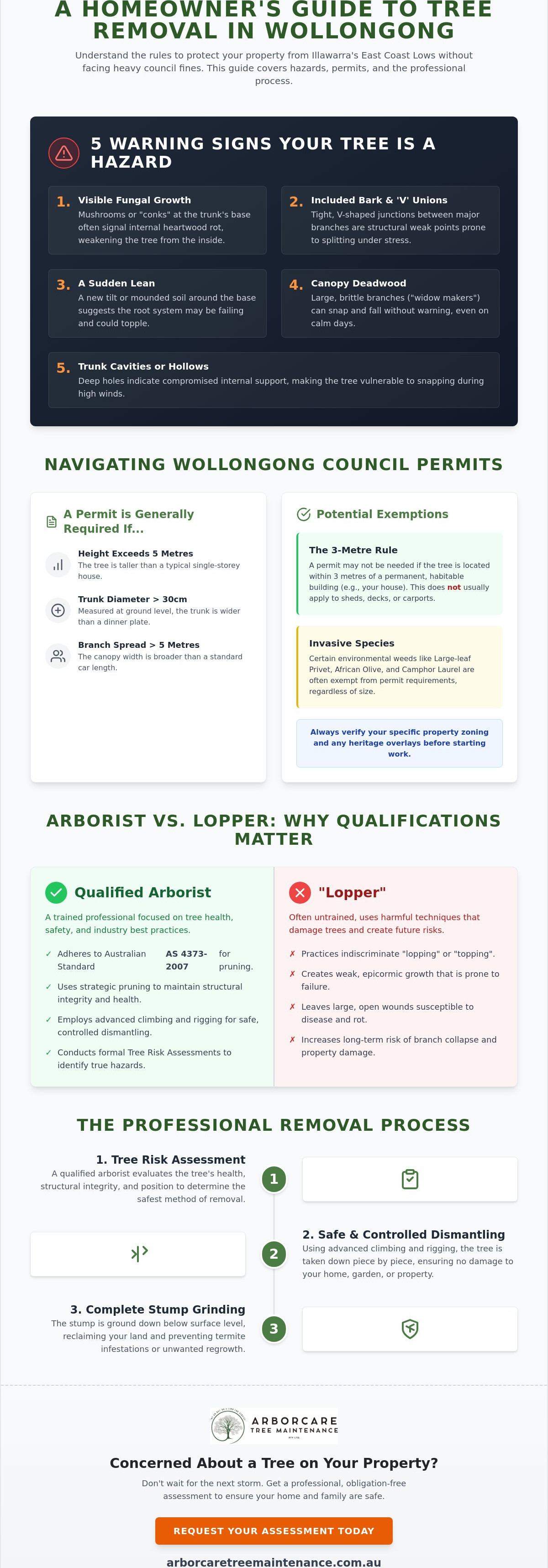
- Visible fungal growth: Mushrooms or "conks" growing at the base of the trunk often indicate internal heartwood rot.
- Included bark: Tight, V-shaped unions between major branches are structural weak points where the tree is prone to splitting.
- A sudden lean: If a tree develops a new tilt or you notice disturbed, mounded soil around the root plate, the root system may be failing.
- Deadwood in the canopy: Large, brittle branches, often called "widow makers," can drop without warning, even on calm days.
- Trunk cavities: Deep holes or hollows suggest the tree's internal support is compromised, making it vulnerable to snapping during high winds.
Dealing with Dead or Decaying Trees
Dead trees are significantly more dangerous to remove than living ones. As timber dies, it loses its flexibility and becomes incredibly brittle. This unpredictability means branches can shatter unexpectedly when an arborist is climbing or using rigging equipment. In Wollongong, local hardwoods are also highly susceptible to termites and other wood-boring pests that hollow out the structure from the inside. A tree might look solid on the outside while being almost entirely hollow, creating a deceptive and deadly situation for untrained workers.
Removing a dead or decaying tree is a high-priority safety task that should be addressed immediately to prevent an uncontrolled collapse during the next storm cycle.
Navigating Wollongong City Council Tree Permits
Understanding the legal framework is just as critical as the physical work of tree removal Wollongong property owners must manage. The local Development Control Plan (DCP) 2009 provides the specific guidelines for vegetation management across our suburbs. Generally, you require a permit if a tree is taller than 5 metres, has a trunk diameter greater than 30 centimetres when measured at ground level, or has a branch spread exceeding 5 metres. These rules ensure our local canopy remains healthy while allowing for necessary safety interventions.
One common point of confusion is the "3-metre rule." Under the current DCP, you may be exempt from needing a permit if the tree is located within 3 metres of a permanent, habitable building, such as your house. This distance is measured from the outside of the trunk to the external wall of the structure. It's important to remember that this exemption does not usually apply to non-habitable structures like detached carports, decks, or garden sheds. Before you start any work, it's a professional necessity to verify your specific property zoning and any heritage overlays. Adhering to NSW government regulations prevents the risk of significant fines and legal complications.
Exempt Species vs. Protected Natives
Not all trees receive the same level of protection. Many invasive species or environmental weeds are exempt from permit requirements regardless of their size. In the Illawarra, this often includes species like the Large-leaf Privet, African Olive, and Camphor Laurel. Conversely, native timber such as Eucalypts, Banksias, and Illawarra Flame Trees are strictly protected. Removing a protected native without authorisation can lead to heavy penalties under the Environmental Planning and Assessment Act 1979. Since July 1, 2023, the local planning authority also mandates that a replacement tree must be planted for every approved removal, ensuring the long-term health of our coastal environment.
The Role of an AQF Level 3 Arborist
When a tree doesn't meet simple exemption criteria, the local planning authority will typically require a formal Arborist Report to accompany your application. This report must be prepared by a professional with a minimum qualification of AQF Level 3 in Arboriculture. A qualified inspector assesses the tree's health, structural integrity, and the potential impact on surrounding infrastructure. They provide a documented "Tree Risk Assessment" that gives the local planning authority the technical evidence needed to approve a removal. This professional oversight ensures that removal is the only viable option and that all safety protocols are addressed. If you're unsure whether your tree qualifies for removal or needs a formal report, our team can guide you through the professional tree removal and maintenance process to ensure full compliance.
Arborist vs. Lopper: Why Qualifications Matter
Hiring the wrong person for tree removal Wollongong can lead to catastrophic results for your property and your bank account. Many homeowners are tempted by "cheap" quotes from individuals who describe themselves as "loppers." In the professional industry, tree lopping is considered an outdated and harmful practice. It involves the indiscriminate hacking of branches, which leaves the tree vulnerable to disease and structural failure. Professional arborists, by contrast, adhere to the Australian Standard AS 4373-2007 (Pruning of Amenity Trees). This standard ensures that every cut is made with the tree's biological health and future stability in mind.
Choosing an uncertified operator introduces a massive liability risk. If an uninsured worker is injured on your property or causes damage to a neighbour's fence, you as the homeowner could be held legally and financially responsible. What starts as a way to save a few hundred dollars can quickly escalate into a legal battle costing tens of thousands. A qualified arborist provides the technical expertise and legal protection that an amateur simply cannot offer.
The Dangers of DIY Tree Cutting
Attempting to handle large-scale tree work yourself is incredibly high-risk. Chainsaw "kickback" is a leading cause of severe injury, occurring in a fraction of a second when the saw blade hits a hard object or gets pinched. Falls from ladders or within the canopy are equally common and often fatal without professional-grade harnesses and anchor points. Beyond personal injury, there is the constant threat of structural damage. A single miscalculated cut can send a heavy limb crashing through your roof or into live powerlines. Professional arborists use specialised rigging to lower branches safely. This controlled approach protects your home and prevents the chaotic impact of a free-falling limb.
Insurance and Peace of Mind
When you hire a professional service, you aren't just paying for labour; you are paying for protection. Public Liability and Professional Indemnity insurance are non-negotiable requirements for any legitimate business. These policies ensure that if an accident occurs, the costs of repairs or medical care are covered by the insurer, not your personal savings. Worker’s Compensation is another vital shield, protecting you from claims if a crew member is injured while working on your land. Arborcare Tree Maintenance Pty Ltd prioritises safety protocols on every site, ensuring all staff are fully insured and trained in the latest risk-mitigation techniques. This commitment to safety is what separates a qualified specialist from a high-risk amateur.
The Professional Tree Removal Process
Execution begins long before a chainsaw is started. Every project starts with a comprehensive site assessment to identify underground utilities, nearby structures, and the safest path for material extraction. Our team establishes secure exclusion zones to prevent unauthorised access, ensuring that residents and bystanders remain well clear of the work area. This methodical preparation is a hallmark of the professional tree removal Wollongong homeowners expect when dealing with high-risk tasks in residential suburbs.
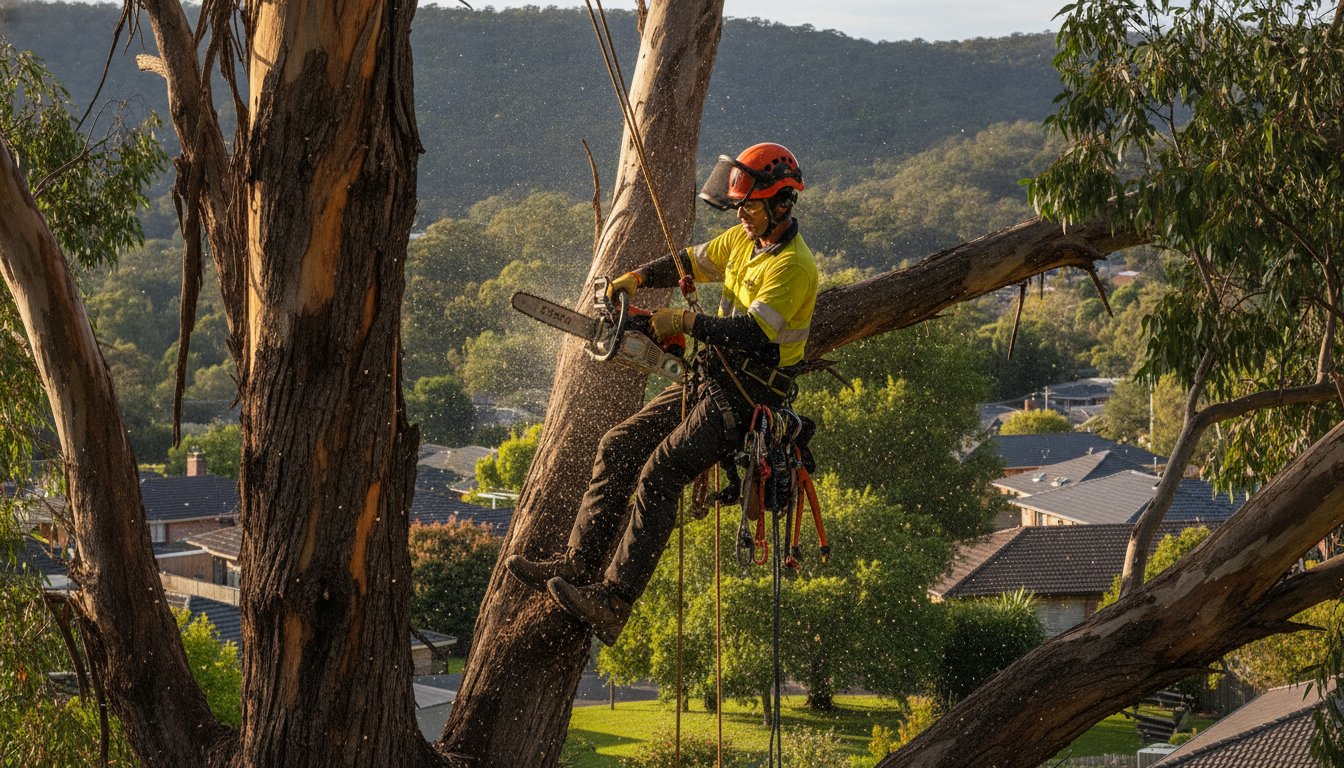
Climbing and rigging represent the most technical phase of the operation. Unlike the destructive practice of lopping, sectional dismantling involves an arborist climbing the tree and removing branches one by one. Each limb is secured with high-tensile ropes and lowered through a pulley system. This controlled descent prevents heavy timber from impacting your lawn, garden beds, or house. In rare cases where a property has vast open space, we may employ a "straight fall" technique, using precision directional cuts to drop the trunk in a single, calculated motion. Both methods require high-level technical authority to manage the immense weight and stored energy of the timber.
The final stage of the process is property restoration. We believe in leaving every site in a better condition than we found it. All smaller branches are processed through a high-capacity wood chipper, while larger logs are either removed or cut into manageable sections. We clear away all sawdust and debris from paths and driveways, ensuring your yard is safe and ready for use immediately after we depart. For immediate assistance with hazardous timber, contact our team for emergency tree service in the Wollongong area.
Specialised Palm Tree Removal
Palms require a distinct approach due to their unique biological structure. Their fibrous trunks don't behave like standard hardwoods; they can be difficult to cut and often dull equipment quickly. A significant risk in the Illawarra is "slumping," where dead fronds and heavy seed pods hang precariously in the canopy before falling without warning. We provide specialised palm tree removals and skinning services to manage these coastal species, ensuring your property remains tidy and free from the mess associated with falling palm debris.
Emergency Storm Response
When an Illawarra East Coast Low brings down trees on houses or blocks essential access, response time is critical. We prioritise emergency calls where there is an immediate threat to life or property. Our crews work alongside emergency services during major storm events to clear blocked driveways and secure damaged canopies. If you find yourself in this situation, stay well clear of the fallen tree and any downed powerlines until a qualified specialist arrives to stabilise the site and begin the recovery process.
Stump Grinding and Reclaiming Your Property
Completing a tree removal Wollongong project involves more than just clearing the canopy. Once the main trunk is safely on the ground, the remaining stump presents its own set of challenges. While some property owners consider leaving the stump to rot naturally, this process can take decades and creates a significant bio-hazard for your garden. A dead stump is an ideal breeding ground for termites and fungal pathogens that can spread to healthy vegetation or even your home's foundations. In many cases, certain species will also attempt to regrow from the base, leading to ongoing maintenance costs and frustration.
Total stump eradication through mechanical grinding is the professional resolution for these issues. This process involves a high-torque machine that pulverises the wood well below the soil line. For those planning land clearing for a new extension, pool, or garden renovation, removing the root plate is a functional requirement. It ensures the ground is structurally sound and free from future sinkholes caused by decaying organic matter. By addressing the stump immediately after the tree is felled, you reclaim the full use of your land and eliminate the risks associated with decaying timber.
The Benefits of Stump Grinding
Removing a stump provides immediate practical benefits for property management. It eliminates trip hazards that are notorious for causing injuries and damaging expensive lawnmower blades. Grinding also prevents root-related damage to underground pipes and foundations, which often continues even after a tree is cut down if the root system remains active. Once the grinding is complete, the ground is prepared for immediate replanting or turfing, allowing you to restore the aesthetic value of your yard without waiting years for a stump to disappear.
Mulching and Wood Chipping
A major benefit of professional intervention is the ability to recycle tree waste into a valuable resource. We process the timber from your site through industrial wood chippers to create nutrient-rich mulch. In the drying NSW climate, high-quality wood chips are essential for moisture retention and weed suppression. Using mulch derived from your own property is an ecologically sound way to improve soil health and protect your garden beds during the hot summer months. It's a sustainable cycle that turns a potential hazard into a garden asset. Reclaiming your outdoor space starts with a clear, safe foundation. If you need a site that's completely clear of hazards and ready for its next chapter, contact Arborcare Tree Maintenance for a comprehensive quote on removal and stump grinding.
Secure Your Property with Professional Arborist Care
Managing hazardous timber requires a balance of local knowledge and technical precision. By understanding the Wollongong City Council permit requirements and the critical difference between professional arboriculture and high-risk lopping, you protect both your property and your legal standing. Reclaiming your garden through total stump eradication ensures your land is safe, functional, and ready for future growth. These steps are vital for maintaining a resilient landscape that can withstand the unique environmental pressures of our region.
When you're ready to address a dangerous tree or clear a site for renovation, choosing a qualified local partner is essential. Arborcare Tree Maintenance provides the expertise needed for complex tree removal Wollongong projects. As fully licensed and insured arborists, we are specialists in high-risk removals near powerlines. We are locally owned and operated in Dapto, dedicated to keeping our community safe. Request a Free Quote from Arborcare Tree Maintenance today to secure your property with professional care.
You don't have to face the next storm season with uncertainty. Take proactive steps now to ensure your yard remains a beautiful and secure space for your family to enjoy.
Frequently Asked Questions
Do I need Wollongong Council approval to remove a tree on my property?
You generally need council approval if a tree exceeds 5 metres in height or has a trunk diameter over 30 centimetres. While some invasive species are exempt, most native and large trees require a formal application through the Wollongong City Council portal. If you're unsure, a qualified arborist can help identify the species and determine if a permit is a legal necessity for your specific tree removal Wollongong project.
How much does tree removal cost in Wollongong?
The cost of removal depends on factors like tree size, its proximity to powerlines, and how easily our crew can access the site. Larger trees requiring advanced rigging or those in confined spaces naturally involve more technical work and equipment. We provide detailed assessments to ensure you receive a fair price that reflects the high-risk nature of professional arboriculture without compromising on safety standards.
Can I remove a palm tree without a permit in the Illawarra?
Most palm trees in the Illawarra require a permit for removal if they meet the council's size thresholds. While some specific palms might be exempt under local vegetation rules, you should always verify the species before starting work. Unauthorised removal of a protected palm can lead to the same significant fines as any other protected native tree in New South Wales.
What is the "3-metre rule" for tree removal in NSW?
The "3-metre rule" allows for the removal of trees located within 3 metres of a permanent, habitable dwelling without a permit in certain zones. This rule is designed to protect the structural integrity of your home from root damage or falling limbs. It's important to note that this exemption rarely applies to sheds, detached garages, or other non-habitable structures on your property.
Is stump grinding included in a standard tree removal quote?
Stump grinding is typically treated as a separate service from the initial tree felling. This is because it requires specialised, high-torque machinery and additional time to pulverise the root system well below ground level. We recommend including stump grinding to prevent regrowth and termite issues, but it's best to confirm this is listed as a specific line item in your professional quote.
How do I know if a tree is dangerous or just losing leaves?
A dangerous tree often shows structural symptoms such as deep trunk cracks, fungal growth at the base, or a sudden change in lean. Deciduous trees losing leaves seasonally is normal, but "dieback" in the upper canopy of an evergreen is a serious warning sign. If you notice large dead branches or disturbed soil around the roots, it's time for a professional risk assessment to prevent an uncontrolled fall.
Do you provide emergency tree services after a storm in Wollongong?
We provide emergency tree service to address immediate hazards caused by storm events or sudden structural failure. This includes clearing blocked driveways and stabilising trees that have fallen onto houses or near powerlines. Our team prioritises these high-risk situations to ensure your property is made safe as quickly as possible during extreme weather events like an East Coast Low.
What happens to the wood and debris after the tree is cut down?
Most timber and foliage is processed through a high-capacity wood chipper on-site to be recycled as garden mulch. You can choose to keep this nutrient-rich mulch for your own garden beds or have us remove all debris from the property entirely. Our cleanup protocol ensures that all sawdust and smaller twigs are cleared away, leaving your yard tidy and safe for immediate use.


