
A large tree’s height is only part of a removal quote. Access, nearby buildings, powerlines, the tree’s condition and the safest removal method can all affect the work involved. If you’re researching how much to remove a large tree Illawarra, online estimates can offer a starting point, but they can’t account for the conditions on your property.
For a large or complex tree, an on-site assessment helps an arborist understand the risks, equipment and work plan required. That way, the quote reflects the actual job rather than a broad estimate. It also gives you a chance to clarify what’s included, such as handling branches and timber, and whether stump grinding is a separate service.
This guide explains the main factors that influence a large tree removal quote in the Illawarra, what an assessment considers and what information to prepare before requesting one. Arborcare Tree Maintenance is a locally owned, licensed arborist company based in Dapto, providing tree removal and complex tree removal services across the region. From Dapto and Wollongong to Shellharbour, Wonoona, Jamberoo, Fairy Meadow and Dombarton, a site-specific assessment is the practical first step in planning the work.
Key Takeaways
- There’s no dependable single answer to “how much to remove a large tree Illawarra” without assessing the tree and worksite.
- Tree size, condition, access and nearby structures can all influence the removal plan and quote.
- Compare removal approaches by how they suit the site, rather than assuming one method fits every tree.
- Review the quote’s work scope and clean-up details so you understand what the removal includes.
- Before arranging removal, note site constraints and check the current tree-preservation guidance for your council area.
What determines the cost of removing a large tree in the Illawarra?
There’s no dependable single figure for large tree removal without assessing the tree and the worksite. Height matters, but it doesn’t tell the whole story. Trunk size, canopy spread, condition, access, nearby structures and the removal method all affect the work involved. A tree in an open yard may be handled differently from one that needs careful dismantling in a confined space.
A large-tree removal quote reflects the tree’s size and condition, site access, surrounding features and the method needed to remove it safely. Together, these factors determine how the work can be planned and what the job includes. For a general explanation of common removal approaches and safety considerations, see this Tree removal overview on Wikipedia.
Which tree characteristics affect the work involved?
Trunk diameter and canopy spread help indicate the scale of the tree and the amount of material to manage. Condition matters too: dead, damaged or unstable limbs may change how an arborist plans the work and handles sections as they’re removed. These features need to be assessed in context. A photo can help describe the tree, but it can’t establish its condition or provide a reliable basis for diagnosing risk.
Two similarly tall trees in the Illawarra could require different plans. A broad-canopied tree with substantial limbs may need more careful handling than a narrower tree of comparable height, depending on its condition and position on the property.
How do access and surroundings change the project?
Access affects where workers and equipment can operate and how branches and trunk sections can be managed. A tree beside a driveway may have a different working area from one behind a narrow side passage. Slopes, garden beds and limited space can also affect how the site is approached. Conditions vary between properties, even within the same suburb.
Nearby homes, fences, sheds and established gardens matter because the removal plan needs to account for what surrounds the tree. For example, a large gum on a sloping block with a house close to its canopy may need a different approach from a similar-sized tree in an open yard. An on-site assessment helps the arborist understand these constraints and shape the removal plan accordingly.
If you’re asking how much to remove a large tree Illawarra, consider the whole worksite, not just the tree’s height. A site-specific assessment is the practical starting point for understanding the job’s scope and the factors behind the quote.
Why large-tree removal methods can affect an Illawarra quote
The removal method is chosen to suit the tree and the site, not simply its height. An open work area may allow a different approach from a backyard where branches are close to a roof, boundary fence or garden. Access and the space available to handle cut sections also shape the plan.
Restricted access or nearby structures can mean a tree needs to be removed in carefully planned stages rather than felled in one piece. That can change the work involved, which is why the method forms part of a site-specific quote.
When does a large tree need sectional removal?
Where there’s no suitable drop zone, an arborist may plan to remove branches and trunk sections in a controlled sequence. Each section can be managed according to the space available and the features around the tree. Boundaries, homes and other obstacles all influence how the work is organised. For more on complex site conditions, see the Complex Tree Removal Illawarra guide.
What site conditions can change the removal plan?
Overhead obstructions, uneven or sloping ground, narrow access routes and limited space for equipment can affect which approach is suitable. Where large machinery or falling debris encroaches on public roads or footpaths, projects often require dedicated safety management, such as the traffic solutions seen at acquiredawareness.com.au. An on-site assessment lets the arborist consider these factors together rather than assuming a method based on height alone.
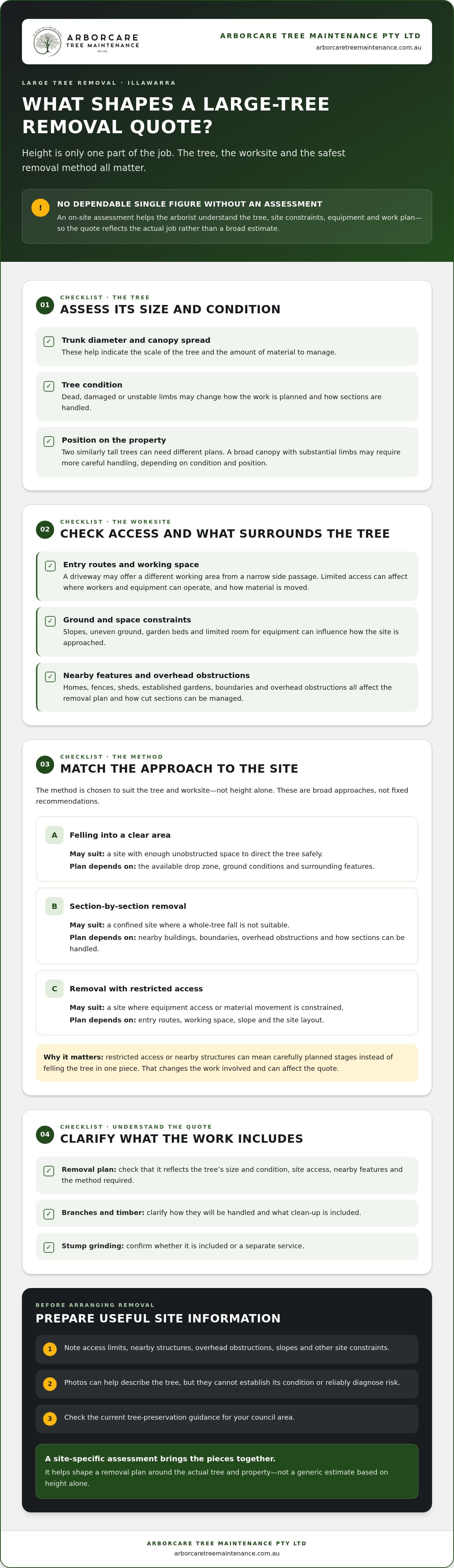
| Work approach | May suit | What affects the plan |
|---|---|---|
| Felling into a clear area | A site with enough unobstructed space for the tree to be directed safely | Available drop zone, ground conditions and surrounding features |
| Section-by-section removal | A confined site where a whole-tree fall isn’t suitable | Nearby buildings, boundaries, overhead obstructions and how sections can be handled |
| Removal with restricted access | A site where equipment or material movement is constrained | Entry routes, working space, slope and the site’s layout |
The table outlines broad approaches, not a fixed recommendation. Two trees of similar height may need different plans because their surroundings and access differ. The suitable method depends on an assessment of the tree and worksite, including how branches and trunk sections can be managed throughout the job.
For anyone asking how much to remove a large tree Illawarra, the method helps explain why a generic estimate may not reflect the work required at a particular property. Arborcare Tree Maintenance provides tree removal and complex tree removal services across the Illawarra. Visit Arborcare Tree Maintenance to learn more about the company’s services.
How to understand a large-tree removal quote in the Illawarra
A site-specific assessment helps define what a quote covers. The arborist can consider the tree’s size and condition, access to the work area, nearby features and the removal method needed. This gives you and the arborist a clearer basis for discussing the scope than a broad online estimate can provide.
Before accepting a quote, check that it describes the agreed work clearly. Use this checklist to guide your review:
- Tree and work area: Does it identify the tree to be removed and the area where work will take place?
- Removal method: Does it describe the planned approach, particularly if the tree will be removed in sections?
- Branches and timber: Is it clear how cut material will be handled and whether removal from the property is included?
- Clean-up: Does the scope explain what clean-up is included, so you know what to expect when the work is complete?
- Additional work: Are any extra tasks, such as stump grinding or other site work, shown separately or clearly included?
Stump grinding is separate from removing the tree above ground, so don’t assume the stump is included in a tree removal quote. If you want the stump addressed as part of the overall project, make sure that work is clearly identified in the scope.
What should you prepare before arranging an assessment?
A few practical details can help the arborist understand the site before visiting. Note the property suburb, where the tree is located and any visible access restrictions, such as a narrow side passage or steps. Clear photos can provide useful context, but they can’t show every site condition or replace an on-site assessment.
If you’re comparing estimates, consider the stated work scope as well as the figure. A quote for removing the tree and clearing the work area may describe a different scope from one that also includes stump grinding or other site work. For a clearer answer to how much to remove a large tree Illawarra, the assessment and agreed scope need to reflect your property.
Arborcare Tree Maintenance provides licensed arborist services across the Illawarra, including tree removals and stump grinding. The Arborcare Tree Maintenance website has further information about these services.
What Illawarra property owners should check before removing a large tree
Before arranging removal, work through a few practical checks. They can help clarify what needs assessing and avoid assumptions about council requirements or site access.
- Identify the tree: Note its location on the property and any visible signs of damage or dead limbs. Avoid trying to diagnose its condition yourself.
- Record site constraints: Make a note of gates, narrow paths, slopes, overhead obstructions and nearby structures that may affect access or the work area.
- Check current council guidance: Find the tree-preservation information for the council area where the property is located before planning removal.
- Arrange an assessment: An on-site assessment helps an arborist understand the tree, its surroundings and the likely work scope.
These details also help explain why a general online answer to how much to remove a large tree Illawarra can’t account for every property. An assessment considers the actual site, while local council guidance helps you understand what requirements may apply before work proceeds.
Do Illawarra councils have the same tree-removal rules?
Local controls can differ, and requirements may depend on the property and the tree. Check the current guidance from the council responsible for your address, whether that’s Wollongong, Shellharbour or Kiama. Don’t rely on a rule described for another council area or assume approval is automatic. Confirm the applicable requirements directly with the relevant council before arranging removal.
How can you prepare the property for a professional assessment?
Point out the access route and any constraints, such as a locked gate, narrow side path, steep section or nearby home, fence or garden. These observations help the arborist consider how the site may affect the assessment and removal plan. Keep people and pets away from the work area during authorised tree work.
Powerlines need particular care. Don’t attempt to prune or remove a tree near powerlines yourself, and keep clear of the area. Tree work around electrical infrastructure requires professional planning. An on-site assessment can help establish the conditions to consider.
If a tree has been damaged by a storm and the situation is urgent, refer to Arborcare Tree Maintenance’s emergency tree service guide for relevant next steps. For broader guidance on professional removal, see Tree Removal Wollongong: The Complete Professional Arborist Guide.
Arborcare Tree Maintenance provides licensed arborist services across the Illawarra. Read more about the company’s services at Arborcare Tree Maintenance.
Get a site-specific large-tree removal assessment in the Illawarra
A generic online estimate can’t account for the details that shape work on your property. Tree dimensions, condition, access and nearby structures all influence how removal can be planned. A large tree beside a house or on a sloping block may need a different approach from one in an open space, even if their heights are similar.
If you’re weighing up how much to remove a large tree Illawarra, an on-site assessment is the practical next step. Arborcare Tree Maintenance is a locally owned company based in Dapto, providing licensed arborist services, including tree and complex tree removals, across the Illawarra. An assessment helps establish the site conditions, an appropriate work plan and the scope to be discussed in a quote.
When is it worth arranging an assessment?
Consider an assessment if a large tree is close to a home, boundary or area with restricted access. Visible damage, broken limbs or recent storm impacts are also good reasons to seek professional attention. These signs don’t establish a tree’s condition or level of risk on their own. An arborist needs to assess the tree and its surroundings before recommending what work may be appropriate.
Keep clear of damaged branches and avoid attempting to climb, prune or remove a large tree yourself. If powerlines are nearby, don’t approach or work on the tree. Prioritise people’s safety and leave the assessment and removal planning to professionals.
What happens after you request an assessment?
The process starts with understanding where the tree is and what concerns you have. An on-site assessment then gives the arborist a chance to consider its dimensions and condition, access routes, available work space and nearby features. With those details in view, the required work and proposed scope can be discussed clearly.
Project details are specific to the property, so the assessment informs the quote rather than relying on assumptions about timing or cost. You can also explain what you’d like included, such as handling branches and timber or considering stump grinding as separate follow-on work. The assessment helps clarify the plan and scope before you decide how to proceed.
For a clear, property-specific understanding of large tree removal, visit Arborcare Tree Maintenance to learn about its tree removal services.
Plan your large tree removal with confidence
There’s no reliable one-size-fits-all answer to how much to remove a large tree Illawarra. The quote depends on the tree’s dimensions and condition, site access, nearby features and the method needed to complete the work. A site-specific assessment helps turn those details into a clear work plan and defined scope.
Before proceeding, review what the quote includes, including how branches and timber will be handled, what clean-up is covered and whether stump grinding is a separate option. Check the current tree-removal guidance for your local council, as requirements can vary by property and location.
Arborcare Tree Maintenance is a licensed arborist company providing tree removal and complex tree removal services across the Illawarra, from Dapto and Wollongong to Shellharbour, Wonoona, Jamberoo, Fairy Meadow and Dombarton. Arrange a tree removal assessment to discuss your property and the work involved.
Frequently Asked Questions
How much does it cost to remove a large tree in the Illawarra?
There’s no dependable price without assessing the tree and worksite. The quote depends on factors such as the tree’s dimensions and condition, access, nearby structures and the removal method. An on-site assessment helps define the work and its scope. Arborcare Tree Maintenance is based in Dapto and provides tree removal across the Illawarra, including Wollongong, Shellharbour, Wonoona, Jamberoo, Fairy Meadow and Dombarton.
Why can two large trees cost different amounts to remove?
Two trees of similar height can require different work because their trunk size, canopy spread, condition and surroundings may differ. For example, a tree in an open yard may have more room for handling branches than one close to a home or boundary. Dead, damaged or unstable limbs can also affect the removal plan. An assessment considers these details together before the work scope is set.
Does tree height determine the cost of removal?
No. Height is one factor, but it doesn’t determine the quote on its own. Trunk size, canopy shape, tree condition, access and nearby obstacles also influence how removal can be planned. A tall tree in an open area may involve a different approach from a shorter tree with limited working space. An arborist needs to assess the specific tree and site to understand the work required.
Can access to a tree affect a removal quote?
Yes. Narrow gates, side paths, slopes and limited space can affect how workers reach the tree, position equipment and handle branches or trunk sections. Nearby fences, gardens and buildings also need to be considered in the work plan. These conditions vary between properties, so describing access helps, but an on-site assessment is the practical way to understand how the layout may affect removal.
Is stump grinding included when a large tree is removed?
Not necessarily. Removing a tree above ground and grinding its stump are separate parts of the work, so stump grinding may be listed as a separate option. Check the quote’s scope to see whether the stump is included or whether the work covers the tree only. If you want the stump addressed as well, make sure that requirement is clearly discussed when the removal work is planned.
Do I need council approval to remove a large tree in the Illawarra?
Possibly. Tree-preservation requirements can vary according to the property and the local council, so check the current guidance for the area where the tree is located. Owners in Wollongong, Shellharbour or Kiama should use the relevant council’s information rather than assuming the same rules apply across the Illawarra. Confirm applicable requirements before arranging removal, as an assessment doesn’t replace any council process.
Can a large tree be removed if it is close to a house or powerlines?
A tree near a house may be removable, but its position can affect the method and work plan. An arborist needs to assess the tree, access and surrounding features in person. Powerlines require particular caution: don’t approach, climb, prune or attempt to remove a tree near them. Keep clear and arrange a professional assessment so the site conditions can be considered safely.


