
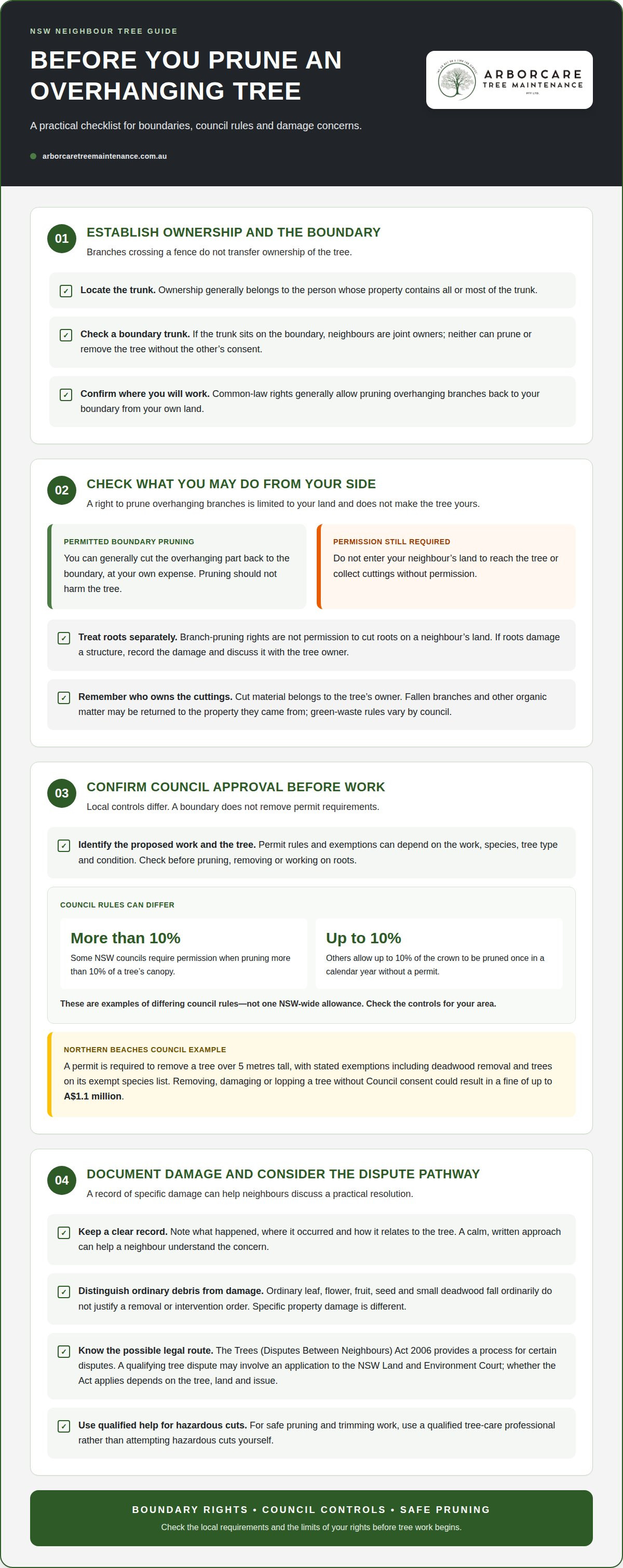
An overhanging branch doesn’t make the tree yours. Under NSW legislation on overhanging trees, ownership generally depends on where the trunk is: the person whose property contains all or most of it is considered the owner. You may usually prune branches back to your boundary, but you can’t enter your neighbour’s land without permission.
It’s understandable to want to deal with branches crossing a fence, especially if they’re causing damage or raising a safety concern. Before pruning, consider whether council approval is required. Permit rules and exemptions can depend on the work, the tree species and its condition.
This guide explains who owns an overhanging tree, what you can trim from your side and how NSW law approaches neighbour disputes. It also covers when a dispute may involve the Land and Environment Court, and why clear communication and safe pruning matter.
Key Takeaways
- Tree ownership generally follows the location of the trunk, not the direction its branches grow.
- You can generally prune overhanging branches back to your boundary, but entering your neighbour’s land requires permission.
- Check whether council approval applies before pruning or removing a tree; requirements can depend on the tree and the work.
- Clear communication and a record of any damage can help neighbours address a tree dispute constructively.
- For qualifying tree disputes, NSW law provides a pathway to seek orders through the Land and Environment Court.
Who Actually Owns That Overhanging Tree?
In New South Wales, ownership generally follows the trunk: the person whose property contains all or most of it owns the tree. Branches crossing a boundary don’t transfer ownership. NSW legislation on overhanging trees operates alongside common-law rights, which allow limited pruning from your own land.
The relevant rules include common law and the Trees (Disputes Between Neighbours) Act 2006, which provides a process for certain neighbour disputes. The Act’s application depends on the tree, land and issue involved. Understanding NSW legislation on overhanging trees means distinguishing those legal processes from the practical question of who owns the trunk.
Common-law pruning rights
Common-law pruning rights allow a property owner to cut branches overhanging their land back to the boundary, without entering the land where the tree stands. You can address encroaching branches from your side, but this doesn’t give you permission to cross the boundary or take ownership of the tree.
The rule is associated with Lemmon v Webb, reported as [1894] 3 Ch 1 and [1894] UKHL 1; [1895] 1 AC 1. Pruning should not harm the tree. If branches or roots have caused property damage, the Trees Act provides a possible court application for an order addressing qualifying damage.
Self-help for overhanging branches
Self-help means pruning the part of a neighbour’s tree that extends over your property, at your own expense. You can cut back to the boundary, but you can’t enter your neighbour’s land without permission, even to reach the trunk or collect cuttings.
Before cutting, identify the boundary and the affected branches. A branch crossing the fence remains part of a tree owned according to the trunk’s location. If the trunk sits on the boundary, the neighbours are joint owners, and neither can prune or remove the tree without the other’s consent.
Roots raise a separate practical concern. A right to prune branches shouldn’t be treated as permission to cut roots on a neighbour’s land. If roots are damaging a structure, document the damage and discuss it with the tree owner. An application under the Trees Act may be available if a qualifying tree caused property damage.
Fallen branches and other organic matter may be returned to the property they came from. Cut material from an overhanging tree belongs to its owner, so don’t assume pruning transfers ownership of the cuttings. Council rules for green-waste disposal vary, so local requirements matter.
Ordinary leaf, flower, fruit, seed and small deadwood fall from urban trees ordinarily don’t justify a removal or intervention order. The NSW Land and Environment Court has also applied this approach to mould and slime on shaded steps and paving. Specific damage is different: record what happened, where it occurred and how it relates to the tree before considering a resolution or application.
Can I trim back the branches of a tree or a hedge myself?
Before pruning or removing a tree in NSW, seek any required council permit or development approval. Exemptions depend on the work, species, tree type and condition. A boundary with a neighbour doesn’t remove those requirements, and entering their property still requires permission.
For a specific local example, Northern Beaches Council says removing, damaging or lopping a tree without Council consent could result in a fine of up to A$1.1 million.
Council approval and pruning permits
Council approval is required for tree work when local controls apply, so establish whether it’s needed before pruning, removal or root work begins. Requirements differ between councils and can depend on the proposed work and the tree’s species, type and condition.
Some NSW councils require permission when pruning more than 10% of a tree’s canopy. Others allow up to 10% of the crown to be pruned once in a calendar year without a permit. These are differing council rules, not a single NSW-wide allowance, so the proposed work and local controls matter.
Protected trees and pruning exemptions
Protected-tree controls restrict work on trees identified by a council’s local rules, while exemptions may allow specified work without approval. This matters because pruning an exempt species or removing deadwood may be treated differently from cutting a protected tree.
Northern Beaches Council requires a permit to remove a tree over 5 metres tall, but its stated exemptions include deadwood removal and trees on its exempt species list. That example shows why owners should identify the tree and the exact work before attempting pruning or removal. The Trees (Disputes Between Neighbours) Act 2006 addresses certain neighbour disputes; it doesn’t replace council approval requirements.
Risks of unauthorised pruning or entry
Unauthorised work can bring serious consequences where council consent is required, and crossing a property boundary without permission raises a separate issue. In Northern Beaches, removing, damaging or lopping a tree without Council consent could result in a fine of up to A$1.1 million, according to Northern Beaches Council.
Don’t treat a neighbour’s overhanging branches as permission to enter their land or work on the whole tree. Before starting, establish where the work will take place, identify any required council approval and limit permitted pruning to the relevant area.
Root pruning can affect the tree beyond the visible cut, so include the proposed root work when seeking approval. A practical sequence is to describe the work, identify the tree’s species and condition, then establish whether a permit or exemption applies. For safe pruning and trimming work, use a qualified tree-care professional rather than attempting hazardous cuts yourself.
Communicating with neighbours and documenting damage
A calm, written approach can help a neighbour understand the concern and consider practical options. In NSW tree disputes, records of communication and damage can also support an application if you can’t reach an agreement.
Neighbour communication and mediation
Communicating with a neighbour means explaining the tree issue directly and making a reasonable effort to agree on a response. Describe the affected branches, the specific concern and the outcome you’re seeking, such as access for an inspection.
Under section 10(1) of the Trees (Disputes Between Neighbours) Act, an applicant must make a reasonable effort to reach agreement with the tree owner and usually give notice of an application. The Land and Environment Court must also be satisfied that the parties tried to resolve the dispute before it lists a final hearing. Mediation isn’t compulsory.
Recording damage and seeking entry permission
To document damage, keep dated photographs or video of the branches, affected areas and any visible harm. A clear record helps distinguish an ongoing concern from ordinary leaf or fruit fall, which the Land and Environment Court says ordinarily doesn’t justify an intervention order.
If an inspection or pruning requires access to your neighbour’s land, ask permission before entering. Explain the specific area and purpose, then keep a written record of the response. A photograph taken from your own property can document an overhanging branch without crossing the boundary.
Keep communication factual. For example, a Dapto resident concerned about a branch above a roof could send the neighbour a dated message describing its position and the observed damage. Include photographs taken from a safe place and suggest discussing an inspection or suitable work. Don’t present a suspected cause as proven if the evidence shows only timing or proximity.
If direct discussion stalls, mediation gives neighbours a structured way to discuss the issue with an impartial facilitator. The aim is to identify the concern, hear each person’s position and consider workable options. Mediation isn’t required before a tree application, but the Land and Environment Court needs evidence that the parties attempted to resolve the dispute before a final hearing.
Keep copies of messages, letters, photographs and any written agreement together. Record when the damage appeared, what changed and how the tree relates to the affected property. If the neighbour declines access, don’t enter without permission; rely on observations from your own land and document your request. These records can clarify what was discussed if the disagreement proceeds to an application.
For a potential application, distinguish property damage or personal injury concerns from disputes about leaves, flowers or shade. The Trees Act provides a court process for qualifying tree-related damage or injury, while ordinary urban tree debris generally doesn’t justify intervention. A concise timeline can show the neighbour’s response, your efforts to resolve the issue and the concern that remains.
What if the tree is blocking sunlight or a view?
For qualifying hedge obstructions, Part 2A of the Trees (Disputes Between Neighbours) Act 2006 provides a court pathway. It applies to at least two trees planted as a hedge, reaching at least 2.5 metres above existing ground level.
Under Part 2A, a landowner may apply for orders about a severe obstruction of sunlight to a dwelling window or a view from a dwelling. The obstruction must be caused by qualifying trees on adjoining land. This is narrower than a general complaint that a tree makes a garden darker or changes the outlook.
Section 14D allows orders requiring pruning and maintenance at a specified height, width or shape. The Land and Environment Court can tailor an order to address the qualifying obstruction, rather than treating removal as the automatic outcome. The Act also provides a process for other disputes between neighbours about trees and hedges.
For property damage or personal injury, section 7 allows a landowner to apply for an order to remedy, restrain or prevent harm caused by a qualifying tree on adjoining land. Section 9 includes remedies for property damage, prevention of damage or injury, and compensation for property damage. The Court can order removal of all or part of a tree to prevent imminent damage or injury.
A filing fee applies to applications in the Land and Environment Court. Section 9 provides for compensation for property damage, but the available rules here give no fixed compensation cap or universal filing deadline. For hedge disputes involving dividing fences or vegetation severely obstructing sunlight or views, the NCAT process requires notice to relevant parties at least 21 days before preliminary hearings.
Evidence helps define the issue. An arborist report is required before the Land and Environment Court makes an order in a tree dispute. Applicants are also advised to search the property title and zoning, and to consider qualified, experienced experts if evidence is needed about damage caused by a tree.
Before applying, make a reasonable effort to reach agreement with the tree owner and usually give notice of the application. The Court must be satisfied that the parties attempted to resolve the dispute before a final hearing, although mediation isn’t compulsory. Keep records of communications and evidence showing how the tree relates to the claimed obstruction, damage or injury.
Tree disputes are allocated to Class 2 of the Land and Environment Court’s jurisdiction. The Court may consider other legal requirements, including the Environmental Planning and Assessment Act 1979. A nuisance claim is not a substitute for the Trees Act where that Act applies, because section 5 bars nuisance actions for damage caused by a covered tree.
Dividing Fences Act 1991 and common law nuisance
Different rules can apply depending on whether a tree stands on private, public or strata land. The Dividing Fences Act 1991 is one framework relevant to overhanging branches, while the Trees (Disputes Between Neighbours) Act 2006 sets limits on which tree disputes it covers.
The Trees Act applies to trees on residential, industrial or business land, but not to trees on public land or those protected by conservation or heritage laws. Check this distinction before considering an application: disputes about public or protected trees don’t follow the same Trees Act process.
For a tree on a neighbour’s private land, the Trees Act can provide a route to seek orders about qualifying property damage or personal injury. Section 5 bars nuisance actions for damage caused by a tree to which the Act applies. A nuisance claim may not be available for every tree-related dispute, so the appropriate process depends on the circumstances.
That limit doesn’t mean every tree-related risk is irrelevant. A tree owner may be liable for damage if they knew, or should have known, their tree was dangerous and failed to act. The key issue is evidence of danger and the owner’s knowledge, not simply overhanging branches or ordinary debris.
The Dividing Fences Act 1991 is identified as a relevant legal framework, but it doesn’t mean every disagreement about a fence and branches is automatically a tree claim. Consider what is actually disputed: the dividing fence, a tree causing damage, or vegetation affecting a neighbour’s property. Each issue may involve a different process, and the Trees Act’s scope depends on the land and tree involved.
Strata ownership changes who manages a tree. In a NSW strata complex, the owners corporation is responsible for a tree, bush or hedge whose base is entirely or principally on common property. If you’re concerned about a tree rooted in a shared courtyard, raise the issue with the owners corporation rather than treating it as solely another lot owner’s tree.
The boundary location also matters. If a tree’s trunk is on the dividing boundary, the adjoining owners are joint owners, and neither may prune or remove it without the other’s consent. For a tree rooted wholly on one side, ownership generally follows the property containing all or most of the trunk, even if branches cross the fence.
Before taking action, identify the land category, where the trunk or base sits, and whether conservation or heritage protections apply. Those details help distinguish a private neighbour dispute from a public-land or strata issue. For safe work on tree growth that needs attention, arrange professional tree maintenance within the relevant property and approval requirements.
Arborcare Tree Maintenance
Arborcare Tree Maintenance Pty Ltd can help when overhanging branches need careful assessment or pruning. Its tree maintenance work includes hedging, pruning and trimming, as well as tree removals where removal is appropriate. The right work depends on the tree’s condition, the branches involved and any relevant council requirements.
For work near a boundary, explain the access arrangements and area of concern before pruning begins. This keeps the work focused on the agreed property and avoids confusion about which branches are being addressed. If a tree presents a more complex safety issue, a professional assessment can clarify the practical next step.
Contact Arborcare Tree Maintenance Pty Ltd to discuss tree work on your property.
Make your next tree-work decision with confidence
Understanding NSW legislation on overhanging trees is only one part of resolving a boundary concern. The practical next step is to define the work needed, where it can safely take place and what outcome will protect your property without creating another dispute.
Keep the legal question and the tree-care task distinct. Agreement about access or responsibility doesn’t determine whether council approval is needed, and proposed cuts should stay within the agreed scope. If access, safety or the tree’s condition makes the work complex, seek professional support rather than attempting a risky job yourself. This keeps the response focused on the site and the work required.
Arborcare Tree Maintenance can help with practical tree work on your property. Discuss your tree work with Arborcare Tree Maintenance and move forward with a clear plan.
Frequently Asked Questions
Can Northern Beaches Council force my neighbour to deal with their tree?
No. Northern Beaches Council cannot order a private landowner to deal with a neighbour’s tree; the Land and Environment Court can make such an order. A council complaint about a branch over a private fence does not itself compel pruning. If the tree may cause property damage or personal injury, record the concern and consider whether the Trees (Disputes Between Neighbours) Act 2006 provides a court pathway.
Do I have to use mediation to resolve my dispute?
No, mediation isn’t compulsory for NSW tree disputes. However, an applicant must make a reasonable effort to reach agreement with the tree owner and usually give notice of an application. The Land and Environment Court must also be satisfied that the parties attempted to resolve the dispute before a final hearing. Keep a record of proposals and responses to show what resolution efforts took place.
Liability: Who pays if a branch falls?
A tree owner may be liable for damage if they knew or should have known the tree was dangerous and failed to act. A fallen branch alone doesn’t establish those circumstances. For example, evidence that the owner was warned of a dangerous condition before the branch fell may be relevant. Record the damage and any earlier warnings, then consider whether the tree dispute process applies to the harm.
What can you do if a tree is causing or may cause damage?
A landowner may apply under section 7 of the Trees (Disputes Between Neighbours) Act 2006 for an order to remedy, restrain or prevent property damage or personal injury caused by a qualifying tree on adjoining land. The Land and Environment Court can order removal of all or part of a tree to prevent imminent damage or injury. Evidence should connect the tree to the actual or threatened harm.
Can NSW property owners cut overhanging branches at the boundary without permission?
Generally, yes. You can prune branches extending over your property back to the boundary without the tree owner’s permission, but you must pay for the pruning and must not enter their land without permission. For example, a branch accessible from your yard is different from one that requires access across the fence. Council approval may also apply, so a boundary right doesn’t override local tree controls.
Who owns cut branches and fruit removed from an overhanging tree in NSW?
Cut material from a neighbour’s tree belongs to the tree owner. Fallen branches and other organic matter, including fruit, may be returned to the property where they originated. If you prune branches from your side, don’t assume the cuttings become yours to keep or dispose of as you choose. Council disposal rules vary, so how you manage green waste depends on local requirements.
How does the NSW Land and Environment Court resolve tree disputes under the Trees (Disputes Between Neighbours) Act 2006?
The Court considers the application and supporting evidence, including an arborist report, before making an order. Tree matters are allocated to Class 2 of its jurisdiction. Depending on the case, orders can address damage, require pruning or removal, or include compensation for property damage. The Court may also order a replacement tree to be planted and maintained to maturity when it orders a mature tree removed.
What are the NSW court fees, compensation limits and deadlines for tree disputes?
A filing fee applies to applications to the Land and Environment Court. The court may order compensation for property damage. For NSW hedge disputes handled through NCAT, notice must be given to relevant parties at least 21 days before preliminary hearings.


