
What if your neighbour’s complaint doesn’t mean you have to remove the whole tree? If you’re searching “neighbor complaining about overhanging branches law NSW”, the answer depends on where the trunk sits, which branches cross the boundary and whether council tree controls apply. Acting too quickly could damage the tree, create a safety risk or make a neighbour disagreement harder to resolve.
NSW law provides a framework for tree disputes, but boundary rights and council requirements are separate considerations. A calm conversation is often a practical first step. Formal options may be available if there’s a risk of damage or injury and informal efforts don’t resolve the issue. Small debris, such as leaves and twigs, is treated differently from a genuine safety or property concern.
This guide explains what to document, what to avoid and how to approach the dispute before it escalates. It also covers how a qualified arborist can assess branches and inform safe pruning, without replacing legal advice or required consent. For property owners in Dapto, Wollongong, Shellharbour and across the Illawarra, understanding the rules can help protect the tree and keep the neighbour relationship workable.
Key Takeaways
- The rules for a neighbor complaining about overhanging branches law NSW depend on the boundary, the concern raised and any applicable council tree controls.
- Before responding, record the complaint, take dated photos from your own property and keep written notes of discussions.
- Direct conversation, an arborist’s assessment, mediation and a court application serve different purposes. Consider the least escalatory suitable option first.
- An arborist can assess branch condition and tree health, and inform safe pruning options, but their assessment doesn’t determine legal rights or replace required consent.
- Knowing what information to gather and which actions to avoid can help address the issue while keeping communication with your neighbour constructive.
Neighbour Complaining About Overhanging Branches? Start With the NSW Context
A complaint about a tree can feel personal, particularly when it concerns branches growing from your property. Keep your first response factual: ask which branches are causing concern and whether the issue is obstruction, damage or a possible safety risk. An overhanging branch is growth that crosses the property boundary. Its presence alone doesn’t establish that it’s damaging anything or that the tree must be removed.
If you’re looking up “neighbor complaining about overhanging branches law NSW”, separate the fact of the overhang from the reason for the complaint. A branch extending across a fence is different from a limb that has damaged a roof or appears at risk of falling. That distinction helps identify what evidence may matter and which next step is proportionate.
What NSW tree-dispute law covers
The Trees (Disputes Between Neighbours) Act 2006 (NSW) provides a statutory framework for eligible disputes involving trees on adjoining land, including cases where a tree has caused, or is likely to cause, damage to property or injury to a person. The NSW Land and Environment Court hears applications under the Act. The legislation also provides for certain disputes about high hedges, which involve two or more trees and must meet specific criteria around height and obstruction. Whether a case is eligible depends on its circumstances; the Act doesn’t promise a particular outcome.
An informal complaint is a request to discuss a concern. It isn’t the same as a formal application to the Land and Environment Court under NSW tree-dispute law. A neighbour raising the issue doesn’t, by itself, mean a court case has started or that removal is required.
Separate overhang, damage and safety concerns
Listen for the specific impact being described. Is a branch simply crossing the boundary, touching a structure, causing identifiable damage or raising a credible concern about injury? Leaves and small twigs can be frustrating, but they don’t automatically show that a tree has caused property damage or created a risk of injury. The nature of the concern helps determine whether a calm discussion, further assessment or consideration of formal options is appropriate.
Keep the first conversation practical. You might say, “I understand you’re concerned about the branch near the fence. Can you show me what it’s affecting?” If you can view the area safely from your own property, note the branch’s location and the issue described. Avoid agreeing to removal before the concern and the tree’s condition are understood. A complaint alone doesn’t establish that pruning or removal is legally required.
Not every overhang is an emergency, and not every complaint calls for court action. If a branch appears unstable or there’s an immediate safety concern, treat that differently from a routine request about shade or minor debris. A clear account of what’s happening gives both neighbours a better starting point for deciding what to do next.
What Can Neighbours Do About Overhanging Branches in NSW?
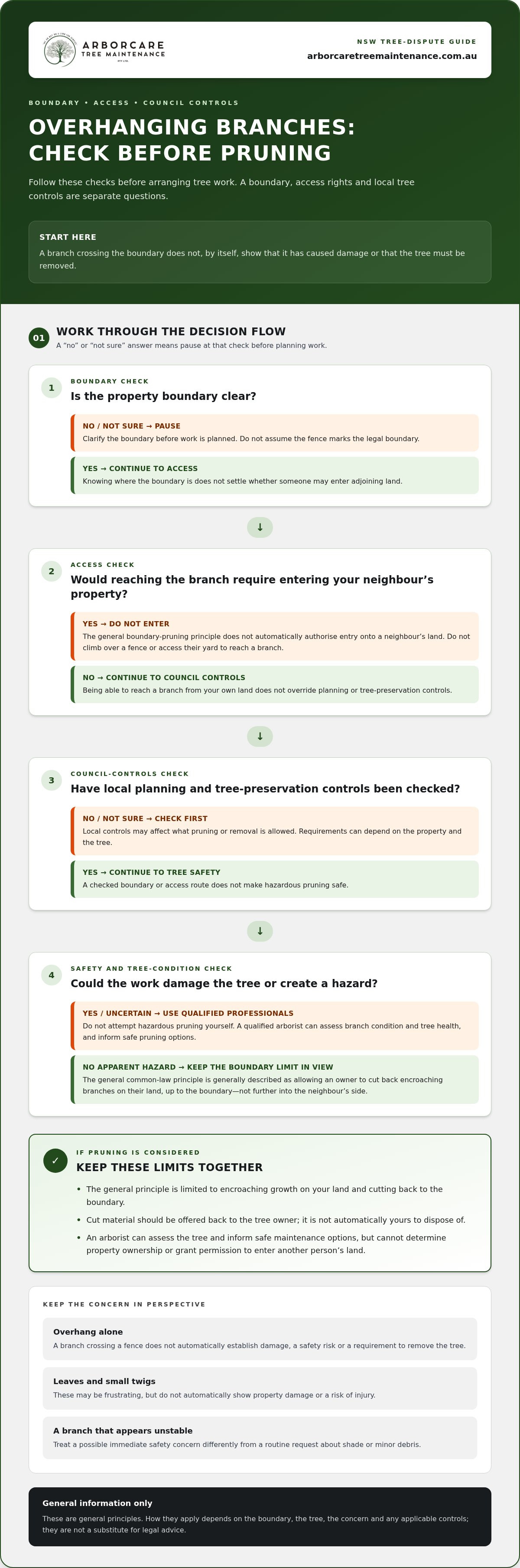
A boundary line can make the issue seem straightforward, but it doesn’t settle every question about pruning. In NSW, a common-law principle generally allows a property owner to cut back branches or roots that encroach onto their land, up to the boundary. That principle is limited. It doesn’t automatically authorise entry onto a neighbour’s property, override council controls or permit work that could damage the tree or create a hazard. Confirm how the current rules apply before arranging pruning.
For anyone searching “neighbor complaining about overhanging branches law NSW”, keep three separate questions in view: where the branch crosses the boundary, whether anyone has permission to access adjoining land, and whether planning or tree-preservation controls affect the work. One answer doesn’t decide the others.
Boundary pruning is not the same as entering a neighbour’s property
The general principle concerns growth encroaching onto your land; it doesn’t give you permission to enter the neighbouring property to reach a branch. Don’t climb over a fence, access your neighbour’s yard or attempt hazardous pruning yourself. Tree work can involve unstable limbs, tools and risks to people or property, so leave assessment and pruning to qualified professionals.
The cut itself also matters. The common-law principle is generally described as allowing pruning only back to the boundary, not cutting further into the tree on the neighbour’s side. The cut material is a separate matter too: it should be offered back to the tree owner rather than treated as automatically yours to dispose of. These are general principles, not a substitute for legal advice about a particular boundary or dispute.
If the trunk sits close to the boundary, or the title boundary is uncertain, don’t assume a fence precisely marks the legal line. Clarify the boundary before work is planned. An arborist can assess the tree and inform safe maintenance options, but can’t determine property ownership or grant permission to access another person’s land.
Check council controls before arranging tree work
Even where branches cross a boundary, local planning or tree-preservation controls may affect what pruning or removal is allowed. Requirements can depend on the property, the tree and the relevant council rules. There isn’t a universal exemption that makes all boundary pruning permissible.
Before arranging work, check the requirements that apply to the specific property and tree with the relevant council. This is separate from getting a neighbour’s consent or understanding a court order. A court order may address a dispute, but shouldn’t be treated as a blanket replacement for any separate approvals that apply.
Remember: the boundary concerns where encroachment occurs; access concerns whether you may enter adjoining land; council controls concern whether the proposed tree work is permitted. Keeping these issues separate helps prevent a neighbour’s complaint from turning into unauthorised access or work that conflicts with local requirements. If a tree assessment would help document the branches and inform safe pruning, qualified tree assessment and pruning can provide practical arboricultural guidance, separate from legal advice or consent.
Informal Resolution, Arborist Advice or Court: Compare Your Options
There isn’t one best response to every branch complaint. A conversation may be enough where the issue is clear and a safe pruning option is available. If the tree’s condition is disputed, an arborist’s assessment can add practical evidence. Mediation may help neighbours discuss a disagreement, while a formal application is a legal step for eligible disputes. These options serve different purposes; an arborist doesn’t decide who has legal rights.
Direct discussion
Purpose: clarify the concern and agree on a practical next step.
Useful evidence: the location of the branches, photographs and a written record of what each neighbour says.
Limitation: relies on both neighbours being willing to communicate.
Arborist assessment
Purpose: assess tree health, branch condition and appropriate maintenance options.
Useful evidence: observations and professional findings about the tree and the work being considered.
Limitation: doesn’t determine ownership, liability or legal rights.
Mediation
Purpose: provide a neutral setting to discuss a possible agreement.
Useful evidence: records of the complaint, the concerns raised and any proposals already discussed.
Limitation: a mediator doesn’t make a binding legal ruling.
Land and Environment Court
Purpose: determine an eligible tree-dispute application under NSW law.
Useful evidence: material showing the tree, the alleged damage or risk, and efforts to resolve the issue informally.
Limitation: a formal legal process with specific requirements; get legal guidance for your circumstances.
When a conversation or mediation may help
Keep the discussion focused: identify the branches, ask what they’re affecting, clarify any access concerns and suggest a practical next step, such as arranging an assessment. If a direct conversation stalls, mediation can give both neighbours a structured chance to explain their concerns and consider an agreement. It isn’t a court decision. Don’t assume mediation is compulsory or unnecessary; check current Court guidance and get legal advice about the requirements for your circumstances.
When formal court guidance may be relevant
The NSW Land and Environment Court hears eligible applications under the Trees (Disputes Between Neighbours) Act 2006. Depending on the application and evidence, the Court may make orders to remedy, restrain or prevent damage or injury, including orders about pruning or removal. The Court’s guidance says applicants need to show they attempted informal resolution, and its process includes notice to the tree owner. Check current requirements before acting; a lawyer can advise on rights, evidence and court documents.
If you’re weighing up the neighbor complaining about overhanging branches law NSW options, match your next step to the concern. A tree assessment can help document branch condition and inform safe pruning, but it can’t replace consent, council checks or legal advice. For residents of Dapto, Wollongong, Shellharbour and the Illawarra, this distinction can help keep practical tree care separate from decisions that require legal or council guidance.
How to Respond to a Branch Complaint Without Escalating It
A calm, documented response can keep a tree concern from becoming a personal argument. Follow a clear sequence: acknowledge the complaint, inspect only from a place you’re entitled to access, record what’s been reported, then discuss a safe and lawful next step. Don’t prune, move branches or enter adjoining land to investigate.
- Acknowledge the concern. Thank your neighbour for raising it and ask which branch they mean and what it’s affecting. Keep the first exchange neutral, even if you disagree about the seriousness of the issue.
- Observe from your own property. Note the branch’s position and whether it appears to touch a structure or create an obvious safety concern. Don’t climb, use equipment or disturb the tree to get a closer look.
- Document what you can see. Take dated photographs from a safe, lawful vantage point. Record the date of the complaint, the branch location and the specific impact your neighbour describes.
- Agree on a sensible next step. Depending on the concern, this could mean checking council requirements or arranging a qualified arborist’s assessment before considering any tree work.
Record the concern and keep communication constructive
Keep a brief written record of conversations, messages and proposals. Describe observable facts, such as “the branch extends above the rear fence” or “the neighbour reports contact with the gutter”. Avoid blame or assumptions about cause. You don’t need to admit legal liability before the facts are understood. A practical response might be: “I’ve noted the concern. Let’s identify the branch and work out whether an assessment is needed.”
For someone searching “neighbor complaining about overhanging branches law NSW”, clear records can help distinguish an ordinary overhang from a report of damage or possible danger. They can also help an arborist understand the concern if you arrange an assessment. Keep copies of relevant council correspondence or earlier tree assessments with your notes.
Prepare useful information before arranging tree work
Gather the property address, photographs, your neighbour’s description of the issue and any relevant council correspondence. Note whether the concern relates to contact with a building, visible damage, a branch that appears unstable or another impact. Don’t cut branches, enter land or operate equipment to test the tree. This preparation keeps the discussion focused and gives a professional clearer context for an assessment.
Treat immediate danger differently from routine overhang. If a branch appears to be falling or there’s an immediate threat to people or property, stay clear and call for help. Don’t attempt to stabilise or remove it yourself. Arborcare provides a 24/7 emergency tree service for fallen or storm-damaged trees. For non-urgent concerns, a qualified, licensed and insured arborist can assess tree condition and inform safe pruning options. Arborcare’s AQF 3 and AQF 5 qualified arborists hold Arborist licence AL2856, and pruning is carried out to AS 4373.
If you’re in Dapto, Wollongong, Shellharbour or the Illawarra and need a professional assessment of branches or pruning options, arrange an onsite tree assessment. It can inform tree-care decisions, but it doesn’t determine legal rights or replace any required consent.
When a Qualified Arborist Can Help With Overhanging Branches
A neighbour’s concern may be about a branch crossing the fence, but deciding what maintenance is suitable requires looking at the tree itself. A qualified arborist can assess tree health and branch condition, then explain practical pruning options. That input can help move a discussion from competing opinions to a clearer picture of the tree and the work that may be appropriate.
Arboricultural advice has limits. An assessment doesn’t decide who owns the tree, whether someone is legally liable, who may enter a property or what a court would order. It also doesn’t replace required consent or council checks. Keep those questions separate: the arborist assesses the tree, while legal rights and planning requirements need to be addressed through the appropriate channels.
What a professional tree assessment can clarify
An arborist can inspect the tree and the branches in question, consider their condition and identify maintenance options. This may help clarify whether a branch appears damaged or compromised, how it relates to nearby structures, and whether pruning is an appropriate tree-care response. The assessment can also document the issue, giving neighbours a more specific basis for discussing what to do next.
For example, a complaint that a branch is “too close” may become a more focused conversation once its position, condition and potential impact have been assessed. That doesn’t settle a legal disagreement or guarantee a particular result. It provides arboricultural information to support a practical discussion and, where suitable, safe pruning.
Pruning advice is not a legal ruling
A recommendation about tree work isn’t permission to carry it out. Before arranging pruning or removal, keep boundary access, neighbour consent, council requirements and any relevant legal process in view. The assessment can inform the tree-care decision, but it can’t grant access to adjoining land, override applicable controls or determine what either neighbour is entitled to do.
This distinction matters in searches for “neighbor complaining about overhanging branches law NSW”. An arborist can describe the tree and maintenance options; they can’t interpret the law as it applies to your dispute. If the disagreement concerns ownership, liability, consent or a court application, seek legal guidance on those matters.
Local tree care across the Illawarra
Arborcare Tree Maintenance Pty Ltd is a family-owned, fully insured arborist business operating since 2000, serving Dapto, Wollongong, Shellharbour and the Illawarra. Its team includes AQF 3 and AQF 5 qualified arborists, and the business holds Arborist licence AL2856. Tree assessments and hedging, pruning and trimming are practical services for understanding a branch concern and planning suitable maintenance.
Pruning is carried out to AS 4373, the Australian Standard for pruning amenity trees. A professional assessment can help identify appropriate work while keeping tree health and safe practice in view. It remains distinct from legal advice, and any required permissions or council requirements still need to be considered.
If you’d like an arborist to assess the branches and discuss suitable maintenance, request a free onsite quote. A clear assessment can support informed tree-care decisions while leaving legal questions to the appropriate advisers.
Take the Next Step Towards a Safer Tree
A branch complaint doesn’t have to define your relationship with your neighbour. A calm, evidence-led next step can shift the conversation from frustration to a practical plan, while keeping safety and the tree’s long-term condition in view.
If you’re dealing with a neighbor complaining about overhanging branches law NSW concern, an onsite arborist assessment can give you clearer information about the branches and suitable maintenance. It won’t decide legal rights or replace council requirements, but it can help inform a tree-care decision. Arborcare Tree Maintenance Pty Ltd is family-owned and operated, with AQF 3 and AQF 5 qualified arborists and Arborist licence AL2856. The team serves Dapto, Wollongong, Shellharbour and the Illawarra.
Move forward with a professional assessment or pruning advice tailored to the tree and its setting. Request a free onsite quote for tree assessment or pruning, and take a considered step towards resolving the branch concern safely and constructively.
Frequently Asked Questions
Can I cut branches overhanging my property in NSW?
Not automatically; whether you may prune branches at the boundary depends on the facts, applicable law and any council controls. If you searched “neighbor complaining about overhanging branches law NSW”, don’t treat an overhang alone as blanket permission to start cutting. Check the current Trees (Disputes Between Neighbours) Act 2006 (NSW), relevant legal guidance and your council’s tree requirements before arranging work. Leave pruning to qualified professionals.
Can I enter my neighbour’s property to trim an overhanging branch?
No. A branch crossing the boundary doesn’t automatically give you permission to enter your neighbour’s land. Ask for consent before access, or seek legal guidance about a lawful process if access is disputed. Don’t climb, use a ladder over the fence or operate cutting equipment to reach the branch. Pruning that involves risk should be undertaken by qualified, licensed and insured professionals, not by the homeowner.
Who pays to prune branches overhanging a neighbour’s property in NSW?
Who pays can depend on the circumstances, applicable law and any agreement between the neighbours, so don’t assume one party is automatically responsible. Discuss the proposed work and payment before it’s arranged, and keep a written record of any agreement. In an eligible tree dispute, the Land and Environment Court may make orders, but the outcome depends on the case. Check current Court guidance for your situation.
Do I need council approval to prune a neighbour’s tree in NSW?
Possibly. Local tree-preservation controls can affect pruning or removal, and there isn’t a universal exemption for branches crossing a boundary. Check the current requirements of the council responsible for the property before work starts. This applies whether the tree is in Dapto, Wollongong, Shellharbour, Wonoona, Jamberoo, Fairy Meadow or Dombarton, as the relevant council requirements depend on the address and tree.
Is mediation compulsory for a tree dispute in NSW?
Not necessarily; whether mediation is required depends on the process and circumstances. Mediation can give neighbours a neutral setting to discuss an agreement, but it doesn’t guarantee resolution or provide a binding legal ruling. The Land and Environment Court’s process emphasises attempts to resolve a dispute informally. Before filing an application, check the Court’s current guidance on what evidence of those attempts is required, and seek legal advice if unsure.
What evidence should I keep if a neighbour complains about tree branches?
Keep dated, original photographs taken from places you’re entitled to access, along with copies of messages and a factual note of the concern raised. Record when the complaint was made and what impact was described. Save relevant council correspondence and any professional assessment documents if available. Don’t trespass or alter the tree to gather evidence. Photos can help record conditions, but alone they don’t establish legal responsibility.
Can the NSW Land and Environment Court order a neighbour to prune a tree?
Yes, the Court can make orders in eligible tree disputes, but pruning isn’t automatic just because a neighbour complains. Whether pruning or another order is appropriate depends on the law, the application and the evidence. The Court may consider issues such as damage or risk of injury. Check the current Act and Court guidance before taking formal steps, and get legal advice about how the rules apply to your circumstances.


