What if the only thing standing between your home and a falling five-tonne trunk is a few lengths of high-tensile rope and a calculated rigging plan? For many homeowners, the need for complex tree removal Illawarra presents a daunting mix of physical risk and administrative red tape. It's completely natural to feel a sense of dread when a large, decaying, or poorly positioned tree threatens your property. You aren't just worried about the tree itself; you're likely stressed about the potential for structural damage, the confusing permit requirements from Wollongong or Shellharbour councils, and the logistics of getting heavy machinery into a tight backyard.
We understand that your home is your most significant investment, and you need a solution that prioritises safety over speed. This guide will help you master the process of managing high-risk removals, covering everything from securing essential council permits to the advanced rigging techniques used by professional crews. You'll gain a clear understanding of the safety protocols required to protect your assets and learn how to identify a licensed arborist who follows the Australian Standard AS 4373-2007. We will examine the technical framework for local compliance and the specialised equipment needed to ensure a controlled, damage-free result.
Key Takeaways
- Identify the technical hazards, such as restricted access and structural proximity, that define a complex tree removal Illawarra project.
- Learn how professional arborists choose between sectional dismantling and crane-assisted removals to protect your home and assets.
- Navigate the complexities of local government permits by understanding the Development Control Plan (DCP) and the 10/50 vegetation clearing rules.
- Understand the importance of the Australian Standard AS 4373-2007 and specialised rigging equipment in mitigating high-risk property damage.
- Gain peace of mind by knowing what to look for in a licensed arborist who prioritises safety, local environmental knowledge, and professional compliance.
What Defines Complex Tree Removal in the Illawarra?
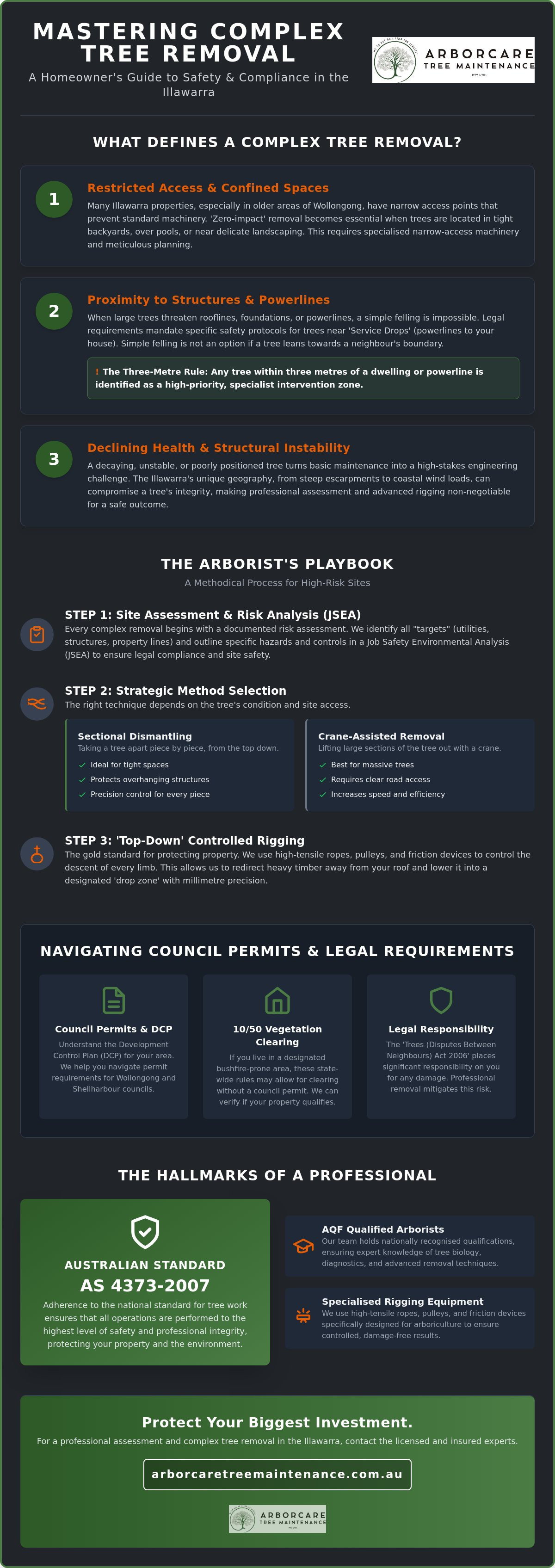
A standard tree removal involves a clear fall zone and minimal obstacles. However, a complex tree removal Illawarra project is defined by variables that increase the risk to people, property, and the environment. Complexity is usually triggered by three factors: restricted access, proximity to structures, and the declining health of the tree itself. When a tree is unstable or positioned in a way that prevents a natural fall, the job shifts from basic maintenance to a high-stakes engineering task. Complex tree removal is a high-risk operation requiring advanced rigging and AQF qualifications.
Local geography plays a major role in these challenges. The Illawarra escarpment creates steep terrain in suburbs like Dombarton, where heavy machinery cannot easily reach a site. Simultaneously, coastal wind loads along the Wollongong shoreline mean that even a healthy tree can become a hazard during a storm. Understanding the principles of Arboriculture is vital for assessing how these environmental forces affect a tree's structural integrity. We also strictly observe the "Three-Metre Rule," which identifies any tree within three metres of powerlines or dwellings as a high-priority specialist intervention zone.
Restricted Access and Confined Spaces
Older residential areas in Wollongong and Fairy Meadow often feature narrow side-access, sometimes less than a metre wide. This makes it impossible to bring in standard chippers or trucks. In these scenarios, "zero-impact" removal is the only acceptable standard. If a tree sits directly above a swimming pool or expensive glass fencing, every branch must be meticulously rigged and lowered. We use specialised narrow-access machinery and compact spider lifts to navigate these tight urban corridors without damaging your landscaping or driveway.
Structural Risks and Powerline Proximity
In the Shellharbour region, urban sprawl means many large trees now threaten rooflines or underground foundations. Identifying these risks early prevents costly structural repairs later. A major complexity involves "Service Drops," the powerlines connecting your house to the street. Legal requirements dictate specific clearances and safety protocols for these zones. If a tree has a significant lean toward a neighbour's boundary, simple felling is physically impossible. We resolve this by dismantling the tree in sections, ensuring each piece is safely redirected away from sensitive infrastructure.
How to Plan a Complex Tree Removal: The Arborist’s Playbook
Planning a complex tree removal Illawarra requires more than just a chainsaw and a ladder. It is a methodical engineering exercise where every variable is accounted for before the first cut is made. During the initial site assessment, we identify "targets" such as underground utilities, adjacent structures, and neighbouring property lines. This is crucial because the Trees (Disputes Between Neighbours) Act 2006 places significant legal responsibility on property owners for damage caused by trees or removal activities. We perform a Job Safety Environmental Analysis (JSEA) for every site to outline specific hazards and the controls used to mitigate them. Every complex removal begins with a documented risk assessment.
Choosing the right method is the next critical decision. While crane-assisted removal is ideal for massive trees with clear road access, many Illawarra properties require sectional dismantling due to restricted space. Our team evaluates the tree's structural integrity to determine if it can support the weight of a climber or if an Aerial Work Platform is necessary for safety.
Step 1: Sectional Dismantling and Rigging
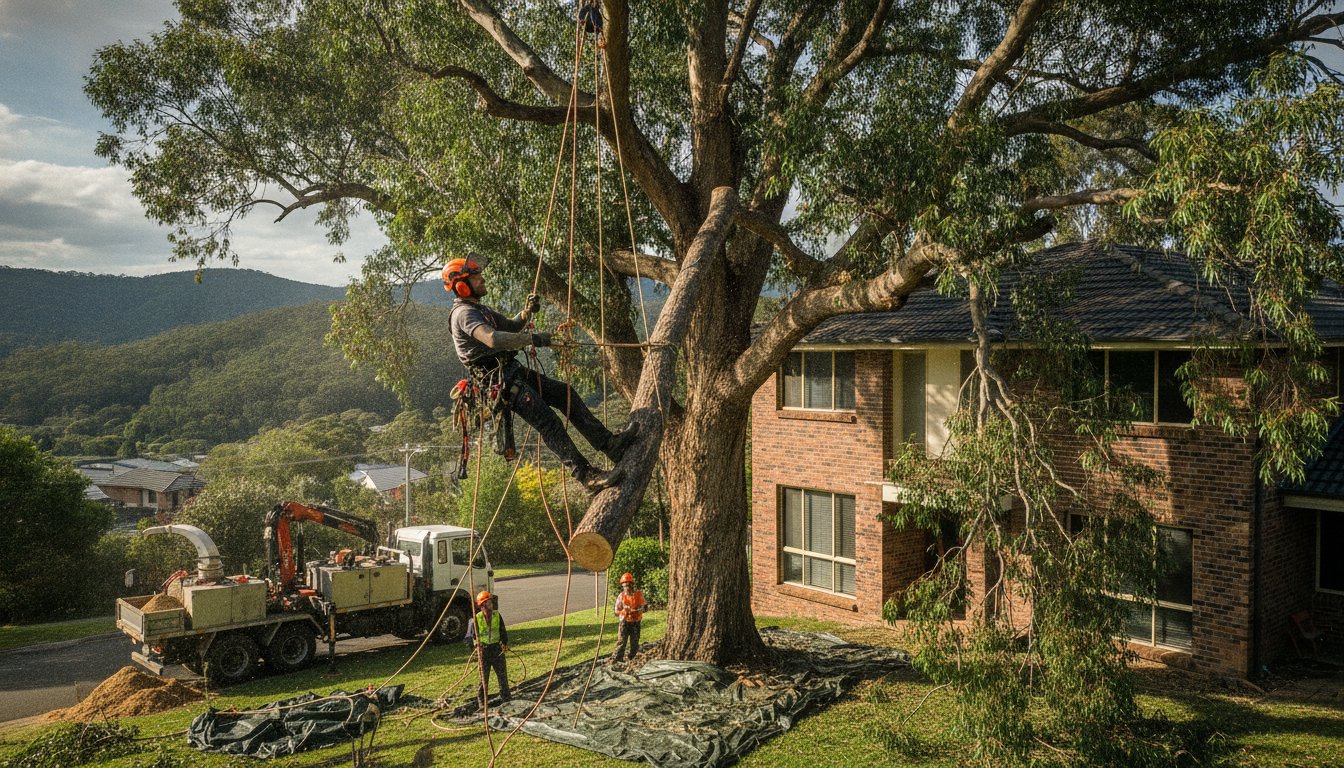
Sectional dismantling is the process of taking a tree apart piece by piece from the top down. Arborists use high-tensile ropes, pulleys, and friction devices, often called bollards, to control the descent of every limb. This "Top-Down" approach ensures that the canopy is cleared systematically, reducing the risk of branches getting caught or swinging unpredictably. High-angle rigging is the gold standard for trees overhanging houses or sensitive garden features. It allows us to redirect heavy pieces of timber away from the roofline and lower them into a designated "drop zone" with millimetre precision. This technique is essential for protecting your home's structural integrity during the removal process.
Step 2: Managing Heavy Timber in Tight Spots
Once the canopy is removed, we focus on the heavy timber of the main trunk. We manage large sections through "snubbing," a rigging technique where friction is used to slow a falling log's momentum safely. Protecting your property is a priority, so we use ground protection mats to ensure your lawn and garden beds aren't crushed by the weight of the timber or our machinery. Extracting debris through narrow side gates or over fences requires careful coordination and specialised equipment. If you are dealing with a high-risk tree in a difficult location, our specialists in complex tree removals can provide a tailored safety plan for your property.
Equipment and Safety: What Separates Professionals from Loppers
A standard chainsaw is merely a basic tool in the context of a complex tree removal Illawarra project. While an untrained "lopper" might arrive with basic hardware store gear, a professional arborist utilises a sophisticated kit designed for force management and structural control. Every high-risk operation must strictly adhere to the Work Health and Safety (WHS) Act 2011. This legislation mandates that contractors identify hazards and implement the highest level of protection reasonably practicable. For property owners, the most critical safeguard is ensuring their contractor holds an AQF Level 3 certification in Arboriculture. This qualification is the industry benchmark for safety and technical competence; it ensures the person in the canopy understands the physics of timber under tension.
Deciding between climbing and using an Aerial Work Platform (AWP) is a pivotal safety choice. While climbing is traditional, an AWP or "spider lift" is often the safer alternative for trees with compromised structural integrity. These machines allow our team to access the canopy without putting weight on a potentially hollow or decaying trunk. If the site allows for it, mechanical access reduces fatigue and provides a stable work environment, which is essential for precision cuts near powerlines or rooflines. We evaluate the tree's health and the ground's stability to determine which method provides the lowest risk profile for your specific property.
Specialised Rigging Gear
The science of complex removals relies on load-rated slings and arborist blocks. Unlike standard pulleys, these blocks are engineered to handle the massive dynamic loads generated when a heavy limb is dropped into a rope. We use "Port-a-Wraps," which are friction devices attached to the base of the tree. These allow a single ground person to control the descent of a 500kg section of timber with just one hand. Using cheap, non-rated ropes or hardware is a recipe for disaster on an Illawarra job site. Every piece of our equipment is inspected regularly and retired the moment it shows signs of wear, ensuring that our rigging systems never fail under pressure.
Insurance and Liability: Protecting Your Assets
Professional tree services carry two distinct types of coverage: Public Liability and Professional Indemnity. Public Liability protects against physical damage to your home or fences, while Professional Indemnity covers the expert advice provided by the arborist. It is a common misconception that the worker's own insurance is the only thing at stake. In reality, homeowners can be held liable for workplace injuries if they engage an uninsured, "cash-in-hand" worker on their property. You should always ask to see a current Certificate of Currency before any work begins. A reputable business will provide these documents readily, giving you the reassurance that your assets and legal interests are fully protected during a high-risk removal.
Navigating Illawarra Council Permits and Legal Requirements
Securing a permit is the first administrative hurdle for any complex tree removal Illawarra project. Each Local Government Area (LGA) operates under a specific Development Control Plan (DCP) that dictates which trees are protected and which can be removed. In the Illawarra, these rules are designed to preserve the urban canopy while allowing for the removal of hazardous or unsuitable species. You must also consider the 10/50 Vegetation Clearing Scheme, which allows some property owners in designated high-risk bushfire zones to clear trees within 10 metres of their home without a permit. However, this scheme has strict eligibility criteria based on the NSW Rural Fire Service entitlement map, and misinterpreting these boundaries can lead to heavy fines. We advise homeowners to always check with their local council before removing any tree over 3 metres to ensure they are fully compliant with current regulations.
While most removals require formal approval, there are scenarios where you don't need a permit. Exemptions typically apply to specific environmental weeds or fruit trees, as well as "imminent risk" scenarios where a tree is clearly failing and poses an immediate threat to life or property. If you believe a tree is an imminent hazard, you must still document the evidence thoroughly with photos and, ideally, a professional assessment to justify the emergency intervention to council later. For standard applications, the processing time with the Wollongong City Council is typically around 28 working days, and once issued, a tree permit is valid for one year.
Wollongong City Council vs Shellharbour City Council
The nuances between LGAs can be confusing for residents. Wollongong City Council maintains a Significant Tree Register and heritage overlays that apply to many older suburbs. In Wollongong, a permit is generally required to prune or remove trees over 5 metres in height or those with a trunk diameter of 30cm or more at ground level. Shellharbour City Council has its own set of criteria focused on urban canopy retention. For a detailed breakdown of these local rules, see our Tree Removal Wollongong: The Complete Professional Arborist Guide. Council application fees in the region generally range between $75 and $100 for the first few trees, with additional fees for extra specimens.
The Role of the Arborist Report
If your application is for a healthy tree that you believe is causing structural damage, council will almost certainly require a Level 5 Arborist report. This is a technical document that provides an evidence-based assessment of the tree's condition and its impact on the surrounding environment. Proving "Imminent Hazard" or "Structural Damage" through a qualified report is often the only way to secure a permit for large, protected species. An arborist report can cost between $200 and $400, but it serves as your legal protection and technical justification. Our team simplifies the permit process for Dapto and Wonoona residents by providing the necessary documentation and technical data required by local assessors. If you are unsure about your legal obligations, you can contact our experts for professional guidance on council applications.
Why Arborcare is the Choice for Complex Tree Removal in the Illawarra
Selecting the right partner for a complex tree removal Illawarra project involves more than just comparing prices. It requires a team that understands the specific environmental pressures of our region. Based in Dapto, our crew possesses deep local knowledge of Illawarra soil structures and the volatile weather patterns that roll off the escarpment. We don't believe in shortcuts. Our commitment to safety means we never "lop" trees, as this outdated practice creates weak regrowth and future hazards. Every job we undertake follows the Australian Standard AS 4373-2007, ensuring that the structural integrity of your remaining landscape is never compromised. We provide a steady, methodical approach to high-risk removals that prioritises the protection of your home and family.
Our service is comprehensive, taking you from the initial risk assessment through to the final tidy-up. This includes everything from high-altitude dismantling in tight urban spaces to expert stump grinding to reclaim your garden beds. We also understand that emergencies don't stick to business hours. When a severe coastal storm brings down heavy timber, our 24/7 emergency response team is ready to secure your property and mitigate further damage. We act as your protective guide through the entire process, resolving hazards with technical authority and local dedication.
The Arborcare Process: From Quote to Clean-Up
Transparency is the foundation of our client relationships. When we quote for a complex tree removal Illawarra project, we conduct a thorough site audit to identify every potential obstacle. This means you won't be hit with hidden fees for "difficult access" or specialised rigging once the work has started. Our team treats your property with the highest level of respect. We use ground protection mats to shield your lawn and employ advanced rigging to ensure no debris touches your structures. We aim to leave your property cleaner than we found it, disposing of all mulch and timber efficiently. For trees that don't yet require removal, we offer a Professional Tree Pruning in the Illawarra service to maintain health and safety standards.
Ready to Secure Your Property?
It's a mistake to wait for the next major storm to turn a "problem tree" into a property-damaging emergency. Proactive management is the most effective way to avoid the high costs and stress of structural repairs. Contact our licensed arborists today for a fair dinkum assessment of your high-risk trees. We provide clear, declarative advice based on years of technical experience in the field. Request your obligation-free complex tree removal quote today and let our specialists handle the heights and the hazards for you.
Securing Your Illawarra Property for the Future
Managing high-risk trees is a matter of technical precision and regulatory compliance rather than just brute force. You now have the framework to identify when a project requires specialised intervention, from navigating the nuances of local council permits to understanding the advanced rigging required for confined spaces. Prioritising safety and professional standards ensures that your property remains protected during even the most challenging removals. Our team of fully licensed and insured AQF level arborists is dedicated to maintaining these high standards across every complex tree removal Illawarra homeowners require.
We combine local expertise with specialised high-risk rigging equipment to resolve hazards before they become emergencies. Whether you need a proactive site assessment or 24/7 emergency storm response across the Illawarra, we provide the steady hand and technical authority your property deserves. Don't leave your home's safety to chance or uncertified operators who take unnecessary risks with your assets. Get a Professional Quote for Complex Tree Removal today and gain the peace of mind that comes with expert care. Your landscape is a vital part of your home; we're here to help you manage it safely and professionally.
Frequently Asked Questions
How much does complex tree removal cost in the Illawarra?
The cost of removal depends on the tree's size, its location, and the technical risks involved in the job. While small trees might cost around $300, industry data from June 2026 indicates that large or complex removals in the Wollongong area typically range from $3,500 to over $7,500. These figures reflect the need for specialised rigging, heavy machinery, and larger crews to manage high-risk environments safely. We provide a detailed site audit to ensure your quote is accurate and covers all safety requirements.
Do I need council approval to remove a tree on my property in Wollongong?
You generally need a permit from Wollongong City Council if the tree is over five metres tall or has a trunk diameter exceeding 30cm at ground level. Approval is also required for branches wider than 10cm. The application process usually takes about 28 working days, and once issued, your permit remains valid for one year. It's essential to secure this approval before work begins to avoid significant fines for non-compliance with local environmental regulations.
What makes a tree removal "complex" compared to a standard job?
A job is classified as a complex tree removal Illawarra residents should note when the tree cannot be felled in one piece due to surrounding obstacles. This includes trees positioned over houses, swimming pools, or glass fencing, as well as those with restricted access where heavy machinery cannot enter. Complexity also increases if the tree is structurally unsound, decaying, or located on the steep terrain of the Illawarra escarpment, requiring advanced rigging techniques to lower timber safely.
Can you remove a tree that is overhanging my neighbour's house or fence?
Yes, we specialise in removing timber from sensitive boundaries using a top-down sectional dismantling approach. We use high-tensile ropes and friction devices to redirect every branch away from your neighbour's roofline or fencing. This process ensures that no debris falls onto adjacent property, fulfilling your legal obligations under the Trees (Disputes Between Neighbours) Act 2006. Our team coordinates the entire rigging plan to maintain a "zero-impact" work zone throughout the project.
What is the difference between an arborist and a tree lopper?
An arborist is a qualified professional, typically holding an AQF Level 3 or 5 certification, who follows the Australian Standard AS 4373-2007 for tree care. In contrast, a "lopper" often lacks formal education and may use techniques that cause long-term structural weakness or decay in your trees. Engaging a qualified arborist ensures the work is performed with technical authority and proper insurance coverage, whereas "lopping" can lead to increased hazards and potential liability for the homeowner.
How long does it typically take to complete a complex tree removal?
Most complex removals are completed within one to three days. The exact timeframe depends on the volume of canopy that needs to be rigged and the speed at which debris can be extracted from the site. Because every piece of timber must be lowered slowly to protect your assets, these jobs take longer than a standard felling operation. We provide a clear schedule during the quoting phase so you know exactly how long our crew will be on-site.
What happens if a tree is touching powerlines?
Trees touching or growing near powerlines represent a severe electrocution and fire risk that requires immediate professional intervention. You should never attempt to prune these trees yourself. Only arborists with specific electrical hazard certifications are permitted to work within the "Three-Metre Rule" zone near live service drops. We coordinate with local utility providers where necessary to ensure the power is managed safely while we clear the encroaching timber from your lines.
Will my garden be damaged during a complex tree removal process?
We take extensive precautions to protect your landscaping and garden beds during the removal process. Our crew uses ground protection mats to distribute the weight of heavy timber and prevents soil compaction from our machinery. By using controlled rigging and arborist blocks, we lower sections of the tree into a designated "drop zone" away from your prized plants. Our goal is always to leave your property in a clean and tidy state once the high-risk task is finished.


