
Last storm season, a homeowner in Dapto watched as a seemingly healthy Eucalypt narrowly missed their roof during a fierce East Coast Low. It's a terrifying scenario that many families in our region fear, especially when the escarpment winds start to howl. Learning to identify the signs of a dangerous tree Illawarra property owners often overlook is the best way to prevent a disaster before the weather turns again.
You likely want to preserve your local canopy, yet the confusion over council permits and the potential cost of emergency removals can feel paralysing. We'll help you cut through that uncertainty. This guide provides a practical safety checklist to evaluate your trees, explains the latest Wollongong City Council permit requirements, and details exactly when it's time to call a professional arborist to ensure your home remains a safe haven.
Key Takeaways
- Understand how the unique wind tunnels created by the Illawarra Escarpment put specific structural stress on local tree species.
- Learn to identify the five critical signs of a dangerous tree Illawarra homeowners often miss, including "widow-makers" and deep trunk cavities.
- Discover how to distinguish between a tree that is merely messy or shedding leaves and one that poses a genuine structural risk.
- Perform a safe, ten-minute ground-level inspection of your property using our professional "wide view" assessment technique.
- Recognise the legal and safety importance of engaging a qualified arborist for risk assessments to protect your property and liability.
Identifying Dangerous Trees in the Illawarra: Why Local Context Matters
A tree is professionally classified as "dangerous" when it possesses structural defects that make a failure likely, potentially leading to property damage or personal injury. In our region, assessing these risks requires more than a glance; it demands an understanding of how our unique geography impacts signs of a dangerous tree Illawarra residents should watch for. From the towering heights of the Escarpment to the coastal fringes of Fairy Meadow, environmental stressors dictate whether a specimen stands firm or becomes a liability. In coastal pockets, constant salt spray can lead to "salt burn" and increased wood brittleness, making branches more prone to snapping during sudden gusts. For a deeper dive into how environmental factors and biological stressors impact vitality, you can consult this comprehensive guide to tree health.
The Role of Illawarra Weather Patterns
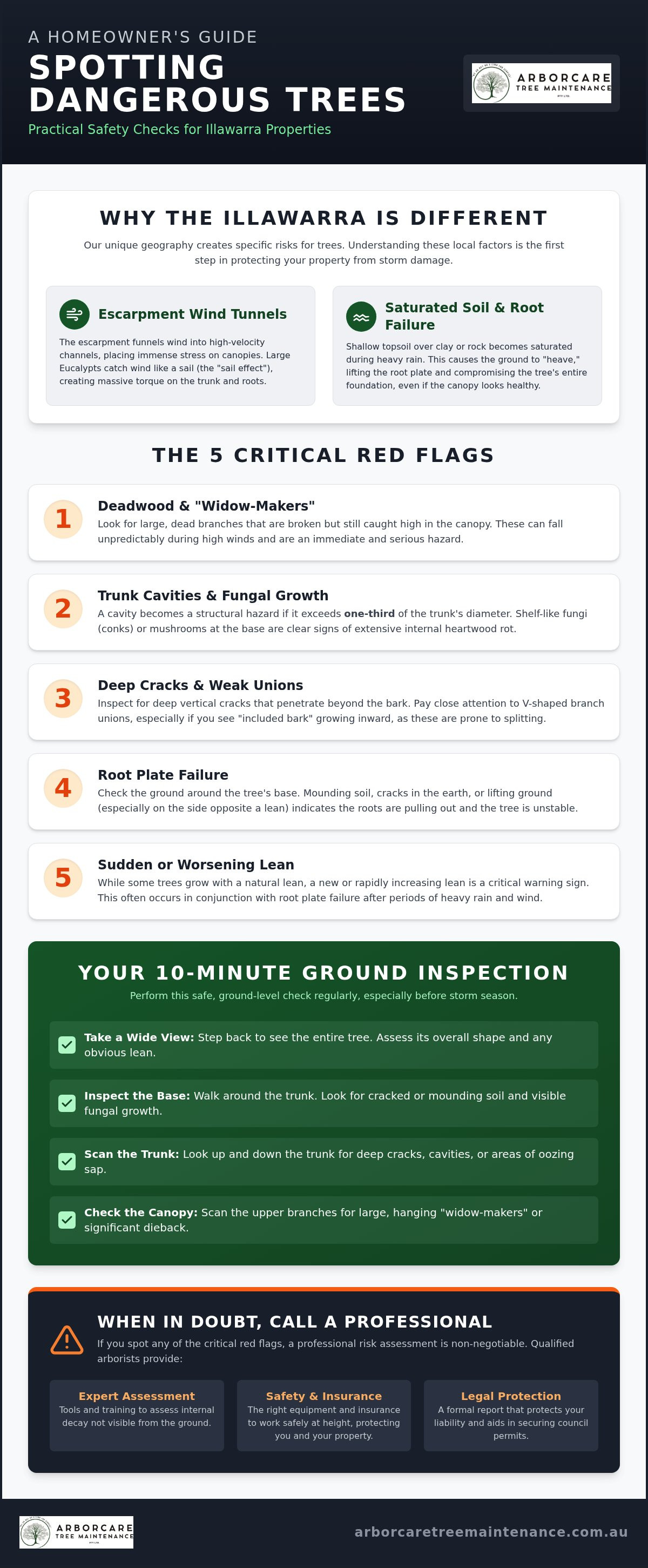
Our local geography creates a literal wind tunnel. The Illawarra Escarpment forces air into high-velocity channels that put immense pressure on tree canopies. During an East Coast Low, these winds are coupled with torrential rain, creating a perfect storm for structural failure. Large Eucalypts are particularly susceptible to the "sail effect." This occurs when the dense canopy catches the wind like a sheet, putting massive torque on the trunk and root system. While trees in Shellharbour might deal with direct coastal gusts, those in Wollongong's foothills face turbulent, swirling winds that stress wood fibres in unpredictable ways. It's often this repeated stress, rather than a single event, that leads to a sudden collapse during a southerly buster.
Soil Saturation and Root Stability
Root anchorage is the foundation of tree safety, yet the Illawarra’s geology often works against it. In suburbs like Dombarton and Jamberoo, trees frequently grow on steep slopes with shallow topsoil sitting over hard rock or heavy clay. When prolonged rain events saturate the ground, the soil can begin "heaving." This is a process where the root plate physically lifts and moves as the tree sways in the wind. Observing this movement provides one of the most reliable signs of a dangerous tree Illawarra residents can spot from the ground. Identifying the critical root zone, the area of soil around the trunk containing the roots essential for stability, is vital. If this zone is compromised by erosion, excavation, or saturated clay, the tree's structural integrity is lost. This remains true even if the canopy appears healthy and vibrant to the untrained eye.
The 5 Critical Red Flags: Visual Signs of a Hazardous Tree
Visual inspections are your first line of defence when spotting the signs of a dangerous tree Illawarra storms might otherwise find for you. Deadwood and "Widow-Makers" are the most immediate threats to your safety. These are large, dead branches that have snapped but remain caught in the higher canopy. During our local winds, these can drop without warning. It's vital to identify and assess hazard trees before they cause harm to your family or home. Trunk cavities also require careful scrutiny. While hollows provide essential habitat for local fauna, if the cavity exceeds one-third of the trunk's diameter, it transitions from an ecological benefit to a structural hazard.
Cracks and Cankers in the Trunk
Look for deep vertical cracks that penetrate the heartwood rather than just the outer bark. Surface shedding is common in species like Spotted Gums, but structural splits indicate the tree is failing under its own weight. Pay close attention to V-shaped branch unions. If you see "included bark," which is bark growing inward between two stems, the union is structurally weak and prone to splitting. Oozing cankers or "bleeding" sap often signal internal infections that weaken the wood's density. If you spot these signs of a dangerous tree Illawarra properties often harbour, a professional risk assessment is the safest next step.
Fungal growth, specifically shelf-like "conks" or mushrooms at the base, indicates internal heartwood rot. These organisms feed on the structural cellulose and lignin that give the tree its strength. By the time you see the fungal fruiting bodies on the outside, the internal decay is often extensive and the wood may be brittle.
Root Plate Failure and Ground Signs
The ground around the tree tells a story of what is happening underground. Soil mounding or cracked earth on the side opposite a lean suggests the roots are physically pulling out of the ground. This often happens after driveway or fence construction severs critical lateral roots that provide stability. Root heave is a physical lifting of the soil and root plate on the windward side of a tree, serving as a primary indicator of imminent toppling.
Distinguish between a natural curve and a sudden lean that has developed over a short period. A tree that has grown with a curve usually has "reaction wood" and a thickened trunk to compensate for the weight. However, a tree that has recently tilted, evidenced by disturbed soil or exposed roots at the base, is actively failing. This is particularly dangerous on the Illawarra slopes where gravity and wet soil combine to increase the risk of a total collapse.
Structural Risk vs. Aesthetic Issues: Does Your Tree Need Removal?
It is common for homeowners to mistake a messy tree for a hazardous one. A deciduous species shedding leaves or a gum tree dropping bark in autumn often creates a maintenance burden, but these aren't inherently signs of a dangerous tree Illawarra residents need to fear. We distinguish between health issues, which might cause a thinning canopy, and structural issues like a significant lean. One of the most deceptive dangers is "Lion’s Tailing." This occurs when an unqualified lopper removes too many internal branches, leaving foliage only at the very ends. This shifts the centre of gravity and turns branches into long levers that snap easily during heavy storms. In many cases, professional weight reduction pruning can restore balance; however, if the core structural integrity is compromised, the tree becomes a ticking clock.
When Pruning and Hedging is Enough
In many instances, the danger is localized rather than systemic. Managing overhanging branches near powerlines or gutters in Woonona is a routine safety requirement that doesn't necessitate total removal. Engaging a specialist for tree pruning Illawarra wide can significantly reduce wind resistance by thinning the canopy. This allows the wind to pass through the tree rather than pushing against it like a solid sail. Minor dieback in the outer tips can often be managed with targeted trimming, provided the primary limbs remain sound and the root plate is stable.
The Point of No Return: When Removal is Mandatory
There are clear thresholds where a tree moves beyond the help of pruning. If a tree exhibits more than 50% deadwood in its primary canopy, its ability to recover is statistically unlikely, and the risk of limb drop becomes extreme. Structural cracks that extend through more than one-third of the trunk diameter are also a terminal sign. These fissures indicate that the internal wood fibres have failed and can no longer support the tree's vertical mass. When these signs of a dangerous tree Illawarra homeowners identify are combined with a location overhanging bedrooms or high-traffic areas, complex tree removal Illawarra services become the only responsible option. At this stage, the priority shifts from preservation to the immediate protection of life and property.
The Homeowner’s 10-Minute Ground Inspection Checklist
You don't need to be a professional climber to spot the signs of a dangerous tree Illawarra properties often harbour. Safety is the absolute priority; you should never attempt to climb a tree or use a ladder to inspect high-altitude defects. Stay firmly on the ground and follow this systematic four-step process. Begin with the "Wide View" by standing across the street or at a distance where you can see the entire specimen. Assess the overall balance and lean. A lopsided canopy often indicates uneven root loading, especially if the tree leans toward a high-value target like your home. Next, perform the "Trunk Check" to look for deep cavities or daylight visible through the main stem. Move to the "Base Inspection" by clearing away mulch or leaf litter at the foot of the trunk. Look for "frass," which is a sawdust-like material indicating borers, or fungal growth suggesting internal rot. Finally, conduct a "Canopy Scan" to spot dead branches or "widow-makers" lodged in the upper limbs.
Tools for a Safe Inspection
You can gather significant data using basic household items. Use a simple flat-head screwdriver to gently probe the wood at the base of the trunk. If the tool sinks easily into soft, punky wood, the tree’s structural foundation is likely decaying. A smartphone camera is another essential tool for monitoring. Take a photo from a fixed point and repeat the process every few months to track if a lean is progressively increasing. Binoculars are the safest tool for checking high-altitude branch unions for the V-shaped splits or included bark discussed in previous sections.
Recording Your Findings for the Council
If your inspection reveals hazards, you'll need documented evidence to support a tree removal permit Wollongong council requires. Take clear, high-resolution photos of specific defects like cracks, oozing cankers, or fungal brackets. Note the proximity of the tree to "targets" such as your bedroom, the neighbour's garage, or public footpaths. Providing this documented evidence speeds up the arborist’s assessment by highlighting the most critical areas of concern immediately. If your ground inspection reveals any of these red flags, don't wait for the next storm to test your luck. Contact our team for a professional emergency tree service assessment to secure your property today.
Professional Risk Assessment: Why Expert Intervention is Non-Negotiable
While the homeowner's checklist is an excellent first step, identifying the technical signs of a dangerous tree Illawarra families should worry about requires a trained eye. There is a significant difference between a "tree lopper" and a "qualified arborist." A lopper often lacks formal arboricultural education and the comprehensive liability insurance necessary for high-risk work. In contrast, a qualified arborist (AQF Level 3 or higher) possesses the technical knowledge to assess structural integrity accurately. This distinction is vital for your legal protection. If you are aware of a hazardous tree and it subsequently falls on a neighbour’s property, you may be held legally liable for the resulting damages. Engaging a professional ensures that your duty of care is met through a documented safety audit.
Our team uses industry-standard techniques to determine internal wood density, looking far beyond what is visible on the surface. A tree may appear vibrant and full of green leaves while harbouring significant internal heartwood rot. By using sounding techniques and advanced visual analysis, we can identify if the trunk is becoming a hollow shell. This level of detail provides the "peace of mind" factor that is so crucial before the storm season peaks. Having a written report allows you to make informed decisions based on data rather than guesswork.
What Happens During an Arborcare Assessment?
Our Dapto-based team follows rigorous Visual Tree Assessment (VTA) protocols during every site visit. We don't just look at the tree in isolation; we carefully evaluate the "Target Zone." This involves identifying what exactly is at risk if a failure occurs, such as your house, a vehicle, or a public footpath. A tree with a structural defect in the middle of a large clearing is a low risk, whereas the same defect in a tree overhanging a bedroom is a high-priority hazard. Following this evaluation, we provide a clear, prioritised action plan. This document outlines whether the tree requires targeted pruning, weight reduction, or a complete removal to maintain property safety.
Emergency Services and Rapid Response
You should never wait for a severe storm to "finish off" a leaning or cracked tree. Proactive intervention is always safer and more cost-effective than reactive emergency work. When a tree is already failing during a gale, the risks to our crew and your property increase exponentially. Our emergency tree service Illawarra process is built for speed and safety, ensuring we can stabilise or remove hazards before they collapse. Keeping a professional arborist on speed-dial is a standard part of storm readiness for Wollongong homeowners. Recognising the signs of a dangerous tree Illawarra early means we can intervene on your terms, not the weather's.
Secure Your Property Against Environmental Risks
Spotting the signs of a dangerous tree Illawarra residents frequently overlook is a vital skill for property maintenance. We have explored how the escarpment winds and saturated soils create unique hazards that require more than just a passing glance. By following a systematic ground inspection and understanding the difference between simple aesthetics and structural failure, you can take control of your property's safety before the weather turns.
Technical assessments require professional expertise to truly mitigate risk. As fully licensed and insured arborists, we specialise in complex removals near property foundations and provide a 24/7 emergency response for those unpredictable local storms. Don't leave your safety to chance when the winds pick up. Request a Professional Tree Risk Assessment from Arborcare Today and ensure your landscape remains a safe haven for your family. Proactive care is the most effective way to protect your home and provide lasting peace of mind.
Frequently Asked Questions
Does Wollongong Council allow me to remove a dangerous tree without a permit?
Wollongong City Council generally requires a permit for any tree over 5 metres in height or with a trunk diameter of 30cm or more at ground level. As of 2026, the application fee for 1-2 trees is $114.00. In an immediate emergency where a tree poses an imminent threat, you can perform work to make it safe, but you must provide evidence like photos or an arborist's report within 72 hours to obtain the necessary permit post-event.
How much does it cost to have a tree risk assessment in the Illawarra?
A professional arborist report in the Wollongong area typically ranges from approximately $325 to $755 depending on the complexity and number of trees involved. These assessments provide the documented evidence required for council applications and legal liability protection. Investing in a formal report is often more cost-effective than the fines for unauthorised removal, which can reach $3,000.00 for individuals who breach local tree management regulations.
What is a "widow-maker" and why is it so dangerous for my family?
A "widow-maker" is a large, dead branch that has detached from the tree but remains snagged in the upper canopy. These are significant signs of a dangerous tree Illawarra families should avoid, as they can fall at any moment with no warning. Even a light breeze can dislodge these heavy limbs. Because they often hang high up, you should always use binoculars to spot them safely from the ground rather than walking underneath.
Can a leaning tree be straightened, or must it be removed?
Most mature leaning trees cannot be straightened and often require removal if they show signs of active movement. If the lean is a natural growth pattern and the root plate is stable, the tree may be safe. However, if you see mounded soil or exposed roots on one side, the tree is actively failing. An arborist can determine if weight reduction pruning can stabilise the specimen or if the structural risk is too high.
How do I know if the fungi on my tree trunk is a sign of rot?
Fungi appearing as shelf-like brackets or mushrooms on the trunk are indicators of internal heartwood decay. These organisms consume the structural cellulose and lignin that keep the tree upright. By the time fruiting bodies appear on the exterior, the internal rot is usually advanced. If you notice these growth patterns near the base or on main limbs, it's a clear signal that the wood's density and structural strength are compromised.
Will my home insurance cover a tree falling on my house if it was already dead?
Many home insurance policies exclude coverage for damage caused by trees that were already dead or clearly neglected before a storm. Insurers often view a "known dangerous tree" as a maintenance issue rather than an accidental event. If an investigation finds that you ignored obvious signs of a dangerous tree Illawarra properties frequently harbour, your claim may be denied. Maintaining records of professional risk assessments is the best way to prove you've met your duty of care.
Is it safer to remove a tree before or after the Illawarra storm season?
It is always safer to remove a hazardous tree before the Illawarra storm season begins. High winds and saturated soils during East Coast Lows are the primary triggers for tree failure. Removing a known hazard in calm weather is safer for the crew and reduces the risk of the tree falling on your home during a gale. Proactive removal also avoids the higher costs and limited availability associated with emergency call-outs during peak storm periods.
What should I do if my neighbour has a dangerous tree overhanging my yard?
In New South Wales, you are generally entitled to trim overhanging branches back to your property boundary at your own expense. However, you cannot remove the entire tree or enter their property without their consent. If the tree is clearly dangerous, it's best to communicate with your neighbour first. If they refuse to act, you may need to seek a professional arborist's report to provide to the council or local court to facilitate a resolution.


