
Tree work is a safety decision as well as a property decision. A licensed arborist in Shellharbour can assess signs of poor tree health or potential hazards and explain what work may be appropriate. Before pruning or removing a tree 5 metres or taller, Shellharbour City Council requires a Vegetation Removal Application, subject to stated exceptions.
It’s sensible to get clear advice before work begins, especially when a tree is close to a home, boundary or other property feature. An assessment can explain what’s happening with the tree, whether pruning may address the concern and whether council approval may apply.
This guide explains what an arborist considers when assessing tree health and safety, outlines Shellharbour’s council approval process, and shows how to compare local services by qualifications, safe work practices and scope. You’ll also learn when tree removal, pruning or stump grinding may suit the problem, helping you make an informed decision for your property.
Key Takeaways
- Look for signs of decline or decay when considering a tree health and safety assessment; an arborist can help determine whether pruning or removal is appropriate.
- In Shellharbour, a Vegetation Removal Application is required before pruning or removing trees 5 metres or taller, subject to stated exceptions.
- Consider how the work will be carried out safely and in line with relevant Australian standards when comparing arborist services.
- Hollow-bearing trees can provide native animals with places to forage, shelter, roost or nest, so their ecological value matters when planning tree work.
- Compare services by the work they can address and how clearly they explain the proposed approach for your property.
Arborist advice on tree health, safety and council rules
A tree assessment connects visible health concerns with practical management and council requirements. In Shellharbour, the tree’s condition, location and characteristics all help determine the next step.
Tree health and management advice
A licensed arborist in Shellharbour can assess whether a tree is dead, unhealthy or showing signs of decay that may indicate a hazard. The assessment should relate those observations to the tree’s location and surroundings. For example, a declining tree near a home needs a different management discussion from one in an open part of a property.
Look for specific observations, not just a broad recommendation to remove or prune. An arborist should explain what the signs mean and whether targeted maintenance could address the concern. This gives you a clearer basis for deciding what work is suitable.
Pruning means selectively removing parts of a tree, including branches, buds or roots. It may support tree health and surrounding safety when planned for the tree’s condition and setting. The pruning service states its cuts comply with AS 4373, giving readers a standard to look for when considering the proposed work.
Shellharbour’s Development Control Plan, section 21.1, describes exempt trees and the conditions associated with exemptions. A private-property tree may also be declared if it is hollow-bearing, with cavities in its trunk or branches usable by native animals for foraging, shelter, roosting or nesting. These details can affect how you assess a tree and plan work.
For a property in Shell Cove or Flinders, note the tree’s position relative to buildings, access areas and neighbouring boundaries. These details help shape the safety assessment and practical options. Don’t assume Wollongong rules apply: council requirements depend on the local area, so Shellharbour properties need advice specific to Shellharbour.
Tree surgery and contractor qualifications
Tree surgery covers planned work such as pruning and managing damaged or declining growth. Ask for a clear explanation of the recommended cuts, the reason for them and how the work relates to the tree’s condition. For pruning, reference to AS 4373 helps make the proposed approach more concrete. A qualified contractor should explain technical decisions in plain language, including why removal may be considered instead of continued management.
Council approval for pruning or removing private trees
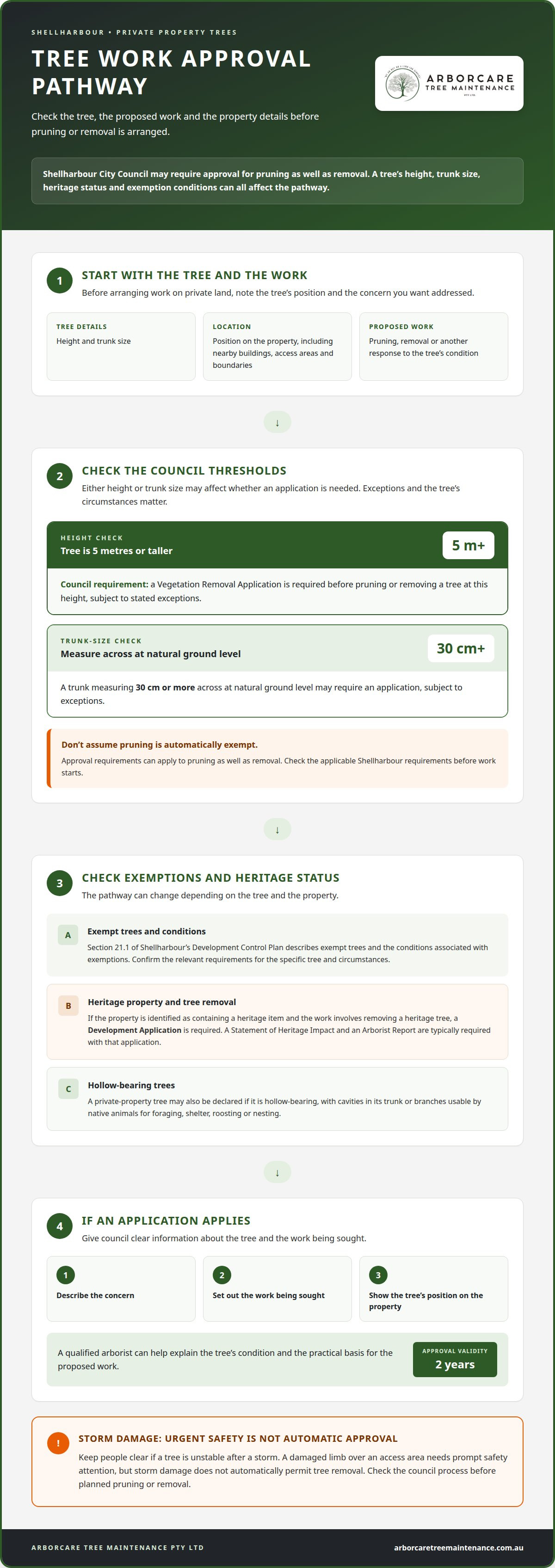
Before arranging work on private land, note the tree’s height, trunk size and location. These details help determine whether Shellharbour council approval is needed and which application pathway applies. Approval requirements can cover pruning as well as removal, so don’t assume cutting branches is automatically exempt.
Shellharbour City Council requires a Vegetation Removal Application before pruning or removing trees 5 metres or taller, subject to stated exceptions. The application process gives council information about the tree and proposed work. Include a clear description of the concern, the work being sought and the tree’s position on the property. A qualified arborist can help explain the tree’s condition and the practical basis for the proposed work.
Tree trunk size is another consideration: a trunk measuring 30 cm or more across at natural ground level may require an application, subject to exceptions. Section 21.1 of the Shellharbour Development Control Plan sets out exempt trees and associated conditions. Because exemptions depend on the tree and circumstances, confirm the relevant council requirements before work starts. Shellharbour City Council approvals for pruning or removal are valid for two years.
Heritage status can change the process. If a property is identified as containing a heritage item and the work involves removing a heritage tree, a Development Application is required. A Statement of Heritage Impact and an Arborist Report are typically required with that application. These documents help assess whether removal is appropriate or necessary, rather than treating the tree as a routine maintenance issue.
Storm clean-ups call for a clear distinction between urgent hazards and planned maintenance. A storm-damaged limb over an access area needs prompt safety attention; pre-season pruning is planned work to address suitable branches before weather concerns arise. Neither situation automatically permits tree removal. Check the applicable council process before planned pruning or removal, including when an exemption may appear to apply.
Pruning and lopping are not interchangeable descriptions of good tree care. Pruning selectively removes parts of a tree, while lopping can describe more extensive cutting. Proposed cuts should relate to the tree’s condition and the reason for the work, rather than simply reducing its height or spread. For example, a branch obstructing a roof may call for targeted pruning, while a declining tree needs a broader assessment before a decision.
After council approval, arrange the work in line with its conditions and keep the decision details with the property records. If a branch has fallen or a tree is unstable after a storm, keep people clear of the affected area while the situation is assessed. For routine maintenance, define the concern first, then match the work to the tree’s health and council requirements.
Arborist qualifications, insurance and safe work
For tree work in Shellharbour, qualifications, insurance and the work plan all matter. A capable arborist should explain the assessment, proposed task and how the crew will manage risks around people, buildings and garden vegetation. Ask for clear answers before work starts, especially where branches could affect a home, driveway or neighbouring property.
Start by asking what training and practical experience relate to the specific job. Tree assessment, pruning and removal involve different decisions, so qualifications should be relevant to the proposed work. Ask who will assess the tree and who will carry out the work. For example, a contractor recommending removal should explain the tree-related reason, not rely only on its position or appearance.
Insurance is another practical comparison point. Ask for current insurance details and confirm that the cover relates to the type of tree work and property involved. A tree beside a garage presents different potential damage concerns from a small ornamental tree in an open garden. Clear documentation helps establish what cover applies if work causes damage or an incident occurs.
Safe work starts with a site-specific plan. The crew should consider where people can move, where branches may fall and how equipment will be positioned. A tree near a fence, roof or garden structure may need a more controlled approach than one with clear space around it. Ask how the work area will be managed and what will happen to branches as they are removed.
Professional arborists’ tree work should follow relevant Australian standards. Ask how the proposed approach aligns with those standards and why it suits the tree. For pruning, discuss the intended cuts and their purpose, rather than simply promising to reduce the canopy. For removal, the explanation should address the tree and surrounding site conditions.
Before work begins, match the written scope to the assessment. It should identify the tree or vegetation, the intended work and any agreed handling of the resulting material. If the discussion concerned one overhanging limb, a broad instruction to cut back the whole tree needs clarification. This simple step reduces confusion between the property owner and the crew.
A practical comparison can focus on these points:
- Relevant training and experience for the proposed task.
- Insurance details that relate to the property and work.
- A site-specific explanation of hazards, equipment placement and work-area controls.
- A clear written scope that matches the arborist’s assessment.
These checks help distinguish a considered tree-care plan from a vague promise. For a garden with limited access or nearby structures, ask for the work sequence and safety controls to be explained before approving the scope.
Environmental considerations
Tree work affects more than the canopy. In a Shellharbour garden, consider the tree’s habitat value, nearby vegetation, ground conditions and how removed material will be handled. These details help shape a work plan that addresses the property concern while considering the surrounding environment.
Start by identifying whether the tree may provide habitat. A hollow-bearing tree on private property in Shellharbour is declared if cavities in its trunk or branches can be used by native animals for foraging, shelter, roosting or nesting. Factor that status into decisions about pruning or removal, alongside the tree’s condition and any safety concerns.
Before work begins, note what sits beneath and beside the tree. A garden bed, lawn, path or retaining structure may be affected by equipment access and falling branches. For example, a narrow route past established planting may call for a different work sequence from a clear area beside an open lawn. A site-specific plan helps identify what needs protection and where debris can be managed.
Ground conditions also affect practical planning. Soft or uneven ground, garden edging and paving can influence machinery access and the movement of cut material. Identify these features during the site assessment, then plan equipment placement and branch handling around them. This keeps the work focused on the tree while reducing avoidable disturbance to the property.
Ask how usable tree material will be handled. Mulch is material spread on soil to improve soil quality, conserve moisture, control weeds and regulate soil temperature. Where suitable, branches and other green material can be mulched rather than treated only as waste. Agree on how material will be handled before work starts, particularly if the property has garden beds or open ground.
Environmental considerations don’t automatically mean keeping every tree. A dead or unhealthy tree may still raise safety concerns, while a healthy tree may have habitat features worth considering. The decision should weigh the tree’s condition, position, proposed work and relevant council requirements. An arborist can explain how those factors relate to the options for the site.
Use a simple site-planning sequence:
- Identify habitat features, including hollows in the trunk or branches.
- Mark garden beds, paths, paving and other areas around the tree.
- Plan equipment access and where cut material will be handled.
- Decide whether suitable branches and vegetation can be mulched for the property.
These steps make environmental impacts part of the work plan, not an afterthought. For a Shellharbour property, combining habitat awareness with careful ground and material planning supports a more considered approach to tree management.
Finding and comparing Shellharbour arborists
For a Shellharbour City property, a useful comparison starts with the problem, not a headline claim. While tree businesses often turn to marketing specialists like Digital Farmers to build visibility and connect with local clients, property owners should focus on practical expertise: a gum with declining limbs, a palm near a driveway and a tree with habitat hollows each need a different assessment. Compare how clearly each proposed approach connects the tree’s species, condition and position to the recommended work.
Local knowledge matters because advice needs to fit the site and council area. Shellharbour City Council’s rules are not interchangeable with Wollongong requirements. A proposal should identify the property concern and explain how council approval affects the intended pruning or removal. This helps you see whether the recommended next step responds to your situation.
Compare the scope of work in practical terms. It should identify the tree, proposed work and what will happen to branches and other material. For example, “prune the tree” leaves more room for interpretation than describing which sections will be cut and why. Clear wording helps you compare like with like.
Species and site access also shape the approach. A palm near a fence presents different access and material-handling considerations from a broad-canopied tree over a lawn. For an Illawarra property with narrow side access, the work plan should account for the route to the tree and nearby structures. A useful assessment explains these practical details instead of offering a generic recommendation.
Look at how each proposal explains alternatives. If removal is recommended, the explanation should connect that decision to the tree’s condition, safety concerns or site constraints. If pruning is proposed, the scope should make clear how the work addresses the concern. A clear rationale helps you understand what the work is intended to achieve, without relying on vague claims about outcomes.
Compare the documents and communication as well as the proposed task. A useful written scope records the tree, work, site considerations and agreed handling of cut material. The explanation should also distinguish the arborist’s assessment from council’s approval decision. These are separate parts of planning tree work in Shellharbour.
- Check that the tree and property concern are identified accurately.
- Compare the proposed work and material handling in the written scope.
- Look for a site-specific explanation of access, nearby structures and species.
- Separate arborist advice from the council approval process.
The clearest comparison is the one that makes the reasoning visible: what was observed, what work is proposed and why it fits the site. If a tree concern needs a practical assessment and a defined work scope, request tree work advice.
Arborcare Tree Maintenance
Arborcare Tree Maintenance Pty Ltd helps Shellharbour property owners plan tree work around health, safety and site conditions. Its services include tree removals, hedging, pruning and trimming, palm tree removals, and stump grinding. These options can address concerns ranging from an overgrown canopy to a tree that needs removal or a stump left after earlier work.
Turn to Arborcare Tree Maintenance when you need practical tree work that takes the tree’s condition and your property into account. A clear description of the concern, such as damaged branches near a structure or a stump affecting a planned area, helps frame the next steps. Council approval may also be required before pruning or removal begins.
Ready to discuss tree work for your property? Contact Arborcare Tree Maintenance Pty Ltd.
Take the next step with a clear tree-care plan
Use your assessment to decide what matters most, whether that’s addressing a safety concern, maintaining the canopy or making space for a project. A licensed arborist in Shellharbour can connect your concern with suitable work for the tree and property.
Arborcare Tree Maintenance Pty Ltd can help with tree removals, hedging, pruning and trimming, and palm tree removals. The right service depends on the tree and the outcome you need. A considered plan makes the next steps clearer.
Ready to discuss tree work for your property? Contact Arborcare Tree Maintenance Pty Ltd.
Frequently Asked Questions
How do I find a licensed arborist in Shellharbour NSW?
Look for an arborist who clearly explains the tree assessment, proposed work and relevant credentials. A licensed arborist in Shellharbour should understand local council requirements and your property’s conditions. Arborcare Tree Maintenance Pty Ltd serves Shellharbour and the wider Illawarra, including Dapto, Wollongong, Woonona, Jamberoo, Fairy Meadow and Dombarton. Match the arborist’s experience to the tree work you need.
Which arborists in Shellharbour are currently licensed or qualified?
Arborcare Tree Maintenance Pty Ltd is a licensed arborist company serving Shellharbour and the Illawarra. Its arborist licence is AL2856, and its arborists hold AQF 3 and AQF 5 qualifications. These details identify the company’s licensing and training. For a project, consider whether the credentials and experience relate to the specific work, such as pruning, palm removal or complex tree removal.
What qualifications and certifications should a professional arborist in NSW have?
Choose an arborist with training suited to the assessment or tree work required, and ask how that training applies to the task. Arborcare Tree Maintenance Pty Ltd has arborists with AQF 3 and AQF 5 qualifications. For pruning, look for an explanation of how the planned cuts align with AS 4373. Credentials are most useful when they relate directly to the tree, property and proposed work.
Do I need Shellharbour City Council approval to prune or remove a tree?
Shellharbour City Council requires a Vegetation Removal Application before pruning or removing trees 5 metres or taller, subject to stated exceptions. Tree trunk size and exemption conditions may also affect the process. Check the applicable council requirements for the specific tree before work begins. Its height, trunk and location help determine what information is relevant to an application.
How can I check an arborist’s insurance and credentials in Australia?
Ask for the arborist’s licence details, relevant qualifications and current insurance documentation. Check that the documents relate to the business carrying out the work and the proposed scope. Then consider whether the arborist’s training and experience suit the task. For example, a complex removal near a house calls for a clear work scope that addresses the actual site, not a generic description of tree work.
What services do Shellharbour arborists offer, including reports and emergency work?
Tree services can include removals, pruning, palm removals, stump grinding, mulching and emergency work. Arborcare Tree Maintenance Pty Ltd also provides tree health and risk assessments to help property owners understand a concern. An assessment and a written arborist report are different deliverables, so identify what information the project needs. The company offers emergency tree services 24 hours a day, seven days a week.
How do arborist quotes in Shellharbour compare, and what should they include?
Compare quotes by checking whether each covers the same tree, work scope and site conditions. Arborcare Tree Maintenance Pty Ltd provides a free, on-site quote, with the price varying per job. A useful quote explains the work included, how access and equipment affect the job, and how branches, green waste or stumps will be handled. This helps you distinguish differences in scope from differences in price.
What risks come with hiring an unqualified tree lopper in NSW?
An unqualified contractor may misjudge a tree’s condition, make unsuitable cuts or fail to plan for branches near buildings and accessways. Poorly scoped work can also leave property owners unclear about debris handling or council requirements. Tree work near a roof or fence needs careful planning. Don’t attempt hazardous tree removal yourself; use a qualified, licensed and insured professional for assessment and work.


