
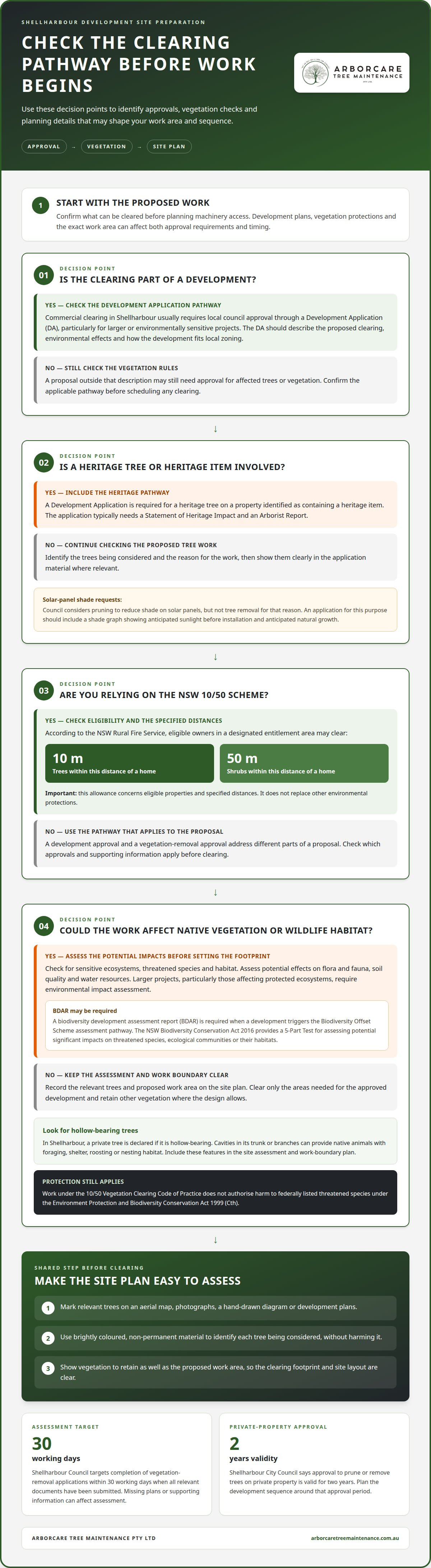
Getting machinery onto a development site isn’t the first step; confirming what can be cleared is. Land clearing for development in Shellharbour can require council approval, and protected vegetation or wildlife constraints may affect the work area and sequence. Vegetation-removal applications are targeted for completion within 30 working days when all relevant documents have been submitted. According to Shellharbour City Council, approvals to prune or remove trees on private property are valid for two years.
It’s understandable to expect site preparation to begin once a development is planned, but land clearing for development in Shellharbour must follow the applicable approval and vegetation rules. A clear site plan, identification of affected trees and a defined work area help show what is proposed.
This guide explains how approvals, vegetation protections and clearing requirements shape development site preparation in Shellharbour. It also covers practical planning for clearing and debris removal, so you can understand the steps to take before work begins and how careful preparation can help keep the project on track.
Key Takeaways
- Confirm the applicable approval pathway before clearing, as development plans and vegetation protections can shape the work area and timing.
- Under the NSW 10/50 scheme, eligible owners in a designated entitlement area may clear trees within 10 metres of a home and shrubs within 50 metres without council approval, according to the NSW Rural Fire Service.
- Identify trees and potential wildlife habitat early, then show relevant vegetation clearly on the site plan.
- Declared vegetation may need council approval before work begins, so understand which trees and proposed activities the local rules cover.
- Plan selective clearing, debris disposal and soil-stabilisation measures together to leave the site ready for its next development stage.
Development Applications and council approval
Development clearing must follow the approval pathway that applies to the land and proposed work. In Shellharbour, commercial clearing usually requires local council approval through a Development Application (DA), particularly for larger or environmentally sensitive projects. The DA should describe the proposed clearing, its environmental effects and how the development fits local zoning. This helps council assess the work as part of the development, rather than as a separate tree-removal request.
Prepare a site plan that identifies the trees relevant to the application. Applicants in Shellharbour can use an aerial map, photographs, a hand-drawn diagram or development plans with tree locations marked. Mark each tree being considered with brightly coloured, non-permanent material that won’t harm it. Clear identification links the proposed work to the site layout and supporting documents.
Shellharbour Council aims to complete vegetation-removal applications within 30 working days when all relevant documentation has been submitted. Missing plans or supporting information can affect the assessment process. If council approves pruning or removal on private property, Shellharbour City Council says the approval is valid for two years. Plan the development sequence around that approval period, especially where clearing depends on other project stages.
The reasons for proposed tree work matter. For example, Shellharbour Council considers pruning to reduce shade on solar panels, but not tree removal for that reason. An application for this purpose should include a shade graph showing anticipated sunlight before installation and anticipated natural growth. A Development Application is required for a heritage tree on a property identified as containing a heritage item. It typically needs a Statement of Heritage Impact and an Arborist Report. These documents explain the heritage and tree considerations behind the request.
One separate pathway has specific limits. Under the NSW 10/50 scheme, eligible owners in a designated entitlement area may clear trees within 10 metres of a home and shrubs within 50 metres without council approval, according to the NSW Rural Fire Service. This allowance concerns eligible properties and specified distances; it doesn’t replace other environmental protections. Check the correct pathway before scheduling clearing, because a development approval and a vegetation-removal approval address different parts of the proposal.
Shellharbour’s tree management framework also shapes how applications are considered. The proposed Tree Management Policy was adopted by Shellharbour City Council on 23 June 2025. For a development, align the tree locations, requested work and supporting reports across the application documents. A consistent submission gives council a clear account of which vegetation is affected and why the proposed work is needed.
Native vegetation and wildlife protection
Before clearing in Shellharbour, assess native vegetation and habitat for threatened species. Check the work area for sensitive ecosystems and endangered species, then assess potential effects on flora and fauna, soil quality and water resources. Larger projects, particularly those affecting protected ecosystems, require environmental impact assessment. The findings help define where clearing can proceed and which areas need protection.
A biodiversity development assessment report (BDAR) is required when a development triggers the Biodiversity Offset Scheme assessment pathway. The assessment considers whether the proposal is likely to significantly affect threatened species, ecological communities or their habitats. The NSW Biodiversity Conservation Act 2016 provides a 5-Part Test for assessing those potential significant impacts. Some rural land clearing also triggers Biodiversity Offset Scheme provisions under that Act.
Assess tree habitat before machinery enters the site. In Shellharbour, a private tree is declared if it is hollow-bearing, meaning cavities in its trunk or branches can support native animals for foraging, shelter, roosting or nesting. Such a tree can have habitat value beyond its canopy. Include these features in the site assessment and account for them when planning work boundaries.
Protect tree canopy by limiting the clearing footprint. Clear only the areas needed for the approved development and retain other vegetation where the design allows. For example, keeping vegetation beyond building and access areas can preserve existing habitat while avoiding unnecessary disturbance. Mark retention areas clearly on site plans so crews can distinguish vegetation to protect from trees designated for removal.
Federal protections also apply. Work carried out under the 10/50 Vegetation Clearing Code of Practice does not authorise harm to federally listed threatened species under the Environment Protection and Biodiversity Conservation Act 1999 (Cth). This means a vegetation-clearing allowance does not remove separate obligations relating to protected wildlife. Identify relevant habitat before work, especially where a tree cavity, native vegetation or a sensitive ecosystem occurs within the proposed footprint.
Environmental assessment should inform practical site controls and the clearing plan. Use the findings to stage work, define exclusion areas and keep machinery away from retained vegetation. Where protected flora or fauna occur, environmental experts can support compliance. For a Shellharbour development, documenting habitat features and the reasons for retaining canopy helps align site preparation with biodiversity protections and reduce avoidable disturbance.
Since colonisation, NSW has lost more than half its native forest and woodland, 29 million hectares. The proposed Redbank biomass project could encourage landholders to clear tens of thousands of hectares of native bushland for fuel.
Before clearing land in NSW, check for endangered species and sensitive ecosystems. Clear only the development areas and leave other vegetation intact.
Shellharbour vegetation removal rules
Shellharbour’s rules depend on the vegetation, land zoning and proposed activity. Identify the applicable controls before setting the clearing boundary or starting work.
Targeted vegetation clearing
Targeted clearing means limiting removal to vegetation that conflicts with the approved development footprint. Shellharbour DCP section 21.1 covers exempt trees and associated conditions, but exemption depends on those conditions being met. Trees classified as Declared Vegetation require a council permit before work. A private tree is declared if it is at least 5 metres tall, has a trunk diameter of 30 centimetres or more at natural ground level, or contains hollows used by native animals.
Tree preservation and significant tree controls
Shellharbour DCP Chapter 21 is titled “Preservation and removal of trees and vegetation”. Council consent is generally required to prune or remove trees on private land, subject to exemptions and other applicable rules. The controls allow more flexibility for work on a tree within 3 metres of an approved habitable dwelling, measured from the wall to the trunk centre, subject to exceptions. Check how each tree’s location and status affect the proposed removal.
Approvals for sensitive areas
Near wetlands, waterways, coastal areas or endangered ecological communities, identify the environmental constraints before clearing. In urban areas and environmental zones, vegetation clearing is regulated under the State Environmental Planning Policy (Vegetation in Non-Rural Areas) 2017 or through development assessment under the Environmental Planning and Assessment Act 1979 (NSW). Larger projects affecting protected ecosystems require environmental impact assessment. The assessment considers effects on flora, fauna, soil and water, helping define the relevant approvals and protection measures.
Unauthorised clearing penalties
There isn’t one penalty for every unauthorised clearing case in Shellharbour and NSW. The applicable law, vegetation type, land zoning and extent of clearing determine the consequences. Clearing without a required permit or outside an exemption can breach the relevant controls. Confirm the approval pathway and permitted work area before machinery starts, rather than relying on a neighbouring property’s previous approval.
Site controls also matter during removal. Use measures such as silt fences or cover crops to stabilise exposed soil and limit sediment movement. For bushfire-related clearing, the NSW 10/50 scheme applies only to eligible owners in a designated entitlement area: the NSW Rural Fire Service says they may clear trees within 10 metres of a home and shrubs within 50 metres without council approval. This doesn’t replace other applicable environmental protections.
Debris removal and site preparation
Clearing isn’t complete when trees and shrubs are down. The development site also needs a plan for vegetation, debris, access and exposed soil. Set the sequence before machinery arrives: identify what will be retained, what can be processed on site and what needs removal. This keeps the cleared footprint aligned with the development plan and helps avoid disturbing areas outside the work zone.
Separate material according to its intended destination. For example, suitable vegetation may be mulched for use on site, while larger timber and unsuitable debris need separate handling. Keep retained trees and marked exclusion areas clear of machinery and stockpiles. An organised layout reduces obstructions around access routes and helps crews stay within the approved clearing area.
Plan debris movement alongside site access. Confirm where machinery will enter, where cleared material can be temporarily placed and how removal vehicles can leave without crossing retained vegetation. A narrow access route beside a marked habitat area, for instance, may require a different sequence from an open building footprint. Keep temporary stockpiles out of drainage paths and away from protected areas.
- Retained vegetation: mark trees and areas that must remain before clearing starts.
- Reusable material: identify vegetation suitable for on-site mulching where the site plan allows it.
- Removed debris: organise collection and removal so material doesn’t obstruct access or later construction work.
- Exposed ground: plan stabilisation measures, such as silt fences or cover crops, to help limit soil movement.
Protect soil in line with the clearing sequence. After vegetation is removed, exposed ground can be more vulnerable to erosion, particularly where runoff may carry sediment towards a waterway or drainage line. Install planned controls before clearing creates broad bare areas. On complex infrastructure sites or steep embankments where vegetation has been cleared, civil works may also require heavy-duty revetment solutions, with teams consulting experienced rock pitching contractors Western Australia to stabilise critical drainage paths and batters. Keep controls in place as site preparation progresses and maintain them if later work disturbs soil or shifts their position.
Legislation and approval conditions can determine how cleared material is handled and which areas must remain untouched. Keep the site plan, clearing boundaries and material-handling approach consistent with the approved development documents. If the approved footprint changes, pause work in the affected area until the change has been addressed through the relevant process. A revised work area is not automatically covered by the original approval. Much like keeping site plans compliant with council standards, enterprises managing offshore ventures also require strict administrative accuracy; for European corporate structuring, engaging a commercialista italiano a Budapest contabilità aziendale ensures financial and regulatory obligations remain fully aligned.
Complete a handover check before the next construction stage. Confirm that planned debris has been removed or processed, access routes are usable, protected areas remain undisturbed and soil controls are effective. Shellharbour sites may also need ongoing attention to vegetation regrowth that could interfere with commercial development. Include follow-up maintenance in the site sequence so regrowth doesn’t obstruct access or planned work.
Land clearing for development
For a Shellharbour development, clearing should follow the approved footprint, not remove every tree on the lot. Align site access, vegetation retention, debris handling and soil controls with the construction plan. This gives each stage a defined work area and helps avoid disturbing land intended to remain untouched.
The planning pathway depends on the land’s zoning and proposed activity. In urban areas and environmental zones, clearing is regulated under the State Environmental Planning Policy (Vegetation in Non-Rural Areas) 2017 or through development assessment under the Environmental Planning and Assessment Act 1979 (NSW). Rural clearing has a different framework: the Local Land Services Act 2013 (NSW) allows clearing for allowable activities only when it doesn’t exceed the minimum extent necessary for the purpose.
Translate those requirements into a workable site sequence:
- Set the clearing boundary against the development layout and applicable approval.
- Separate vegetation marked for removal from retained canopy and habitat areas.
- Plan access and debris handling so machinery avoids protected areas.
- Stage clearing to limit exposed ground, then install planned erosion controls.
- Review the cleared area before the next construction activity begins.
For example, a building footprint may require vegetation removal, while a neighbouring strip can remain intact. Keeping that distinction visible on site helps crews work to the plan. It also supports selective clearing, rather than expanding the disturbed area simply because machinery is already present. The Local Land Services Act 2013 (NSW) makes minimum necessary extent a condition for allowable activities in its scope.
Site preparation continues after vegetation removal. Cleared material needs a planned destination, while exposed soil may need silt fences or cover crops to reduce erosion. Coordinate these measures with the clearing sequence and drainage paths. Ongoing maintenance can also manage regrowth that might interfere with commercial development. Include follow-up in the site program rather than treating initial clearing as the final task.
A sound plan connects approval conditions with the practical work: which areas are cleared, which remain, how debris is handled, and what controls protect the ground. This helps deliver a site ready for its next development stage without extending clearing beyond the project’s needs. Discuss development land clearing when the approved work area needs to be prepared.
Responsible land clearing means focusing removal on approved areas and planning where cleared material will go before work begins. This preserves the distinction between vegetation marked for removal and areas intended to remain. Erosion controls such as silt fences and cover crops can stabilise soil after vegetation removal. Coordinate them with the clearing sequence so exposed ground is addressed as work progresses.
Cleared NSW sites may need ongoing maintenance to manage regrowth that could interfere with commercial development. Include follow-up in site preparation, alongside plans for cleared material and soil stabilisation. Checking for regrowth as the site approaches its next development stage helps keep vegetation management aligned with the project without expanding the clearing area. Selective removal, responsible disposal, erosion controls and maintenance together support a considered site-preparation approach.
Arborcare Tree Maintenance: Land Clearing
Arborcare Tree Maintenance Pty Ltd provides land clearing for development sites across the Illawarra, including Shellharbour, Wollongong, Dapto, Woonona, Jamberoo, Fairy Meadow and Dombarton. The team can help prepare the defined work area when clearing involves trees, palms or vegetation that needs a considered approach.
Depending on the site and proposed scope, work may include land clearing, tree removals, palm tree removals, or hedging, pruning and trimming. Keeping the clearing boundary aligned with the development plan distinguishes vegetation intended for removal from areas to retain. Obtain relevant approvals and account for environmental constraints before work begins.
For a site where tree work forms part of a larger clearing task, discuss the required scope and site conditions with Arborcare Tree Maintenance Pty Ltd. Contact Arborcare Tree Maintenance Pty Ltd to discuss land clearing for your development.
Set your development site up for the next stage
Before work begins, align the proposed clearing area with your development plans and applicable approvals. This gives site preparation a clear starting point and keeps the work focused on the project’s needs. For land clearing for development in Shellharbour, start by defining the vegetation work required and how it fits the site.
Arborcare Tree Maintenance can assist with development land clearing, including related tree removals, palm tree removals, and hedging, pruning and trimming where needed. A defined scope helps connect vegetation work with the site’s preparation needs.
Contact Arborcare Tree Maintenance to discuss the land clearing required for your development. With a clear plan for the work area and next stage, you can move forward with greater confidence.
Frequently Asked Questions
What permits are required for land clearing for development in Shellharbour NSW?
The required approval depends on the land, proposed development and affected vegetation. A Development Application may cover clearing as part of a larger project, while declared vegetation on private land requires a council permit before work. Sensitive sites may also need environmental assessment or state-agency approvals. For example, a proposal affecting a heritage tree can require a Statement of Heritage Impact and an Arborist Report. Establish the applicable approval pathway before scheduling work.
Which Shellharbour LEP and DCP rules regulate vegetation clearing and development?
Shellharbour’s Development Control Plan (DCP) Chapter 21 addresses preservation and removal of trees and vegetation, including exempt-tree conditions in section 21.1. The applicable Local Environmental Plan (LEP) depends on the site: the relevant plans include the Shellharbour LEP 2013, Shellharbour LEP 2000 and Shellharbour Rural LEP 2004. Zoning and land context affect the development controls, so identify the property’s planning framework before finalising the clearing footprint.
What is the process and timeline for getting land-clearing approval in Shellharbour?
Start by identifying the trees and vegetation involved, then prepare the application with a site plan and supporting reports relevant to the proposal. Submit complete documentation through the applicable council or development-application pathway. Shellharbour Council aims to complete vegetation-removal applications within 30 working days when all relevant documents have been submitted. A development proposal may involve additional assessment, particularly where heritage or environmental impacts need consideration, so allow for the documents and approvals required for that site.


