Did you know that as of 2026, an individual in New South Wales can face fines as high as $1.1 million for unauthorised vegetation removal? It is a staggering figure that highlights just how serious the state government is about environmental compliance. If you are feeling overwhelmed by the conflicting rules between your local Council and State legislation, you aren't alone. Most property owners find the complex web of Local Environmental Plans and the Biodiversity Offsets Scheme incredibly stressful to navigate when planning residential land clearing NSW projects.
We understand that you want a build-ready lot that doesn't compromise your budget or your legal standing. This comprehensive guide simplifies the process, offering a clear path through the 2026 regulatory landscape. You will learn exactly how to determine if your property qualifies for the 10/50 Vegetation Clearing Code and how to identify which trees must be preserved to maintain your property's value. From initial site preparation to professional methods like stump grinding and mulching, we provide the expert framework you need to clear your land safely, legally, and efficiently.
Key Takeaways
- Identify the specific zoning and governing authorities for your lot to ensure you're following the correct approval pathway.
- Learn how to distinguish between protected native vegetation and general garden maintenance to avoid accidental legal breaches.
- Discover how modern forestry mulching can streamline your site preparation while significantly reducing your overall project costs.
- Follow a structured checklist to mark boundaries and protect high-value trees that must be retained for your development application.
- Understand why it's vital to verify AQF qualifications and insurance when hiring a specialist for residential land clearing NSW.
What is Residential Land Clearing in NSW?
Residential land clearing NSW is the strategic removal of trees, shrubs, and underbrush to prepare a specific lot for construction or safety improvements. Unlike large-scale agricultural operations, residential clearing is a precision task. It focuses on transforming a raw or overgrown block into a "build-ready" site. This status means the land is level, accessible, and compliant with all local environmental regulations, allowing builders to commence work without the threat of stop-work orders. Land clearing in Australia is heavily regulated, and the rules for urban blocks are often more stringent than those for rural properties.
It's vital to distinguish between general garden maintenance and clearing native vegetation. Mowing a lawn or trimming a hedge doesn't require a permit, but removing native trees or clearing undergrowth often does. Native vegetation includes any species of indigenous plants, including trees, shrubs, and even certain grasses. Because many of these species are protected under the Biodiversity Conservation Act 2016, a professional assessment is necessary before any machinery touches the ground. Identifying a protected species early can be the difference between a successful build and a legal nightmare.
Why Residential Properties Require Professional Clearing
Property owners typically require professional intervention for several critical reasons. We often see these requirements during the early planning stages of a development:
- Site Preparation: Clearing is the first step for new home builds, granny flats, or structural extensions. It ensures the footprint of the new building is free from roots and debris that could compromise the foundation.
- Asset Protection Zones (APZs): In bushfire-prone areas like the Illawarra, owners must create APZs. These are managed areas around a home designed to reduce the fire's fuel load and protect the structure.
- Hazard Mitigation: Removing invasive species or hazardous trees is essential for safety. Dead or unstable timber can threaten future structures and the people living within them.
As you prepare your site for construction, it is also the ideal time to consider long-term energy efficiency; to explore renewable power options available across Australia, visit G-Solar & Electrical.
The Legal Risks of "DIY" Clearing
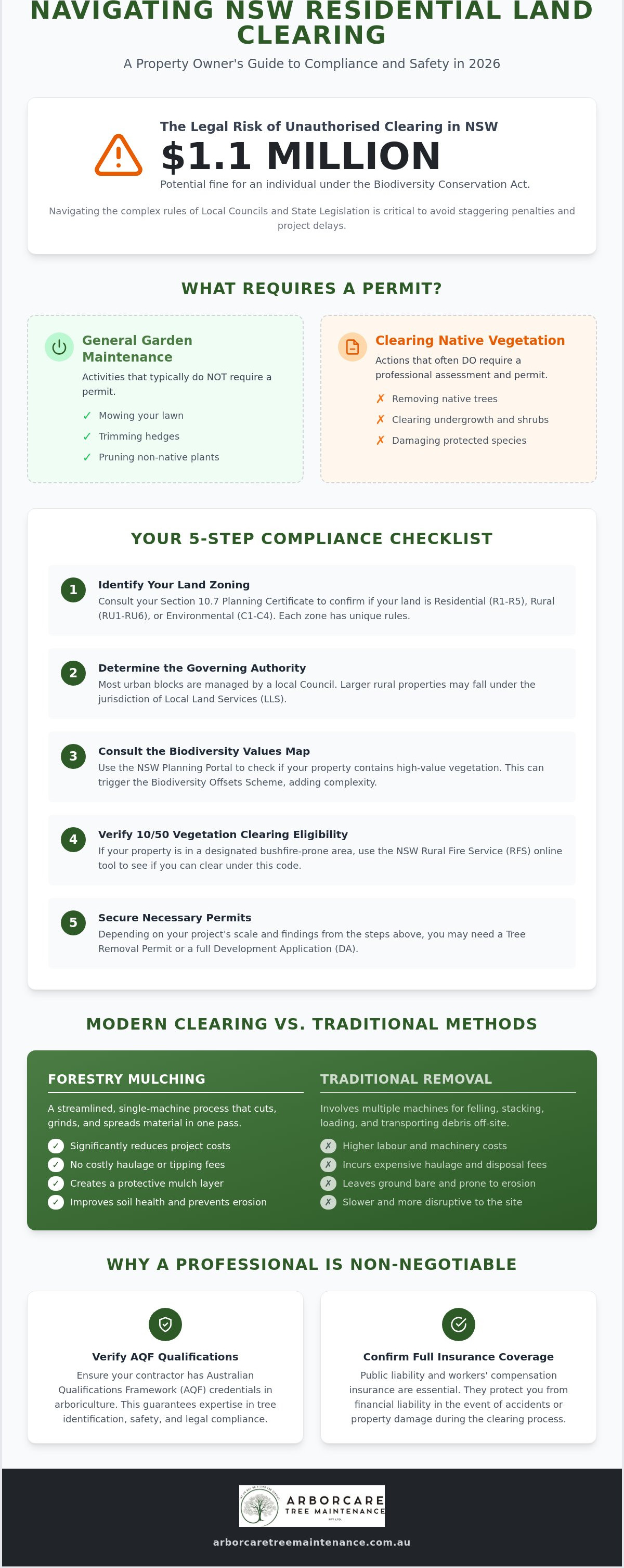
Taking a "do-it-yourself" approach to residential land clearing NSW is a high-risk gamble. The legal landscape is unforgiving. As of 2026, individuals can face fines as high as $1.1 million for unauthorised clearing under the Biodiversity Conservation Act. These aren't just empty threats; the Land and Environment Court frequently issues substantial penalties for non-compliance. An accidental removal of a single protected tree can stall a development for years while environmental audits are conducted. Investing in a professional arborist report during the planning phase provides a clear, legal roadmap. It ensures every tree removed is documented and every permit is secured, protecting both your bank account and your property's future value.
The NSW Land Clearing Regulatory Checklist
Before any machinery arrives on site, you must establish the legal framework governing your property. Zoning is the foundation of every residential land clearing NSW project. It determines whether your lot falls under urban, rural, or environmental protection categories. Each zone carries distinct restrictions and requires different approval pathways. To ensure your project remains compliant and avoids the risk of heavy penalties, follow this essential regulatory checklist:
- Identify your land zoning: Consult your Section 10.7 Planning Certificate to confirm if your land is zoned as Residential (R1–R5), Rural (RU1–RU6), or Environmental (C1–C4).
- Determine the governing authority: Most urban residential blocks are managed by local councils like Wollongong City Council or Shellharbour Council. Larger lifestyle blocks may fall under the jurisdiction of Local Land Services.
- Consult the Biodiversity Values Map: Check the NSW Planning Portal to see if your property contains high-value vegetation. If it does, clearing may trigger the Biodiversity Offsets Scheme.
- Verify 10/50 eligibility: Use the NSW Rural Fire Service online tool to see if your home is in a designated bushfire-prone area.
- Secure necessary permits: Depending on the scale and location, you might need a standalone Tree Removal Permit or a full Development Application (DA).
Council vs. State Government: Who Approves What?
In the Illawarra, local councils are the primary regulators for suburban residential clearing. They operate under Local Environmental Plans (LEPs) and Development Control Plans (DCPs) that specify which trees are protected based on height, girth, or species. However, the state government intervenes when clearing exceeds certain thresholds or impacts critical habitats. Navigating NSW rural land clearing laws is particularly important for property owners on the urban-rural fringe, where Local Land Services may oversee vegetation management rather than your local council. If your project is deemed "State Significant," the Department of Planning and Environment will take the lead.
The 10/50 Rule: Bushfire Safety in the Illawarra
The 10/50 Vegetation Clearing Scheme was designed to protect lives and property in high-risk bushfire zones. It allows owners to clear trees within 10 metres of a home and smaller vegetation within 50 metres without a formal permit. While this sounds straightforward, it isn't a "clear everything" card. The rule doesn't override protections for Aboriginal heritage, nor does it allow for the removal of certain threatened species. Using this scheme incorrectly can still result in legal action. For residents unsure of their property's status, consulting with a qualified arborist can prevent legal complications and ensure your safety measures are fully compliant with current 2026 standards.
Preparing Your Site: A Homeowner’s Pre-Clearing Checklist
Once you have secured your permits and understand the legal framework, the focus shifts to the physical environment. Moving from the planning office to the property requires a disciplined approach to site safety and logistics. Effective residential land clearing NSW requires a clear site plan that accounts for both the vegetation being removed and the infrastructure staying behind. Rushing this stage often leads to avoidable damage or project delays.
To ensure a smooth operation, follow these essential preparation steps:
- Verify boundaries: Engage a professional surveyor to peg out property boundaries accurately. Relying on old fences or guesswork often leads to costly boundary disputes or the accidental clearing of a neighbour's land.
- Flag the "keepers": Use high-visibility tape or specialised tree paint to flag every tree that must be retained. These trees are often legally protected by your DA, and their survival is vital for your final occupancy certificate.
- Organise machinery access: Trucks, mulchers, and stump grinders require a clear path at least 3 to 4 metres wide. Ensure the entry point is stable and free from low-hanging branches that could snag equipment.
- Consult with neighbours: A simple conversation about your timeline and expected noise levels maintains community relations. It also allows them to secure pets or move vehicles that might be affected by dust.
Utility Identification and Safety
Safety is the primary concern when heavy machinery enters a residential lot. Before any ground is broken, you must lodge a "Before You Dig Australia" enquiry to identify the location of underground water, gas, and telecommunications lines. In many established parts of the Illawarra, older blocks may still rely on septic tanks or absorption trenches. These are frequently omitted from official maps. You must locate and mark these manually to prevent heavy machinery from crushing the infrastructure. Additionally, always look up. Maintaining safe distances from overhead powerlines is a non-negotiable safety protocol. If you are unsure about the state-level requirements for vegetation management near urban infrastructure, consult the NSW Government regulations on tree clearing for detailed guidance.
Protecting the "Keepers"
Protecting trees marked for retention is just as important as removing the ones you don't want. Install sturdy temporary fencing around the drip line of these trees to prevent accidental bark damage or limb breakage from machinery. Soil compaction is a silent killer; heavy equipment driving over root zones can starve a tree of oxygen and water, leading to its death months after your build is finished. A qualified arborist identifies a Tree Protection Zone (TPZ) by calculating a specific radius around the trunk based on the tree's diameter at breast height, ensuring the long-term health of the specimen according to Australian Standard AS 4970-2009.
Professional Clearing Methods: Forestry Mulching vs. Traditional Removal
Choosing the right methodology for residential land clearing NSW is a decision that impacts both your project timeline and your bottom line. Traditionally, site preparation involved a "push and burn" or "haul away" approach. This method requires heavy excavators to uproot vegetation, followed by the logistical nightmare of transporting tonnes of green waste to landfill. In 2026, these traditional methods are increasingly viewed as inefficient due to rising tipping fees and the risk of soil erosion. Modern property owners now favour more surgical, high-tech solutions that treat vegetation as an asset rather than a waste product.
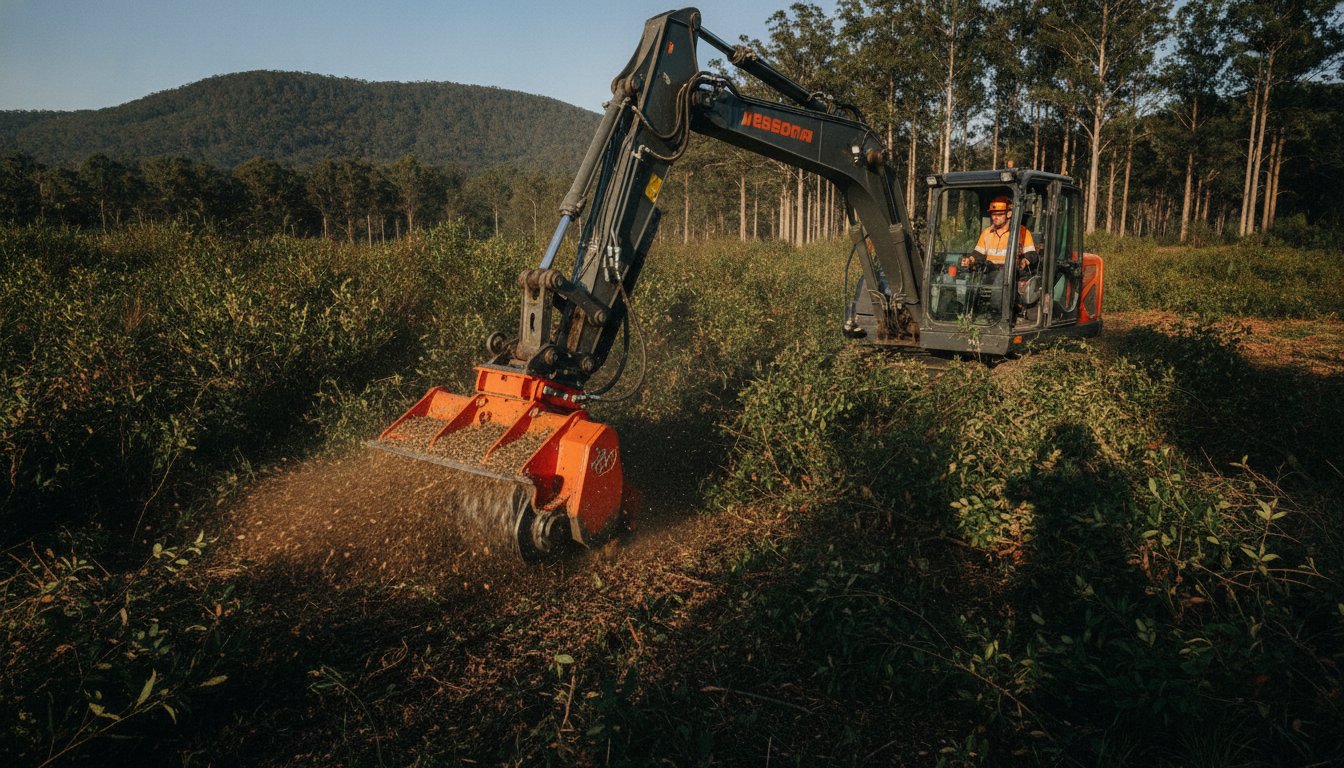
Forestry mulching has emerged as the gold standard for residential lots. Instead of multiple machines, a single specialised unit cuts, thins, and grinds vegetation into a fine mulch in one pass. This process eliminates the need for burning or hauling, which can significantly reduce your overall site preparation costs. By keeping the biomass on-site, you create an immediate barrier against weeds and moisture loss. This is particularly beneficial for sloped blocks where exposed soil is prone to washing away during the heavy rain events common to the coast.
Stump grinding is the final, essential step in creating a level, build-ready surface. While some contractors might suggest simply cutting trees flush to the ground, leaving stumps behind is a recipe for future structural failure. Decaying wood under a building pad can lead to soil subsidence or attract termites to your new home's doorstep. Deep root management ensures the ground is stable and ready for the first pour of concrete.
The Advantages of Forestry Mulching
One of the primary benefits of this method is minimal soil disturbance. Traditional clearing often strips the topsoil, leaving the land scarred and nutrient-poor. In contrast, mulching services Wollongong provide an instant return of organic matter to the earth. This layer of wood chips protects the soil structure from the weight of building machinery and provides a clean, stable surface for surveyors and tradespeople to navigate. It's a faster, cleaner way to prepare a lot while maintaining the ecological integrity of the site.
Stump Grinding and Root Management
Precision is vital when managing a building pad. Effective land clearing Illawarra must include deep stump grinding to ensure no organic material is left to rot beneath your foundation. While surface grinding might suffice for a backyard lawn, a construction site requires the removal of the root ball to prevent future sinkholes. Ensuring your lot is properly prepared from the ground up is the best way to protect your long-term investment. If you are ready to transform your block into a safe, buildable site, contact our team for professional land clearing services today.
Choosing a Local NSW Professional for Your Clearing Project
The selection of a contractor for residential land clearing NSW represents a critical safety and financial decision. It is not merely about removing vegetation; it is about managing risk on your property. A professional team must possess more than just machinery; they require the technical education to operate within the strict legal frameworks established by New South Wales authorities. Hiring an uncertified operator can lead to property damage, legal liability, and the compromise of protected environmental zones.
Before signing a contract, you must verify the following professional credentials:
- AQF Qualifications: Ensure the lead arborist holds an Australian Qualifications Framework (AQF) Level 3 for operational work or Level 5 for complex reporting and site management.
- Insurance Coverage: Verify current public liability and professional indemnity insurance. These policies protect you against accidental damage to infrastructure or neighbouring properties.
- Local Expertise: A contractor should demonstrate a clear history of working with Wollongong City Council or Shellharbour Council. They must understand the specific permit requirements and Local Environmental Plans (LEPs) unique to the Illawarra.
- Specialised Fleet: Residential blocks often present narrow access points. Look for a professional who utilises specialised equipment, such as compact forestry mulchers and stump grinders, designed for tight urban environments.
The Arborcare Difference in the Illawarra
Arborcare Tree Maintenance operates with a commitment to safety and strict compliance with the latest 2026 NSW environmental standards. We understand that residential projects require a higher level of precision than broad-acre clearing. Our team utilises advanced equipment suited for both standard blocks and complex tree removals where space is a premium. By combining technical authority with a local, community-focused approach, we ensure your land is prepared efficiently while preserving the long-term health of your property. For more detailed information on managing specific specimens, consult our tree removal Wollongong guide.
Next Steps: Getting Your Quote
Obtaining an accurate quote for residential land clearing NSW requires a thorough assessment of your site's unique hazards and requirements. To streamline the process, prepare a package that includes recent site photos, your current permit status, and your final development plans. While over-the-phone estimates provide a baseline, a physical site visit is essential. This allows our arborists to identify underground utilities, assess soil stability, and determine the most cost-effective clearing method for your specific lot. When you are ready to move forward with a build-ready site, Contact Arborcare Tree Maintenance for a professional land clearing quote to ensure your project begins on a safe and compliant foundation.
Secure Your Build-Ready Site Today
Successful residential land clearing NSW is a precise operation that balances environmental compliance with technical site engineering. You now have the framework to navigate local council regulations, prepare your lot for heavy machinery, and select the most cost-effective clearing methods. By prioritising the protection of retained trees and ensuring all stumps are professionally managed, you safeguard your property's value and the integrity of your future home. It's about moving from a raw block to a stable, build-ready foundation without the risk of legal delays or safety hazards.
As a local Illawarra family owned and operated business, we provide the technical authority and safety-conscious expertise your project demands. Our team consists of licensed NSW arborists who are fully insured for both residential and commercial work. We understand the specific environmental needs of our community and are equipped with the specialised machinery required for narrow-access residential lots. Take the first step toward a safe and compliant property development by choosing a partner that understands the local landscape. Book a Professional Site Assessment with Arborcare to ensure your project begins on solid ground. We look forward to helping you prepare your site for a successful build.
Frequently Asked Questions
Do I need a permit to clear native vegetation on my residential lot in NSW?
Yes, you generally require a permit from your local council or the state government to clear native vegetation. Exemptions are rare and typically involve minor maintenance or specific bushfire safety codes. You must consult your local Council's Development Control Plan (DCP) to see which species are protected before starting any residential land clearing NSW project.
What is the 10/50 vegetation clearing rule and does it apply to me?
The 10/50 rule is a bushfire safety scheme that allows property owners in designated zones to clear trees within 10 metres of their home and other vegetation within 50 metres without a permit. You must verify your eligibility through the NSW Rural Fire Service online mapping tool. It's vital to remember this rule doesn't override protections for Aboriginal heritage or critical habitats.
How much does residential land clearing cost in the Illawarra?
The cost of clearing land in the Illawarra depends on the size of the lot, the density of the vegetation, and the accessibility for heavy machinery. Factors such as the need for stump grinding or the removal of complex, large trees will also influence the final figure. Because every site has unique hazards and requirements, a professional site visit is the only way to get an accurate estimate.
Can I clear my land myself if I own the property?
While you own the land, performing the clearing yourself is often dangerous and legally risky. Professional land clearing requires specialised machinery and an understanding of Australian Standards for tree protection. Attempting to remove large trees without AQF-qualified arborists can lead to serious injury, property damage, and the risk of voiding your insurance policy.
What happens if I clear land without a permit in NSW?
Clearing land without a permit can result in fines of up to $1.1 million for individuals under the Biodiversity Conservation Act 2016. Beyond financial penalties, the Land and Environment Court can issue remediation orders, forcing you to replant the area. This process often stalls building developments for years, significantly increasing your project's holding costs.
How long does the residential land clearing process take?
The timeframe for clearing depends on the approval process and the physical scope of the work. Council permit applications can take several weeks or months to process. Once approvals are in place, the physical clearing of a standard residential block usually takes between one and three days, depending on the density of the timber.
What is forestry mulching and is it suitable for small residential blocks?
Forestry mulching is a modern clearing method that uses a single machine to cut and grind vegetation into mulch on-site. It's highly suitable for small residential blocks because it eliminates the need for large trucks to haul away green waste. This method is efficient and leaves a stable, nutrient-rich layer of mulch that prevents soil erosion.
Will land clearing affect my future building application (DA)?
Unauthorised residential land clearing NSW will negatively impact your Development Application (DA) and may lead to its immediate rejection. Councils often require an arborist report as part of the DA process to ensure significant trees are preserved. Following the correct legal pathway ensures your lot reaches build-ready status without attracting stop-work orders from the authorities.


