
Imagine the next Illawarra East Coast Low is battering your roof at midnight, and every heavy gust makes you look toward that towering gum tree with genuine fear. For many residents, the thought of booking a tree inspection Wollongong wide only happens when a branch is already touching the gutters. It's a stressful position to be in, especially when you're caught between the fear of falling limbs and the confusion of council permit requirements. You want your home to be a safe haven, but the complex rules in Chapter E17 of the Development Control Plan can make even basic maintenance feel like a legal minefield.
Professional tree assessments replace this uncertainty with technical authority and local expertise. This guide provides a clear roadmap for protecting your property, ensuring you understand when a $114 permit is required and how to identify hazards before they turn into costly storm damage. We will explore the vital signs of tree health, the specifics of council compliance for trees over five metres, and how to organise a maintenance plan that meets Australian standards. You'll gain the confidence to manage your land safely while avoiding the risk of significant fines for non-compliance.
Key Takeaways
- Understand the difference between a casual glance and a qualified arborist’s assessment to ensure your property remains genuinely safe.
- Learn how a professional tree inspection Wollongong wide identifies structural defects like "widow-makers" before they become emergency hazards.
- Navigate Wollongong City Council regulations with ease, including when you can prune without a permit and when formal approval is mandatory.
- Identify critical warning signs such as trunk decay and overhanging limbs that require immediate intervention to prevent storm damage.
- Discover why professional pruning is essential for long-term tree health compared to the structural risks associated with lopping.
What is a Professional Tree Inspection and Why Does it Matter?
A professional tree inspection Wollongong wide is a technical audit of a tree's biological health and structural integrity. It's far more than a casual glance from the ground or a quick "look-over" by a general gardener. A qualified arborist performs a systematic tree risk assessment to identify issues that aren't visible to the untrained eye, such as internal fungal decay, hollows, or root plate instability. In our coastal environment, regular assessments are a necessary safety measure rather than an optional luxury. Detecting a structural flaw early allows for targeted maintenance, which is significantly more cost-effective than dealing with a fallen tree and property repairs after a storm.
Expert inspections focus on three core pillars:
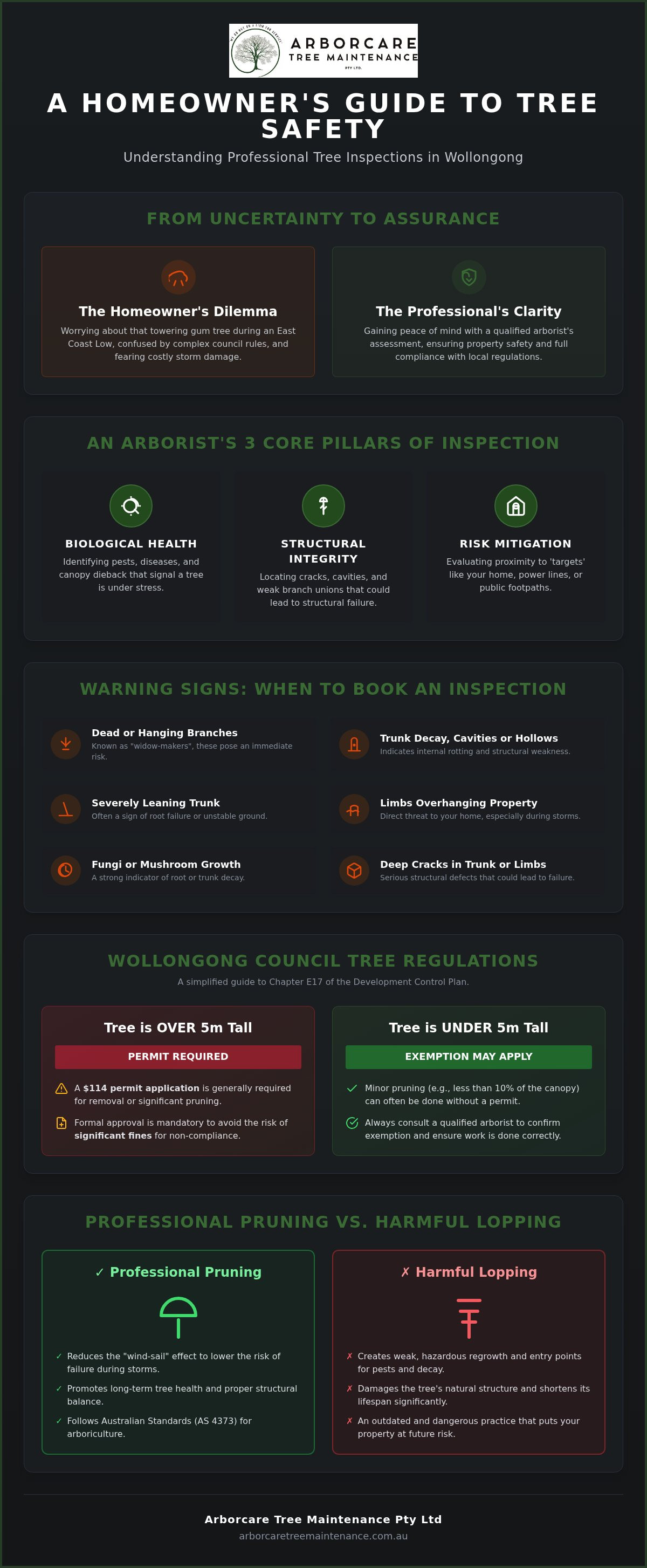
- Biological Health: Identifying pests, diseases, and canopy dieback that signal a tree is under stress.
- Structural Integrity: Locating cracks, cavities, and included bark in branch unions that could lead to failure.
- Risk Mitigation: Evaluating the tree's proximity to "targets" like your home, power lines, or public footpaths.
The Role of a Licensed Arborist in the Illawarra
Engaging an arborist who is licensed and insured provides you with critical legal protection. If a contractor lacks proper Public Liability insurance, the homeowner could be held liable for injuries or property damage occurring during the work. We follow the Australian Qualifications Framework (AQF) standards, ensuring every tree inspection Wollongong homeowners receive is grounded in modern arboricultural science. Local knowledge is also vital. Wollongong features a diverse range of species, from robust Turpentines to various Eucalypts, and an expert understands how these trees interact with local soil types and salt-heavy air.
Protecting Your Home from Storm Damage
Illawarra suburbs like Woonona and Fairy Meadow often bear the brunt of East Coast Lows. These weather systems produce fierce winds that can trigger the "wind-sail" effect in large, dense canopies. When a tree's canopy is too thick, it acts like a sail in the wind, transferring massive force to the trunk and roots. This pressure frequently leads to limb failure or total uprooting if the tree hasn't been properly maintained. Preventative pruning is the strategic thinning and shaping of a tree's canopy to reduce wind resistance and improve structural balance, significantly lowering the risk of failure during severe weather events.
Types of Tree Assessments: From Visual Checks to Detailed Reports
A professional tree inspection Wollongong property owners book isn't a one-size-fits-all service. The depth of an assessment depends on the specific goals of the landholder, whether you're concerned about a leaning gum tree or planning a home extension. By categorising these assessments, we ensure the right level of technical detail is applied to your specific situation, balancing property safety with regulatory requirements.
Visual Tree Assessment (VTA) is the baseline industry standard. It involves a systematic external examination to identify defects. Beyond just looking, arborists often conduct health audits to check for nutritional deficiencies or pest infestations that might be compromising the tree’s vitality. For property owners undergoing renovations, development reports provide the essential documentation required by council to protect significant vegetation during construction and ensure the site remains safe for workers.
Visual Tree Assessment (VTA) Explained
The VTA follows a logical three-step progression. We start at the root zone, looking for soil heaving or severed roots. We then move up the trunk to check for cavities and finish with a canopy analysis to spot deadwood. Arborists use specialised tools, such as sounding hammers to detect internal hollows or probes to check for soft wood, to provide a complete picture of structural integrity. This thorough process is often the vital first step before recommending tree removal Wollongong residents might otherwise have avoided or delayed. Identifying "body language" in a tree, like specific bulges or cracks, allows us to predict potential failures before they occur.
When Do You Need a Formal Arborist Report?
A verbal quote or a basic maintenance check is different from a formal arborist report. You typically need written documentation for insurance claims, legal disputes, or Wollongong City Council permit applications. These reports utilise the methodologies supported by Arboriculture Australia to quantify the likelihood of a tree failure. Having a formal report is particularly critical during complex tree removal Illawarra projects, as it provides a clear safety justification for high-risk work near houses or power lines. When you require a formal tree inspection Wollongong based experts provide, you'll receive a document that details specific hazards and mitigation strategies. If you're unsure which level of documentation your property requires, reaching out for a professional consultation can clarify your legal and safety obligations.
Navigating Wollongong City Council Tree Regulations
Wollongong City Council manages local vegetation through Chapter E17 of the Wollongong Development Control Plan (WDCP). This regulation preserves the city’s urban canopy while allowing for the management of genuine risks to life and property. For many homeowners, the trigger for a tree inspection Wollongong wide is discovering that a permit is required for any tree exceeding five metres in height or possessing a trunk diameter greater than 30cm at ground level. Pruning also falls under these rules; you generally need council approval to cut branches larger than 10cm in diameter.
While these rules are strict, there are specific exemptions. Certain species, often considered invasive or unsuitable for residential blocks, can be removed without a permit. However, misidentifying a species can lead to significant fines of $3,000 for individuals or $6,000 for corporations. A qualified arborist acts as your technical guide, ensuring you don't breach the Environmental Planning and Assessment Act 1979. We assist in the permit application process, which typically takes approximately 28 working days to be processed by council. Note that for most approved removals, council now mandates that a replacement tree be planted on the property to maintain the local ecosystem.
The 10/50 Vegetation Clearing Code
The 10/50 rule is a NSW Rural Fire Service (RFS) initiative that allows residents in designated "entitled areas" to clear certain vegetation to reduce bushfire risk. You can use the RFS online tool to check if your property qualifies. If you're eligible, you may be able to remove trees within 10 metres of your home without a council permit. Even if the law allows removal, a professional assessment is vital. Removing a large tree can change the wind loading on your house or impact soil stability, so an expert's advice ensures the clearing doesn't create new structural hazards for your home.
Regional Variations and Heritage Trees
Rules change as you move across the Illawarra. If your property is in Shellharbour or Kiama, you'll need to consult their specific Development Control Plans, which often have different height or species thresholds. Suburbs like Jamberoo or central Wollongong may also have "significant tree" registers or heritage overlays that provide extra protection to historic specimens. For larger projects involving extensive site preparation, our land clearing Illawarra guide offers a deeper look at the regulations surrounding major vegetation removal. Identifying these constraints early during a tree inspection Wollongong prevents legal delays and ensures your property maintenance remains fully compliant with NSW legislation.
Warning Signs: When to Book a Tree Inspection in Wollongong
Identifying early indicators of instability can prevent catastrophic property damage during the next storm cycle. While some trees appear healthy from a distance, a closer tree inspection Wollongong homeowners perform often reveals hidden structural flaws. Visible decay or large cavities in the main trunk are clear signals that the tree's structural capacity is compromised. Fungal growth, specifically mushrooms appearing around the base or on the trunk, suggests that internal wood-decay fungi are active, which can hollow out a tree from the inside. If you notice cracks in the soil or heaving ground near the root plate, it indicates that the tree is no longer securely anchored. A sudden lean that wasn’t there previously is a critical warning sign of imminent failure.
Property owners should regularly check for these specific hazards:
- Deadwood: Large, brittle branches (the "widow-makers") that can fall without warning.
- Trunk Cavities: Deep holes or soft, punky wood that weakens the main support.
- Fruiting Bodies: Fungi or conks growing on the bark or root flare.
- Soil Changes: Ground lifting on the side opposite a lean.
Crown and Canopy Health
The canopy acts as the tree's engine room. "Dieback," where the top of the tree or the ends of branches start to lose leaves and turn brittle, often signals root distress or disease. Yellowing or thinning foliage out of season is another indicator that the tree isn't receiving adequate nutrients or water. You should also look for epicormic growth; these are small, vigorous shoots that sprout directly from the trunk or main limbs. While they look like new life, they are actually a stress response, showing the tree is struggling to survive and is desperately trying to produce more foliage to compensate for a failing canopy.
Root System and Trunk Integrity
Roots are often the most neglected part of the tree because they are out of sight. Construction projects, such as installing new driveways or trenching for pipes, can sever critical root zones and lead to instability years later. On the trunk, look for "included bark" in V-shaped unions. This occurs when two stems grow so close together that bark is trapped between them, preventing a strong physical connection and creating a natural split point. If you suspect a tree is a hazard, it's vital to act before an emergency tree service Illawarra is required. If any of these signs are present, you should book a professional assessment to secure your property's safety.
Professional Solutions: From Inspection to Maintenance
Once the diagnostic phase of a tree inspection Wollongong homeowners trust is complete, we move into the implementation of professional solutions. A technical assessment identifies the specific needs of each specimen, allowing us to transition from identifying risks to resolving them through targeted action. This methodical approach ensures that every intervention, whether it is a subtle trim or a full removal, is justified by the tree’s health and the safety requirements of your property. We act as a protective guide, ensuring that high-risk tasks are performed with the precision required to protect your home and assets.
One of the most critical distinctions in our industry is the difference between professional pruning and "lopping." While lopping involves the indiscriminate cutting of branches to stubs, professional pruning follows the Australian Standard AS4373-2007. Lopping often triggers a stress response in the tree, leading to rapid, weakly attached regrowth that becomes a significant hazard in the future. In contrast, professional pruning and trimming manage the tree's structure and health, ensuring long-term stability. For trees that have already reached the end of their safe life, we utilise advanced rigging and removal techniques to dismantle them safely, even in tight residential spaces near buildings or power lines.
Pruning, Hedging, and Maintenance
Regular maintenance extends the life of your trees and keeps your garden looking its best. Our team provides professional hedging and trimming for Illawarra estates, ensuring that your boundaries remain neat and healthy. We prioritise clean, professional cuts. This is vital because jagged or improper cuts leave the tree vulnerable to fungal infections and decay. By establishing a routine maintenance programme, you can manage the growth of your trees and palms, preventing them from encroaching on structures and reducing the debris that clogs your gutters during the storm season.
The Final Step: Stump Grinding and Mulching
The job isn't finished once the tree is down. Leaving a stump behind can create a trip hazard and, more importantly, attract pests like termites that may eventually move toward your home. Our professional stump grinding service removes the remaining wood below ground level, allowing you to reclaim your yard for new plantings or lawn. We also offer mulching as a sustainable way to process tree waste. By converting the removed limbs into high-quality mulch, you provide your garden with a protective layer that retains moisture and suppresses weeds. For a deeper look at how to clear your site effectively, refer to our stump grinding Wollongong guide. Taking these final steps ensures your property is left clean, safe, and ready for future use.
Secure Your Property with Expert Tree Care
Proactive property management is the most effective way to ensure your home remains safe during the Illawarra's unpredictable storm seasons. By booking a professional tree inspection Wollongong residents trust, you move from reacting to emergencies to preventing them entirely. You now understand that navigating council compliance and identifying early warning signs like trunk decay or root heaving can save you from both heavy legal penalties and significant property damage. Professional maintenance is a disciplined approach to risk mitigation that protects your family and your long-term investment.
Arborcare Tree Maintenance is your locally owned Dapto specialist. Our team consists of fully insured and licensed arborists dedicated to providing the technical authority and reassurance you need. We provide 24/7 emergency response across the Illawarra, ensuring help is available when you need it most. Don't wait for the next East Coast Low to test the structural integrity of your canopy. Book Your Professional Tree Inspection with Arborcare Today and gain peace of mind knowing your trees are in expert hands.
Frequently Asked Questions
Do I need a council permit for a tree inspection in Wollongong?
You don't need a permit to have an arborist inspect your trees. A tree inspection Wollongong residents book is a diagnostic service used to identify health and safety risks. You only require a Wollongong City Council permit if the inspection reveals that pruning or removal is necessary for a tree over five metres in height. Starting with an inspection ensures you have the technical evidence required for any subsequent permit application.
How much does a professional tree inspection cost?
Industry data suggests a basic visual tree inspection typically costs between $60 and $150. If you require a formal arborist report for a development application or insurance claim, the cost generally ranges from $350 to $600 for a single tree. Hourly consultation rates for qualified arborists in Australia often fall between $100 and $250. These fees cover the expert’s technical knowledge and the specialised tools used to assess internal trunk integrity.
Can I remove a dead tree without council permission?
You generally still need a permit for dead or dying trees if they meet the height or diameter thresholds. Wollongong City Council may offer a streamlined process for trees that pose an immediate risk to life or property, but you must provide evidence of the tree's condition. It's vital to consult the exempt species list first, as some invasive trees can be removed without any formal council intervention or permit application fees.
What is the 3-metre rule for trees in Wollongong?
The 3-metre rule allows property owners to prune branches that are within 3 metres of a residential building without a permit. This exemption specifically applies to branches overhanging the roofline to prevent property damage and gutter blockages. While a permit isn't required for this specific maintenance, all work must still comply with Australian Standard AS4373-2007. Pruning more than 10 percent of the canopy or branches further from the house still requires council approval.
How often should I have the trees on my property inspected?
We recommend a professional assessment every 12 to 24 months for large, mature trees. You should also book a tree inspection Wollongong wide after significant weather events, such as an East Coast Low or severe windstorm. Regular inspections allow for the early detection of structural cracks, fungal growth, and root instability. Catching these issues early often means you can save the tree through targeted pruning rather than having to pay for a full removal.
Does Wollongong Council provide free tree inspections for residents?
Wollongong City Council does not provide free inspections for trees located on private land. The responsibility for maintaining private vegetation rests entirely with the property owner. Council arborists only inspect trees situated on public land, such as nature strips, parks, and reserves. If you are concerned about a council-owned tree near your boundary, you can lodge a request for them to inspect it, but private trees require a private arborist.
What happens if a tree on my property falls on a neighbour’s house?
Liability often depends on whether the tree was foreseeably dangerous. If an inspection would have revealed the tree was hazardous and you failed to maintain it, you could be held responsible for damages. Maintaining a record of regular professional assessments provides a legal paper trail. It proves you acted as a responsible owner by taking reasonable steps to manage the safety of your vegetation, which is critical for insurance claims and neighbour disputes.
How do I know if my tree is protected by a Heritage Order?
You can determine if a tree is protected by checking the Wollongong Local Environmental Plan (LEP) or the State Heritage Register. Trees may be protected if they are part of a Heritage Conservation Area or listed as a Significant Tree. These protections often apply to older suburbs and can override standard exemptions. A qualified arborist can help you identify these constraints during an inspection to ensure you don't accidentally breach heritage legislation.


