

That massive gum tree in your front yard isn't actually "pushing" your house over; it's likely just very thirsty. In the Illawarra, foundation damage is often a result of roots drinking the moisture out of reactive clay rather than direct physical pressure. When homeowners encounter tree root problems foundation Illawarra residents often assume the worst, fearing that a single tree might lead to massive underpinning bills. You've probably noticed hairline cracks in the brickwork or a door that suddenly sticks, and the confusion over whether to remove the tree or install a root barrier can be overwhelming.
We're here to provide a professional, steady hand. This guide will help you confirm if your greenery is truly the cause of the damage and show you how to protect your home's structural integrity. We'll explore the specific environmental needs of our region, navigate the permit requirements for councils like Wollongong and Shellharbour, and explain the most practical ways to manage root systems. You'll learn how to identify high-risk species and understand when a professional intervention is the most cost-effective path to long-term property safety. By following a methodical approach to land management, you can alleviate the stress of potential hazards and ensure your home remains secure for years to come.
Key Takeaways
- Learn how reactive clay soils across our region contribute to tree root problems foundation Illawarra homeowners face and why moisture depletion is the primary cause of damage.
- Identify the critical early warning signs of structural movement, including internal sticking doors and specific diagonal cracking patterns in external masonry.
- Discover which common Illawarra tree species pose the highest risk to residential footings and how to calculate a safer planting distance for your garden.
- Explore effective management strategies like root barriers that can protect your home's integrity without the immediate need for total tree removal.
- Understand the importance of professional arborist reports for securing council permits and ensuring complex removals are handled with technical precision.
Understanding Tree Root Problems and Foundation Damage in the Illawarra
Many homeowners assume a tree is physically pushing their house over. In reality, the relationship between vegetation and architecture is far more subtle. Tree roots are biological sensors designed to find water. When they encounter the stable, moist environment beneath a concrete slab, they congregate there. This interaction is the primary driver of tree root problems foundation Illawarra locals experience, especially as our climate cycles between heavy rain and intense dry spells. The tree isn't always the sole culprit; it's often the catalyst for wider soil movement that the house wasn't designed to handle.
The Role of Reactive Clay Soils in Wollongong and Dapto
The Illawarra landscape, stretching from the sandstone escarpment down to the coastal plains of Dapto and Wollongong, is heavily defined by reactive clay. These soils behave like a sponge. They expand significantly when saturated during our high-rainfall periods and shrink as they dry out during hot NSW summers. This constant "heave" and "settlement" puts immense pressure on concrete footings. Because the soil profile varies so much from the hills to the coast, the way a house reacts to a nearby tree can change from one street to the next.
We see these issues frequently in newer housing estates. In these developments, the soil often hasn't reached a moisture equilibrium after the initial land clearing and levelling. When a fast-growing tree is planted too close to a new slab, it accelerates the drying process in that specific patch of clay. This uneven shrinkage causes the foundation to settle at different rates. The resulting structural stress manifests as cracks, indicating that the ground is no longer providing uniform support.
Direct vs. Indirect Root Damage
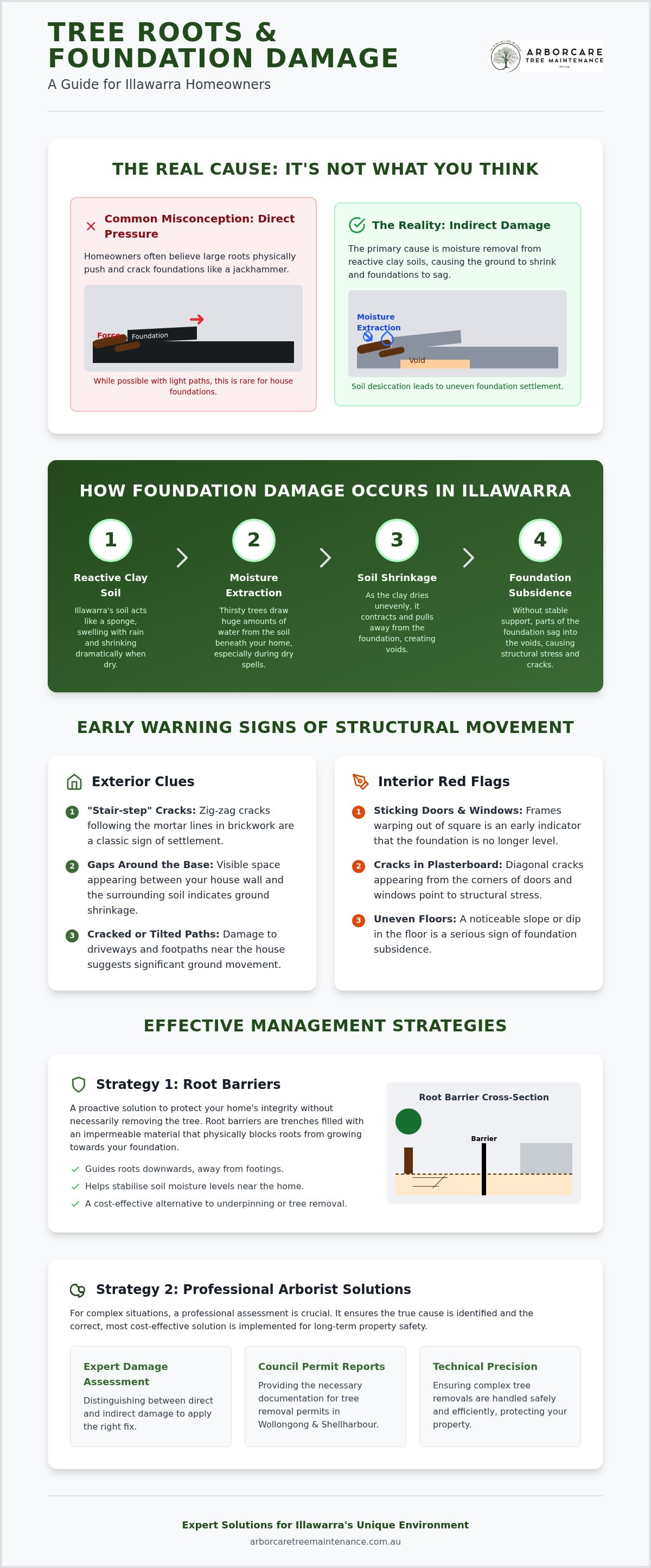
It's a common misconception that roots act like jackhammers, physically prying concrete apart. While tree root systems can occasionally lift light structures like garden paths or old garage floors, this "direct damage" is relatively rare for modern house foundations. Thickening roots require a pre-existing gap or a very shallow footing to exert enough upward force to cause a break.
"Indirect damage" is the more frequent threat in our local area. This occurs through moisture extraction, also known as soil desiccation. As a tree transpires, it draws vast amounts of water from the surrounding clay. This causes the soil to contract and pull away from the concrete footings. Without the consistent support of the earth, the foundation begins to sag into the newly created voids. A professional arborist assessment is essential to distinguish between these two types of damage. Identifying whether the root is physically encroaching or if the tree's water consumption is the primary cause ensures you don't invest in a resolution that fails to address the underlying environmental issue.
Recognising the Early Warning Signs of Structural Movement
Early detection is the most effective way to prevent minor settling from becoming a major structural failure. When dealing with potential tree root problems foundation Illawarra residents often notice subtle changes before a major crack appears. These signs typically follow a seasonal rhythm. You might see evidence of movement during a dry Australian summer, only for the issues to seemingly vanish after a period of heavy coastal rain. This cyclical nature confirms that the soil moisture levels are fluctuating, often due to the high water demand of nearby vegetation.
Exterior Clues: Brickwork and Footpaths
The most visible indicator of foundation stress is the "stair-step" crack. This pattern follows the mortar lines between bricks, zig-zagging up or down the wall. It's a clear sign that one part of the footing is sinking faster than the rest. You should also inspect the perimeter of your home for gaps appearing between the house wall and the soil. If the earth is pulling away, it indicates significant desiccation. While many tree root problems are hidden underground, they frequently cause visible lifting or cracking in adjacent footpaths and driveways. If a heavy concrete path is tilting toward your house, it may be redirecting water toward your foundations, worsening the soil stability issues.
Interior Red Flags: Doors, Windows, and Cornices
Internal signs often appear before external masonry cracks become obvious. Doors that suddenly jam or rub against the frame during the hotter months are a classic symptom of soil shrinkage. As a tree extracts moisture from the clay, the house sags, pulling door and window frames out of square. You might also notice new gaps appearing in cornices or where the wall meets the ceiling. In older Illawarra bungalows with timber floors, you can perform a basic "golf ball test." Place a ball on a hard floor surface; if it consistently rolls toward the same external wall where a large tree is located, your floor levels have likely shifted. Monitoring these changes with a simple pencil mark at the end of a crack can help you determine if the movement is active. If you notice these red flags, requesting a professional assessment is the most reliable way to determine if a tree is the primary cause.
Common Illawarra Trees Linked to Foundation Issues
Selecting the right species for your garden is a critical step in long-term property maintenance. In our region, the risk of tree root problems foundation Illawarra homeowners face often stems from a mismatch between a tree's mature size and its proximity to the dwelling. A standard rule of thumb is the "safe distance" rule; a tree should ideally be planted at a distance from the foundation equal to its full mature height. If a species grows to 15 metres, it requires a 15-metre buffer to minimise the risk of soil desiccation near the slab. Even smaller ornamental trees can cause significant issues if their root architecture is particularly aggressive or if they're positioned directly over drainage lines.
Large Natives: Eucalypts and Figs
The Illawarra is home to magnificent specimens like the Moreton Bay Fig and various Eucalypt species. While these trees are vital to our local canopy, they possess expansive root systems designed to anchor massive weights and seek out distant water sources. Eucalypts are experts at surviving dry NSW summers by aggressively hunting for moisture beneath concrete slabs, where evaporation is minimal. This leads to the soil shrinkage and settlement issues that compromise structural integrity. It's important to remember that many of these large natives are protected under local council Development Control Plans. This means that even if they're causing structural concern, you'll likely need a formal arborist report to justify any significant pruning or removal work.
Invasive Garden Species and Palms
Older suburbs in Wollongong often feature introduced species like Liquidambars and Plane trees. These are notorious for their vigorous, opportunistic roots that can easily exploit small fissures in older footings. We also see many issues with the Illawarra Flame Tree when it's planted too close to residential structures; despite being a local icon, its root system can be surprisingly intrusive in reactive clay environments.
Palms present a different set of challenges. While they don't have the lateral reach of a Fig, they produce a very dense, fibrous root ball. This mass can put significant pressure on PVC pipes and sewer lines, leading to leaks that further destabilise the surrounding soil. If you're concerned about a specific specimen, our Palm Tree Removal Illawarra guide offers deeper insights into managing these common features. Whether it's a native giant or an ornamental shrub, understanding the biological habits of your trees is the first step in protecting your home's foundation.
Effective Management Strategies and Root Barriers
Identifying a risk doesn't always mandate immediate tree removal. Many non-invasive management strategies exist to protect your home's footings while preserving the local canopy. Successfully addressing tree root problems foundation Illawarra residents encounter involves a combination of physical intervention and environmental control. These methods aim to isolate the foundation from the root zone or stabilise the moisture levels within the reactive clay. Taking action early can often prevent the need for more drastic structural repairs later.
Installing Physical Root Barriers
Physical barriers provide a vertical shield between the tree and your home. We typically utilise high-density polyethylene (HDPE) or reinforced concrete for these installations. HDPE is a popular choice due to its chemical resistance and flexibility. To be effective, the barrier must be installed at a depth that accounts for the specific species and soil profile; otherwise, roots will simply grow underneath the shield. Professional installation is vital because excavating a trench too close to a mature tree can sever structural roots. This doesn't just compromise the tree's health. It can also turn a stable specimen into a significant safety hazard during a storm. Depth is key. A shallow barrier is often useless against the persistent growth of a Moreton Bay Fig or a large Eucalypt.
Pruning and Moisture Control
The volume of water a tree extracts is directly related to its canopy size. Reducing the leaf area through strategic pruning can lower the tree's overall water demand. This reduction helps maintain higher moisture levels in the soil near your foundation during dry spells. You should consult our professional tree pruning services to ensure any canopy work complies with Australian Standards and doesn't stress the tree. A balanced crown is a safer crown.
Consistent moisture management is equally important. In the Illawarra, using soaker hoses to provide a slow, steady supply of water to the clay around your slab can prevent the extreme shrinkage that leads to subsidence. However, you must never attempt to fix the problem by lopping roots yourself. Severing large roots without professional guidance can lead to tree instability and potential property damage. If you're unsure which management strategy fits your property, contact our licensed arborists for a technical site assessment. We focus on providing a steady, reliable resolution that keeps both your home and your landscape safe.
Professional Arborist Solutions for Illawarra Properties
When management strategies are no longer viable or a tree is deemed a high-risk liability, professional intervention becomes the necessary course of action. Resolving the tree root problems foundation Illawarra residents face requires more than just felling a tree; it demands a disciplined approach that prioritises the safety of the remaining structure. A qualified arborist provides the technical authority needed to determine if removal is the only way to stop ongoing structural movement. This transition from monitoring to action must be handled methodically to ensure that the removal process itself doesn't create new hazards for the property.
Safe Removal and Stump Grinding
Removing the visible portion of a tree is only the first stage of a professional resolution. If you leave a stump behind, many resilient species will continue to sprout or maintain active root systems that fluctuate moisture levels in the reactive clay. Decaying stumps also create a significant bio-hazard by attracting termites, which pose a secondary threat to your home's timber frame. We specialise in stump grinding in Wollongong to ensure that root growth is stopped permanently and the land is reclaimed.
For effective foundation protection, grinding must penetrate deep enough to sever the primary lateral roots. This process allows the soil to return to a moisture equilibrium over time. Our team utilises specialised, low-impact equipment designed to operate in tight residential spaces. This allows us to remove stumps located directly adjacent to concrete slabs without causing the heavy vibrations that might worsen existing masonry cracks. Reclaiming this space is essential for homeowners looking to implement long-term drainage improvements or root barriers.
Navigating Local Council Permits
Homeowners in our region cannot simply remove a significant tree because they suspect it's causing foundation damage. Wollongong and Shellharbour City Councils enforce strict Tree Preservation Orders (TPO) that govern the pruning and removal of most species. A formal arborist report is almost always the first requirement for a permit application when structural damage is cited as the reason for removal. This report provides the objective evidence council officers require to approve an application, documenting the specific link between the tree's biological activity and the property's structural failure.
Engaging a licensed and insured team is a critical safety protocol for complex tree removals near residential footings. At Arborcare Tree Maintenance Pty Ltd, we act as a protective guide through this entire process. We understand the specific environmental needs of the Illawarra and provide the high-level expertise required for high-risk tasks. Our methodical approach ensures that every removal is compliant, safe, and focused on the long-term protection of your home.
Securing Your Home’s Structural Future
Protecting your property requires a methodical understanding of how local vegetation interacts with our unique coastal soils. We've explored how reactive clay and moisture extraction drive the tree root problems foundation Illawarra homeowners face; confirming that proactive management is always more effective than reactive repairs. By identifying early warning signs and understanding the biology of high-risk species, you can make informed decisions about your landscape before structural movement becomes a critical hazard.
Arborcare Tree Maintenance Pty Ltd has served Dapto, Wollongong, and Shellharbour for over a decade. As fully licensed and insured arborists, we specialise in stump grinding and complex removals near residential structures. We follow strict safety protocols and industry standards to ensure every task is completed with technical precision. Our team provides the professional intervention needed to navigate council regulations and protect your investment. We act as a protective guide, helping you resolve high-risk property maintenance tasks with confidence and steady expertise.
Get a Professional Tree & Foundation Assessment from Arborcare Tree Maintenance Pty Ltd to secure your home's structural integrity today. Taking the right professional steps now ensures your home and garden can thrive together in safety.
Frequently Asked Questions
Can tree roots really grow through solid concrete foundations?
Roots generally do not grow through solid, intact concrete. They are opportunistic and will follow moisture into pre-existing hairline cracks or expansion joints. Once inside, the root thickens and exerts pressure, which can widen the gap. While direct penetration is rare, the moisture extraction around the slab is the real threat to foundation stability in our region's reactive clay soils.
How far should a tree be from my house to avoid foundation problems?
A safe distance is typically equal to the tree's mature height. If a Eucalypt grows to 20 metres, it should ideally be 20 metres from the dwelling. In tighter residential blocks across the Illawarra, this isn't always possible. In these cases, selecting species with non-invasive root systems or installing physical barriers is the professional resolution to mitigate risks to your footings.
Will removing a tree fix the cracks in my walls?
Removing a tree will not automatically fix existing cracks in your walls. Taking the tree out stops the active moisture extraction, which allows the soil to return to a moisture equilibrium. Once the ground has stabilised, you'll still need a builder or engineer to address the structural damage. We don't guarantee that tree removal heals masonry, but it does remove the primary catalyst for further movement.
Does Wollongong Council allow tree removal if it is damaging my house?
Wollongong City Council permits tree removal if the tree is proven to be causing significant structural damage. You'll need to submit a permit application, which often requires an arborist report as technical evidence. The council balances the preservation of the urban forest with property safety. We assist homeowners by providing the necessary documentation to justify removal when tree root problems foundation Illawarra issues are verified.
What is a root barrier, and do they actually work?
A root barrier is a vertical shield made of high-density polyethylene or concrete installed between the tree and the foundation. They are highly effective when installed to the correct depth, usually at least 600mm to 900mm. These barriers redirect root growth away from the slab. Professional installation is essential to ensure the barrier is continuous and doesn't compromise the structural stability of the tree itself.
Can I just cut the roots myself to save the house?
You should never attempt to cut major structural roots yourself. Severing large roots can lead to tree instability, creating a significant fall hazard during high winds or storms. It can also cause the tree to go into shock and die, which may lead to rapid soil moisture changes that worsen foundation cracking. Professional arborists use specialised tools to prune roots safely without compromising the tree's health or safety.
How do I know if the cracks are from roots or just "house settling"?
House settling is often uniform, while root-related damage is typically localised near the tree and fluctuates with the seasons. If cracks widen significantly during a dry Illawarra summer and slightly close after heavy rain, it suggests moisture extraction by roots is the cause. A professional assessment is the only way to confirm if tree root problems foundation Illawarra residents observe are due to vegetation or other geological factors.
Why is stump grinding necessary after removing a problem tree?
Stump grinding is a critical final step because it ensures the root system is permanently deactivated. If a stump is left in the ground, many species will continue to draw moisture from the soil or send up new shoots. Additionally, decaying stumps are a primary attractant for termites in our region. Grinding the stump below the surface allows the soil to stabilise and removes the risk of ongoing structural interference.


