
A gardener may be the right choice for routine garden maintenance, but trees that need assessment, pruning or removal call for arborist expertise. In Australia, formal arborist qualifications aren’t legally required for every type of tree work, so hiring a certified arborist versus a gardener depends on the task, its risks and the skills required. Certification demonstrates tree-care knowledge, but it doesn’t guarantee the quality of someone’s work.
It’s understandable to think a gardener who already looks after your property can handle every tree as well. The difference matters when branches are large, close to buildings or powerlines, or when a tree’s health and structure need careful attention. This guide explains what arborists do, how their training and insurance compare with gardeners and landscapers, and which jobs suit each role. You’ll also learn when council rules may affect tree work, so you can make a safer, more informed decision for your property.
Key Takeaways
- Match the job to the right expertise: gardeners suit routine garden care, while complex or hazardous tree work calls for specialist tree knowledge.
- Arborist training covers tree health, diagnosis and safe work practices, but certification alone doesn’t guarantee the quality of a job.
- Before tree work begins, understand how insurance, worker protection and responsibility for potential damage affect your property.
- Local council rules can affect whether a tree may be pruned or removed, depending on factors such as its size, species and protection status.
- For tree removal, pruning, palm removal or stump grinding in the Illawarra, Arborcare Tree Maintenance Pty Ltd can help with the work your property needs.
Should I Hire a Certified Arborist for My Tree Removal Needs?
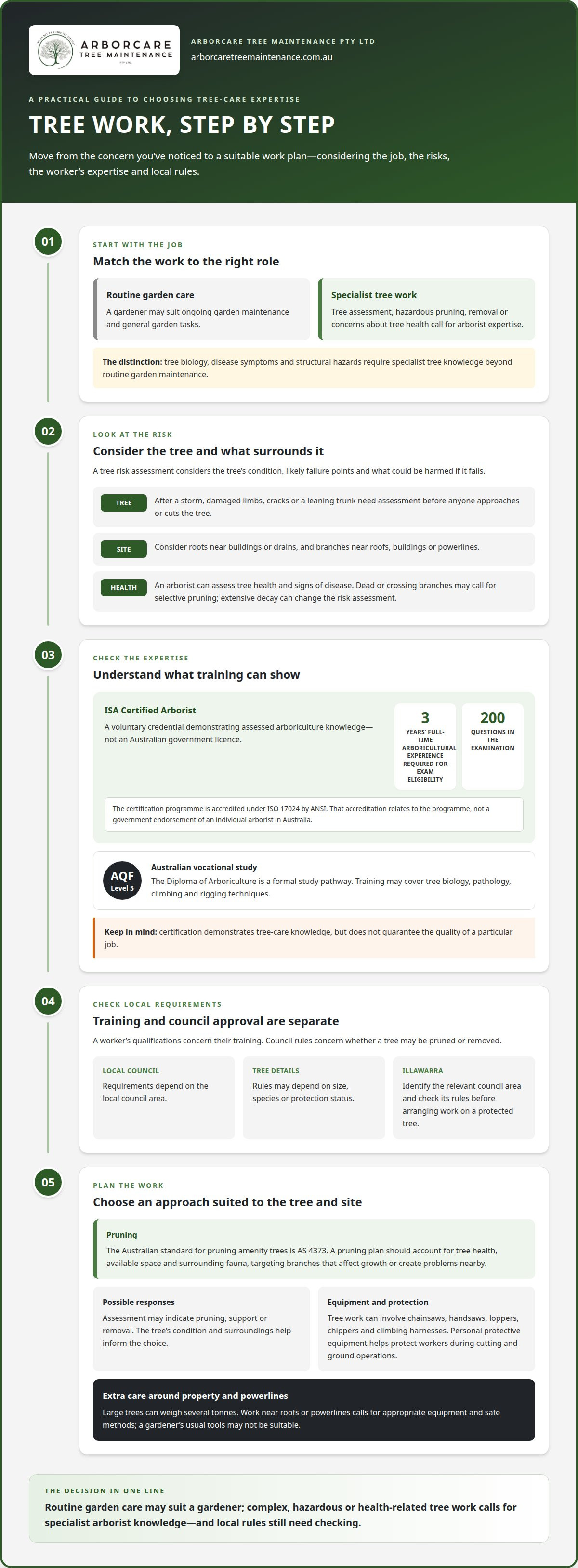
Choose a qualified arborist for tree removal, hazardous pruning or concerns about a tree’s health. Arborists combine tree-care knowledge with techniques and equipment suited to working in and around trees.
The choice between hiring a certified arborist and a gardener depends on the task. Gardeners are suited to routine garden care; tree biology, disease symptoms and structural hazards call for specialist assessment.
Tree risk, roots and damage
Tree risk assessment considers a tree’s condition, likely failure points and what could be harmed if it fails. After a storm, an arborist can assess damaged limbs, cracks or a leaning trunk before anyone approaches or cuts the tree.
Roots can affect nearby buildings or drains, while branches may threaten roofs and other structures. An assessment considers the tree and its surroundings, helping determine whether pruning, support or removal is appropriate.
Tree care starts with understanding how a tree grows and responds to damage. An arborist can assess its health, identify signs of disease and recommend suitable care. For example, dead or crossing branches may need selective pruning, while extensive decay can change the risk assessment.
Pruning should account for the tree’s health, available space and surrounding fauna. The Australian standard for pruning amenity trees is AS 4373. Poor cuts or excessive wood removal can leave wounds that contribute to decay or disease. A correct pruning plan targets branches that affect growth or create problems nearby, rather than removing foliage without regard to the tree’s structure.
Tree removal and pruning involve tools such as chainsaws, handsaws, loppers, chippers and climbing harnesses. Personal protective equipment helps protect workers during cutting and ground operations. Large trees can weigh several tonnes, so work near roofs or powerlines requires appropriate equipment and safe methods. A gardener’s usual tools may not be suitable.
Licensing and council approval
Tree-work qualifications and council approval are separate issues: one concerns a worker’s training, while the other concerns whether a tree may be altered or removed. In Australia, formal arborist qualifications aren’t legally required for every type of tree work.
Whether council approval is needed depends on the local council and the tree’s size, species or protection status. In the Illawarra, identify the relevant council area and check its rules before arranging work on a protected tree.
Certification demonstrates tree-care knowledge through experience and examination, but it cannot guarantee quality work. For a hazardous tree, storm damage or pruning that could affect buildings, a qualified arborist brings relevant assessment skills and specialist techniques that routine garden maintenance doesn’t require.
ISA Certified Arborist training and qualifications
ISA Certified Arborist certification is a voluntary credential, not an Australian government licence. It demonstrates assessed arboriculture knowledge, while vocational qualifications and practical experience provide other evidence of training. These pathways help explain what a specialist may know before undertaking complex tree work.
To qualify for the ISA exam, candidates need at least three years of full-time arboricultural work experience. The examination contains 200 questions covering tree-care knowledge. Passing it demonstrates knowledge through experience and examination, but certification doesn’t guarantee the quality of a particular job or measure standards of practice.
The certification is accredited under ISO 17024 by ANSI. That accreditation relates to the certification programme, not a government endorsement of an individual arborist in Australia. ISA certification is voluntary and isn’t government-sponsored or government-endorsed, so it shouldn’t be mistaken for a legal requirement to perform every type of tree work.
Australian vocational training offers a different route. Formal study can include the Diploma of Arboriculture at AQF Level 5. Qualified arborists may receive vocational training in tree biology, pathology, climbing and rigging techniques. Those subjects connect classroom learning with practical work, from understanding how a tree responds to pruning to planning safe access at height.
Training matters because tree work involves more than operating a chainsaw. Tree biology helps an arborist understand growth and structure; pathology supports the identification of disease symptoms. Climbing and rigging techniques help workers manage access and equipment around a tree. These skills are relevant when branches sit over a roof or removal could damage property.
ISA-certified arborists must continue their education to maintain certification and adhere to a Code of Ethics. Ongoing learning helps keep their knowledge current as tree-care techniques and practices develop. Certification must be renewed periodically, so it represents a continuing commitment rather than a qualification earned once and held indefinitely.
For a homeowner, the practical distinction is the kind of expertise the job needs. Planting a small tree or maintaining a garden bed differs from assessing a mature tree’s structure or planning complex work at height. A trained, qualified specialist brings arboriculture knowledge to those decisions. That can help reduce avoidable mistakes, such as unsuitable pruning that harms a tree or creates property problems.
Insurance, workers’ compensation, and liability
Tree-work insurance matters because falling limbs, equipment and work near buildings can expose people and property to harm. Tree removal work ranks as the sixth deadliest occupation in Australia.
An unqualified person may prune incorrectly, damage property or injure themselves or someone nearby. Poorly maintained trees can also create liability concerns for property owners.
Insurance for workers and the public
Workers’ compensation and liability insurance address different risks: worker injury and claims involving injury or property damage. Their relevance depends on who performs the work and what the job involves.
Before work begins, understand whether insurance covers tree work, the workers involved, and potential damage to property or injury to others. A policy for general gardening may not cover elevated tree work, so the activity and work height matter. Coverage details clarify what protection is in place if a limb damages a roof or equipment injures someone.
Insurance doesn’t replace safe work practices. A crew working near a house needs to plan where cut limbs will fall and how equipment will be used. If a branch lands on a fence or a worker is hurt during removal, the relevant policy and its terms affect how a claim is handled.
Ask for insurance details relevant to the planned work, including public liability and workers’ compensation. Match the stated cover to the job’s scope: pruning over a driveway differs from removing a tree beside a home. This helps establish whether the work and its potential risks are covered.
Accountability and hiring risks
Professional accountability means taking responsibility for the agreed work, its method and its effects on the property. It matters because unsafe pruning can injure people, damage structures or leave a tree vulnerable to decay.
A person without suitable training or equipment may misjudge a branch’s weight, cut position or fall path. That can put workers and bystanders at risk or damage property. Certification alone doesn’t guarantee performance, so consider relevant experience, insurance and a clear written scope.
Tree work can also affect a tree’s future growth. Removing excessive wood or making poor cuts may cause decay or disease, while an unstable tree left partly cut can create further hazards. A qualified arborist can assess the tree and choose suitable techniques for its condition and surroundings.
Before work starts, make sure the scope identifies the tree or branches involved, the intended work and the cleanup arrangements. These details establish what the worker is expected to do. Insurance and a clear scope support accountability, but they don’t replace competent tree care and safe work methods.
Arborists compared with gardeners and landscapers
Roles in tree and garden care
A gardener commonly maintains lawns, plants flowers and small shrubs, weeds beds, spreads mulch and trims small hedges. These tasks keep garden areas tidy without requiring specialist tree work. An arborist focuses on individual trees, including their structure, condition and care needs. That distinction matters when a job involves a mature tree, substantial branches or work above ground level.
Landscapers and gardeners may have skills suited to particular property projects, while arborists bring specialist tree knowledge. For example, a garden redesign may involve planting and arranging garden beds; pruning a mature tree calls for decisions about its form and growth. A tree’s structural branches shouldn’t be treated like a hedge that needs an even outline. Meanwhile, for those fascinated by intentional branch shaping on a miniature scale, specialist cultivators like mori-bonsai.com show how similar pruning principles are adapted to nurture and train container-grown trees.
Choose by task, not job title alone. Routine weeding or lawn maintenance fits garden care. A tree with branches interfering with a nearby building needs an assessment focused on the tree and its surroundings. Climbing, rigging or cutting large limbs calls for relevant tree-work training, safe techniques and suitable equipment.
Questions to ask before hiring
Useful hiring questions clarify who will do the work, how they’ll approach it and what responsibility they accept. The answers help you compare a gardener, landscaper and arborist against the actual job, rather than assuming all outdoor-maintenance skills are interchangeable.
- What experience do you have with this type of tree and task?
- How will you protect nearby structures, garden beds and access areas?
- What pruning or removal method do you propose, and why?
- What equipment and safety measures will the work require?
- Does your insurance cover this specific tree work, including injury or property damage?
- What work, cleanup and removal of cut material are included in the written scope?
For a small hedge, ask how the gardener will maintain its shape without treating an individual tree as a hedge. For a mature tree, ask the arborist to explain the proposed cuts and how they relate to the tree’s structure. Clear answers should connect the method to the specific job.
Compare the proposed scope as well as the credentials. One person might describe a general trim, while another identifies particular branches and explains the intended result. A written description makes those differences clear and helps prevent confusion about what the work includes.
Finally, match the professional’s role to the consequences of an error. A missed weed is different from a poor cut that affects a tree’s structure, or a limb that falls onto a roof. For complex or hazardous tree work, specialist arboriculture knowledge is the relevant skill set.
Are there Australian laws or local council rules for pruning or removing trees?
In Australia, local councils may regulate tree pruning and removal, so the rules depend on the property’s council area and the tree involved. For a property in Wollongong or Shellharbour, identify the council responsible for that address before deciding how to proceed. A rule applying to one site may not apply to a nearby property under another council.
Whether approval is needed depends on factors such as the tree’s size, species and protection status. Start by identifying the tree and the proposed work, then compare those details with the relevant council’s requirements. A request to remove a whole tree is not the same as selective pruning, so describe the intended work accurately.
For example, a property owner considering removal should establish whether the tree has protected status in that council area. Anyone planning to prune should also find out whether local rules cover the proposed extent of canopy work. The tree’s species and size can affect which requirements apply, so the decision cannot be made from the job description alone.
Local rules are separate from the practical assessment of tree health and work risks. A tree may need pruning because branches interfere with a building, yet its protection status may affect what work is permitted. Keep both questions in view: what work suits the tree, and what council requirements apply to the property.
Before arranging work in the Illawarra, establish the property’s council area and the tree’s relevant details. Then determine whether approval applies to the proposed pruning or removal. This is especially important where the tree may be protected or the planned work goes beyond minor trimming. Treating council approval as a separate part of planning helps avoid assuming that a suitable method automatically means work can proceed.
Formal arborist qualifications and council approval address different matters. In Australia, formal arborist qualifications aren’t legally required for every type of tree work; local council rules may still apply to a particular tree. An arborist can explain the proposed work and its effect on the tree, while the council’s requirements determine whether approval is needed for that property.
For a property near a boundary in Wollongong or Shellharbour, establish which council area governs the site rather than relying on a neighbour’s experience. Their tree may differ in species, size or protection status, and their council requirements may not apply to yours. Those details provide a sound basis for planning the next step.
Arborcare Tree Maintenance: Tree Removals
Arborcare Tree Maintenance handles tree removals when a tree’s condition, position or size makes the work unsuitable for routine garden maintenance. If branches need careful shaping rather than full removal, its Hedging, Pruning & Trimming service may suit the job. Palm Tree Removals and Stump Grinding are also available for those specific needs.
Before work begins, consider the tree’s location, nearby structures and any council approval requirements. A clear understanding of the task helps determine whether removal, pruning or stump grinding is the relevant next step. For complex or hazardous trees, choose tree-care professionals equipped for specialist work rather than treating the job as ordinary gardening.
Contact Arborcare Tree Maintenance to discuss tree work on your property.
Make your next tree-care decision with confidence
Before arranging work, decide what your property needs: a safer tree, a clearer space or removal of a tree that no longer suits its location. The choice between hiring a certified arborist and a gardener should follow the job’s complexity and risks, not simply who already maintains the garden. A clear scope keeps attention on the right work and the condition of the surrounding property.
Arborcare Tree Maintenance offers tree removals, hedging, pruning and trimming, and palm tree removals. Whether you need a tree removed or branches managed, describe the issue and the result you’re seeking. That gives the conversation a practical starting point, without treating every tree or garden task as the same kind of work.
Take the next step with a team focused on tree work. Contact Arborcare Tree Maintenance to discuss your property’s needs and move towards a considered plan.
Frequently Asked Questions
What can arborists do?
Arborists can assess tree health and risk, prune canopies, remove hazardous trees and grind stumps. For example, if a tree has a damaged limb over a driveway, an arborist can consider its condition, position and the work needed to manage the hazard. Arborists also advise on structural support and tree-care decisions. Their focus is individual trees, rather than routine garden tasks such as weeding or lawn maintenance.
How do I verify that a tree company is ISA Certified?
ISA certification applies to an individual, not automatically to an entire tree company. Ask for the arborist’s full name and certification details, then use the International Society of Arboriculture’s online verification tool to check their status. Confirm that the person’s credentials relate to the individual who will assess or undertake the work. A company may employ people with different qualifications, so distinguish the arborist’s certification from the business’s other credentials.
Is it worth paying more for a Certified Arborist?
It can be worthwhile when a job needs tree-specific assessment, such as pruning a mature tree near a roof or evaluating storm damage. The relevant comparison is the proposed scope, expertise and safety arrangements, not certification alone. ISA certification demonstrates knowledge but doesn’t guarantee work quality. Ask how the method suits your tree and property. For basic weeding or lawn care, an arborist’s specialist skills may not be necessary.
Is tree work dangerous to DIY?
Yes, pruning or removing trees can be dangerous, particularly when branches are large, unstable or near buildings and powerlines. A cut limb can fall unpredictably, and climbing or chainsaw use adds further hazards. Don’t attempt to remove a hazardous tree yourself; keep clear and arrange qualified help. A small, reachable garden task differs from cutting overhead limbs or working at height, which requires specialist training and equipment.
What qualifications and certifications should a certified arborist have in Australia?
Australia doesn’t legally require formal arborist qualifications for every type of tree work. Training can include the Diploma of Arboriculture at AQF Level 5, while ISA Certified Arborist is a voluntary credential. Arborcare Tree Maintenance states that its arborists hold AQF 3 and AQF 5 qualifications and that the business holds arborist licence AL2856. Match the credentials to the task, especially for complex work or tree-risk assessment.
What work can a gardener do compared with a certified arborist?
A gardener commonly handles lawns, flowers, small shrubs, weeding, mulch and small hedge trimming. An arborist specialises in individual trees, including canopy pruning, health assessment and hazardous tree work. For instance, maintaining a garden bed beneath a tree is routine gardening; deciding which limbs to remove involves arboriculture knowledge. Choose according to the work required, rather than assuming one role covers every outdoor task.
When should I hire an arborist rather than a gardener for tree work?
Hire an arborist when a tree needs a health or risk assessment, large limbs need pruning, storm damage has affected its structure, or removal could endanger people or property. A gardener is generally suited to routine care such as weeding and small hedge trimming. In Dapto, Wollongong, Shellharbour, Wonoona, Jamberoo, Fairy Meadow and Dombarton, assess the tree’s condition and the job’s hazards before choosing the right skill set.
How much does a certified arborist cost in Australia compared with a gardener?
There’s no single reliable comparison because the work, access, tree size, equipment and cleanup requirements affect the quote. Arborcare Tree Maintenance provides a free, on-site quote, and the price varies per job. For a fair comparison, describe the same scope, including the tree or branches involved and any stump grinding or green-waste handling. Routine garden maintenance and complex tree removal are different jobs, so their quotes may cover different work.


