
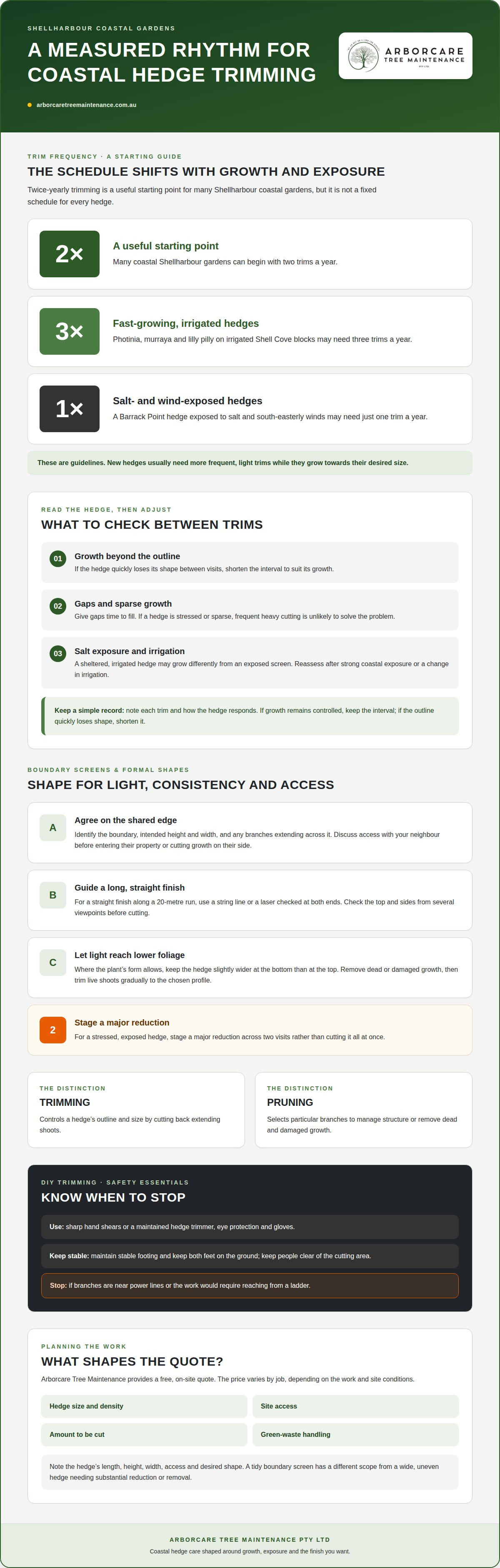
Coastal hedges generally need regular, measured trims rather than a major cut-back. For hedge trimming in Shellharbour, twice-yearly trimming is a useful starting point for many coastal gardens. Fast-growing hedges on irrigated Shell Cove blocks may need three trims a year, while a salt-exposed hedge at Barrack Point may need just one. New hedges usually need more frequent trims as they grow towards their desired size.
If your hedge runs along a boundary, you may be balancing a tidy screen with good relations with your neighbour. Consider the hedge’s shape, growth and position, as well as the finish you want along the shared edge.
This guide explains how coastal conditions affect trimming frequency, what routine care and a one-off tidy-up can involve, and how to maintain boundary screens and formal hedges. It also covers what to consider when a hedge has become overgrown, helping you plan practical upkeep for your Shellharbour garden.
Key Takeaways
- Plan coastal hedge trims around growth and exposure: most Shellharbour gardens are advised to trim twice a year, but local conditions can shift the schedule.
- For a neat boundary screen or formal shape, consistent trimming helps maintain the hedge’s form and density.
- Learn how trimming differs from pruning, and when an overgrown hedge may need a different approach from routine upkeep.
- Shellharbour City Council requires a Vegetation Removal Application for trees 5 metres or taller before removal or pruning.
- A quote for hedge work depends on the task and site conditions, with the scope and cost provided after a quote request.
How often should a coastal hedge be trimmed?
For Shellharbour’s coastal gardens, trimming twice a year is a useful starting point. Fast-growing photinia, murraya and lilly pilly on irrigated Shell Cove blocks may need three trims a year. A hedge at Barrack Point, exposed to salt and south-easterly winds, may need only one. These are guidelines, not a fixed schedule for every hedge.
New hedges need more frequent, light trims as they grow towards their desired size. Short, careful cuts guide the outline as shoots extend. Avoid cutting a young hedge to its final height before it has filled out. Instead, check its growth and shape regularly, then trim extending shoots to encourage an even screen.
Adjust the schedule to the hedge’s condition. Look for fresh growth beyond the intended outline, gaps that need time to fill, and salt exposure on the windward side. A sheltered, irrigated hedge may grow differently from an exposed Barrack Point screen. Keep a simple record of each trim and how the hedge responds. If growth remains controlled, keep the interval; if the outline quickly loses shape, shorten it.
For DIY trimming, use sharp hand shears or a maintained hedge trimmer, along with eye protection, gloves and stable footing. Keep both feet on the ground and people clear of the cutting area. Stop if branches are near power lines or the work would require reaching from a ladder.
An on-site assessment helps define the work before a free quote is prepared. Note the hedge’s length, height, width, access, desired shape and whether clippings need to be removed. Trimming a tidy boundary screen, for example, is a different job from reducing a wide, uneven hedge. A clear scope distinguishes routine shaping from heavier cut-back, so the quote reflects the work at your property.
Arborcare Tree Maintenance provides a free, on-site quote; the price varies per job. Cost depends on factors such as hedge size, density, access, the amount to be cut and green-waste handling. A neat, accessible hedge has a different scope from one needing substantial reduction or removal, so there is no single price for every Shellharbour garden.
Plan the quote request separately from the trimming schedule. Arrange an assessment before branches obstruct paths, windows or access. A clear description and site photos can help explain the work, while an on-site assessment clarifies details photos may miss. Arborcare provides a free, on-site quote, with the price varying by job.
Reassess the hedge after each trim, particularly after strong coastal exposure or a change in irrigation. If it repeatedly loses its shape between planned visits, adjust the interval to suit its growth. If it is stressed or sparse, frequent heavy cutting is unlikely to solve the problem; consider both the hedge’s condition and the screen you want.
Hedge trimming for boundary screens and formal hedges
A boundary hedge can provide privacy, soften a fence and divide garden areas. In Shellharbour, a well-kept screen also needs a clear shape that works from both sides. Before trimming, identify the boundary, intended height and width, and any branches extending across it. Discuss access with your neighbour before entering their property or cutting growth on their side. This helps prevent disagreements and clarifies the finish along the shared edge.
Regular trimming can encourage denser growth, while careful shaping keeps a formal hedge’s outline consistent. Start by checking the top and sides from several viewpoints, rather than cutting to the first visible branch. For a straight finish, use a string line or a laser checked at both ends of a 20-metre run. This gives a reliable guide along a long boundary, where small changes in hand height can create a visibly uneven top.
Where the plant’s form allows, keep the hedge slightly wider at the bottom than at the top. This lets light reach lower foliage and can help prevent a thin or bare appearance near the base. Remove dead or damaged growth, then trim live shoots gradually to create the chosen profile. A formal box shape needs a different finish from a softer screen following a garden border.
Take a measured approach with exposed coastal hedges. Salt and wind can stress a boundary screen, so avoid removing a large amount in one visit. Stage a major reduction of a stressed, exposed hedge across two visits rather than cutting it all at once. This avoids sharply changing the hedge’s shape and foliage in a single session.
For a shared boundary, agree on practical details before work begins: the cut line, whether the hedge should remain a screen, and how clippings will be handled. In Wollongong and Shellharbour, the desired finish may range from a neat formal edge to a looser coastal planting. Marking the intended line and confirming access helps keep the result consistent along the hedge.
If the hedge has become uneven or too broad, define the finished shape before cutting. A gradual reduction may preserve its screening role better than cutting back indiscriminately. For an established boundary that needs consistent shaping, consider professional hedge trimming as part of planned garden upkeep.
Local hedge trimming and pruning in Shellharbour
Local hedge work can range from shaping a screen to removing damaged growth. The right approach depends on the plants, their condition and the result you need.
Trimming Versus Pruning
Trimming controls a hedge’s outline and size by cutting back extending shoots. Pruning selects particular branches to manage structure or remove dead and damaged growth. A clipped formal hedge may need shaping, while a flowering shrub or small garden tree may need selective cuts. Before work starts, decide whether the priority is a tidy profile, better structure or both.
Choosing a Licensed and Insured Trimmer
Choose a licensed and insured hedge trimmer by looking for relevant licence details, current insurance information and a clear written scope. Ask for the intended cut, access arrangements and handling of clippings to be recorded before work begins. A defined scope makes it easier to distinguish routine shaping from heavier pruning. For example, clarify whether the work includes only the hedge face or also its top and damaged branches.
Check the hedge’s condition
Before arranging routine maintenance, check the hedge for bare sections, dead plants and hollow growth. A hedge topped for fifteen years and hollow through its centre may need removal and replanting rather than another trim. Three dead plants in a row of nine may also mean that maintenance alone won’t restore a continuous screen. These signs can show when the task has shifted from shaping to a larger renewal decision.
Match the work to the plants
Plant type affects the right cut. Flowering plants such as roses, fruit trees, shrubs and small garden trees may need selective pruning rather than a uniform hedge trim. Identify the plants in the row and point out any flowering or fruiting growth before work begins. This helps define a suitable scope and avoids treating every plant as if it responds to the same cut.
Local access and work scope
For properties in Shellharbour, nearby Wollongong, Kiama and Helensburgh, explain where the hedge is and how it can be accessed. Narrow side paths, garden beds and nearby structures can affect the work sequence. Say whether you need a one-off tidy-up or planned upkeep, then describe the finish you want. Clear details help distinguish hedge maintenance from pruning or removal work.
Shellharbour City Council rules for trimming hedges and trees
Routine hedge shaping and tree work may be subject to different local controls. Before arranging a cut, identify whether the plant is a hedge or a tree, then consider its height, trunk size and the work proposed.
Shellharbour City Council requires a Vegetation Removal Application for trees 5 metres or taller before removal or pruning. The application requirement applies to pruning as well as removal, so don’t assume that a tree can be cut simply because it will remain standing. Measure the tree’s height and describe the proposed work before setting a date.
Height isn’t the only relevant measurement. The local application criteria also cover a tree with a trunk 30 cm or more across at natural ground level before removal or pruning. A tree can meet this trunk threshold even if it is shorter than 5 metres. If either measurement applies, treat the planned work as potentially requiring an application.
Routine trimming of a hedge kept under 5 metres is listed as ordinary garden maintenance that does not need a Vegetation Removal Application. That distinction matters for a clipped boundary screen, but don’t apply the hedge rule automatically to trees growing within or beside it. A row of tall trees along a fence may be tree work rather than ordinary hedge shaping.
Some tree work may be supported where a tree is dead, dying, dangerous or needs remedial pruning. The condition and purpose of the work matter. Record what is visible, such as dead limbs or structural damage, and distinguish corrective pruning from a cosmetic trim. Larger tree pruning is expected to follow Australian Standard AS 4373-2007.
Shellharbour City Council allows exempt tree species to be removed without approval. Species identification is therefore an important step before planning removal. Don’t rely on appearance alone if you’re unsure which plant forms the screen; a mixed boundary can contain hedging plants and trees subject to different considerations.
A Vegetation Removal Application is usually decided within 30 working days. Build that period into planning where an application is required, rather than treating the proposed work date as fixed. Keep the application decision and the work scope together, so the agreed cutting matches the work considered.
- Identify whether the plant is a hedge or a tree.
- Measure tree height and trunk width at natural ground level.
- Describe whether the work involves trimming, pruning or removal.
- Consider whether species exemption applies before planning tree removal.
These checks help distinguish routine hedge maintenance from regulated tree work. A low hedge may sit beside trees that need separate consideration, so assess each plant individually before cutting begins.
Hedge trimming versus hedge pruning Shellharbour
Trimming and pruning involve different cuts, even when both are needed along one hedge. Trimming usually controls the outer shape by shortening shoots across the top or sides. Pruning selects particular branches to manage structure, remove dead or damaged growth, or address overcrowding. A formal lilly pilly screen may need a neat surface trim, while a shrub with damaged limbs needs selective pruning.
Decide what the plant needs, not just how it looks from the street. If the outline is uneven but the foliage remains healthy, trimming may restore its profile. If individual branches are dead, crossing or growing beyond the intended structure, selective pruning is more appropriate. A mixed boundary of photinia and murraya may need different cuts for each plant rather than one uniform pass.
The amount removed matters too. A light trim follows the existing outline and maintains the chosen size. A substantial reduction changes the hedge’s height or width and may leave an exposed screen with less foliage. For a stressed coastal hedge, stage a major reduction across two visits rather than removing too much at once. This matters especially where wind and salt have already affected growth.
Pruning isn’t a shortcut for every overgrown hedge. A hedge topped for fifteen years and hollow through the centre may need removal and replanting rather than another surface cut. Similarly, three dead plants in a row of nine may leave gaps that routine shaping won’t fix. Look inside the canopy before choosing the work: a leafy exterior can hide a thin or failing centre.
For larger trees, the work can move beyond ordinary hedge shaping. Pruning larger trees in Shellharbour is expected to follow Australian Standard AS 4373-2007. A row of trees beside a fence may need assessment as tree work, rather than being treated as a hedge simply because it forms a screen. The plant’s size, structure and proposed cuts help define the correct scope.
- Choose trimming when healthy shoots need shaping to maintain a defined outline.
- Choose pruning when specific branches need removal or the plant’s structure needs attention.
- Consider removal when the hedge is hollow, failing or has repeated gaps.
Before work starts, describe the desired result: a level top, a narrower screen, removal of damaged branches, or a staged reduction. Clear instructions help prevent a shaping visit from becoming an unplanned major cut. For a hedge that needs both shaping and selective branch work, arrange hedge trimming and pruning to match the plants and intended finish.
Arborcare Tree Maintenance: Tree Removals
Arborcare Tree Maintenance can help with careful shaping, selective pruning or more extensive changes to a Shellharbour garden. Its Hedging, Pruning & Trimming service covers routine upkeep and boundary screens. Tree Removals may be appropriate when a hedge or tree is no longer suitable for maintenance. Palm Tree Removals and Stump Grinding can address related work where palms or remaining stumps affect the property.
Describe the plants, their condition and the result you want, such as a level hedge top, reduced width or removal. Arborcare’s licensed and insured arborists can assess the work and provide a free, on-site quote. Contact Arborcare Tree Maintenance to discuss hedge or tree work at your property.
Plan your next hedge-care step
A well-planned hedge-care visit starts with a clear idea of how you want your garden to work. Before arranging hedge trimming in Shellharbour, consider whether your priority is privacy, a cleaner boundary line, more light or room to use a path. Whether you are aiming for a quiet green buffer or an open alfresco entertaining space reminiscent of lively waterside venues like The Shack Riverfront Restaurant & Tiki Bar, those goals can call for different work, even along the same hedge.
Take photos from the garden and boundary, and mark the areas that concern you. Include nearby trees or structures that affect access, as well as sections where growth or condition has changed. This gives you a practical starting point for discussing the property and the result you want.
Arborcare Tree Maintenance provides hedge and tree services suited to your property. Share the outcome you want and the details that matter to get started. Contact Arborcare for a free, on-site quote.
Contact Arborcare Tree Maintenance to discuss your hedge-care needs and move towards a tidier, more usable garden.
Frequently Asked Questions
Can a hedge on the boundary be cut without asking my neighbour?
Talk with your neighbour before arranging work on a shared boundary hedge. Agree on the cut line, access and clippings, especially if branches extend across the fence or the work requires entering their yard. A quick discussion can clarify, for example, whether they want the screen to remain tall. Don’t enter neighbouring property or cut beyond your boundary without permission.
What hedge trimming services are available in Shellharbour, NSW?
Arborcare provides hedge trimming, pruning and shaping for Shellharbour gardens. The work can cover a formal front hedge, an uneven side screen or selected branches that need attention. Describe the plants and the result you want, such as restoring a neat edge or improving access beside a path. If the job involves trees rather than hedge plants, explain that when arranging the work.
How much does hedge trimming cost in Shellharbour per hour or per hedge?
There is no single hourly or per-hedge price for every property. Arborcare Tree Maintenance provides a free, on-site quote, and the price varies per job. The quote can account for hedge size, density, access, requested shaping and green-waste handling. For a useful assessment, describe which sides need cutting and whether the hedge’s height or width should change.
Does Shellharbour hedge trimming include free quotes, and which areas are covered?
Yes. Arborcare Tree Maintenance provides free, on-site quotes for its services, and the price varies per job. Its local service area includes Dapto, Wollongong, Shellharbour and the wider Illawarra, including Woonona, Jamberoo, Fairy Meadow and Dombarton. In your enquiry, give the property suburb and describe the hedge work needed.
What is the best time of year to trim hedges in Shellharbour’s climate?
There isn’t one best month for every Shellharbour hedge. Set the timing according to the plant’s growth, condition and exposure, rather than choosing a date solely by season. A sheltered hedge putting on fresh growth may need attention before it loses its shape, while a salt-stressed screen may call for lighter work. Check the hedge’s condition and the finish you want before arranging a trim.
What are the risks of trimming hedges near power lines or property boundaries in NSW?
Branches, cutting tools and ladders near overhead power lines pose a serious electrical hazard. Don’t attempt the work yourself if wires are close to the hedge. Keep people clear and arrange a safe assessment before cutting. At a boundary, cutting across the property line or entering a neighbour’s yard can also cause damage or disputes. Agree on access and the cut line before work starts.


