

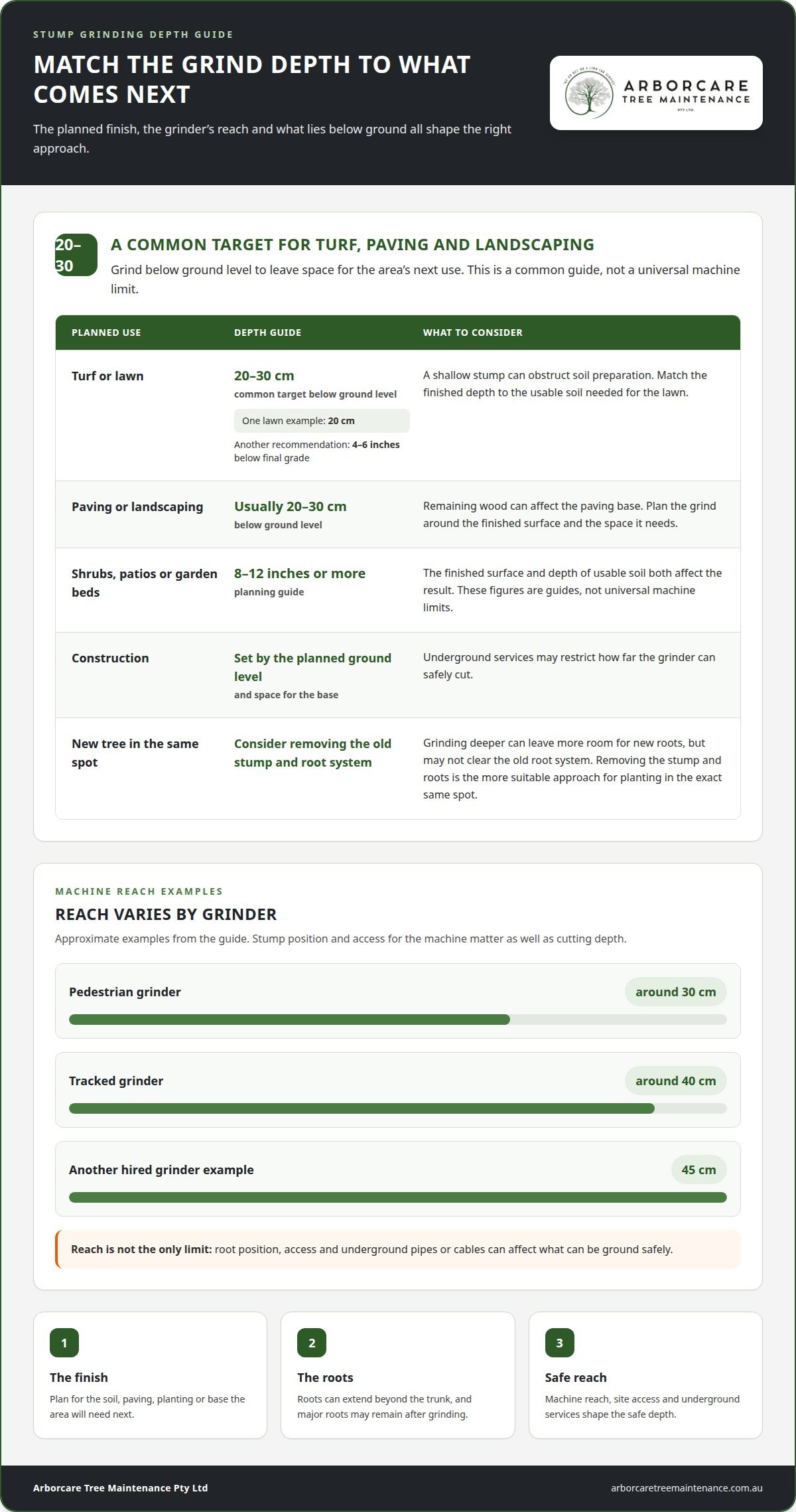
The right depth depends on what will replace the stump. For turf, paving or landscaping, stumps are usually ground 20 to 30 cm below ground level; if you’re deciding how deep to grind a tree stump before planting another tree nearby, the old root system and room for new roots matter too. Grinder reach varies, and underground pipes or cables can limit how deep it’s safe to cut.
It’s understandable to focus on getting a stump out of sight, but the finish you want and the location of underground services both affect how deep to grind. A deeper grind may suit some landscaping plans, while planting a replacement in the same spot may require a different approach.
This guide explains typical grinder depth, how to keep people and pets clear of flying debris, what to consider around underground services and how stump depth affects replanting. You’ll also learn when professional stump grinding can help protect your yard and prepare the area for its next use.
Key Takeaways
- For turf, paving or landscaping, a common target is 20 to 30 cm below ground level; the intended use of the area helps determine the depth.
- Choose protective clothing and keep people and pets well clear, as grinding can throw wood chips and other debris.
- Underground pipes and cables can limit grinding depth, and council permission may apply to some tree and stump work.
- Planting a replacement tree in the same spot can be affected by the old stump and root system, so plan the location and preparation carefully.
- Professional stump grinding can help match the finish to your yard plans while managing access and safety considerations.
How deep can a stump grinder go?
Grinding depth depends on the machine, the stump and what will use the area next. For lawn preparation, 20 cm is one example. Deciding how deep to grind a tree stump starts with the planned finish, because replacement planting may call for deeper grinding or a different approach.
Choosing Depth for the Intended Use
The intended use determines how far below ground level a stump needs to be ground. Matching the depth to your plans leaves suitable space for soil, paving or planting, rather than choosing a depth based on appearance alone.
For grass, one recommendation is to grind 4-6 inches below final grade. Shrubs, patios and garden beds may need 8-12 inches or more. These are planning guides, not universal machine limits. The finished surface and the depth of usable soil both affect the result. For a lawn, a shallow stump can obstruct soil preparation; for paving, remaining wood can affect the base area.
Machines also differ in reach. A pedestrian grinder can reach around 30 cm, while a tracked grinder can reach around 40 cm. Another hired grinder example reaches 45 cm. The stump’s position and access for the machine matter alongside its cutting depth.
Tree Species and Root Factors
Tree species and root structure affect how much wood lies below ground and how the stump responds to grinding. A broad or deep root system can leave more material underground than the visible stump suggests.
Roots may extend beyond the trunk, and major roots can remain after the central stump is ground. What can be removed safely depends on the grinder’s reach, root position and your plans for the area. If a replacement tree will occupy the same spot, the old root system may hinder its establishment.
Is it better to grind a stump or remove it completely? Grinding suits many lawn and garden projects. If you plan to plant a new tree in the exact same spot, removing the old stump and root system is the more suitable approach. Let the intended use of the ground guide your choice.
What should be done with stump grindings and the remaining hole? Grindings can be cleared or used as backfill, but the hole needs suitable soil for its next use. For planting, the fill mix and how it settles affect the finished surface.
Can a tree stump regrow after grinding, and how can regrowth be prevented? Some stumps can produce new shoots if living tissue remains below ground. Grinding removes the central stump, but roots left behind can still influence regrowth. The tree species and grinding depth both matter.
For a replacement tree, grinding deeper can leave more room for new roots, but it may not clear the old root system. If a new tree will go in the same spot, consider how the old root system may affect its establishment. For construction, the depth must suit the planned ground level and space for the base. Underground services may restrict how far the grinder can cut.
Before choosing a target depth, consider how deep to grind a tree stump for the area’s intended use and what the grinder can safely reach. This helps align the work with the next stage of your yard project.
Personal protective equipment and bystander clearance
A stump grinder’s cutting wheel can throw wood chips and other debris across the work area. Safe Work Australia identifies stump grinding as tree work with hazards requiring proper risk management. Protective equipment, a clear exclusion area and attention to nearby trees all help control those hazards before grinding begins.
The operator should wear protective clothing suited to flying debris, noise and contact with the machine. Recommended equipment includes:
- Safety glasses and a helmet to protect the eyes and head.
- Gloves, long trousers and a long-sleeved shirt to cover exposed skin.
- Ear muffs to reduce exposure to the grinder’s noise.
- Steel cap boots to protect feet around heavy equipment and wood.
Each item addresses a different risk. Safety glasses help shield the eyes from chips, while earmuffs protect against machine noise. Gloves and covered clothing reduce skin exposure, and steel-cap boots protect the feet around the work area. The operator also needs suitable training to control the grinder safely.
Keep bystanders, children and pets at least 50 feet from stump-grinding work. This separation matters because the grinder can throw more than wood chips. Nails, bricks, rocks and tools hidden in or around a stump may become airborne when struck by the cutting wheel. A child or pet moving closer can enter the hazard zone before the operator has time to respond.
Before work starts, clear loose objects from the grinding area. A five-foot-diameter area around the stump is a recommended starting point for removing debris. This helps reduce the chance that tools, rocks or other objects will be caught by the machine or struck by flying material. The operator should also consider how far debris may travel, rather than treating the stump itself as the whole work zone.
Nearby trees need protection too. Grinding within another tree’s root zone can cut roots and affect the tree’s health or stability. For example, a stump beside a valued garden tree calls for careful assessment of the roots before grinding nearby. The target depth and surrounding roots both affect how the work should be managed.
For a stump near people, garden structures or another tree’s roots, professional stump grinding helps manage machine operation, debris and clearance as one planned task. A controlled work area protects people nearby while allowing the operator to focus on the stump and its surroundings.
Checking for underground services and council requirements
Underground pipes and cables can limit how deep a stump grinder can cut. If their position is uncertain, the safe depth cannot be judged from the stump’s appearance alone. A shallower cut may be necessary when a service runs close to the wood, which can affect the finished surface and the area’s planned use.
Assess the site for possible underground services before grinding. Consider the stump’s position relative to visible service features, such as a meter, inspection point or connection entering the property. These clues can indicate areas needing closer attention, but they do not establish the exact route or depth of a buried service.
Property records or service plans may help clarify what lies underground, provided they cover the stump’s location and show the relevant route. If a plan does not clearly include the grinding area, do not treat it as proof that the ground is clear. Where uncertainty remains, have the site professionally assessed before deciding on a grinding depth.
Striking a buried service can have consequences beyond the stump. Damage may interrupt a service or create a hazard, and repairs can disturb the surrounding yard. A stump near a building connection, for example, needs careful assessment before the cutting wheel enters the ground. The grinding depth and direction should account for where services may run.
- Look at the site: Note visible meters, access covers and service entry points near the stump.
- Review available plans: Compare the stump’s position with any records showing buried services.
- Resolve uncertainty: Avoid assuming the cutting path is clear when the service route is unclear.
- Set the depth accordingly: Treat nearby services as a limit on how far the grinder can cut.
Council approval may also affect tree and stump work in Australia. Requirements vary by area, site and applicable tree-protection rules. A stump on a residential property, for example, may be within an area covered by local protections. Understand the relevant council’s requirements before work proceeds, especially where a protected tree or site may be involved.
Council approval and underground-service checks are separate. Approval, where required, does not confirm that buried pipes or cables are clear. Likewise, locating services does not establish whether local rules apply. Both can affect the work, achievable depth and how the area can be reinstated.
If service locations are uncertain or council rules may apply, pause before setting a target depth. A professional can assess the stump’s position, available site information and intended finish to determine whether grinding can proceed and what depth is suitable.
Grinding stumps before planting a new tree
Planting a replacement near an old stump takes more planning than preparing a lawn. Remaining wood and roots may hinder the new tree’s establishment, particularly if both trees occupy the same spot. Plan the planting location and consider how much old material will remain underground.
If the replacement tree will go in the old stump’s exact position, the entire stump needs to be removed. Grinding can reduce the visible stump, but it does not automatically clear the old root system. A cleared surface may look ready while buried roots still occupy the space the new tree needs.
Where the replacement can be planted elsewhere, allow at least 3-5 feet from the centre of the old stump. This spacing gives the new tree distance from the old root system. Measure from the stump’s centre, not its outer edge, when laying out the new planting position.
When the new tree needs to occupy the stump site, grinding as deep as safely possible can leave more room for its roots. The achievable depth depends on the grinder’s reach and what lies underground. The visible stump height alone does not show how much wood or root material remains below ground.
After grinding, backfill the hole before finishing the planting area. One recommended mix is:
- Grinding chips from the stump can be used in the backfill.
- 50% native topsoil from the site.
This equal mix uses the available chips and native soil to fill the stump hole. Keep the planned tree position in mind while filling, so the replacement is not placed directly over remaining stump material. For a tree planted 3-5 feet away, prepare the new planting spot separately from the backfilled stump area.
Stump grindings are not the same as complete stump removal. If you plan to replant in the original position, removal needs to account for the old root system, not just the wood above ground. If the replacement tree will go elsewhere, grinding and backfilling can prepare the old stump area for another use.
Before work begins, decide whether the new tree will occupy the old stump’s position or sit 3-5 feet away. That choice affects the depth target, the extent of stump removal and how the hole is filled. A clear planting plan helps match the ground preparation to the replacement tree’s needs, and gardeners looking for guidance on choosing and establishing new plants can turn to Michelle In The Meadow for practical tips and inspiration.
How deep should a tree stump be ground below ground level?
For turf, paving, replanting or landscaping, stumps are usually ground 20 to 30 cm below ground level. That range gives the surface room for reinstatement, but the required depth depends on what will cover the area. A lawn, for example, needs soil above the remaining wood, while a paved area needs suitable space for its planned base.
A stump grinder typically reaches about 12 inches below ground level, which is enough for most lawn and garden reinstatement work. Treat this as a typical machine depth, not a target that suits every yard. The stump’s position, the grinder’s reach and underground services can all affect the achievable cut.
For a new patch of lawn, 15-18 cm of soil below the surface is described as sufficient. This helps explain why depth should be planned around the finished ground level, rather than measured only from the top of the stump. If the ground will be raised or reshaped, the required grinding depth changes with the new surface.
- For turf: Allow for the soil needed above the remaining wood.
- For paving: Account for the planned base and finished level.
- For landscaping: Set depth according to the material and planting planned for the area.
Root depth also matters. According to Barts Tree Service, most tree stumps have their major roots in the top 16 inches of soil. Grinding the visible stump below grade does not mean every root is removed. The roots’ position and the planned use determine whether remaining material will affect the finished area.
Start by deciding what the finished surface needs to be: lawn, paving or a garden bed. Allow for the soil or base required above ground level, then consider the grinder’s reach. Underground pipes and cables may restrict the cut, so account for them before setting a target depth.
For example, a lawn reinstatement plan needs enough soil to cover the remaining stump material and create a suitable surface. A paved area instead needs its base and final level considered. The 20 to 30 cm range is a useful reference for these common uses, while the actual depth must suit the site and machine.
Plan the finished surface before work begins, then match the cut to that use. For a yard where access, stump position or depth complicates the job, arrange professional stump grinding to prepare the area for its next purpose.
Arborcare Tree Maintenance: Tree Removals
Arborcare Tree Maintenance Pty Ltd provides stump grinding to help prepare yards when a stump’s position, access or intended depth makes the job difficult. Tree removal may also be suitable if a tree needs to come down. The right approach depends on your plans for the area, such as restoring a lawn or preparing for landscaping.
If you plan to plant a replacement tree, explain whether it will occupy the old stump’s position or grow elsewhere. That distinction affects the preparation needed and whether grinding alone suits the site. For larger or more complex tree work, Arborcare Tree Maintenance Pty Ltd can assess the related work.
Contact Arborcare Tree Maintenance Pty Ltd to discuss your stump and plans for your yard.
Plan the next stage of your yard
The best result is a stump site prepared for what you want to do next, not simply one that looks clear today. Before work begins, decide how the space will be used and how the finished ground should look. A clear plan gives the grinding work a practical purpose and helps avoid preparing the area twice.
Deciding how deep to grind a tree stump is one part of planning your property. If you need other tree work, Arborcare Tree Maintenance also provides Tree Removals, Hedging, Pruning & Trimming, and Palm Tree Removals across Dapto, Wollongong, Shellharbour and the wider Illawarra, including Woonona, Jamberoo, Fairy Meadow and Dombarton. Considering related work together can help you plan for the whole yard.
Choose a clear next step: describe the stump’s location, your plans for the space and any nearby trees or structures. Discuss your tree work with Arborcare Tree Maintenance and move towards a yard that’s ready for its next use.
Frequently Asked Questions
How deep should a stump be ground for lawn, landscaping, or replanting?
For turf, paving or landscaping, a common depth is 20 to 30 cm below ground level, but the finished use guides the target. For a lawn, allow enough room for the soil layer; 15-18 cm of soil below the surface is described as sufficient for a new lawn patch. Replanting in the old stump’s position needs more consideration, because remaining stump material and roots can affect the new tree’s growing space.
How deep do professional stump grinders typically grind in Australia?
Depth varies by machine. A pedestrian grinder can reach around 30 cm, while a tracked grinder can reach around 40 cm. A typical stump-grinding depth is about 12 inches below ground level, enough for most lawn and garden reinstatement work. The actual reach depends on the equipment used, access to the stump and underground conditions. A target depth should suit the planned finish, not just the machine’s maximum reach.
Can stump grinding damage underground pipes, cables, or foundations in Australia?
Yes. Underground pipes or cables can be damaged if the cutting wheel reaches them, and their depth can limit how far grinding should go. The stump’s location alone does not reveal the exact route of buried services. Near a building foundation, the site layout and the grinder’s working area also matter. If underground conditions are uncertain, have the site assessed before grinding rather than assuming the machine can safely reach a chosen depth.
Are permits or utility checks required before stump grinding in Australia?
Council approval may be required in some Australian areas, depending on the site and applicable tree-protection rules. Check underground services before grinding near buried pipes or cables, as their depth can restrict the cut. These are separate considerations: council approval does not show where services run. Local requirements and site conditions determine what needs attention before work proceeds, particularly where a protected tree or nearby service may be involved.


