
Could the safest first step in clearing overgrown land be to put the tools down and assess the block? Dense growth can hide uneven ground, obstacles and trees you want to retain. Starting without a clear plan can create extra work or increase the risk of injury. It may also be difficult to tell what can be removed and how to handle the green waste.
A careful site assessment helps you estimate the scope, set priorities and decide which tasks are manageable yourself. It also helps identify where specialist equipment or arborist expertise is needed.
This guide explains how to assess an overgrown property in the Illawarra, plan around safety and check local vegetation requirements before work begins. You’ll also learn how to plan for waste and mulching, and when professional land clearing is the practical option. Arborcare Tree Maintenance is a locally owned, licensed arborist company based in Dapto, providing land clearing and mulching across the Illawarra. The aim is a safer, more usable block and a clear plan for getting there.
Key Takeaways
- Start clearing overgrown land by defining how you want to use the block and noting hazards, boundaries and access limits.
- Break the work into stages, matching each stage to the vegetation, terrain and finish you want.
- Small, accessible growth may suit careful DIY work. Dense vegetation, trees or difficult access can call for specialist equipment and arborist expertise.
- Before work begins, consider boundaries, retained vegetation and debris handling. Check relevant council and NSW guidance where clearing rules may apply.
- For residential and commercial properties in the Illawarra, land clearing can be planned alongside tree removal, stump grinding and mulching where suitable.
Clearing overgrown land: assess the block before you begin
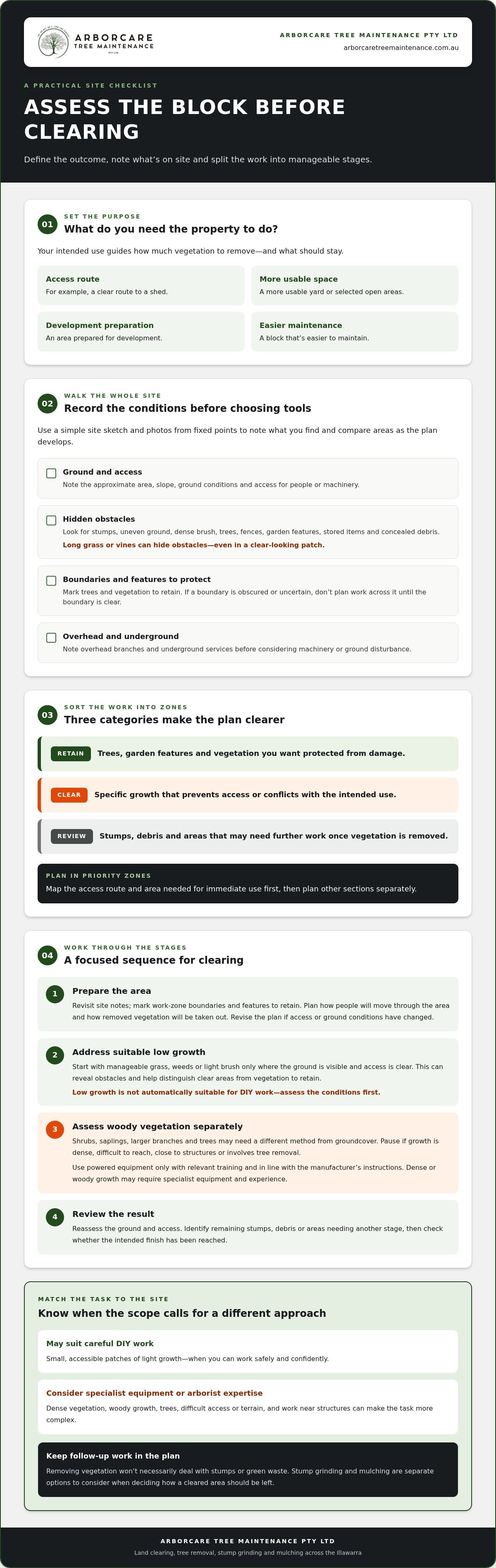
Before clearing overgrown land, decide what you need the property to do next. You might need a clear route to a shed, a more usable yard, an area prepared for development or a block that’s easier to maintain. The intended use determines how much vegetation to remove and what should stay. Land clearing is not simply cutting everything back. It is planned removal or reduction of unwanted vegetation to achieve a defined result.
Walk the whole block before choosing tools or setting a work sequence. A site-wide assessment helps you spot limited access and potential obstacles hidden beneath the growth. Make notes on a simple site sketch and take photos from fixed points to compare areas as the plan develops. For broader context, see Land clearing methods and environmental impact.
What should you check on an overgrown block?
Note the approximate area, slope, ground conditions and access for people or machinery. Look for stumps, uneven ground, dense brush and trees, as well as fences, garden features, stored items or debris concealed by vegetation. Don’t assume a clear-looking patch is obstacle-free if long grass or vines cover the ground.
Mark the trees and vegetation you want to retain, then identify the growth intended for removal. If a boundary is obscured or uncertain, don’t plan work that could cross it until the boundary is clear. Note overhead branches and underground services before considering machinery or ground disturbance.
How do you set a realistic clearing goal?
Describe the desired finish in practical terms: a defined access path, selected open areas or a block that’s easier to maintain. Break extensive overgrowth into priority zones rather than treating the whole property as one task. For example, first map the access route and the area needed for immediate use, then plan other sections separately.
Keep vegetation removal and follow-up work distinct in your plan. Cutting or removing vegetation won’t necessarily deal with remaining stumps or the resulting green waste. Stump grinding and mulching are separate options to consider when deciding how each cleared area should be left.
A useful site plan can group the work into three categories:
- Retain: Trees, garden features and vegetation you want protected from damage.
- Clear: The specific growth that prevents access or conflicts with the intended use.
- Review: Stumps, debris and areas that may need further work once vegetation is removed.
These notes help you judge whether the work can be staged or involves dense woody growth, difficult access or specialist equipment. Arborcare Tree Maintenance Pty Ltd provides land clearing for residential and commercial properties across the Illawarra, with tree removal, stump grinding and mulching as related services. A careful assessment is the first step towards a safer, more useful block.
How to clear overgrown land in manageable stages
A staged plan keeps clearing focused and makes it easier to see what still needs attention. The right approach depends on the size and density of the vegetation, the terrain and the finish you’re aiming for. A lightly overgrown access route is different from a steep, densely tangled area with established trees.
Work through the site in a planned order rather than tackling whichever growth is closest. Matching the method to the site helps avoid unnecessary rework.
- Prepare the area. Revisit your site notes and mark the boundaries of each work zone, along with trees and features to retain. Plan how people will move through the work area and how removed vegetation will be taken out. If access or ground conditions have changed since your assessment, revise the plan before starting.
- Address suitable low growth. Begin with manageable grass, weeds or light brush where the ground is visible and access is clear. This can reveal obstacles and make it easier to separate the area to be cleared from vegetation you’re retaining. Low growth is not automatically suitable for DIY work, so assess the conditions first.
- Assess woody vegetation separately. Shrubs, saplings, larger branches and trees may need a different method from groundcover. Pause if vegetation is dense, difficult to reach or close to structures, or if the work involves tree removal. Don’t improvise with powered equipment. Use it only with relevant training and in line with the manufacturer’s instructions.
- Review the result. Once the planned vegetation is removed, reassess the ground and access. Identify remaining stumps, debris or areas that need another stage of work. This review shows whether the site has reached its intended finish or needs follow-up.
Which tools suit light growth and dense brush?
Hand tools may suit small, accessible patches of light growth when you can work safely and confidently. Powered brush-cutting equipment carries additional risks. Use it only if you have suitable training and follow the manufacturer’s instructions. Dense or woody growth can require specialist equipment and experience, particularly where terrain, access or nearby features make the work more complex.
What happens to trees, roots and cleared vegetation?
Tree removal is a specialist task, not simply another step in cutting back brush. If a tree is part of the plan, treat it as a separate part of the scope. A remaining stump may obstruct the intended use of the area, making stump grinding a possible follow-up. Suitable vegetation may also be processed through mulching, depending on the project’s needs and desired finish.
These stages can be planned together, but they aren’t interchangeable. Arborcare Tree Maintenance Pty Ltd provides land clearing, tree removal, stump grinding and mulching for residential and commercial properties across the Illawarra. If woody growth, awkward access or several types of work make the sequence difficult to manage, professional land clearing can bring the work into one considered project plan.
DIY land clearing or an arborist in the Illawarra: how to decide
The decision isn’t simply about how much vegetation you can see. When clearing overgrown land, consider the block’s size, slope and ground conditions, the type of growth, access for people or machinery, and how close vegetation is to houses, fences and other structures. Be realistic about your confidence using equipment and the training you have.
A residential address doesn’t make a clearing job low-risk. Overgrowth can conceal uneven ground and obstacles, while tree work or restricted access can add hazards even on a small suburban block. Use the comparison below as a starting point, then assess the actual site.
| Site conditions | Possible approach |
|---|---|
| Small patch of light growth, clear access and visible ground | DIY may be manageable if you can work safely and have suitable training and equipment. |
| Dense brush, woody vegetation or an extensive area | Consider professional help, particularly if the work needs specialist equipment or careful staging. |
| Trees, difficult terrain, restricted access or nearby structures | Have an arborist assess the work before deciding how to proceed. |
When might a small DIY task be manageable?
Light, accessible growth may suit a capable person when the ground is visible, the work area is clear and the task stays within their experience. Before using a powered tool, follow its manufacturer’s instructions and proceed only with appropriate training. Stop if you uncover an obstacle, encounter unexpected woody growth or find the task exceeds your ability or equipment.
When should an arborist assess the clearing work?
Get professional help when the scope includes trees, dense woody vegetation, restricted access or growth close to buildings and other structures. These conditions can make it harder to control how the work affects the surrounding property and vegetation you want to retain. An arborist can plan around site constraints. For higher-risk situations, see this complex tree removal guide.
If tree removal is part of the job, consider it separately from clearing low growth. The tree’s position, nearby structures and access all affect how the work should be planned. Arborcare Tree Maintenance Pty Ltd provides land clearing and tree removal across the Illawarra. This tree removal guide for Wollongong explains more about professional tree work.
Use a simple decision check before you start: Is the ground and work area clear? Can you reach the growth safely? Do you have the training and equipment for the task? Could a mistake affect a tree, structure or boundary you need to protect? If any answer gives you pause, stop and have the scope assessed. A cautious decision can prevent a manageable clearing project from becoming more complex.
Plan overgrown land clearing around Illawarra site conditions
A sound plan accounts for more than the vegetation. Before clearing overgrown land, consider how you’ll use the site, what must remain undisturbed, how workers or machinery will reach the area, and how cleared material will be handled. Local requirements can depend on the vegetation, property and proposed scope, so don’t assume the same rules apply to every block.
What local checks matter before vegetation is removed?
For properties in their respective areas, Wollongong City Council and Shellharbour City Council are useful starting points for checking local rules. Review current council and NSW guidance for the specific address and proposed work. Native vegetation, potential habitat, waterways and steep or sloping ground can affect how a site should be assessed. Don’t treat a general online summary as confirmation that a particular clearing activity is permitted.
Before scheduling work, make a brief pre-work checklist:
- Intended use: Record what the cleared area needs to support, such as access, maintenance or a future project.
- Boundaries: Identify the property limits and avoid planning removal where the boundary is uncertain.
- Access: Note entry points, narrow passages, slopes and any constraints affecting people or machinery.
- Vegetation to retain: Mark trees, shrubs and other features that should be protected during the work.
- Debris handling: Decide how cleared material will be managed, and whether mulching may suit the project.
How can you prepare the site for a clearing project?
Include the work area and access route in your plan, and clearly identify which vegetation is to stay. A marked-up site sketch or clear photographs can help distinguish removal zones from retained areas. Consider how the scope might change if hidden obstacles, sensitive vegetation or difficult ground conditions become apparent. For wider site-preparation considerations, use this Illawarra land-clearing guide.
Plan green waste handling as part of the job, not as an afterthought. The right approach depends on the type and amount of material, access and intended finish. Mulching may suit some projects, but it isn’t automatically the right option for every site. Where extensive mixed debris or bulky refuse is uncovered, professional bin hire—exemplified by domestic and commercial waste specialists like Madi’s Skips in Perth—is a practical way to manage disposal efficiently. Include this decision in the clearing plan so debris doesn’t obstruct access or later work.
Conditions can vary between neighbouring Illawarra properties. One block may have straightforward access and limited growth; another may include native vegetation, a nearby waterway, retained trees or a steep section. If any of these features are present, clarify the applicable guidance before work begins. A general plan is not a site-specific approval.
Arborcare Tree Maintenance provides land clearing for residential and commercial properties across the Illawarra, with mulching available as part of a suitable project plan. If your assessment points to a larger or more complex scope, discuss Illawarra land clearing with Arborcare and plan the work around your property’s conditions.
Get professional help clearing overgrown land in the Illawarra
Some properties are straightforward to maintain, while others combine thick vegetation, trees, stumps and limited access. If the work is beyond your experience or requires specialist equipment, Arborcare Tree Maintenance can plan land clearing for your residential or commercial property in the Illawarra. The business is locally owned, based in Dapto and licensed as an arborist company.
A useful plan connects the work to the result you want. Opening access across part of a property, preparing an area for a new use and reducing overgrowth for easier maintenance can require different scopes. The vegetation to retain, the site’s condition and how cleared material will be handled all help define the work.
What can a professional land-clearing plan address?
A land-clearing plan can account for access routes, vegetation type and density, retained trees and the intended use of each area. If trees need removal, tree removal can be included in the wider scope. If a remaining stump would interfere with access or the planned use, stump grinding may be a suitable follow-up. The approach is shaped around the property rather than treating every block the same way.
It also helps to distinguish the main clearing work from related tasks. Land clearing addresses unwanted vegetation across the site, while tree removal and stump grinding deal with specific tree-related obstacles. Mulching may suit some vegetation, depending on the project’s needs and how the cleared area is to be left. Arborcare provides these services for Illawarra properties, with the scope tailored to the work required.
Stumps can affect how you use an area after clearing. If one is in the way of a planned access route or usable space, the stump grinding guide for Wollongong explains how this follow-up work fits into property preparation.
How do you take the next step with Arborcare?
To start a discussion, outline where the property is, which areas are overgrown and what you want to achieve. Mention any trees you intend to retain, access constraints and whether stumps or green waste are part of the concern. These details help define the clearing work and related services for the project.
Arborcare is a local, licensed arborist business serving Dapto, Wollongong, Shellharbour and the wider Illawarra. Its land-clearing work can be planned alongside tree removal, stump grinding and mulching where they’re relevant to the site. This gives you a practical starting point for making a difficult patch of overgrowth better suited to its intended use.
Discuss your property and land-clearing needs with Arborcare, including its location, the overgrowth and the outcome you have in mind.
Turn your clearing plan into a practical next step
Turn your observations into a clear brief: which part of the property needs attention, what you want it to be used for and what should remain untouched. This gives the work a defined purpose and helps prevent unnecessary clearing. If the scope feels uncertain, you don’t need to resolve every detail alone.
Arborcare Tree Maintenance is a locally owned and operated, licensed arborist business serving the Illawarra. Its land clearing, tree removal, stump grinding and mulching services can address different parts of a property project, depending on what the site needs.
Share your property’s location, the overgrowth you’re dealing with and the outcome you have in mind. Discuss your land-clearing needs with Arborcare and take a considered step towards making the block safer and more useful. With a clear purpose and the right support, clearing overgrown land can become a manageable project, not an overwhelming one.
Frequently Asked Questions
Can I clear overgrown land myself?
Yes, clearing overgrown land yourself may suit a small, accessible patch of light growth if you can manage the task safely. Keep the work within your training and follow the equipment’s instructions. If you uncover dumped material, sharp debris or growth tangled around a fence, don’t keep cutting blindly. Pause and reassess, as hidden obstacles can change the risks and effort involved.
Do I need council approval to clear vegetation in the Illawarra?
It depends on the property and the vegetation you intend to remove, so don’t assume approval is always required or never needed. Check current council and NSW guidance for your address and proposed work before starting. Wollongong City Council and Shellharbour City Council are relevant starting points for properties in their areas. Local checks may also matter in Dapto, Wonoona, Jamberoo, Fairy Meadow and Dombarton.
What is the safest way to start clearing an overgrown block?
Inspect the site without cutting, then identify hazards and decide which vegetation must stay. Keep children and pets away from the work area, and don’t begin if you can’t see the ground or understand what’s behind the growth. Look for hazards such as loose wire or concealed rubbish. If the inspection reveals trees, unstable ground or restricted access, have the work assessed before proceeding.
Should I remove tree stumps when clearing land?
Not always. Whether a stump needs attention depends on what you plan to do with that specific spot. A stump in a future access path, garden bed or work area may obstruct the next stage, while one outside the intended use may not need immediate grinding. Consider its position in relation to the finished layout and include stump treatment in the plan if it could interfere with safe use.
Can cleared branches and vegetation be turned into mulch?
Some cleared vegetation may be suitable for mulching, but the material and project requirements determine whether it’s practical. Mulching can be included in a land-clearing plan rather than assumed to suit every type of debris. Consider where the mulch would be used and whether it fits the desired finish. Arborcare provides mulching alongside land clearing for Illawarra properties.
When should I call an arborist to clear overgrown land?
Call an arborist when the job includes trees, substantial woody growth or vegetation near buildings, fences or other features that must be protected. Professional input is also sensible if access is tight or the work involves equipment you aren’t trained to use. Arborcare Tree Maintenance is a licensed arborist business based in Dapto, serving residential and commercial properties across the Illawarra.
Does clearing overgrown land include removing trees?
It can, but the work should specify whether tree removal is included. Clearing light vegetation and removing a tree are different tasks, and a tree’s location and nearby features can affect how its removal is planned. If trees are part of the intended scope, make that clear from the outset. Arborcare provides both land clearing and tree removal, so related work can be planned together.


