
What if the safest response to a worrying tree isn’t to remove it straight away? A cracked trunk, hanging limb or tree leaning towards a building can be alarming, especially when people, vehicles or access routes may be at risk. But not every concerning tree needs to come down. Dangerous tree removal should follow a careful assessment of the risk and the options for managing it safely.
For Illawarra property owners, trying to cut or climb a hazardous tree without specialist skills and equipment can make a difficult situation more dangerous. A professional crew plans the work around the tree’s condition, nearby structures, site access and how to manage each stage. Arborcare Tree Maintenance Pty Ltd is a locally owned, licensed arborist company based in Dapto, providing services for residential and commercial properties across the Illawarra.
This guide explains which signs may call for urgent professional attention, when another management option may be suitable and what to expect from a planned removal. You’ll also find practical steps to prepare your property and a clear next step for a dangerous tree in your area.
Key Takeaways
- Learn which signs may call for urgent professional attention and why a concerning tree doesn’t always need to be removed.
- See how dangerous tree removal is planned around the tree’s condition, site access and nearby property.
- Compare removal, pruning or trimming, and further assessment to understand how the right approach is selected.
- Find practical ways to prepare your property safely while keeping people and pets clear of the affected area.
- Discover how Arborcare Tree Maintenance supports residential and commercial properties across the Illawarra.
What does dangerous tree removal mean for Illawarra property owners?
A tree that might affect people, a building or access to your property can be unsettling. The uncertainty is often just as stressful: is the tree unsafe, and does it need to come down? Dangerous tree removal is planned professional work to manage an identified tree hazard. It’s not a reason to rush into cutting. The aim is to understand the risk and choose an appropriate response for the site.
A tree that looks worrying from the ground doesn’t automatically need removal. Depending on its condition and position, pruning or another management option may address a concern while allowing the tree to remain. In other situations, removal may be the more appropriate way to manage the risk. A general tree removal overview describes common reasons for felling trees. The right decision for an individual property depends on the tree and what could be affected.
It also matters where the tree stands. If it’s on your private property, any assessment and work need to take account of the site and its risks. If a concerning tree is on Crown land, report it to the responsible land manager rather than treating it as a private removal job. Reporting a hazard and arranging work on land you own are different situations.
When does concern become a removal decision?
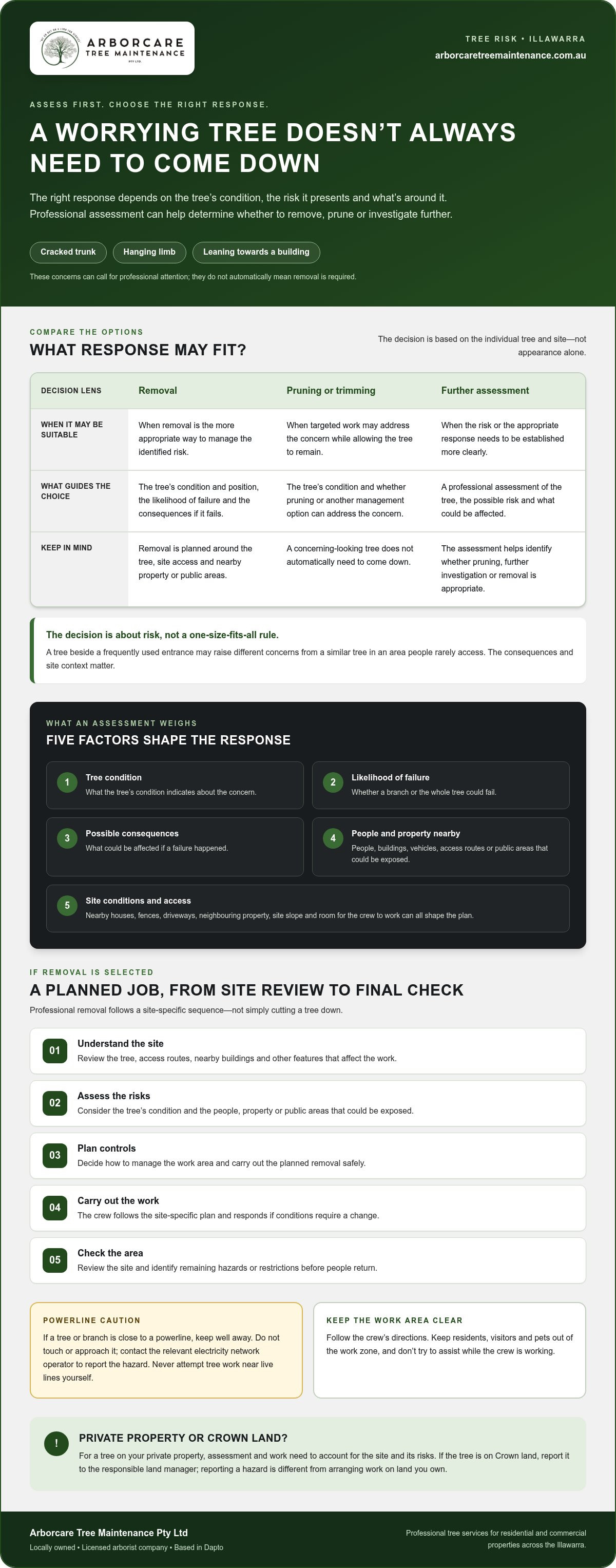
The decision depends on the tree’s condition, the likelihood of a branch or the whole tree failing, and the consequences if that happens. A tree beside a frequently used entrance may present a different level of concern from a similar tree in an area people rarely access. A professional assessment weighs these factors and helps determine whether removal, pruning or further investigation is appropriate. For a separate checklist of visible warning signs, refer to the article’s related tree-hazard guide.
Why Illawarra property context matters
The same tree can call for a different work plan depending on its surroundings. On a compact residential block, a house, fence, driveway or neighbouring property may restrict access. At a commercial site, the team may need to account for entrances and areas used by staff or visitors. A sloping property can also affect equipment positioning and how the work area is organised. These site details help shape a practical approach.
For homeowners and businesses in Dapto, Wollongong, Shellharbour, Woonona, Jamberoo, Fairy Meadow, Dombarton and across the Illawarra, the useful first step is to take the concern seriously without assuming the outcome. Keep people clear of an area that appears unsafe and arrange professional attention to establish the risk. The assessment can guide the next decision, whether that’s targeted pruning, further investigation or carefully planned removal. This measured approach helps protect people and property while avoiding unnecessary work.
How professionals plan dangerous tree removal safely
Safe removal involves a sequence of decisions, not simply cutting a tree down. The crew first needs to understand the tree and site, then plan how to manage risks before work begins. The approach depends on the tree’s condition, the work required, available access and nearby features. A confined backyard with a house and fence close to the tree calls for a different plan from an open commercial site.
A professional process generally moves through these stages:
- Understand the site. Review the tree, access routes, nearby buildings and other features that could affect the work.
- Assess the risks. Consider the tree’s condition and the people, property or public areas that could be exposed during the job.
- Plan controls. Decide how to manage the work area and carry out the planned removal safely.
- Carry out the work. The crew follows the site-specific plan and responds appropriately if conditions require a change.
- Check the area. After the work, review the site and identify any remaining hazards or restrictions before people return to the area.
What goes into a site-specific removal plan?
The plan accounts for the tree’s condition, intended work, crew access and the space around the work area. Nearby homes, fences, driveways, neighbouring properties or public areas may affect how the job is organised. The crew considers these constraints together rather than relying on a one-size-fits-all method. This is especially important for complex removals, where restricted space can affect how the work is planned.
How does a professional crew control the work area?
Before active work starts, the crew establishes boundaries to keep residents, visitors and pets away from the hazard area. It also coordinates the work with access around the property and nearby spaces. Follow the crew’s directions. Don’t enter the work zone or try to assist, even if a task seems simple. Staying clear helps protect you and allows the crew to follow its plan.
Powerlines need particular caution. If a tree or branch is close to a powerline, keep well away and don’t touch or approach it. Contact the relevant electricity network operator to report the hazard. Never attempt to move branches or carry out tree work near live lines yourself.
In NSW, SafeWork NSW provides work health and safety guidance relevant to tree work. For a removal on an Illawarra property, a site-specific plan helps account for the tree, surrounding property and access needs. Arborcare Tree Maintenance carries out professional tree removal for local residential and commercial properties.
Dangerous tree removal or another option: how is the work chosen?
A concerning tree doesn’t automatically need to be removed. The right response depends on its condition, the risk it presents, its location and how the property is used. An assessment connects those factors to a practical outcome, rather than treating one visible defect as proof that the tree must come down. However, retaining a tree isn’t always suitable if the risks can’t be managed effectively.
| Option | When it may be considered |
|---|---|
| Removal | When assessment indicates the tree can’t be retained safely or the risk can’t be adequately managed another way. |
| Pruning or trimming | When targeted work may address a specific concern or meet a maintenance need while retaining the tree. |
| Further assessment | When more information is needed to understand the tree’s condition, potential risk or suitable management response. |
This comparison is a starting point, not a diagnosis. A tree beside a regularly used entrance or building may have different implications from one away from people and property. The assessment considers what could be affected and the needs of the site. For broader local guidance, see the Tree Removal Wollongong professional arborist guide.
When might removal be the appropriate response?
Removal may be recommended when assessment indicates that a tree can’t be retained safely, or that other management won’t adequately address the risk. The decision should consider the whole situation, not a single feature in isolation. A defect needs to be understood in context: the tree’s condition, what could be affected if it fails, and how the property is used all matter.
For a busy driveway or a commercial area used by staff and visitors, the consequences of failure may differ from those in a less-used part of a property. Dangerous tree removal is a considered response to assessed risk, not an automatic reaction to a tree looking unusual or damaged.
When might pruning or a complex removal plan be relevant?
Pruning or trimming is maintenance work that may address a particular concern while keeping the tree. It isn’t the same as removing a tree that has been identified for removal. If removal is needed but access is restricted or nearby property limits the working area, the job may require a more carefully planned, complex approach.
For instance, a tree close to a house or fence may leave less room to organise the work than one in an open area. The suitable option still depends on the site assessment. The complex tree removal Illawarra guide explores the considerations for constrained properties.
Professional arboriculture resources, including the International Society of Arboriculture guidelines, can offer broader context on tree care. For a particular Illawarra property, the practical choice comes back to the tree, its surroundings and whether the identified risk can be managed while retaining it.
How to prepare your Illawarra property for dangerous tree removal
You can prepare for dangerous tree removal without going near the tree or trying to manage the hazard yourself. The priority is to keep people clear, pass on useful information and leave the tree and its surroundings undisturbed for the professionals. If the tree is unstable or the situation changes, don’t approach it to get a better look.
What should you organise before the crew arrives?
Where it’s safe, make the planned access route easier to use. Move vehicles from the driveway, and keep gates and paths clear, but don’t enter an area that may be affected by the tree or branches. Let household members, tenants or site staff know which area to avoid. Bring pets indoors only if you can do so safely.
Share practical details with the removal team in advance. These might include the best entrance, locked gates, access restrictions or areas of the property that need attention. If you can see the tree from a safe location, describe what has changed and provide photos taken from there. Don’t cross barriers or move closer to capture a clearer image.
What should you do after storm damage or a sudden change?
Keep well away from fallen or hanging trees, unstable branches and any damaged structures nearby. Don’t try to shift debris, inspect a split trunk at close range or retrieve belongings from an affected area. A tree can remain hazardous even if it appears to have stopped moving. Keep other people out and wait for professional help. Once the tree hazard is safely cleared, any damaged fencing, siding or outdoor fixtures will typically require standard property repairs—similar to the repair solutions offered by American Handyman for storm-affected homeowners.
Never touch a tree or branch that is in contact with powerlines, or approach the area to take photos. Keep your distance and report the hazard to the relevant electricity network operator. If someone is in immediate, life-threatening danger, move to a safe place and contact emergency services.
After a storm, share what you can observe from a safe position, such as the property address, the tree’s location and whether access is affected. This information can help the team understand the situation before attending. The 24/7 emergency tree service Illawarra guide has more information for homeowners dealing with storm-related tree hazards.
Preparation doesn’t mean trying to make the tree safe yourself. Keep clear, communicate access details and follow the crew’s directions when work is arranged. If a hazardous tree is affecting your Illawarra property, contact Arborcare Tree Maintenance Pty Ltd about tree removal.
Dangerous tree removal in the Illawarra: how Arborcare can help
A tree that may threaten people, property or access can leave you unsure what to do next. Arborcare Tree Maintenance is a locally owned, licensed arborist company based in Dapto, providing residential and commercial tree removals across the Illawarra. The team can discuss the concern and the needs of your property, helping you focus on the details that shape the next step.
For dangerous tree removal, start by sharing the tree’s location, what has changed and what is nearby. If it’s safe, photos taken from a distance may help explain the concern. Keep clear of any area that appears unsafe, and don’t approach the tree to collect more information. The removal requirements can then be discussed in relation to the tree and the property.
Local tree removal for homes and commercial properties
Arborcare serves Dapto, Wollongong, Shellharbour, Woonona, Jamberoo, Fairy Meadow, Dombarton and surrounding Illawarra communities. Every property has its own requirements: a residential block may have limited access, while a commercial site may have entrances or areas used by staff and visitors nearby. These details, along with the tree and the intended work, shape the removal plan. Arborcare undertakes tree removals for both residential and commercial properties.
A straightforward way to begin is to describe:
- Where the tree is and what has prompted concern.
- Nearby buildings, access routes or areas people use.
- Any practical site details, such as a gate or restricted entry.
This gives the team useful context to discuss the job. If the tree has changed suddenly or presents an immediate hazard, keep people away and explain the urgency when getting in touch. Arborcare also provides emergency tree services.
What happens after a tree is removed?
Removal may leave a stump or create other needs for the site. These aren’t automatically part of every removal, so discuss what you’d like done with the remaining area. Stump grinding is a separate service if clearing the stump suits your plans. The stump grinding Wollongong guide explains how it may fit into clearing a property. Once major clearing is complete, repairing and restoring the surrounding lawn and garden beds is often the next step, mirroring the landscape restoration and lawn care services provided by Yardworx Lawn & Landscape.
Share your concerns and discuss the removal needs for your Illawarra property with Arborcare. Contact Arborcare about dangerous tree removal.
Take the next step towards a safer property
If a tree is worrying you, you don’t need to decide on removal alone. Share what you’ve noticed and where the concern is, then discuss what the site may require. A clear first conversation can turn uncertainty into a practical next step, whether the issue calls for planned work or urgent attention.
Arborcare Tree Maintenance is a licensed arborist company based in Dapto, carrying out residential and commercial tree removal across the Illawarra. The team also provides 24/7 emergency tree services. Keep people away from any area that appears unsafe while arranging professional help, and leave inspection or cutting to the arborists.
For dangerous tree removal, choose a considered response that puts safety first and accounts for your property. Contact Arborcare for professional dangerous tree removal in the Illawarra to discuss your concern.
Frequently Asked Questions
What makes a tree dangerous enough to remove?
A tree may need removal if an assessment finds that it could fail and the resulting risk can’t be managed by another suitable option. The decision considers the tree’s condition and what it could hit, such as a home, a frequently used path or a parked vehicle. One crack or unusual lean doesn’t automatically mean removal is necessary. A professional arborist can assess the specific situation and recommend an appropriate response.
Can a dangerous tree be pruned instead of removed?
Yes, pruning may be appropriate if targeted work can address the concern while the tree remains suitable to retain. For example, an arborist may recommend removing a problematic limb rather than the whole tree. Pruning isn’t a safe substitute in every case, though. If the risk relates to the tree’s overall condition or can’t be managed by trimming, the assessment may point to removal or further investigation.
Should I try to remove a dangerous tree myself?
No. Don’t climb, cut, pull or move a tree you think may be dangerous. Even a small-looking branch can shift unexpectedly, and work near buildings, fences or access ways can create risks beyond the tree itself. Keep people and pets away, then arrange help from a professional tree removal team. If anyone faces immediate danger, move to safety and contact emergency services rather than approaching the tree.
What should I do if a tree is touching powerlines?
Stay well away and don’t touch the tree, branches, fence or other objects that may be in contact with the lines. Don’t try to move the tree or take a closer photo. Report the hazard to the relevant electricity network operator and keep other people clear. If someone is in immediate danger, move to safety and contact emergency services. Treat the area as hazardous until the network operator advises otherwise.
How is dangerous tree removal planned around a house or driveway?
The work plan takes account of the tree’s position, nearby structures and how people access the property. For example, a driveway may need to stay clear for residents or be kept out of use during part of the work. Property owners can help by sharing gate or access details and arranging safe alternative access if needed. The removal team determines how the job can be carried out for that particular site.
Can a tree become dangerous after a storm?
Yes. A storm can leave a tree or branch damaged in ways that aren’t obvious from a quick look, including limbs caught overhead or damage partly hidden by foliage. Don’t walk beneath hanging branches or approach a fallen tree to inspect it. Keep clear and report what you can see from a safe place. If powerlines are involved, stay away and contact the relevant electricity network operator.
Does every dangerous tree need to be removed immediately?
No. The appropriate timing and response depend on the assessed risk and the circumstances at the property. A tree that presents an immediate threat needs urgent attention, while another concern may be managed through planned work or a different option. Until it’s assessed, take a cautious approach: keep people away from the affected area and don’t attempt temporary repairs. Contact emergency services if there’s an immediate threat to life.


