
Could crown reduction make your tree smaller without resorting to harmful topping? With crown reduction pruning in the Illawarra, the aim is to shorten selected branches while retaining the tree’s natural structure, not cut the canopy back indiscriminately. It’s understandable to worry about safety, appearance and how a tree will grow after pruning, particularly when the right option isn’t clear.
This guide explains what crown reduction can achieve, how it differs from topping and when pruning may be suitable. You’ll also learn what a professional assessment should consider, including the tree’s condition, its position and whether reduction is appropriate or another option may be more suitable.
Arborcare Tree Maintenance is a family-owned local team serving Wollongong, Shellharbour and the Illawarra. Our AQF 3 and AQF 5 qualified arborists work to AS 4373, the Australian Standard for pruning amenity trees. An onsite assessment can help clarify the options for your tree, with a free, no-obligation quote to outline suitable work.
Key Takeaways
- Understand how selective branch shortening can reduce a canopy while preserving the tree’s natural form, and why it won’t suit every tree.
- See how a professional pruning plan moves from assessing the tree and agreeing on goals to making and reviewing the cuts.
- Compare reduction, topping, thinning and removal by the different needs each approach is intended to address.
- Learn why coastal exposure and wind-related canopy form are useful context for an onsite assessment, not automatic reasons to prune.
- This guide to crown reduction pruning Illawarra explains what questions can help clarify whether pruning or another option is right for your tree.
What is crown reduction pruning, and what can it do for an Illawarra tree?
Wanting a smaller canopy without spoiling a tree’s shape is a common concern for property owners. Crown reduction may help in some cases, but it isn’t a matter of cutting every branch back by the same amount. The tree’s structure and condition, along with the result you’re hoping for, determine whether this approach is suitable.
Crown reduction is the selective shortening of suitable branches to reduce a tree’s canopy while retaining a balanced, natural-looking form. The aim is to work with the tree’s structure, not impose an arbitrary outline. It can reduce canopy dimensions, but it can’t guarantee a particular final size or make every tree safe in every situation.
What does crown reduction involve?
A qualified arborist assesses the tree before selecting which branches, if any, are appropriate to shorten. This means considering how the branches grow in relation to one another and identifying suitable points for cuts, rather than simply removing the outermost growth. The goal is to leave viable remaining growth and an outline that looks proportionate to the tree.
Pruning cuts affect how a tree looks and grows afterwards, so the method matters. General pruning techniques include different approaches for different purposes; reduction is specifically intended to reduce canopy dimensions. It shouldn’t be confused with indiscriminate cutting or a uniform haircut. How much can reasonably be reduced depends on the individual tree and needs an onsite assessment.
If the requested reduction would require extensive cutting, the arborist may explain why the desired result isn’t appropriate for that tree. Species, branch arrangement, existing condition and the amount of canopy that would remain all matter. A careful assessment helps set realistic expectations before work begins.
Why might an Illawarra property owner consider it?
Practical concerns can prompt an assessment. A canopy may feel too large for its setting, branches may extend towards a roof or interfere with clearance, or the tree may be out of balance with nearby structures and usable space. These concerns are reasons to discuss the tree, not proof that reduction is the right answer.
Local conditions also deserve context. Coastal wind exposure can influence how a tree develops and how its canopy relates to its surroundings. It doesn’t automatically mean the tree needs pruning, or that reducing the crown will resolve a concern. An arborist needs to consider the tree’s form and position on the property rather than applying a standard cut-back plan.
That distinction is central to crown reduction pruning Illawarra property owners should understand: the objective is a considered change to suitable branches, not simply making a tree as small as possible. If the tree’s structure can’t support the outcome you want, another management option may be more appropriate. A professional assessment can explain what reduction may achieve, what it can’t, and how the proposed work relates to the tree’s form.
How is crown reduction carried out to AS 4373?
A sound pruning decision starts before any branch is cut. The arborist needs to understand the tree’s structure and your priorities, then determine whether the requested change can be achieved while keeping a coherent canopy. A photo or phone description can help explain your concern, but it can’t replace an onsite assessment of the tree.
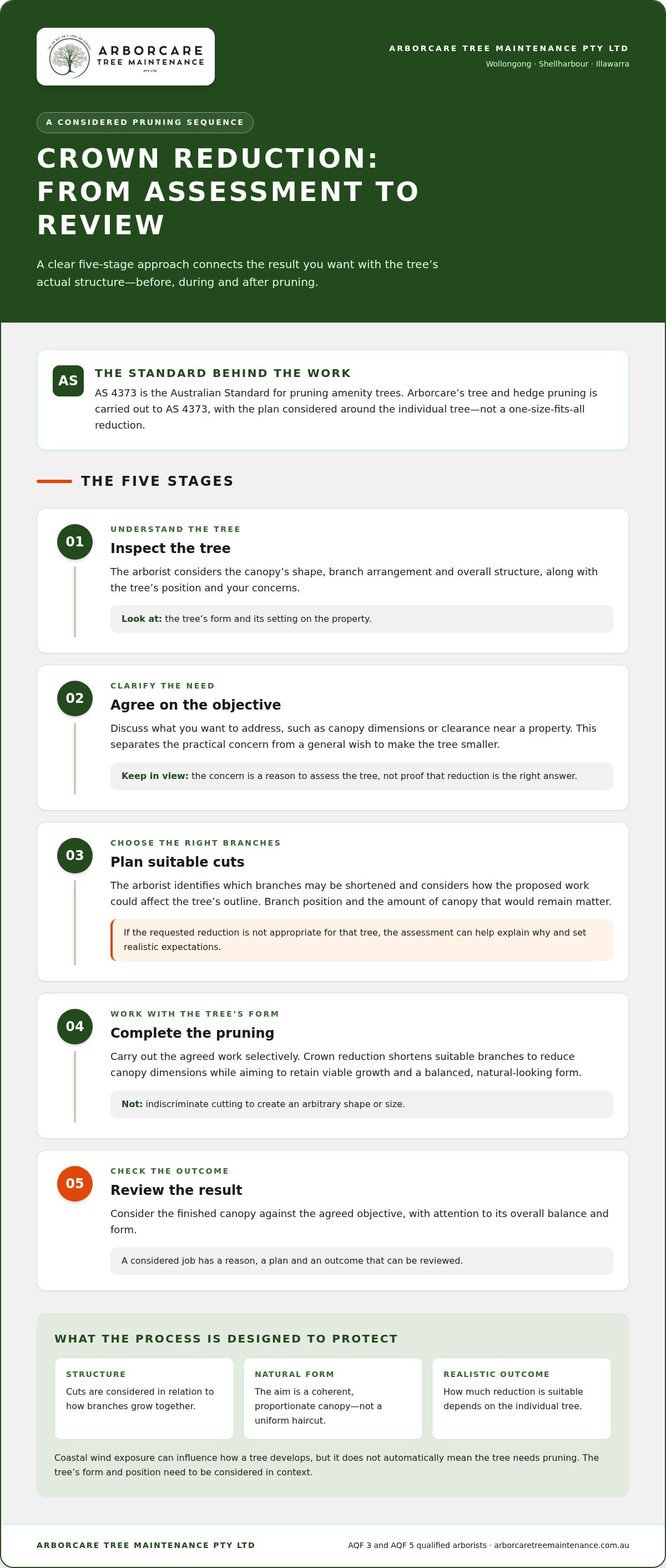
AS 4373 is the Australian Standard for pruning amenity trees. Arborcare’s tree and hedge pruning is carried out to AS 4373. The standard provides a professional framework for pruning work; in practical terms, the job still needs to be planned around the individual tree rather than a one-size-fits-all reduction.
From assessment to review
A crown-reduction job can be understood as a clear sequence. Each stage helps connect the desired result with the tree’s actual form:
- Inspect the tree. The arborist considers the canopy’s shape, branch arrangement and overall structure, as well as the tree’s position and your concerns.
- Agree on the objective. Discuss what you want to address, such as canopy dimensions or clearance near a property. This helps distinguish the practical need from a general wish to make the tree smaller.
- Plan suitable cuts. The arborist identifies which branches may be shortened and how the proposed work could affect the tree’s outline. If the requested reduction isn’t appropriate, the assessment can help explain why.
- Complete the pruning. The agreed work is carried out selectively, rather than removing branches indiscriminately to meet an arbitrary shape or size.
- Review the result. The finished canopy can be considered against the agreed objective, with attention to its overall balance and form.
This sequence gives the property owner a practical point of reference: the work should have a reason, a considered plan and an outcome that can be reviewed. It also helps avoid treating pruning as a simple matter of cutting back whichever branches appear inconvenient.
What guides the pruning plan?
The assessment informs which branches are suitable for reduction and whether the intended change is realistic for that tree. A branch’s place in the canopy matters: shortening one area without considering the rest can leave the outline uneven or fail to address the original concern. A considered plan aims to retain a coherent canopy shape rather than making unrelated cuts across the crown.
For crown reduction pruning Illawarra property owners can rely on, the onsite conversation should make the proposed objective clear before work starts. Ask what the plan is intended to change, which parts of the canopy are involved and what the tree may look like afterwards. These questions help set practical expectations without promising a particular reduction before the tree has been assessed.
If you’re weighing up pruning for a tree in Wollongong, Shellharbour or the Illawarra, an onsite pruning assessment can help clarify a suitable approach and provide a free, no-obligation quote.
Crown reduction vs topping, thinning and removal: which is different?
These terms can sound similar, but they describe different approaches. The key difference is the job each one is meant to do: reduce the canopy’s outer dimensions, selectively remove growth within it, cut back without a considered form, or remove the tree altogether. A comparison can help frame the discussion, but an onsite assessment is needed to determine which option suits a particular tree.
- Crown reduction: Selectively shortens suitable branches to reduce canopy dimensions while aiming to retain a balanced, natural outline. It addresses: “Can the canopy be reduced in a considered way?”
- Topping: Cuts branches back indiscriminately, often leaving an unnatural-looking canopy rather than following a considered pruning plan. It addresses an attempt to make a tree smaller quickly, but isn’t the same as professional crown reduction.
- Crown thinning: Selectively removes some growth from within the canopy, rather than primarily shortening the crown’s outer dimensions. It addresses: “Could selected inner growth be removed?”
- Tree removal: Removes the tree rather than reshaping or selectively pruning its canopy. It addresses: “Is pruning unsuitable, and should removal be considered?”
How does crown reduction differ from topping?
With crown reduction, the arborist assesses the tree and selects particular branches for shortening, with the aim of retaining a coherent form. Topping takes a different approach: branches are cut back indiscriminately, without the same focus on the tree’s natural outline. The result can look blunt or uneven. Asking for a smaller canopy doesn’t mean topping is an appropriate shortcut, and reduction isn’t suitable for every tree either.
In practical terms, the distinction is about intent and selectivity. Reduction has a defined purpose and is planned around the tree; topping is a crude cut-back rather than a tailored pruning decision. The tree’s condition and structure still matter, so an arborist needs to assess whether any reduction is suitable before recommending work.
When is thinning or removal a different consideration?
Thinning and reduction address different parts of the canopy. If the concern is selected growth within the crown, thinning may be worth discussing. If the concern is the canopy’s overall spread or height, reduction may be the relevant option to assess. Neither term guarantees a particular outcome, and the right approach depends on the tree and the reason for the work.
Removal is a separate service, not the automatic next step when a tree is large or pruning is being considered. It may be assessed where pruning isn’t suitable for the desired outcome or the tree’s circumstances call for a different response. Crown reduction pruning Illawarra homeowners consider should begin with the question behind the request: what needs to change, and can pruning reasonably address it?
If removal is being considered, the professional tree removal guide explains that option in more detail. A professional assessment can help clarify whether reduction, thinning, another pruning approach or removal best fits the tree and the property.
When should you seek crown reduction pruning in the Illawarra?
Consider an assessment when a tree’s canopy is causing a practical concern, such as branches encroaching on a building or clearance becoming difficult to manage. That doesn’t automatically mean crown reduction is the answer. The useful first step is to identify what you want to change, then have an arborist assess whether pruning can address it appropriately.
What local conditions should an arborist consider?
Coastal wind exposure can be relevant when an arborist considers a tree’s setting and canopy form. But the Illawarra’s coastal conditions aren’t a blanket reason to prune. Trees vary, even within the same neighbourhood, and a recommendation should be based on the individual tree, its condition and where it grows. Crown reduction can’t make a tree storm-proof or guarantee that storm damage won’t occur.
Nearby buildings, available space and the tree’s shape also help put your concern in context. A canopy that appears too large from one viewpoint may have a different form when assessed around the whole tree. The arborist can consider these details alongside your reason for seeking work, rather than treating location alone as a diagnosis.
What questions help clarify the right outcome?
Before an assessment, think about what prompted your concern. Is it the canopy’s size, a branch near the house, or a clearance issue? Clear examples help the arborist understand what matters to you. You can also ask what the proposed pruning is intended to change, which parts of the canopy it would affect and what it would leave unchanged.
An onsite assessment lets an arborist relate your concern to the tree’s actual condition, form and setting before recommending pruning. It’s also a chance to discuss whether crown reduction is realistic or whether another option may better address the issue. A remote description alone can’t show the full structure of a tree or establish its exact pruning needs.
Timing and suitability depend on the tree and the purpose of the work. Rather than assuming there’s one ideal time for every tree, explain the issue and ask how the proposed work relates to it. If the concern is urgent, such as a branch that appears unstable, keep clear of the area and arrange a professional assessment. Pruning won’t necessarily remove every risk, so the expected outcome should be explained plainly.
Tree work can be hazardous, particularly where branches are large, elevated or close to property. Don’t climb the tree or attempt pruning yourself. Leave the assessment and cutting to qualified professionals with the appropriate experience and equipment.
If you’re considering crown reduction pruning in the Illawarra, arrange an onsite tree assessment with Arborcare Tree Maintenance. The local team can discuss your concern, explain suitable pruning options and provide a free, no-obligation onsite quote.
Arrange crown reduction pruning with Arborcare across the Illawarra
Choosing a pruning approach is easier when the tree and its setting are assessed in person. Arborcare Tree Maintenance is a family-owned local team operating since 2000, with more than 20 years of field experience. The team serves Wollongong, Shellharbour and the Illawarra region, bringing local knowledge and qualified arborist experience to tree-care work.
Arborcare’s arborists hold Arborist licence AL2856, with AQF 3 and AQF 5 qualified arborists on staff. The team is fully insured. These credentials support a careful, professional approach, while an onsite assessment helps connect your concern to the tree’s actual structure and the space around it.
What to expect from Arborcare’s pruning service
Arborcare provides hedging, pruning and trimming for trees and hedges, with pruning carried out to AS 4373. For a crown-reduction enquiry, the onsite assessment gives the team an opportunity to understand what you want to address, inspect the tree and explain suitable work. That may include discussing what a proposed reduction could change and what it would leave unchanged.
The tree and property guide the recommendation. A canopy near a building, for example, needs to be considered in context rather than treated as a reason for a standard cut-back. The assessment helps shape the work around the tree’s form and the property’s needs, and gives you a chance to raise questions before deciding how to proceed.
If removal is part of your decision because pruning may not meet your needs, you can also read Arborcare’s tree removal guide for further information about that separate option.
How to take the next step
Before arranging a quote, consider the concern you want addressed. You might want to discuss the canopy’s size, clearance near a building or whether pruning is preferable to another option. Sharing that context helps focus the onsite conversation. The arborist can assess the tree, explain suitable pruning work and provide a free, no-obligation onsite quote. The recommendation will depend on the individual tree and the work being considered.
For crown reduction pruning in the Illawarra, speak with Arborcare about your tree and arrange an onsite assessment. There’s no need to decide on a pruning method before the visit; the purpose is to understand the tree and discuss an appropriate way forward.
Request a free onsite quote from Arborcare and discuss your tree with the local team.
Take the next step with a clear goal
A useful next step is to describe what you want the tree to do differently, rather than requesting a particular cut before it’s been assessed. You may be seeking more clearance, a smaller-looking canopy or guidance on whether pruning is suitable at all. That clear objective gives the onsite conversation a practical starting point.
With crown reduction pruning Illawarra property owners can explore a considered option, the aim isn’t simply to make a tree smaller. It’s to understand what change is appropriate for that individual tree and whether the desired result can be achieved without an unsuitable approach. An assessment can help set realistic expectations and clarify the options.
Arborcare’s team can assess your tree and provide a free, no-obligation onsite quote. Arrange an onsite assessment and take the next step towards a well-informed decision about your tree.
Frequently Asked Questions
Is crown reduction the same as tree topping?
No. Crown reduction and topping aren’t interchangeable terms. Reduction selectively shortens suitable branches to reduce canopy dimensions while aiming to retain a considered form. Topping involves indiscriminate cutting and can leave an unnatural outline. The right work depends on the individual tree, so a qualified arborist should assess it before making a recommendation. Neither the tree’s eventual appearance nor its health should be treated as guaranteed.
Can crown reduction make a tree shorter?
Yes, crown reduction can reduce a tree’s height where suitable branches and the tree’s structure allow. The extent of any change depends on the individual tree, so an onsite assessment is needed before setting expectations. For example, a request to lower a canopy near a roof may involve different considerations from reducing a tree’s overall spread. An arborist can explain what may be achievable without promising a particular height, percentage or lasting result.
How often should a tree have crown reduction pruning?
There’s no single interval that suits every tree. The need for crown reduction pruning in the Illawarra depends on factors such as the tree, how it grows and the purpose of the previous work. A tree pruned to address a specific clearance concern may need a different approach from one whose canopy is being managed for another reason. Rather than setting a fixed recurring schedule, arrange an arborist assessment when a new concern arises.
Does crown reduction prevent storm damage?
No. Pruning can’t guarantee protection from storm damage, and crown reduction isn’t a universal storm-prevention measure. An arborist can assess the tree’s condition and discuss whether any work is suitable, without promising that pruning will eliminate risk. If a tree or branch appears to threaten people, property or vehicles, stay clear of the area and call a qualified professional. Don’t approach, climb or attempt to cut the tree yourself.
When is the best time of year for crown reduction pruning in the Illawarra?
There isn’t one month that applies to every tree. Suitable timing depends on the tree and the reason for pruning, so a calendar date alone can’t establish whether work is appropriate. During an assessment, an arborist can consider the tree’s condition alongside the intended work and discuss a suitable approach. If you’re in the Illawarra and have a particular concern, explain what prompted it rather than relying on a general seasonal rule.
Can crown reduction help with branches near a house or driveway?
It may be an option to discuss, but crown reduction isn’t automatically suitable for every branch over a house or driveway. An onsite assessment lets a qualified arborist consider the branch’s position, the tree’s form and the clearance concern, then explain the proposed scope of work. Don’t climb, cut or try to move a branch yourself. If it appears hazardous, keep people and vehicles away and arrange professional help.


