
A tree that’s cracked, leaning or shedding large limbs needs prompt attention, but an assessment doesn’t automatically mean it must be removed. For a dangerous tree assessment in Dapto, the urgency depends on the visible hazard, the tree’s condition and its proximity to people or property. Keep clear of the affected area and arrange a professional assessment if you’re concerned about immediate risk.
It’s understandable to want to know how quickly an arborist can assess a potentially unsafe tree. A proper assessment looks beyond the canopy: root movement, signs of disease and structural defects can all affect whether a tree may be retained or needs removal. This guide explains what an arborist checks, how urgency is judged and how the findings can guide your next steps, so you can make a safer decision for your property.
Key Takeaways
- A tree risk assessment considers condition, structural defects and nearby people or property to help identify practical safety concerns.
- Cracks, cavities, leaning, dieback or signs of root damage can help guide what an arborist investigates more closely.
- After a major storm, keep clear of damaged areas and arrange an assessment to identify visible damage and potential hazards.
- Inspection methods can range from visual checks to tools that help reveal internal decay or hollowing.
- Recommendations may include pruning, support measures or removal, depending on the tree’s condition and the risks around it.
What is a Tree Risk Assessment?
A tree risk assessment examines condition, structure and surrounding targets to identify hazards. In Dapto, an arborist uses visible evidence and site context to guide tree management decisions.
Assessing Tree Condition and Structural Defects
Decay can weaken a trunk or branch, while cracks, cavities and damaged unions may indicate structural defects. Dieback, dead branches or sparse foliage can signal stress, but each sign needs to be considered in context. An arborist looks at where defects occur, how they affect the tree’s structure and whether people, buildings or access areas could be within reach if something fails.
Visual Tree Health Assessments
A Visual Tree Assessment starts with a ground-level inspection of the trunk, canopy and visible roots. The arborist looks for leaning, wounds, fungal growth, deadwood, cracks and changes in foliage. These observations are considered together, rather than treated as proof that a tree will fail. This helps distinguish visible symptoms from underlying condition and determine whether closer inspection or monitoring is appropriate.
A qualified arborist assesses the tree’s condition, structural defects, root damage, decay and nearby people or property. The findings describe potential hazards and help inform practical management options.
Reports, Risk Assessments and Removal Quotes
A tree risk assessment evaluates the tree, possible failure and what could be affected. An arborist report records observations and may provide advice for a specific purpose, while a removal quote sets out proposed removal work. These documents serve different decisions: risk, evidence and scope. For development sites, AS 4970-2025 covers tree protection, arboricultural impact assessments, tree protection plans, and NRZ, TPZ and SRZ calculations.
Wollongong City Council generally requires a Tree Permit for a tree more than 5 metres high, with a trunk diameter of 300 mm or more at ground level, or when pruning branches over 100 mm in diameter. Don’t assume an imminent-risk situation removes approval requirements; apply the relevant council rules to the work.
Evidence for Dangerous Tree Applications
If you’re supporting an application, gather clear photographs of the whole tree and close-ups of defects, along with an arborist’s written findings. Include the tree’s location, visible damage, nearby structures or access areas, and the work being requested. This information helps explain the hazard and the reasoning behind a proposed response. Keep dated records of changes, storm damage or falling branches to show how the condition has developed.
For a boundary or neighbouring tree, the landholder responsible for the tree should manage foreseeable risks to people and property. Identify where the trunk stands, document the hazard and discuss access or proposed work with the neighbour. Boundary-tree disputes may be heard by the NSW Land & Environment Court.
Hazardous and unsafe tree assessments in Dapto
A risk assessment considers what could fail, who or what could be affected, and what action could reduce exposure. For a dangerous tree assessment in Dapto, urgency depends on the tree’s condition and the location of the potential hazard.
Assessment Providers in Dapto and Nearby Suburbs
Arborists assess trees across Dapto and nearby Illawarra suburbs, considering the tree, its setting and the potential consequences of failure. A damaged limb above a driveway, for example, presents a different risk from a defect beside a seldom-used boundary. Ask for findings that explain the concern and distinguish immediate hazards from longer-term management needs.
Match the assessment to the decision you need to make. A written report records observations for a property or application, while a risk assessment considers possible failure and its consequences. If the concern involves pruning, removal or nearby infrastructure, explain that context so the inspection addresses the practical question. A dangerous tree assessment in Dapto can help clarify whether the concern involves one limb, the trunk or the whole tree.
Responding to Trees That Threaten Safety
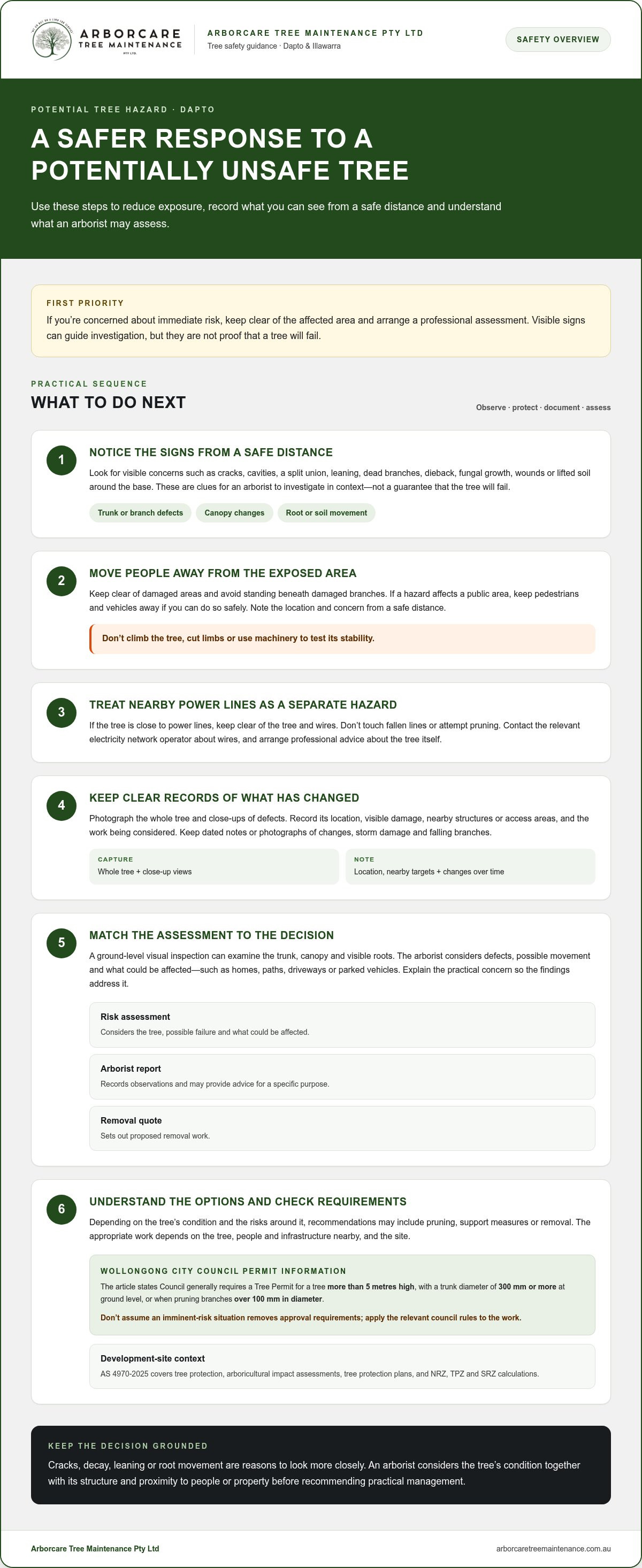
If a tree threatens a house, move people away from the exposed area and avoid standing beneath damaged branches. If it is close to power lines, keep clear of the tree and wires. Don’t touch fallen lines or attempt pruning. Contact the relevant electricity network operator about wires, and arrange professional advice about the tree itself.
For an immediate public hazard, keep pedestrians and vehicles away if you can do so safely. A leaning tree beside a footpath, for instance, may affect people beyond the property boundary. Note the location and visible concern from a safe distance. Don’t climb the tree, cut limbs or use machinery to test its stability.
An arborist considers the defect, possible movement and nearby targets, such as homes, paths and parked vehicles. Storm damage, a split union or lifted soil around the base can change the level of concern. These details help prioritise a response, including whether access should remain restricted while the hazard is addressed.
Keep dated photographs and notes of changes, especially when a hazard affects a shared driveway or public access. Clear records help explain how the situation developed. If overhanging growth is the main issue, pruning may address the obstruction; a dangerous tree assessment in Dapto can help distinguish that from a wider safety concern. For urgent tree hazards, emergency tree service is a relevant next step. The appropriate work depends on the tree, the risk to people and infrastructure, and the site.
Root location and disease investigation
Investigating roots and disease means looking beyond visible canopy symptoms to understand what may be affecting a tree. In Dapto, the site history, tree species and nearby residential infrastructure help guide the inspection.
Start by noting changes around the base, such as exposed roots, lifted soil, fresh ground cracks or excavation damage. These observations can help an arborist investigate whether root disturbance may affect the tree’s stability. A Visual Tree Assessment checks for visible root damage alongside signs such as leaning, cracks and cavities.
Roots may extend beneath lawns, paths or buildings, so their likely location matters before construction or ground work. Record where paving has lifted, where soil has changed and where trenches or other disturbance have occurred. These are useful site clues, but they don’t prove on their own that roots have failed. An arborist considers the pattern and context before drawing conclusions.
Disease investigations also start with observable changes. Note canopy dieback, dead branches, wounds, fungal growth or changes around the trunk, then photograph affected areas from a safe position. The tree species can help frame what these signs mean, while the location and extent of symptoms can guide closer inspection. Don’t scrape bark or cut into the tree to investigate it yourself.
If internal decay is suspected, an arborist may use specialised tools. A resistograph measures wood resistance with a drilling needle, helping detect internal decay. Sonic tomography uses sound waves to image internal structure and identify decay or hollowing. These methods can add information beyond an external inspection, particularly when a trunk appears intact but other signs raise concern.
Development work adds another layer. AS 4970-2025 covers tree protection on development sites, including tree protection plans and NRZ, TPZ and SRZ calculations. For a residential project, an arboricultural assessment can consider how proposed work relates to roots and protected trees. Include site plans, the work area and visible ground changes when discussing the proposal with an arborist.
- Record: Photograph soil changes, root exposure and canopy symptoms.
- Map: Mark paths, buildings, excavation areas and nearby infrastructure.
- Describe: Note when changes appeared and whether they followed ground work or construction.
These observations give the assessment a clearer starting point. They can also help distinguish a localised symptom from a broader site pattern, supporting practical tree management and informed discussions about council requirements.
Tree health and structural inspections
A structured inspection connects visible tree health with risks around the site. An arborist records defects, considers who or what could be affected, and explains how each observation informs tree management. A cracked branch above a regularly used path deserves attention because people pass beneath it. The same defect over an unused area presents a different level of exposure.
A Visual Tree Assessment checks visible signs such as cracks, cavities, root damage and leaning. The arborist also considers canopy condition, deadwood, wounds and the tree’s overall form. One symptom alone doesn’t establish the level of risk. Its position, extent and relationship to the rest of the tree all matter.
A good inspection covers the surroundings, not just the trunk. Nearby homes, driveways, public access areas and infrastructure help identify potential targets if a branch or tree fails. For larger properties, inspection resources can focus on areas with greater use. Trees near people or property need a more rigorous inspection regime than trees in less-used areas.
- Observe: Note visible changes to the trunk, canopy, roots and branch unions.
- Locate: Record paths, buildings and other targets within the tree’s potential reach.
- Document: Photograph evidence and record where each defect appears.
After a major storm, arrange an assessment to identify damage and potential risks. A split limb over a garage, for example, needs to be considered alongside the tree’s other structural features and the space below it. Clear photographs taken from a safe distance can help document what has changed. Regular inspections can also help keep tree-related risks at an acceptable level.
If visual evidence leaves questions about the tree’s internal condition, further investigation may be considered. The approach depends on the suspected defect and what the assessment needs to establish. An arborist explains the evidence gathered and how it supports the findings, rather than treating a single test as a complete assessment.
For formal advice, an AQF Level 5 arborist can prepare tree reports, development application reports and tree removal reports, and provide consultation about trees and their environment. The report should connect observed evidence to clear recommendations. That helps a property owner understand whether monitoring, maintenance or another response best addresses the identified risk.
Inspection findings are useful when they lead to a clear next step. Ask for the defect’s location, its relevance to nearby targets and the reasoning behind the recommendation. A written record supports consistent tree management, particularly when conditions change after storms, construction or further canopy decline.
Understanding the relationship to nearby targets and the evidence behind the recommended response makes it easier to see why an inspection is being prioritised and what should happen next. For larger properties, inspection resources can focus on areas with the greatest use and risk, rather than treating every tree as an equal priority. This approach accounts for exposure and site use when planning inspections.
Trees near public access areas, people and property require a more rigorous inspection regime. Inspection priorities can reflect how close trees are to people and property, as well as how much each area is used. Clear records of observed defects and their locations help keep those priorities connected to the tree’s condition and the risks around it.
Tree retention and removal recommendations
A recommendation should connect the tree’s condition with the risk and practical options. A consulting arborist weighs structural evidence, nearby targets and environmental considerations before advising on retention, treatment or removal.
Removal isn’t the only possible response to a defect. Depending on the tree and its surroundings, an assessment may recommend pruning, cabling or bracing to mitigate risk. For example, targeted pruning may address a hazardous branch while retaining the rest of a viable tree. The recommendation should explain which risk the proposed work addresses.
Decisions about retaining a tree consider whether it can remain safely with appropriate management. The arborist looks at the location and extent of defects, the likelihood of failure and the consequences for people or property. A defect above a regularly used area may have different implications from one away from buildings and access. Environmental value and the effects of removal also inform the advice.
Removal may be recommended where the assessment identifies risks that other measures cannot adequately address. A report should set out the evidence, explain why removal is proposed and identify relevant site constraints. After a major storm, an assessment can reveal damage and potential risks. Before construction, assessing surrounding trees can help prevent site damage and support compliance with local council requirements.
Do Wollongong Council rules require approval to prune or remove a dangerous tree? Wollongong City Council generally requires a Tree Permit for a tree more than 5 metres high, with a trunk diameter of 300 mm or more at ground level, or when pruning branches over 100 mm in diameter. A hazard assessment doesn’t itself establish that approval is unnecessary.
Properties zoned RU1, RU2 or RU4 may require approval from Local Land Services rather than Wollongong City Council. Identify the property’s zoning and proposed work before proceeding. Where approval applies, the arborist’s report and supporting evidence can explain the hazard and the recommended response.
- Retain: Consider whether suitable management can address the identified risk.
- Modify: Assess whether pruning, cabling or bracing can reduce the hazard.
- Remove: Use the report’s findings to explain why removal is recommended.
Keep the recommendation, photographs and any council correspondence together. These records help connect the assessment to the work proposed and clarify why that response fits the tree and site. For a tree removal recommendation, request tree removal advice as the next practical step.
If a recommendation concerns a boundary tree or follows a disputed removal, keep the assessment, photographs, correspondence and work records together. The NSW Land & Environment Court hears most tree-related civil matters in NSW, including boundary-tree disputes and illegal-removal compensation disputes. Clear records help show what was observed, what response was advised and how the work related to the reported condition.
If views differ about the recommendation, distinguish the arborist’s observations from assumptions about responsibility or intended work. A concise record of the tree’s condition, the options considered and the reasons for the selected response can make later discussions more focused. Keep the report available when arranging work, and note any agreed changes so the final action remains connected to the assessment.
Arborcare Tree Maintenance: Tree Removals
Arborcare Tree Maintenance Pty Ltd can help when an assessment recommends removal to address a tree hazard. Its Tree Removals service offers a practical next step when a tree needs to come down, while pruning may suit a specific branch or canopy concern. Palm Tree Removals and Stump Grinding are also available when those tasks are part of the property work.
Use the assessment findings to explain the tree’s condition, location and recommended work. If removal is advised, these details help clarify the next step and keep the decision connected to the identified risk.
Contact Arborcare Tree Maintenance Pty Ltd to discuss tree removal for your property.
Take the next step with a clear plan
A dangerous tree assessment in Dapto can guide what happens next, but the findings are most useful when matched to a practical plan for your property. Keep the arborist’s observations, photographs and recommended work together. This gives you a clear basis for discussing the tree and deciding how to manage the affected area.
Where removal is recommended, Arborcare Tree Maintenance offers Tree Removals and Palm Tree Removals. If the assessment points to managing selected branches instead, its Hedging, Pruning & Trimming service may suit the work. The right option follows the tree’s condition and the assessment’s advice, rather than assuming every concern requires removal.
Take the next step by sharing your tree concern and the assessment findings with Arborcare Tree Maintenance. Contact Arborcare Tree Maintenance to discuss the work needed for your property. A clear plan can help you move forward with confidence and keep safety at the centre of your decision.
Frequently Asked Questions
How soon can you attend for an urgent assessment?
Arborcare Tree Maintenance’s emergency tree service is available 24 hours × 7 days for fallen or storm-damaged trees. Call 1300 673 407 and describe the immediate hazard, its location and whether people, property or vehicles are threatened. The service covers Dapto, Wollongong, Illawarra, Shellharbour, Wonoona, Jamberoo, Fairy Meadow and Dombarton. This gives the team clear information about the situation when you call.
What signs indicate a tree may be dangerous or structurally unstable?
Sudden changes deserve attention, especially after strong wind or heavy rain. From a safe distance, look for a branch newly caught in the canopy, a shifted trunk or fresh damage near a building or driveway. Compare the tree with earlier photographs if you have them. Keep people away from the affected area and don’t touch fallen branches, climb the tree or attempt repairs.
How quickly can an arborist inspect an urgent hazardous tree in Dapto?
For an urgent inspection, contact Arborcare’s emergency service and explain what makes the tree hazardous. Say whether it has fallen, blocks access, hangs over an occupied area or threatens vehicles. Give the property address and describe safe access, along with any nearby overhead wires. These details help communicate the urgency clearly. Keep people clear of the tree while arranging professional assistance, and never approach damaged power lines.


