
Don’t cut down a tree near power lines yourself. If you’re considering cutting down a tree near power lines in Wollongong, leave the work to a professional, and report a tree touching wires or posing immediate danger to Endeavour Energy on 131 003. The clearance that applies depends on the line type and the relevant network requirements.
It’s understandable to want to deal promptly with an overhanging branch or a tree on your property. But working near live lines can put you, others and the electricity supply at risk. Who can carry out the work depends on how close the vegetation is to the wires.
This guide explains the difference between service lines and distribution powerlines, what clearance rules mean for tree work, and when contractor approval or notification may apply. It also covers what to do if a tree is touching a line, helping you make a safer decision before any cutting begins.
Key Takeaways
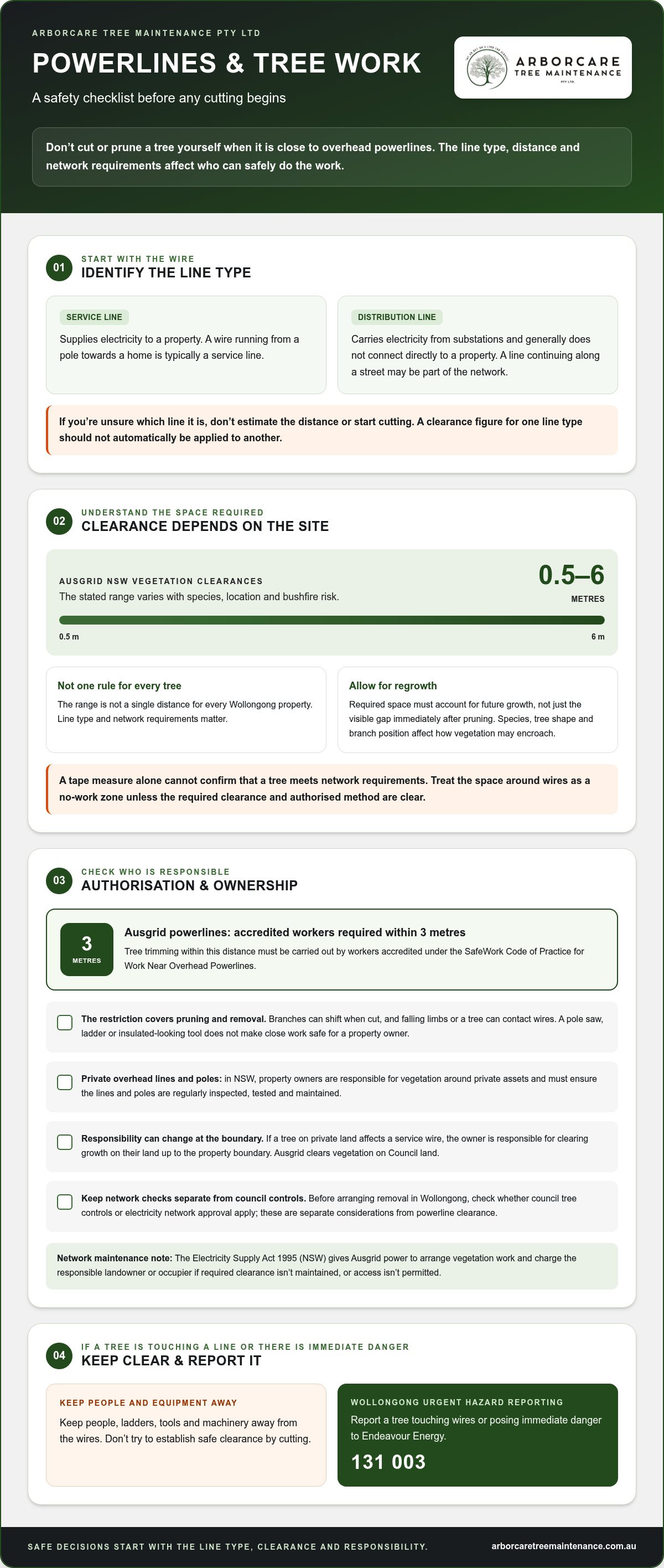
- Don’t cut or prune a tree yourself when it is close to overhead powerlines; the line type and distance affect who can safely do the work.
- Service lines and distribution powerlines have different clearance requirements, so identifying the kind of line is an important first step.
- Within three metres of Ausgrid powerlines, tree trimming must be done by workers accredited under the SafeWork Code of Practice for Work Near Overhead Powerlines.
- Check whether council tree controls or electricity network approval apply before arranging removal, as these can affect what happens next.
- If a tree is touching powerlines or poses immediate danger in Wollongong, report it to Endeavour Energy by calling 131 003.
What are the required clearances for Service lines?
There is no single clearance distance for every tree near overhead wires in New South Wales. The required space depends on the line type, location, vegetation and bushfire risk.
Minimum powerline clearance distances
Minimum clearance is the space vegetation must remain from electrical wires to reduce contact risks and help protect the network. According to Ausgrid, NSW vegetation clearances range from 0.5 to 6 metres, depending on species, location and bushfire risk. That range is not a single distance to apply to every Wollongong property. The electricity network and line type matter.
Clearance must also allow for future growth. A branch cut back from a wire can grow towards it again, so the required space must account for regrowth, not just the visible gap after pruning. Tree shape, species and the position of branches around the wires all affect how vegetation may encroach.
Clearance zones for distribution lines
A distribution line carries electricity from substations and generally does not connect directly to a property. A service line supplies electricity to a property. Identifying which type of line is involved helps establish the relevant clearance zone and who should manage nearby vegetation.
For example, a wire running from a pole towards a home is typically a service line, while a line continuing along a street may be part of the distribution network. The distinction matters because a clearance figure for one line type should not automatically be applied to another. If you are unsure which line it is, don’t estimate the distance or start cutting.
In Wollongong, treat the space around wires as a no-work zone unless the required clearance and authorised method are clear. A tape measure alone cannot show whether a tree meets the network’s requirements: branches move, crowns spread, and the line’s position and type affect the assessment. Keep people, ladders, tools and machinery away from the wires while arranging the appropriate response.
Clearance is an ongoing maintenance issue, not just a one-off measurement. A tree that appears clear after pruning may grow back into the required space, and different species have different growth patterns. Consider the whole canopy and likely regrowth when assessing trees near lines. Repeatedly cutting branches without understanding the applicable clearance can leave the underlying risk unresolved.
These distinctions explain why cutting down a tree near power lines in Wollongong is not ordinary garden work. The required distance depends on the network’s requirements for that line and site. If vegetation is close to a wire, touching it or creating an outage risk, don’t try to establish safe clearance by cutting it yourself.
Accredited contractors and electrical safety
Tree work beside live electricity lines is not ordinary garden trimming. In NSW, the distance from the wires determines who can perform the work, while ownership of the line affects who must maintain it.
For Ausgrid powerlines, tree trimming within three metres must be carried out by workers accredited under the SafeWork Code of Practice for Work Near Overhead Powerlines. A pole saw, ladder or insulated-looking tool does not make it safe for a property owner to work closer. Have a professional arborist or tree trimmer handle vegetation near powerlines rather than attempting the work yourself.
This restriction applies to both pruning and removal. A branch can shift as it is cut, and a falling limb or tree can contact wires. Electricity can also make nearby equipment and vegetation hazardous. Species and branch structure affect how a tree moves during cutting, but they do not change who is authorised to work within the required zone.
Private overhead lines and landowner duties
In NSW, property owners are responsible for vegetation around private overhead powerlines and poles. They must also ensure those lines and poles are regularly inspected, tested and maintained. These duties apply to private electrical assets on the property, not only to trees that look unstable.
If a tree on private land affects a service wire, the owner is responsible for clearing growth on their land up to the property boundary. Ausgrid clears vegetation on Council land. This distinction helps establish where responsibility changes, especially when branches cross a boundary or a service wire runs above more than one area.
The Electricity Supply Act 1995 (NSW) gives Ausgrid power to arrange vegetation work and charge the responsible landowner or occupier if required clearance isn’t maintained, or access isn’t permitted. Avoiding access doesn’t remove the underlying maintenance duty. Keeping private lines and poles accessible for inspection helps identify damaged assets and vegetation conflicts before work becomes urgent.
Before any tree work, establish whether the affected wire is a private overhead line, a service wire or part of Ausgrid’s network. Don’t assume that a line above your yard is yours to trim. Work within three metres of Ausgrid powerlines must meet the accreditation requirement. Even outside that zone, electrical hazards call for careful assessment and a suitable professional.
Once electrical risks and network responsibilities are addressed, routine vegetation management can help prevent branches growing towards wires again. For work away from the electrical hazard, tree pruning and trimming may suit the property’s maintenance needs.
Council permits and tree removal
Electricity network clearance and council permission are separate considerations when a tree near powerlines may need removal. Before arranging work in Wollongong, establish which decision applies to the tree and which applies to the wires. The tree’s position, condition and relationship to electrical assets can affect the assessment.
Start by identifying the property boundary, the tree’s location and the nearby line. Then establish whether the proposed work is pruning or complete removal. These details help you describe the work accurately when contacting council or reporting a powerline concern. Network involvement does not automatically cover council requirements, and council permission does not authorise work near live wires.
Tree protection controls can depend on the site and the tree, so the same approach may not suit every property. A tree near a home, boundary or public area may raise different planning and access questions from one in an open backyard. Council considers the property context and proposed work. Don’t begin removal until you understand the applicable requirements.
Why a tree may need removal
Removal may be considered when a tree is dead, structurally compromised, damaging property or creating an ongoing conflict with overhead electricity lines. For example, a large tree whose crown repeatedly grows towards a supply line may need a broader assessment than a single branch that needs pruning. The tree’s condition and the proposed work help determine whether removal is appropriate.
Proximity alone does not mean a tree must come down. If targeted pruning can address the issue safely, removal may not be necessary. Removing a tree also does not authorise unqualified work near wires. Council and network decisions address different concerns, so resolve each before work begins.
Approval and work timeframes
Allow time for council and network decisions before setting a removal date. The timeframe depends on the information required, the tree’s condition, proximity to electrical assets, access and whether the situation is urgent. A tree too close to wires may require network assessment or coordination before pruning or removal can proceed.
Urgent danger requires a different response from planned maintenance. If a tree is touching powerlines or threatening the electricity supply, report the hazard to Endeavour Energy rather than treating it as a routine council application. For non-urgent vegetation growing towards a line, clearly describe the location and issue when seeking an assessment. Don’t start cutting while approval or electrical arrangements remain unresolved.
Keep council correspondence and network instructions with the tree-work details. This helps distinguish permission to remove a tree from authorisation to work near powerlines. If a tree is too close to electrical assets, resolve the network safety requirements first, then plan removal around any applicable council decision.
Contractor notification and tree removal approval
Before booking tree work near overhead electricity lines, separate three decisions: who can perform the work, whether network coordination is needed, and whether council permission applies. Set a contractor’s proposed removal date only after those decisions are settled. This avoids arranging for a crew to cut branches while electrical access or tree approval remains unresolved.
In Wollongong, Endeavour Energy is the local electricity company. A tree affecting its network may need to be reported or assessed before work proceeds. Clearly describe the tree’s position, the nearby line and whether branches are touching or approaching it. This helps distinguish planned maintenance from an immediate hazard.
Notification periods can depend on the network and type of work. A scheduled trim, an urgent hazard and a complete removal are different requests. Don’t assume a notice period published for another electricity distributor applies in Wollongong. Follow the relevant network’s instructions for the affected line and wait for any required coordination before working near it.
What approval changes for the contractor
Network approval or coordination may affect when a contractor can begin and what work can safely proceed. For example, a tree may be ready for removal from an arboricultural perspective, but branches near live wires still require an appropriate electrical safety arrangement. Council permission is separate. Approval to remove a protected tree does not authorise work inside a powerline safety zone.
Give the contractor the information available, including the property location, tree species if known, proposed work and any network or council correspondence. A request to prune branches differs from a request to remove the whole tree. Clear records help everyone understand the scope and prevent work from going beyond the approval received.
Timing also depends on whether the tree presents an immediate danger. For planned work, allow the network and council processes to run before confirming a start date. If branches are touching wires or threatening the electricity supply, report a safety hazard rather than making a routine contractor booking. Don’t climb, cut or move the tree while waiting for a response.
Planting choices can reduce future conflicts. Before planting beneath overhead lines, consider the species’ mature height and spread, not just the size of the sapling. Vegetation growing into a clearance zone can lead to repeated pruning or a later removal request. Avoiding unsuitable trees in these areas supports network access and reduces preventable conflicts.
Once any required council and network decisions are in place, the contractor can plan the work around the approved scope and site conditions. For a complex removal, the tree’s size, branch structure and position relative to electrical assets shape the work plan. Keep approval records available on the day, and stop if actual conditions differ from the agreed arrangements.
What should I do if a tree is touching power lines or poses an immediate danger in Wollongong?
If a tree is touching powerlines or appears likely to fall onto them, don’t approach or try to cut it. In Wollongong, report the hazard to Endeavour Energy through its website or by calling 131 003. Keep other people away while you report the location and what you can see.
Report the hazard, not a routine tree job
Tell Endeavour Energy whether branches are touching wires, the tree is leaning towards a line or damage has occurred. Give the street address and a clear description of the affected tree. If you can provide details from a safe position, explain whether the wires run to a property or along the street. Don’t move closer to identify the line.
Reporting a hazard to the electricity network is different from booking a contractor to remove a tree. The network must assess hazards involving its powerlines and determine the appropriate response. Don’t ask a private tree contractor to start work on or beside live wires before the electrical risk has been addressed.
Keep people clear and avoid contact
Do not touch the tree, branches, wires or anything in contact with them. Keep away with ladders, pole saws, vehicles and garden tools. A branch touching a line can make the tree dangerous even if it appears stationary. Keep children, visitors and pets away, and tell anyone nearby to avoid the area.
If the tree is on a driveway, footpath or access route, don’t try to clear it yourself. Report the obstruction and its position to Endeavour Energy. If the situation changes, such as a branch falling onto wires, report the updated condition. Don’t approach the hazard to take a photograph.
If a tree is near powerlines but does not present an immediate danger, contact Endeavour Energy before arranging work. Describe the tree’s location and the work being considered. Network instructions matter because a contractor’s usual tree-removal plan may not be suitable beside electrical assets. A routine appointment is not approval to work near wires.
After the electricity hazard has been addressed, the tree may still need separate assessment for removal or maintenance. Council requirements can also apply, depending on the tree and property. Keep network advice and council correspondence available for the person planning later work. These decisions are separate from the initial hazard report.
If the tree has been cleared for ordinary removal work, arrange professional tree removal rather than attempting a high-risk cut yourself. Keep the tree and wires untouched until the immediate electrical danger has been dealt with.
Arborcare Tree Maintenance: Tree Removals
Arborcare Tree Maintenance provides Tree Removals for property owners planning work after electrical and council requirements have been addressed. If a tree’s size, position or condition makes removal more suitable than ongoing pruning, professional tree removal can help manage the work across your property.
For trees that can remain, Hedging, Pruning & Trimming may address overgrowth away from powerlines. Arborcare also provides Palm Tree Removals and Stump Grinding where those tasks are needed. Work close to live wires must not begin until the electricity network has addressed the electrical risk and any required arrangements are in place.
Contact Arborcare Tree Maintenance to discuss tree removal or maintenance for your property.
Plan the next step with safety in mind
Before booking work, make the intended outcome clear: retain the tree with selective maintenance, or remove it once the relevant approvals and electrical arrangements are settled. This defines the scope and helps prevent a powerline hazard from being treated as routine garden maintenance. For cutting down a tree near power lines in Wollongong, follow the network’s safety requirements rather than rushing to clear branches.
Once work can safely proceed, Arborcare Tree Maintenance can help with Tree Removals, Hedging, Pruning & Trimming, and Palm Tree Removals. The right service depends on the tree and agreed scope, not proximity to wires alone.
Contact Arborcare Tree Maintenance about your tree work and take the next step with a clear plan.
Frequently Asked Questions
Can I cut the tree myself or do I need to hire a contractor?
Don’t cut or prune a tree close to powerlines yourself. Branches can move unexpectedly, and a tree touching a wire can create a serious electrical hazard. For cutting down a tree near power lines in Wollongong, first report any immediate danger to Endeavour Energy on 131 003. For planned work near wires, a qualified professional must assess the electrical risk and the applicable network requirements before cutting starts.
Can a property owner trim trees near the network?
Property ownership doesn’t authorise you to trim vegetation close to network powerlines. Within three metres of Ausgrid powerlines, tree trimming must be carried out by workers accredited under the SafeWork Code of Practice for Work Near Overhead Powerlines. Property owners in NSW are responsible for vegetation around private overhead lines and poles. That responsibility is distinct from permission to work near electricity network assets.
What happens where vegetation grows too close to powerlines on a private property?
Where required clearance isn’t maintained, Ausgrid may arrange vegetation work and charge the responsible landowner or occupier under the Electricity Supply Act 1995 (NSW). This can also apply if access is not permitted. The action depends on the affected network and the property circumstances. Don’t delay reporting branches approaching wires; a tree near a service line and one near a street distribution line may involve different responsibilities.
What is minimum vegetation clearance?
Minimum vegetation clearance is the required separation between a tree or branch and an overhead electrical line. According to Ausgrid, NSW vegetation clearances range from 0.5 to 6 metres, depending on species, location and bushfire risk. The applicable distance isn’t one universal figure for every Wollongong property. Line type and network requirements affect the assessment, so don’t use a general measurement to decide whether cutting is safe.
When are you coming to cut my tree?
A tree-work date can be planned once the work scope and any required electrical or council arrangements are established. A routine removal differs from a hazardous tree touching wires, which should be reported to Endeavour Energy on 131 003. For planned work, the tree’s location, access and proximity to powerlines affect scheduling. Keep any network or council correspondence available when discussing the proposed work with a tree contractor.
Who can help me trim vegetation near my Service line?
Use a qualified tree professional for vegetation near a service line, and don’t attempt the trimming yourself. If branches are above or touching a service line in Wollongong, contact Endeavour Energy on 131 003 to report the issue and establish the appropriate network response. A tree contractor can address ordinary tree work only when electrical safety requirements allow it. Describe the line’s location and the affected branches from a safe position.
Who is responsible for trees near power lines in Wollongong?
Responsibility depends on the tree’s location, the line and who owns the relevant land or electrical asset. In NSW, property owners maintain vegetation around private overhead lines and poles. For a tree affecting a service wire, the owner clears growth on their land up to the property boundary; Ausgrid clears vegetation on Council land. Endeavour Energy is Wollongong’s local electricity company, so report network hazards to it.
When must a licensed arborist be authorised to work near power lines in NSW?
For Ausgrid powerlines, tree trimming within three metres must be carried out by workers accredited under the SafeWork Code of Practice for Work Near Overhead Powerlines. A general arborist licence alone does not show that a worker holds this specific accreditation. The relevant network and distance determine the work requirements. Before arranging pruning, identify which line is involved and keep people, tools and equipment away from nearby wires.


