What if that leaning trunk in your backyard isn't just a garden eyesore, but a structural liability waiting for the next southerly buster to strike? Many homeowners in the Illawarra feel a genuine sense of dread when the winds pick up, wondering if their palms will hold firm or come crashing down on the roof. It's frustrating to deal with the constant mess of falling seeds and heavy fronds; it's even more stressful to feel uncertain about whether your tree is actually dying. If you're concerned about property damage, understanding the process for dead palm tree removal is the first step toward reclaiming your peace of mind.
You shouldn't have to guess when it comes to the safety of your home and family. This article provides a comprehensive safety checklist to help you accurately identify a dead palm, assess the immediate risks, and navigate the specific permit rules for Wollongong and Shellharbour councils. We will preview the essential steps for organising a professional removal, ensuring you have a clear plan in place before the next storm season arrives. By the end of this guide, you'll have the certainty needed to secure your property and eliminate the hazards of a failing tree.
Key Takeaways
- Learn to identify critical signs of decline, such as a failing spear leaf or trunk narrowing, before the tree becomes a structural hazard.
- Understand the unique mechanical risks of dead palm tree removal, including brittle wood and the "sail effect" that can cause unexpected failure during storms.
- Clarify whether your specific palm species requires a council permit in the Illawarra or if it falls under local environmental weed exemptions.
- Follow a professional site assessment checklist to ensure overhead powerlines and surrounding structures are protected during a sectional dismantle.
- Recognise the importance of professional stump grinding to eliminate termite risks and restore your garden's health after a tree is gone.
Is Your Palm Tree Actually Dead? The Diagnostic Checklist
Determining whether a palm is truly dead or simply dormant requires a methodical approach. Unlike traditional hardwood trees that might lose leaves and recover, palms are monocots that rely on a single growing point. If that central point fails, the tree's biological clock has essentially stopped. Identifying these signs early is vital for property safety; a standing dead palm is a structural liability that only becomes more brittle over time. Professional dead palm tree removal is often the only way to eliminate the risk of an uncontrolled collapse during a storm.
The "Spear Leaf" Test
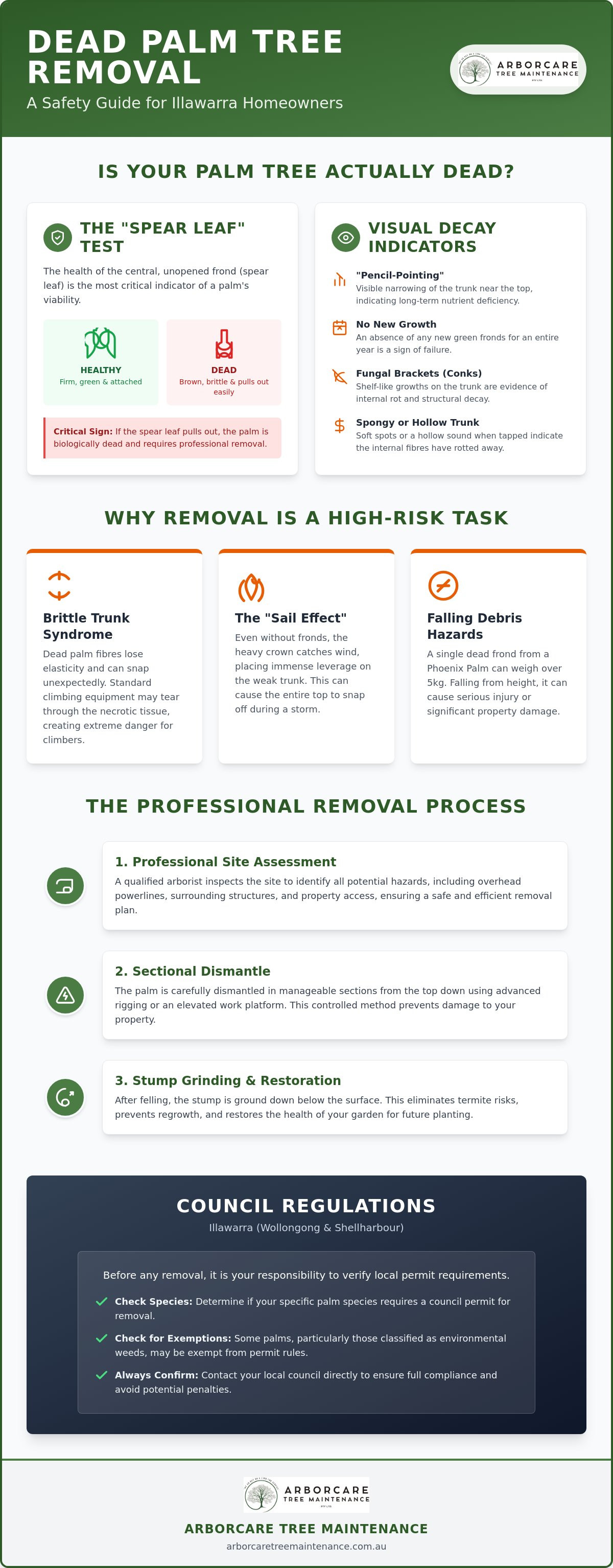
The health of any palm rests entirely on its apical meristem, commonly known as the heart. This is the central point at the very top of the trunk where new fronds emerge. The "spear leaf" is the newest, unopened frond in the very centre of the crown. To check the tree’s viability, you can inspect this central growth. If the spear leaf has turned brown or feels brittle, it is a sign of internal rot. In many cases, a dead heart allows the spear leaf to be pulled out of the crown with very little effort. If this occurs, the palm is biologically dead and cannot be saved. It's a clear point of no return that requires immediate professional intervention to prevent the crown from eventually detaching and falling.
Visual Decay Indicators
While the crown tells the story of the tree's current life, the trunk reveals its structural history. One of the most common signs of long-term decline is "pencil-pointing". This is a visible narrowing of the trunk as it nears the top, suggesting the tree hasn't had the nutrients or water to maintain its girth for several seasons. If you haven't seen a single new green frond emerge for an entire year, the tree is likely failing. You should also inspect the base of the trunk for fungal brackets or "conks". These shelf-like growths are the fruiting bodies of fungi that feed on decaying wood; their presence proves that the internal structure is rotting away.
Environmental factors and pests can accelerate this decline. Diseases like Lethal yellowing can spread quickly through a garden, turning fronds yellow and killing the tree's heart in months. You should also look for signs of the palm weevil, such as small entry holes or "frass" that looks like wet sawdust at the base. While some palms naturally shed old bark, necrotic tissue that feels soft, spongy, or hollow when tapped is a serious warning sign. If the trunk can no longer support the weight of the crown, the risk to your family and home increases daily. Recognising these symptoms early allows you to plan for a safe removal before the next high-wind event hits the Illawarra coast.
Why Dead Palm Tree Removal is a High-Risk Task
Dead palm trees are deceiving. They look like solid, immovable pillars, but internally, they are often undergoing a rapid structural breakdown. This makes dead palm tree removal far more dangerous than removing a healthy specimen. While a living palm is designed to sway and flex in the coastal winds of the Illawarra, a dead one becomes a rigid, brittle liability that can fail without warning.
Brittle Trunk Syndrome
Palm "wood" isn't actually wood; it's a dense mass of fibrous vascular bundles. When the tree dies, these fibres lose their moisture and elasticity. Instead of bending under pressure, the trunk can snap like a dry twig. This poses a severe risk for climbers. Standard climbing spurs or safety anchors that would hold firm in a live tree can easily tear through necrotic, dry tissue. Because of these unpredictable failures, complex tree removal Illawarra expertise is essential to ensure the work is performed using aerial platforms or advanced rigging that doesn't rely on the tree's integrity.
The "sail effect" further complicates the risk. Even without green growth, a dead palm crown remains a massive, heavy structure. During a storm, this crown catches the wind, exerting thousands of kilograms of force on the trunk. A healthy palm absorbs this energy by swaying. A dead palm resists it until the breaking point. This often results in the entire crown "popping" off or the trunk splintering mid-way up, sending tonnes of debris toward your home or powerlines.
Falling Debris Hazards
The weight of falling palm components is frequently underestimated by homeowners. A single dead Phoenix Palm frond can exceed 5kg. When these fall from heights of 10 or 15 metres, the impact force is enough to shatter roof tiles, pierce guttering, or destroy expensive glass pool fencing. Seed pods are even heavier and can drop with zero warning. Many backyard accidents in Australia occur when homeowners attempt DIY ladder work to trim these hazards. Balancing a heavy, prickly frond while standing on a ladder is a high-risk activity that rarely ends well.
Finally, dead palms are prone to rapid root rot, especially in the often-saturated soils of the Illawarra region. Once the roots stop drawing moisture, they decay quickly, and the tree's subterranean anchor vanishes. A dead palm that survived last year’s winds might tip over entirely this year during a period of heavy rain. If you are concerned about a leaning or dead tree, engaging a specialist for safe dead palm tree removal is the most effective way to protect your property. For peace of mind, it is best to organise professional Palm Tree Removals before the next major weather event hits the coast.
Council Regulations: Do You Need a Permit in the Illawarra?
Understanding local government regulations is a critical step before commencing any tree work. In the Illawarra, both Wollongong City Council and Shellharbour City Council maintain strict Tree Preservation Orders (TPOs) to manage the region’s urban canopy. While the risks discussed in previous sections make dead palm tree removal a priority, you must ensure your actions comply with local laws to avoid significant fines. Generally, a permit is required in Wollongong for any tree taller than five metres or with a trunk diameter exceeding 30 centimetres at ground level. However, specific exemptions exist for dead or dying vegetation that simplify the process for homeowners.
Exempt Species in Wollongong
Many palms found in local backyards are classified as environmental weeds rather than protected species. The Cocos Palm (Syagrus romanzoffiana) is a prime example. Because it is an invasive species that outcompetes native flora and creates significant mess, it is often exempt from permit requirements. In Shellharbour, for instance, a Cocos Palm with a trunk diameter of 600mm or less typically does not require a formal application for removal. Conversely, the native Cabbage Tree Palm (Livistona australis) is a protected species. Even if a Cabbage Tree Palm appears dead, you should verify its status with council before proceeding, as native specimens over five metres almost always require a merit assessment by a qualified arborist.
The "Imminent Risk" Exception
If a tree poses an immediate threat to life or property, it may fall under the "imminent risk" exception. This is common when a dead palm is leaning precariously over a dwelling or powerlines during storm season. In Wollongong, council policy generally allows for the removal of dead trees with no living foliage without a permit. It is vital to document the tree’s condition thoroughly before the saws start. We recommend taking clear photographic evidence of the decay and obtaining a brief risk assessment from a professional. This ensures you are protected if council enquiries arise later. For a deeper dive into these local requirements, our guide on palm tree removal Illawarra provides a detailed breakdown of the application process.
Since July 1, 2023, Wollongong City Council has mandated a replacement tree policy. If you remove a tree under a permit, you are now required to plant a new one elsewhere on your property. Navigating these shifting rules is part of our role as your local experts. By ensuring your dead palm tree removal is performed legally and safely, you protect both your property and your standing with the local community.
Professional Removal Checklist: What to Expect
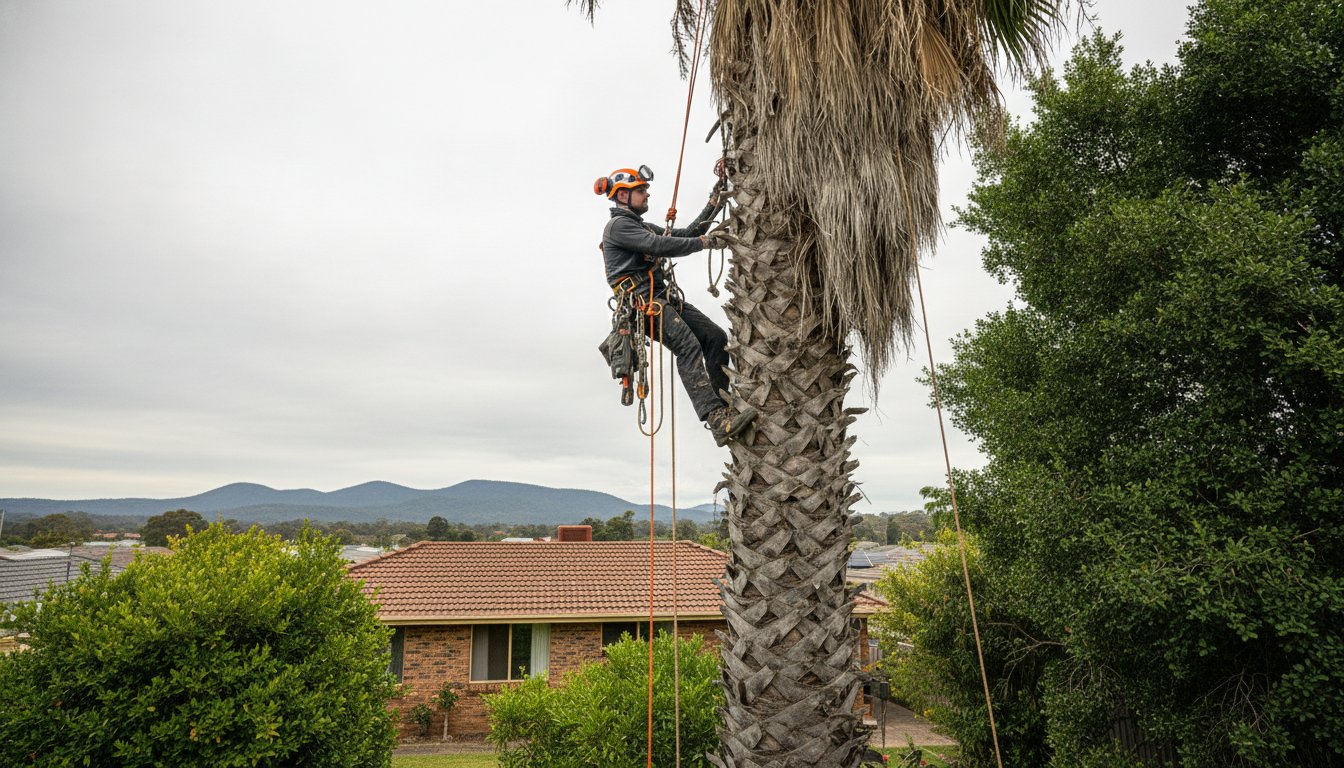
Every professional dead palm tree removal begins with a rigorous site assessment. We don't just look at the tree; we evaluate the entire environment, identifying overhead powerlines, underground services, and nearby property obstacles like glass pool fencing or garden sheds. This methodical preparation ensures that every potential hazard is accounted for before a single cut is made. In the Illawarra, where properties often have tight access and coastal winds are a factor, this initial step is the foundation of a safe and successful operation.
Specialised Equipment
Removing a dead palm requires a specific kit that differs from standard tree lopping gear. Because dead palm tissue is notoriously fibrous and tough, our chainsaws require specialised sharpening to prevent the chain from binding or dulling instantly. For trees that are structurally unsound or located in high-risk areas, we often utilise elevated work platforms (EWPs) or cranes. This allows our team to access the crown without putting weight on a brittle trunk. We also employ a system of high-strength rigging ropes and pulleys to lower heavy sections of the trunk and the crown in a controlled manner, preventing any uncontrolled impacts on your lawn or structures.
Property Protection Measures
We treat your property with the same respect as our own. This includes laying heavy-duty ground mats to protect your turf and driveways from equipment weight and falling debris. We establish clear exclusion zones to keep your family and pets at a safe distance while the work is in progress. Our commitment to a spotless site is a core part of our service; we don't consider the job finished until every frond and seed pod is cleared away. This "Arborcare promise" ensures that your garden is left in better condition than we found it.
The actual removal process involves a sectional dismantle. Rather than felling the palm in one dangerous piece, we take it down in small, manageable segments. This is particularly important for frond management. Dead fronds are secured and lowered individually to prevent them from catching the wind or striking the house. Once the tree is on the ground, the fibrous waste is processed through a high-capacity wood chipper. While palm waste is difficult to mulch compared to hardwoods, our industrial equipment handles it efficiently, leaving you with a clean, clear space. If you need help managing a hazardous tree, you can book a professional inspection for Palm Tree Removals to secure your property today.
Beyond the Cut: Stump Grinding and Replanting
The physical removal of the trunk and crown is only one part of a professional resolution. To truly eliminate the risks associated with dead palm tree removal, you must address the subterranean remains. Many homeowners assume that cutting a tree to ground level is sufficient; however, leaving the stump behind creates a long-term maintenance burden that can impact the health and safety of your entire garden. A professional finish ensures your land is safe, level, and ready for future growth.
The Problem with Palm Stumps
Palm stumps are unique because they are essentially a massive, moisture-retaining ball of wet fibre. Unlike hardwoods, which eventually dry out, palm stumps rot slowly from the inside out and often produce a distinct, sour odour. This damp, decaying environment is an ideal habitat for pests, particularly termites. If a stump is left in the ground near your home or timber fencing, it can act as a primary nesting site for wood-destroying insects. Beyond the pest risk, as the massive root ball eventually decomposes over several years, the soil above will subside. This creates "sinking" spots in your lawn that become dangerous trip hazards. We recommend professional stump grinding as the essential final step for every tree removal Wollongong project to avoid these long-term liabilities.
Reclaiming Your Garden
Once the stump is ground into a fine mulch, you have a blank canvas to restore your property’s value. While the resulting palm mulch can be used in garden beds to suppress weeds, you should ensure it doesn't contain seeds if the removed tree was an invasive species. For the best results, we suggest mixing the ground material with fresh topsoil to rebalance the nutrients before you begin replanting. This preparation is vital for ensuring the next generation of greenery thrives in the same location.
Choosing the right replacement is key to a resilient, bird-friendly yard in the Illawarra. Native species such as Banksias or Bottle Brushes (Callistemon) are excellent choices for our coastal climate. They require significantly less water than most palms and provide vital habitat for local honeyeaters and parrots. By replacing a hazardous dead palm with a healthy native tree, you fulfill local council replacement requirements while ensuring your property remains safe and beautiful. If you have concerns about a failing tree on your property, the first step is a qualified inspection. You can contact Arborcare for a professional palm assessment to determine the safest course of action for your landscape.
Secure Your Illawarra Property Before the Next Storm
Managing a failing palm requires more than just aesthetic maintenance; it's a critical safety requirement for your home. By using our diagnostic checklist to identify signs of rot early and navigating the specific council permit exemptions for the Illawarra, you can address potential hazards before they escalate. A professional dead palm tree removal ensures that brittle trunks and heavy crowns are dismantled safely, preventing the uncontrolled collapse that often occurs during high-wind events. We prioritise property protection by using specialised rigging and equipment, ensuring your garden remains a safe environment for your family.
As specialists in high-access and complex Illawarra removals, our team of fully licensed and insured arborists is ready to help. We provide a 24/7 Emergency Storm Response to keep our local community safe when the weather turns. Don't wait for the next southerly buster to test the structural integrity of your trees. Get a Professional Quote for Dead Palm Removal today and gain the certainty that your property is fully protected. We look forward to helping you reclaim a clean, hazard-free backyard.
Frequently Asked Questions
Is a dead palm tree a fire hazard?
Yes, a dead palm tree is a significant fire hazard because the dry fronds and fibrous trunk act as highly flammable kindling. In the hot, dry conditions often experienced in New South Wales, these trees can ignite quickly from stray embers or garden accidents. Removing dead vegetation is a core part of proactive bushfire property preparation and safety maintenance.
Can a dead palm tree grow back?
A palm tree cannot grow back once the central growing point, or "heart," has died. Unlike many Australian hardwoods that can resprout from the base or trunk, palms rely on a single apical meristem at the top of the stem. If this core is dead, the tree's biological functions have ceased permanently and it will eventually collapse if left standing.
How much does it cost to remove a dead palm tree in Wollongong?
The cost for dead palm tree removal in Wollongong depends on the tree's height, its species, and how easily our team can access the site. While smaller palms with clear access are relatively straightforward, larger specimens or those positioned near powerlines require more complex rigging and specialised labour. We recommend requesting a site-specific assessment to get an accurate quote for your specific property requirements.
Will my home insurance cover a dead palm tree falling on my house?
Most home insurance policies cover damage caused by a falling tree during a storm, but they may reject claims if the tree was known to be dead and neglected. Insurers expect homeowners to maintain their property and mitigate foreseeable risks. Proactively organising dead palm tree removal is often far more cost-effective than paying a high insurance excess or facing a denied claim after property damage occurs.
What happens if I try to remove a dead palm tree myself?
Attempting to remove a dead palm yourself is extremely dangerous due to the brittle nature of the dead trunk and the unpredictable weight of falling fronds. Without professional climbing gear and rigging expertise, you risk serious injury from ladder falls or being struck by heavy debris. Our specialists use elevated work platforms and industrial-grade saws to manage these high-risk tasks without compromising property safety.
Do I need to notify my neighbours before removing a dead palm?
You don't legally need to notify your neighbours if the tree is entirely within your property boundary, but doing so is a helpful courtesy that prevents disputes. If the tree is leaning toward their land or if the removal team needs access to their yard to manage falling debris, clear communication is essential. It also allows them to prepare for the temporary noise of chainsaws and wood chippers.
How long does a dead palm tree take to fall over on its own?
There is no set timeline for when a dead palm will fall, but the risk of failure increases significantly during the Illawarra's high-wind storm seasons. Once the root system rots or the trunk becomes too brittle to flex, the tree can fail suddenly and without any warning. Waiting for it to fall on its own is a high-stakes gamble that often leads to avoidable property damage.
Can I keep the mulch from my removed palm tree?
You can keep the mulch from your removed palm tree, though you should be aware of its unique fibrous texture. Palm mulch takes much longer to break down than standard hardwood chips, which makes it excellent for long-term weed suppression in garden beds. However, if the tree was infested with pests or carried a large volume of seeds, we usually recommend having the waste removed from the site to protect your garden's health.


