
That standing dead tree in your backyard isn't just an eyesore; it's a structural liability that becomes more expensive to handle with every passing storm. While it might look stable now, dead wood is notoriously unpredictable and can fail without warning during an East Coast Low. Many residents delay dead tree removal Wollongong because they're worried about the cost or the complexity of council permits. It's a common feeling to want to wait, but ignoring a hazardous tree is often the most expensive mistake a property owner can make.
In this guide, you'll discover the hidden risks of decaying timber and the reality of Wollongong City Council requirements. We're debunking five dangerous myths that lead to avoidable property damage and legal headaches across the Illawarra. You'll learn how to identify a truly hazardous tree and how to find a reliable local arborist to ensure your home remains a safe haven. This methodical approach will help you understand the legalities of tree management in NSW while protecting your family and your budget.
Key Takeaways
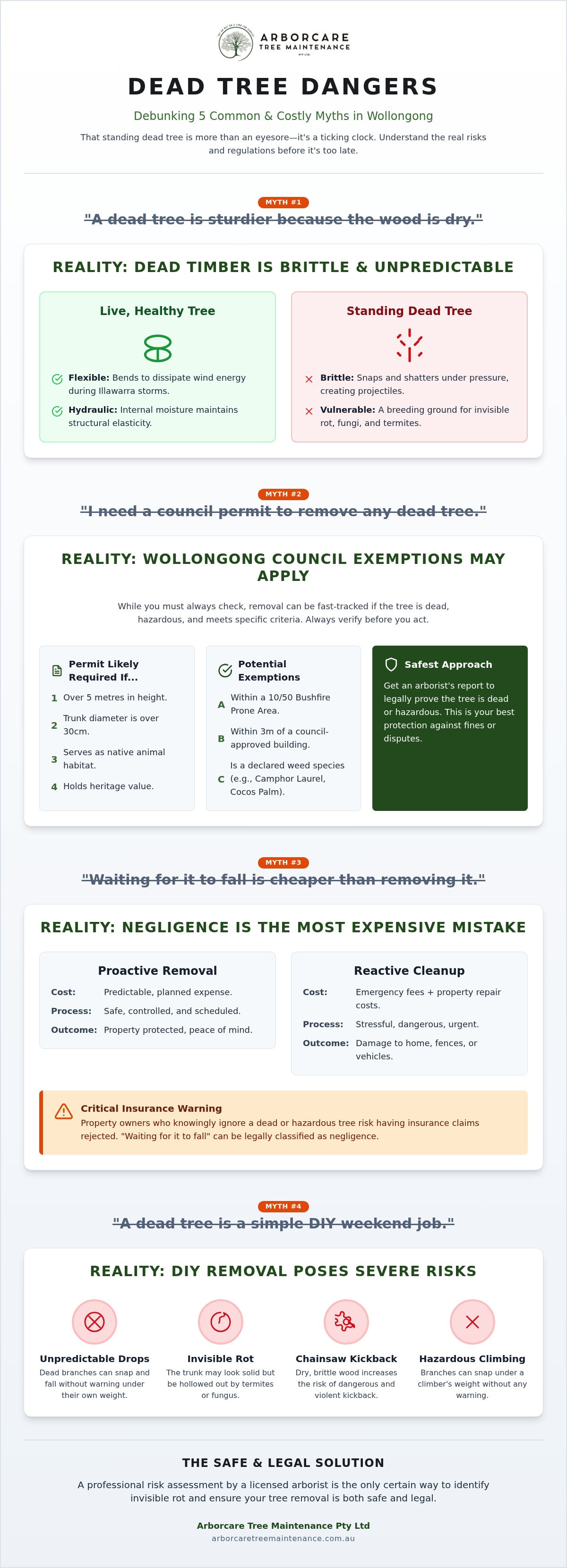
- Dead timber lacks the natural flexibility of live wood, making it prone to sudden snapping rather than bending during heavy Illawarra storms.
- You may be able to fast-track dead tree removal Wollongong by utilising specific council exemptions or the 10/50 vegetation clearing code.
- Property owners who ignore dead trees risk having insurance claims rejected, as "waiting for it to fall" can be legally classified as negligence.
- Dry, dead wood increases the risk of chainsaw kickback and unpredictable branch drops, making it far too dangerous for a DIY weekend project.
- A professional risk assessment by a licensed arborist is the only certain way to identify invisible rot and ensure your removal is safe and legal.
Myth #1: "A Dead Tree is Sturdier Because the Wood is Dry"
Many property owners believe that because a tree has dried out, it has become a hardened pillar of strength. This is a dangerous assumption that ignores the basic biology of timber. Live trees are hydraulic structures that use moisture to maintain elasticity. In Wollongong's coastal winds, a healthy tree bends to dissipate energy, but a dead tree lacks the internal moisture to flex. This leads to brittle failure. Brittle failure is the primary cause of dead tree property damage because the timber shatters under pressure rather than giving way gracefully.
The Illawarra's humid climate creates a perfect breeding ground for wood-decay fungi. While the top of the tree might look solid, the base often suffers from invisible rot. Fungi thrive in our warm, moist air, eating away at the root plate and lower trunk long before the canopy shows signs of total collapse. By the time you notice the decay, the tree's structural foundation may already be compromised beyond repair.
The Science of Timber Decay in the Illawarra
Once a tree dies, the distinction between sapwood and heartwood becomes critical. Sapwood decays rapidly, removing the tree's external structural sleeve. In our region, local pests like termites often move in to hollowise dead trunks, leaving a shell that cannot support its own weight. This makes dead tree removal Wollongong significantly more complex, as dry wood is notoriously unpredictable for an arborist to cut. It doesn't behave like green timber; it can splinter or snap without warning. Using professional arboricultural methods is the only way to manage these structural uncertainties during a removal.
Why Storms Turn Dead Trees into Projectiles
When an East Coast Low hits the coast, dead trees become immediate hazards. Even without a full canopy of leaves, bare branches create a sails effect, catching high-velocity winds and transferring that force directly to a compromised trunk. Dead Eucalypts are particularly prone to this in the Wollongong region. We frequently see these trees drop heavy branches or suffer total trunk failure because the wood simply couldn't absorb the wind's energy. These trees don't just fall; they snap and propel debris across yards and onto roofs, often with devastating force.
Myth #2: "I Need a Council Permit to Remove Any Dead Tree"
Navigating local regulations can feel like a maze, but the belief that you always need a permit for dead tree removal Wollongong isn't strictly true. Wollongong City Council provides specific exemptions for trees that are dead or dying, provided they don't serve as a habitat for native animals or hold heritage value. However, you can't just pick up a saw and start cutting without checking the measurements. The council generally requires a permit if the tree is over 5 metres in height or has a trunk diameter exceeding 30cm at ground level. For a detailed breakdown of these regulations, see our guide on Tree Removal Permits Wollongong.
Another vital tool for Illawarra residents is the 10/50 Vegetation Clearing Code. If your property is within a designated bushfire prone area, you may be allowed to remove trees within 10 metres of your home without council approval. It's a complex system where eligibility depends on your specific suburb and property boundaries. Before proceeding, you should verify your status on the Rural Fire Service website. If you're unsure about your tree's status, a qualified arborist can provide a brief report to prove the tree is structurally unsound or dead, which serves as your legal protection against future disputes.
Identifying Exempt Species in Wollongong
Certain species are almost always exempt from permit requirements because they're considered environmental weeds in our region. This list includes Camphor Laurels, Large-leafed Privets, African Olives, and Cocos Palms. Additionally, the "3-metre rule" often allows for the removal of trees within three metres of a permanent, council-approved structure like your house. Even if you're certain a tree is exempt, we recommend taking clear photos of the tree and its location before work begins. This evidence is vital if a neighbour reports the work or if council officers visit your property later to verify the species and condition.
The Risk of Illegal Tree Removal
Removing a protected species by mistake can lead to heavy fines and legal action. Beyond the legalities, there's a significant physical risk that many DIYers overlook. Dead wood is structurally compromised and lacks the predictable strength of living timber. This makes climbing or rigging dead trees extremely hazardous, as branches can snap under the weight of a climber without warning. Following national standards for managing risks of tree work is essential for safety. A professional team understands how to use mechanical lifts or specialised rigging to avoid putting weight on brittle wood. If a tree becomes an immediate threat during a storm, the "Dangerous Tree" loophole may allow for emergency removal, but you'll still need an arborist to document the hazard. To ensure your property remains compliant and safe, it's best to book a professional tree risk assessment before the next storm season.
Myth #3: "Waiting for the Tree to Fall is Cheaper Than Removing It"
Many homeowners in the Illawarra view a dead tree as a problem for another day. They assume that letting nature take its course is a cost-effective strategy that avoids a professional service fee. This is a significant financial gamble. The cost of a planned dead tree removal Wollongong is almost always lower than the combined cost of home insurance excesses and structural repairs. When a tree falls on its own, it rarely lands in a convenient spot. It targets fences, carports, or roofs, turning a simple maintenance task into a major restoration project.
There is also the "Negligence Trap" to consider. Most home insurance policies require owners to maintain their property in a safe condition. If an insurer determines you were aware the tree was dead and failed to act, they may reject your claim entirely. This leaves you personally liable for all damages. Complex tree removals are cheaper before the tree becomes a collapsed hazard because the arborist can control the descent of each limb. Once a tree has collapsed, it often becomes a tangled mess of tension and compression that requires significantly more man-hours and heavier equipment to clear safely.
Property Value and Liability
A dead tree is a visible sign of property neglect that immediately lowers the curb appeal of your home. Beyond aesthetics, you face serious legal liability if that timber falls onto a neighbour's property. Whether it crushes a boundary fence or a parked car, you are responsible for the cleanup and replacement costs. For a clearer understanding of how professionals calculate these risks, check our Tree Removal Cost Wollongong guide. Proactive maintenance is a small investment compared to a legal dispute or a massive repair bill.
Emergency Call-Out Fees vs. Scheduled Maintenance
The timing of your removal has a massive impact on the final invoice. A planned removal on a Tuesday morning is a standard operation. However, a 2 AM emergency call-out during a storm involves significantly higher rates due to the immediate risk and after-hours staffing. Arborists charge more for high-risk, unstable dead trees because the work requires specialised safety protocols. A professional Tree risk assessment helps identify these hazards early. Choosing a scheduled service also allows you to keep the resulting mulch for your garden, rather than paying for the rapid disposal and haulage of a fallen trunk.
Myth #4: "A Dead Tree is a DIY Weekend Job"
Many homeowners look at a dead tree and see a straightforward weekend project. However, dead timber is fundamentally different to green wood and requires a completely different approach. Chainsaws behave unpredictably on hardened, dry timber. The risk of "kickback", where the saw blade is violently thrown back toward the operator, increases significantly when cutting through dead wood. Gravity is also a major concern. Dead branches, often called "widow-makers", can detach without the vibration of a saw even touching them. This extreme unpredictability is why dead tree removal Wollongong is a task strictly for specialists.
Professional arborists follow a strict safety protocol: never climb a dead tree. Because the wood is brittle and the internal structure is often rotted, it cannot be trusted to hold the weight of a climber or their rigging points. Instead, we use Elevated Work Platforms (EWPs) or cranes to dismantle the tree from the top down without ever putting weight on the compromised trunk. For more on how to spot these dangers before they lead to an accident, check out our Hazardous Tree Removal Wollongong safety checklist.
Professional Equipment vs. The Garden Shed
A DIYer might have a ladder and a basic saw, but they lack the heavy-duty wood chippers and stump grinders required to manage the massive amount of debris a dead tree generates. More importantly, ropes and pulleys fail when they are attached to dead, rotting anchors. If a branch snaps your rigging point, the resulting fall can be fatal or cause catastrophic property damage. Professional teams also carry comprehensive Public Liability Insurance. Homeowner policies rarely cover accidents or structural damage resulting from uncertified DIY tree work, leaving you financially exposed if something goes wrong.
Powerlines and Public Safety
In the Illawarra, many trees grow dangerously close to powerlines. Dead trees are especially hazardous in these corridors because they can drop limbs onto live wires during even a light breeze. You must never attempt to prune or remove a tree within three metres of a service line. This is a high-voltage environment that requires specialised training and equipment. Our team coordinates directly with local utility providers to ensure power is safely managed or disconnected during complex removals. If you have a high-risk tree near your service lines, it's time to book a professional tree removal assessment to ensure your property and the local grid remain safe.
How to Organise Safe Dead Tree Removal in Wollongong
Managing a hazardous tree requires a methodical approach to ensure the safety of your family and the integrity of your property. You shouldn't rush into a removal without a clear plan. Following a structured process helps you navigate council regulations while ensuring the physical work is handled by experts. The first step is always a professional risk assessment. A licensed arborist will examine the tree's structural integrity, looking for signs of internal rot or root instability that might not be visible to the untrained eye. This assessment determines the safest method for dead tree removal Wollongong.
Once the risk is established, you must verify your legal standing. As we discussed earlier, Wollongong City Council has specific exemptions for dead trees, but confirming these before the first cut is made protects you from potential fines. After securing any necessary permits, you can prepare your property. This involves clearing the work zone of vehicles, outdoor furniture, and ensuring pets and children are safely indoors. The final stage is the removal itself. A professional service doesn't just drop the tree; it involves a controlled dismantle, followed by stump grinding and mulching to leave your land clear and ready for new growth.
- Step 1: Secure a professional risk assessment from a licensed arborist to identify hidden structural failures.
- Step 2: Verify council exemptions or secure the necessary Tree Management Permits to ensure legal compliance.
- Step 3: Clear the access paths and work zone to allow specialised equipment like EWPs or wood chippers to reach the site.
- Step 4: Complete the full removal, including stump grinding to prevent pest infestations and mulching for garden reuse.
The Arborcare Difference in the Illawarra
Our Dapto-based team brings a high level of technical authority to every residential job. We don't just remove hazards; we provide a full-service solution grounded in safety-conscious expertise. We understand that a dead tree is a source of stress, so we prioritise professional reliability and clear communication. A key part of our service is sustainability. We recycle your dead timber into high-quality mulch on-site, which you can use to suppress weeds and retain moisture in your garden beds. Our "no mess left behind" policy ensures that once the hazardous timber is gone, your property is left tidy and safe.
Get Your Obligation-Free Quote Today
High-risk dead trees require a rapid response, especially during the volatile storm seasons common in the Illawarra. We offer prompt assessments for properties across Dapto and the wider Wollongong region. To speed up your initial assessment, you can provide clear photos of the tree and its surroundings when you enquire. This helps our team understand the access requirements and equipment needed before we even arrive on-site. Don't let a ticking time bomb compromise your home's safety. Contact Arborcare Tree Maintenance for professional dead tree removal and secure your property today.
Secure Your Property Before the Next Storm
Leaving a dead tree standing is a gamble that rarely pays off. As we have explored, dead timber doesn't gain strength as it dries; it loses the vital flexibility needed to survive coastal winds. Organising dead tree removal Wollongong now prevents the negligence trap that could see your insurance claim rejected after a failure. Proactive maintenance is a controlled, predictable process that is far more affordable than a frantic emergency cleanup in the middle of the night.
Professional intervention is the only way to ensure your property remains compliant with local regulations while protecting your home from structural damage. Our team of fully licensed and insured arborists provides the technical expertise needed for complex removals across the Illawarra. As a local family owned and operated business, we are committed to keeping our community safe with 24/7 emergency storm response. Take the first step toward a safer backyard and a more resilient property today.
Get a Professional Safety Assessment & Quote from Arborcare
Frequently Asked Questions
How can I tell if my tree is dead or just dormant?
You can perform a "scratch test" by peeling back a small section of bark to see if there is green, moist tissue underneath. If the layer is brown and brittle across multiple branches, or if the twigs snap easily like matchsticks, the tree has likely died. Dormant trees maintain flexible branches and living tissue, whereas dead trees often show significant bark shedding and fungal shelf growth around the base of the trunk.
Does Wollongong Council allow me to remove a dead tree without a permit?
Wollongong City Council generally allows the removal of dead trees without a permit provided they are not heritage-listed or serving as a habitat for native fauna. This exemption only applies to trees that are completely dead, not those that are just dying or diseased. If the tree exceeds five metres in height or has a trunk diameter wider than 30cm, it is best to have a licensed arborist verify the condition to protect you from potential legal disputes.
What is the average cost of dead tree removal in Wollongong?
The investment required for dead tree removal Wollongong is determined by the tree's size, its proximity to structures, and how easily our equipment can access the site. Dead trees often involve higher risks and may require specialised machinery like cherry pickers because the wood is too brittle for traditional climbing. We provide site-specific assessments to ensure the removal plan is both safe and cost-effective for your specific situation.
Can a dead tree attract termites to my house?
Dead trees are a primary attractant for termites as they provide a nesting site and a consistent food source of decaying cellulose. If a dead tree is located near your home's foundation, it can serve as a bridge for pests to migrate into your structural timbers. Professional removal and stump grinding are essential steps to eliminate these breeding grounds and protect your property from expensive pest damage.
What happens if a dead tree falls on my neighbour’s property?
If you were aware the tree was dead and failed to act, you may be held legally liable for any damages to your neighbour's property under negligence laws. Insurance companies often reject claims if they determine the property owner didn't take reasonable steps to manage a known hazard. Proactive removal ensures you avoid the stress of legal liability and the high cost of repairing neighbouring fences, roofs, or vehicles.
How long does it take for a dead tree to become dangerous?
A dead tree becomes a liability the moment it loses the moisture that provides wood with its natural elasticity. While some species might remain standing for a period of time, the Illawarra's high humidity accelerates internal rot, particularly in the root plate. Brittle failure can occur without warning during a storm or even on a calm day once the internal structure has been sufficiently compromised by decay.
Do I need to be home when the arborist removes the tree?
You don't need to be present for the work as long as our team has clear access to the tree and any gates are unlocked. We establish all requirements and safety protocols during the quoting stage so the removal can proceed while you are at work or running errands. Our crew follows a methodical safety plan and ensures the site is left tidy, providing a hassle-free experience for residential property owners.
Can I keep the wood from the dead tree for my fireplace?
You are certainly able to keep the timber for your own use, but it should be seasoned correctly before burning to ensure safety and efficiency. Storing large piles of dead wood close to your house can attract spiders and termites, so it's important to stack it away from your main dwelling. Please note that while we provide the removal and mulching service, our business does not offer firewood splitting or sales.


