
Imagine waking at 2 am to the sound of a structural crack as a massive gum tree limb settles onto your tiled roof during a sudden South Coast storm. In that moment of crisis, finding a reliable emergency tree service Illawarra homeowners can trust is the only thing that matters for your family's safety. It is completely natural to feel overwhelmed by the immediate threat of property damage and the complex logistics of what comes next.
You want the hazard gone, but you also need to ensure the work meets strict insurance criteria and local council standards. This rapid response guide provides the professional clarity you need during a high-stress event. We will outline the essential steps for emergency triage, clarify the roles of the SES versus private arborists, and explain how to navigate the permit exemptions for Wollongong, Shellharbour, and Kiama. By the end of this article, you will have a clear path to restoring your landscape and securing your home with confidence.
Key Takeaways
- Learn to identify the critical signs of imminent tree failure, such as heaving soil and fresh trunk cracks, before they lead to property damage.
- Understand why a professional emergency tree service Illawarra assessment is vital for identifying hidden hazards like tension and compression in fallen timber.
- Discover how the unique "Southerly Buster" and escarpment winds specifically impact the structural integrity of trees across the Illawarra region.
- Get a clear framework for gathering the photographic evidence and arborist reports required to satisfy retrospective council approvals and insurance claims.
- Recognise the lethal risks associated with DIY storm cleanup and why professional-grade equipment is necessary for high-risk removals.
Recognising a Tree Emergency: When to Call for Immediate Help
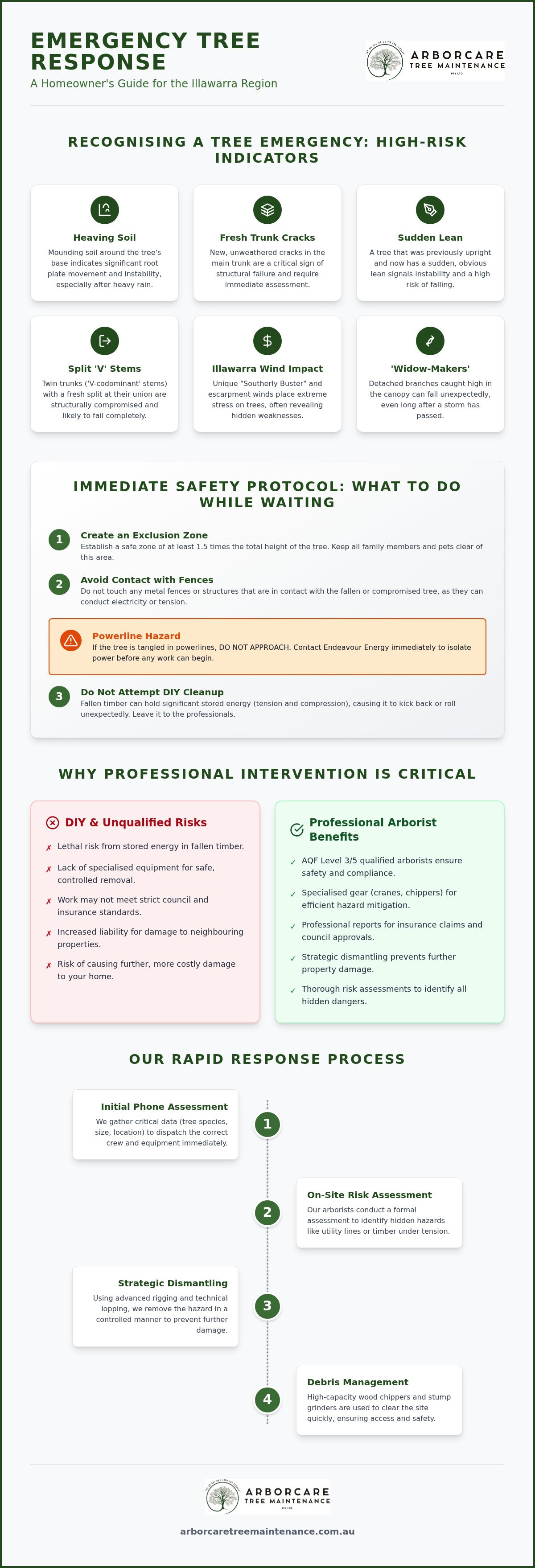
A tree emergency is defined as any situation where a tree or its components pose an immediate threat to life, property, or public infrastructure. It is not merely a fallen branch on a lawn; it is a structural failure that requires the urgent intervention of a certified arborist to mitigate risk. Identifying these failures early can prevent catastrophic property damage. Look for heaving soil around the base, which indicates root plate movement, or fresh, unweathered cracks in the main trunk. A sudden lean in a tree that was previously upright is a clear signal of instability and requires professional assessment.
Homeowners should apply the 'Wait or Act' test when assessing a hazard. If a compromised tree is within striking distance of a bedroom, a shared boundary fence, or powerlines, it requires an emergency tree service Illawarra response. Delaying hazardous tree removal in Wollongong often leads to increased liability if the tree eventually fails and causes damage to a neighbour's property. It can also result in significantly higher costs if the tree falls onto a structure, requiring complex crane work rather than a controlled, technical dismantle. Acting while the tree is still standing is always the safer and more cost-effective choice.
High-Risk Indicators After an Illawarra Storm
Storms on the Illawarra escarpment often bring heavy rain that saturates the soil, leading to root failure. Watch for root plate movement after heavy rain, which often manifests as soil mounding on one side of the trunk. You should also look for "widow-makers," which are detached branches snagged high in the canopy. These can fall without warning even after the wind has died down. Additionally, inspect trees for 'V-codominant' stems. These are twin trunks that grow closely together in a V-shape. If you see a fresh split at the union where they meet, the tree's structural integrity is compromised and a total failure is likely.
Immediate Safety Protocol: What to Do While Waiting
Your primary goal is to secure the site before professionals arrive. Establish an exclusion zone that is at least 1.5 times the total height of the tree. Keep family and pets well away from this area. Avoid touching any metal fences or structures that are in contact with the tree, as these can transmit tension or electrical current. If the tree is tangled in powerlines, do not approach it under any circumstances. You must contact Endeavour Energy immediately to isolate the power before an emergency tree service Illawarra team can safely begin work. Do not attempt to clear debris yourself, as fallen timber often holds significant stored energy that can cause the trunk to kick back or roll unexpectedly.
The Arborcare Rapid Response Process: What to Expect
Efficiency in a crisis depends on a structured protocol. When you request an emergency tree service Illawarra response, we initiate a methodical assessment process designed to stabilise the site immediately. As a local Dapto-based team, we can reach suburbs from Wonoona to Jamberoo quickly, which is vital when storm fronts move through the region. This begins with the initial phone assessment, where we gather critical data regarding the tree species, its approximate height, and its proximity to structures or powerlines. This information ensures we dispatch the correct crew and specialised equipment from the outset, reducing downtime during a critical event.
Upon arrival, our arborists conduct a formal on-site risk assessment to identify secondary hazards that may not be visible to the untrained eye. These can include underground utilities, compromised structural roots, or limbs held under extreme tension. Only after the site is secured do we begin strategic dismantling. Using advanced rigging and technical lopping, we remove weight from the canopy in a controlled manner. This prevents further impact damage to your property and ensures the safety of everyone on site. Our process concludes with thorough debris management, using professional mulchers to clear access paths immediately.
Specialised Equipment for Emergency Removals
High-capacity wood chippers are essential for rapid site clearing during an emergency tree service Illawarra operation. For complex tree removals near houses, we deploy cranes or cherry pickers to lift heavy timber vertically, preventing further property damage. Additionally, we utilise stump grinding to eliminate immediate trip hazards on driveways, ensuring your home remains accessible and safe for your family while we clear the remaining debris.
Arborist Qualifications and Why They Matter
The distinction between a "tree lopper" and a Level 3 or 5 qualified arborist is critical during a crisis. Insurance companies frequently require a tree risk assessment Wollongong from a professional before approving claims. Our team ensures compliance with Australian Standard AS4373-2007 and NSW tree removal regulations. For reliable results, trust our professional tree maintenance services to handle the task safely.
Assessing Storm Damage: Triage for Illawarra Properties
The Illawarra region faces unique meteorological challenges that directly impact the health and stability of our urban forest. One of the most significant threats is the 'Southerly Buster,' a rapid weather front that brings violent wind gusts and a sudden drop in temperature. These fronts often strike trees that have adapted to prevailing northerly winds, causing structural failures because the timber has not developed the necessary reaction wood to withstand force from the opposite direction. When you require an emergency tree service Illawarra team, it is often because these unpredictable gusts have exploited a pre-existing structural weakness.
Topography also plays a critical role in how trees fail during a storm. In suburbs like Dombarton and Wonoona, the escarpment acts as a natural funnel, accelerating wind speeds as they crest the ridge. This creates intense turbulence and twisting forces on the canopy. When combined with the high rainfall common in coastal areas, the soil becomes saturated, significantly reducing the friction required for root anchorage. In these conditions, even a healthy tree can suffer from 'wind throw,' where the entire root plate lifts out of the sodden ground. For detailed advice on protecting your property before the clouds roll in, consult the NSW State Emergency Service storm preparation guide.
During a large-scale storm event, we follow a strict triage protocol to manage hazards efficiently. Our priorities are always clear:
- Level 1: Clearing dwellings and structures where life or shelter is threatened.
- Level 2: Clearing driveways and access points to ensure emergency vehicles and residents can move freely.
- Level 3: Managing secondary garden structures, internal fences, and aesthetic landscape features.
Common Tree Failures in the Illawarra
Large Eucalypts are particularly prone to "widow-maker" branch drops during high winds, as their heavy, over-extended limbs snap under the pressure of escarpment gusts. We also see frequent issues with invasive species like Privet or Camphor Laurel; these trees grow rapidly but often lack the deep root systems needed for stability in wet weather. Additionally, storm fronts can leave heavy fronds and unstable trunks in their wake, necessitating professional palm tree removal Illawarra to prevent damage to nearby glass pool fencing or roof tiles.
When the SES Ends and the Arborist Begins
It's a common misconception that the State Emergency Service (SES) will completely remove a fallen tree. The SES is a volunteer organisation focused on making a situation 'safe' by removing immediate threats to life or property. They will often cut a trunk into manageable sections and leave the debris on your lawn. The homeowner remains responsible for the final storm damage tree removal and site cleanup. Our team coordinates closely with emergency services to ensure a seamless transition from the initial 'make safe' to the final professional clearing of your property.
Navigating Insurance and Council Regulations
Securing your home during a storm is a multi-stage process. Once the immediate physical hazard is neutralised, the focus shifts to administrative compliance. Engaging a qualified emergency tree service Illawarra professional ensures that your response meets the strict legal standards set by local authorities. While your priority is safety, failing to follow the correct protocols for tree removal can result in significant fines or rejected insurance claims. Most insurance providers are specific about who handles the work; their Product Disclosure Statements (PDS) typically require a licensed arborist with comprehensive public liability insurance to perform any high-risk tasks.
In the Illawarra, local councils recognise that waiting for a standard permit during a crisis is not always feasible. Wollongong and Shellharbour Council Tree Preservation Orders (TPOs) include 'Emergency Works' exemptions for trees that are imminently dangerous. However, this isn't a free pass to remove any tree without oversight. You're still required to provide evidence that the tree posed an immediate threat. This typically involves submitting an application with supporting arborist reports and photographic evidence as soon as possible after the event. Without this documentation, you risk penalties under the NSW Biodiversity Conservation Act 2016, where unauthorised removals can lead to substantial fines.
The Insurance Roadmap for Tree Damage
Managing an insurance claim requires a methodical approach to documentation. Your first step is always immediate safety and mitigation, which is where our arborist team intervenes to stabilise the site. Following this, you must gather professional documentation, especially in the case of a tree fallen on house Wollongong event. It's also vital to understand the difference between 'Impact' and 'Maintenance' clauses. Most policies cover trees that have fallen due to a storm (impact), but they may deny a claim if the tree was clearly dead or diseased before the storm (maintenance). Our detailed reports help clarify these distinctions for your assessor.
Local Council Compliance in a Crisis
Wollongong City Council and Shellharbour Council have specific post-storm clearing requirements. While a standard permit application in Wollongong costs $109.00 for one to two trees, emergency exemptions allow you to act first if the danger is documented. Arborcare assists with this vital paperwork, providing the technical evidence needed to avoid heavy fines for unauthorised removals. We ensure your property recovery aligns with local vegetation clearing schemes and safety standards. If you're facing a dangerous tree situation now, contact our emergency response team for immediate assistance and expert guidance on council compliance.
Why Professional Emergency Intervention is Critical
Fallen timber is rarely as stable as it appears. When a tree fails during a storm, the trunk and branches often become trapped under immense tension or compression. Cutting into these points without a technical understanding of wood physics can trigger an explosive release of energy. This is why an emergency tree service Illawarra specialist is necessary to manage the dismantling process. A professional approach ensures that the tree is neutralised in a controlled sequence. This prevents the timber from shifting and causing secondary damage to your home or injuring those nearby.
Attempting to manage large-scale storm debris with consumer-grade tools is a significant safety risk. Ladders and chainsaws are a lethal combination in any setting, but they're particularly dangerous in the wet, unstable conditions following a South Coast storm. Professional arborists use specialised climbing harnesses, aerial work platforms, and rigging systems to maintain total control over every piece of timber. This technical authority protects your property. It also provides the peace of mind that comes from hiring a locally owned team that understands the specific risks of the Illawarra landscape.
The Risks of DIY Tree Lopping
One of the most dangerous phenomena in emergency work is the "barber chair" effect. This occurs when a leaning tree or a branch under tension splits vertically before the cut is complete, causing the back of the trunk to kick out with lethal force. Homeowners typically lack the high-risk insurance coverage and personal protective equipment (PPE) required for these scenarios. Inadequate equipment often leads to half-finished sites where partially cut limbs are left hanging; this creates a greater hazard than the original fallen tree.
Long-Term Property Health and Safety
The immediate removal of a hazard is only the first step in property recovery. Proper pruning cuts are essential to prevent future rot, pest infestation, and structural instability in the remaining canopy. A comprehensive tree removal Wollongong service ensures that no hidden hazards, such as fractured root systems or internal trunk decay, are left behind. Our team leaves your property clean and mulched, ensuring the site is safe for your family to enjoy once the storm has passed.
Securing Your Property and Restoring Safety
Managing a tree crisis requires a balance of immediate physical stabilisation and careful administrative compliance. By identifying high-risk indicators early and understanding local council emergency exemptions, you can protect your home from further damage while ensuring your insurance claim remains valid. Professional intervention is the only safe way to manage the extreme tension found in fallen timber and avoid the lethal risks associated with DIY removal attempts.
As a locally owned and operated business in Dapto, Arborcare Tree Maintenance provides the rapid, technical response needed for complex and high-risk removals across the region. Our team of fully licensed and insured Level 5 arborists is equipped with specialised machinery to clear your site and restore safety to your landscape immediately. When you need a reliable emergency tree service Illawarra homeowners can depend on, our experts are ready to assist.
Call Arborcare Now for 24/7 Emergency Tree Service in the Illawarra
Your family's safety is the absolute priority. With the right professional support, your property will be secure, clear, and ready for recovery in no time.
While restoring your physical environment, small business owners should also consider their digital resilience; you can explore cyber security with Aspire Computing to protect your home office from online risks.
Frequently Asked Questions
What defines a tree emergency in the Illawarra?
A tree emergency is any situation where a tree or large limb poses an immediate threat to life, property, or public infrastructure. This includes trees that have already fallen onto homes or vehicles, as well as those showing signs of imminent failure. If a vehicle has been damaged or trapped by debris, you can learn more about how Done Wright Towing & Transport assists with professional recovery and towing. Indicators such as fresh soil mounding at the base, unweathered trunk splits, or a sudden lean after an escarpment storm signify a high-risk scenario that requires professional intervention.
Does the SES remove fallen trees from my house?
The State Emergency Service (SES) is a volunteer organisation focused on life safety and making a situation "safe." They will typically cut a fallen tree into manageable sections to remove a threat to a structure or clear an access point, but they don't perform complete removals. You'll need a private emergency tree service Illawarra provider to handle the final dismantling, wood chipping, and site cleanup once the immediate danger is neutralised.
How much does an emergency tree service cost in Wollongong?
Costs for emergency work are determined by the size of the tree, its location, and the specialised equipment required for a safe removal. While standard removals in the region often range from several hundred to several thousand dollars, emergency call-outs typically involve higher rates due to the urgent dispatch of crews and machinery outside of standard hours. We provide site-specific assessments to ensure the response matches the complexity of the hazard.
Do I need council permission to remove a tree that has fallen in a storm?
Wollongong, Shellharbour, and Kiama councils generally allow for the immediate removal of trees that are imminently dangerous to life or property. While you can act quickly to mitigate the risk, you're usually required to submit photographic evidence and a professional arborist's report to your council as soon as possible after the event. This retrospective notification is essential to avoid potential fines for unauthorised clearing under the NSW Biodiversity Conservation Act 2016.
Will my home insurance cover the cost of emergency tree removal?
Most home insurance policies cover the cost of removal if the tree has caused physical damage to an insured structure, such as your roof, a fence, or a shed. Coverage is rarely provided for trees that fall in a yard without damaging property. It's vital to check your Product Disclosure Statement (PDS) and take clear photos of the impact before the arborist begins work to support your claim.
Can you remove a tree that is touching powerlines?
Private arborists cannot work on trees in contact with live powerlines until the site is declared safe by the utility provider. If a tree has fallen onto lines, you must contact Endeavour Energy immediately. Once their technicians have isolated the power or cleared the electrical hazard, our emergency tree service Illawarra team can safely move in to remove the timber and clear the debris from your property.
What suburbs in the Illawarra do you cover for 24/7 service?
Our Dapto-based team provides rapid emergency response across the entire Illawarra region. We regularly service Wollongong and northern suburbs like Wonoona and Bulli, as well as southern areas including Shellharbour, Kiama, and Jamberoo. Our local knowledge of the escarpment and coastal conditions allows us to reach properties quickly when a storm front moves through the South Coast.
What should I do if a tree is leaning dangerously but hasn't fallen yet?
If you notice a tree leaning suddenly or see soil heaving around the roots, you should establish a 1.5x tree-height exclusion zone for all family members and pets. Avoid touching any structures or fences the tree might be leaning against. Contact a qualified arborist immediately for a risk assessment; it's often safer and more cost-effective to dismantle a standing hazardous tree than to clear one that has already collapsed onto your home.


