Imagine waking up at 2:00 am to the sound of a heavy branch snapping over your roof during a fierce East Coast Low. It's a terrifying moment that many locals face, yet the anxiety often stems from not knowing if a tree is truly a risk or just swaying in the wind. When considering hazardous tree removal Wollongong homeowners frequently feel stuck between the fear of sudden property damage and the headache of navigating council permit rules.
We understand that your family's safety is the priority, and you shouldn't have to guess whether a tree is structurally sound. This article provides a definitive 2026 safety checklist to help you spot warning signs like ground heaving or fungal growth before they become emergencies. You'll learn which trees are exempt from permits, how to handle immediate threats under current Wollongong City Council guidelines, and the best way to organise a professional arborist assessment for total peace of mind.
Key Takeaways
- Identify critical warning signs of instability, such as ground heaving or crown dieback, to catch potential hazards before the next East Coast Low hits.
- Understand the unique structural risks associated with local Illawarra species, including heavy lateral branches on Eucalypts and trunk constriction in palms.
- Navigate Wollongong City Council regulations confidently, including the specific conditions under which hazardous tree removal Wollongong can be performed immediately for safety.
- Discover how professional Visual Tree Assessments (VTA) calculate the "Probability of Failure" to determine if a tree requires pruning or complete removal.
- Learn how expert arborists manage complex removals near powerlines and dwellings to ensure your property remains protected during severe weather events.
How to Spot a Hazardous Tree in Wollongong: The Initial Inspection
Identifying a dangerous tree requires a methodical approach that goes beyond simply checking for dead leaves. For homeowners considering hazardous tree removal Wollongong, the process starts with a visual assessment of the entire specimen from a safe distance. You need to look for structural flaws that could lead to a total failure during a storm. A tree might look green and healthy on the outside while the internal heartwood is rotting away, leaving it hollow and unstable.
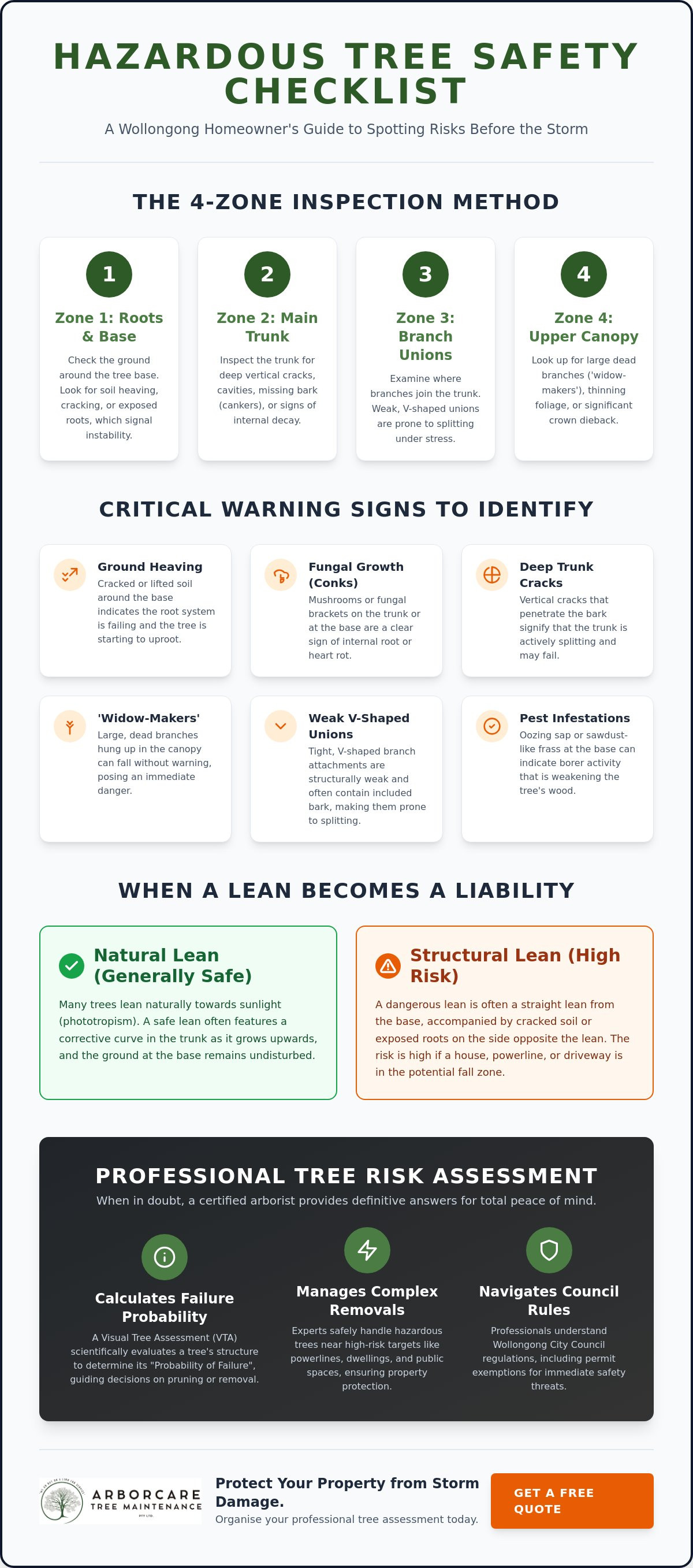
Start your inspection at the ground. Soil heaving or fresh cracking around the root plate often indicates a tree is beginning to lift or pivot. If you see fungal brackets, also known as conks, growing at the base or on the lower trunk, it's a clear sign of internal decay. These biological indicators are central to the scientific practice of arboriculture and should never be ignored. When the structural integrity of the roots is compromised, the tree loses its primary anchor, making it a high-risk liability in the high winds common to the Illawarra.
Move your eyes up to the trunk and canopy. Deep, vertical cracks that penetrate through the bark and into the wood suggest the trunk is physically splitting. In the canopy, look for "widow-makers" which are large, dead branches hung up in the crown. These are immediate hazards that can fall without warning, even on a calm day. Oozing sap or sawdust-like frass at the base of the trunk may also indicate borer infestations that weaken the wood over time.
The 4-Zone Inspection Method
To ensure you don't miss any critical signs, we recommend a zoned approach. Zone 1 covers the roots and the soil within the "drip line" of the branches. Zone 2 focuses on the main trunk, looking for cavities or "cankers" where bark is missing. Zone 3 involves the crotches, where branches meet the trunk; V-shaped unions are significantly weaker than U-shaped ones and often split under the weight of rain. Finally, Zone 4 is the upper canopy, where dead wood or thinning foliage indicates the tree's overall health is in decline.
When a Lean Becomes a Liability
Not every leaning tree is a candidate for hazardous tree removal Wollongong. Many trees lean naturally to find sunlight, a process known as phototropism. You can identify a safe, natural lean by the way the trunk curves back toward the vertical. However, a structural lean is straight and often accompanied by cracked soil or exposed roots on the "high" side of the lean. You must also consider the "target" factor. A leaning tree in an empty field is a minor concern, but if that same tree is positioned over a driveway, powerlines, or a neighbour's roof, the risk level increases exponentially.
Common Signs of Structural Instability in Local Species
Wollongong's coastal environment and clay-heavy soils create specific challenges for local flora. Eucalypts, while iconic, often develop heavy lateral branches that extend far from the trunk. These limbs carry immense weight and can fail without warning during high-wind events, a phenomenon sometimes called "Summer Branch Drop" when it occurs in extreme heat. Another common issue is "included bark" within V-shaped branch unions. This occurs when bark grows inward at a tight junction, preventing the wood from fusing together. It acts as a physical wedge, making the tree prone to splitting under pressure. Homeowners often seek hazardous tree removal Wollongong when they notice these V-shaped unions beginning to crack or pull apart.
Palm trees present different but equally serious risks. Trunk constriction, often called "pencil-pointing," indicates a period of severe stress and creates a structural weak point where the trunk can snap. Large dead fronds also become "hang-ups," posing a strike risk to residents. When these hazards are identified near dwellings or public footpaths, it's vital to organise a professional inspection before the next storm season arrives.
Identifying Decay and Fungal Pathogens
Mushrooms or fungal brackets at the base of a tree are more than just a garden curiosity; they are often the fruit of a root-rotting fungus. While surface moss is generally harmless, these structural pathogens actively consume the wood's lignin and cellulose, compromising the tree's stability. Heart rot is a hidden killer of mature gums that decays the central support wood while leaving the outer sapwood intact. This makes the tree look healthy even as it becomes a hollow shell. Understanding these NSW Government tree removal rules is essential when assessing whether decay has progressed enough to warrant immediate intervention. Professional hazardous tree removal Wollongong is usually required once the internal decay exceeds 30% of the trunk's diameter.
Illawarra Weather Patterns and Tree Stress
The Illawarra's proximity to the escarpment means we experience intense East Coast Lows that bring saturated soils and gale-force winds. When heavy rain hits our local clay soils, the ground becomes plastic, losing its ability to hold a root plate firmly. This leads to "wind throw," where the entire tree topples because the soil can no longer support its weight. In these high-stakes scenarios, homeowners often require complex tree removal Illawarra to safely dismantle specimens that have become entangled with powerlines or nearby structures. Acting early when you spot a shifting root plate can prevent a costly emergency call-out during a storm.
Wollongong Council Regulations for Dangerous Trees
Navigating council red tape can be the most frustrating part of property maintenance. In Wollongong, the Development Control Plan (DCP) dictates that you need a permit for any tree taller than 5 metres or with a trunk diameter exceeding 30 centimetres at ground level. As of the 2025-2026 fee schedule, the application for one or two trees costs $109.00. However, when a tree poses an immediate danger, the rules change to prioritise public safety. This is where hazardous tree removal Wollongong becomes a matter of emergency protocol rather than standard planning.
The council provides an "Emergency Works" provision for trees that are an imminent threat to life or property. If a tree is physically split or uprooting during a storm, you can act immediately to make the area safe. You must, however, apply for a Tree Permit within 72 hours of the work being completed to remain compliant. Without clear evidence, you risk heavy fines. We always recommend taking high-quality photos before and during the process. A formal report from a qualified expert using professional tree risk assessment methods acts as your legal shield, proving the necessity of the intervention to council officers.
Certain species are exempt from these permit requirements due to their invasive nature in the Illawarra. This list currently includes species such as the African Olive, Camphor Laurel, and Canary Island Date Palm. Even if a tree is on the exempt list, you should verify it isn't a heritage item or a habitat for threatened native species before starting work. These specific environmental protections often override standard exemptions, and a mistake here can lead to costly legal complications.
The Definition of an "Immediate Threat"
Council defines an immediate threat as a tree with obvious structural failure that could impact a "target," such as a dwelling, driveway, or powerline. To bypass the standard 28-day assessment wait, a Certificate III or V arborist must validate the hazard. Removing a tree without this professional sign-off can result in significant fines. By engaging a specialist for hazardous tree removal Wollongong, you ensure that the dangerous specimen is documented correctly, protecting you from future litigation or council disputes.
Neighbouring Trees and Boundary Disputes
Safety concerns don't always stop at your fence line. If a hazardous tree is located on your neighbour's property, the first step is always a polite, documented conversation. If they refuse to act on a visible risk, the Trees (Disputes Between Neighbours) Act 2006 provides a legal framework for resolution through the Land and Environment Court. Organising a joint inspection with a qualified arborist is often the most effective way to resolve these tensions, as it provides an objective safety rating that both parties can review before the next storm season arrives.
The Professional Tree Risk Assessment Process
While a homeowner's initial inspection is a vital first step, a professional assessment provides the technical data needed to make high-stakes safety decisions. Qualified arborists use a Visual Tree Assessment (VTA) as the industry standard. This process involves a systematic analysis of the tree's biological health and mechanical stability. We look for subtle clues that indicate how the tree is compensating for internal stress, such as the growth of "reaction wood" or changes in bark texture. For residents considering hazardous tree removal Wollongong, this professional sign-off ensures that you aren't removing a healthy tree unnecessarily or leaving a dangerous one standing.
The core of the assessment is calculating two specific variables: the "Probability of Failure" and the "Likelihood of Impact." A tree might have a high probability of failure due to heart rot, but if it's located in a remote corner of a large property with no structures nearby, the overall risk rating remains low. Conversely, a minor defect in a tree overhanging a bedroom creates a critical risk. Our goal is to determine if the risk can be mitigated through weight reduction or pruning. In many cases, strategic lopping or crown thinning can shift the centre of gravity and make the tree safe. However, if the structural integrity is too far gone, complete removal is the only responsible recommendation.
What to Expect from a Level 5 Arborist Report
A Level 5 arborist report is a comprehensive document often required for insurance claims or complex council applications. It provides a detailed map of structural defects and quantifies decay levels using objective data. These reports are essential for justifying the tree removal cost Wollongong homeowners may face, as they provide a clear evidence base for the work. Having this documentation protects you legally if a tree fails despite maintenance, proving you took all reasonable steps to manage the hazard.
Tools of the Trade
Modern arboriculture uses advanced technology to see what the naked eye cannot. We use tools like the Resistograph, which drills a tiny needle into the trunk to measure wood density, and sonic tomography, which uses sound waves to create a cross-sectional image of internal decay. Aerial inspections are also performed when defects are suspected in the upper canopy that cannot be seen from the ground. DIY lopping is never a substitute for this level of analysis. Inexperienced cutting often creates new points of decay and increases the likelihood of future failure. If you are concerned about a specific tree on your property, contact us for a professional assessment to ensure your safety measures are based on expert data.
Safe Removal and Emergency Response in the Illawarra
Executing the safe removal of a dangerous specimen requires more than just a chainsaw and a ladder. It demands a disciplined approach to risk management and technical rigging. For hazardous tree removal Wollongong residents depend on a team that understands the local topography and the specific way our coastal weather impacts wood density. Our Emergency Tree Service operates throughout the region, providing rapid support for storm-damaged trees in areas like Dapto and Fairy Meadow. We prioritise stabilising the site to prevent further property damage before commencing the final removal process.
A professional response for hazardous tree removal Wollongong ensures that every stage of the job is handled with precision. Once the tree is safely on the ground, we provide mulching and wood chipping to recycle the organic waste back into your garden. This provides a practical benefit for your soil health while clearing the debris from your yard. To finish the job properly, professional stump grinding is used to clear the site entirely. This allows you to reclaim your space, preventing trip hazards and stopping the potential for suckering growth from the remaining root system.
High-Risk Removal Techniques
In tight suburban blocks, traditional felling isn't an option. We utilise sectional felling, where climbers lower the tree piece-by-piece using advanced rigging systems to ensure no impact occurs on the structures below. This controlled descent protects dwellings and fences in densely populated suburbs like Woonona. For larger, structurally unsound gums in Jamberoo, we often employ cranes to lift heavy sections over obstacles. These Complex Tree Removals require high-level technical coordination and strict adherence to safety protocols to manage the unpredictable nature of decaying wood.
Your Next Steps for Property Safety
Proactive maintenance is consistently more cost-effective than emergency response. Waiting for a storm to identify a structural weakness often leads to higher costs and avoidable property damage. Booking a seasonal safety audit before the summer storm peak allows us to identify and address hazards while they are still manageable. If your initial inspection has raised concerns about a specific specimen, don't wait for the next East Coast Low. You can get a tree removal Wollongong quote today to secure your home against the elements. Our team is ready to provide the professional intervention needed to keep your landscape safe and compliant.
Secure Your Property Before the Next Storm
Managing the trees on your Illawarra property requires a proactive balance of biological observation and local regulatory awareness. By identifying early warning signs like ground heaving, fungal conks, or structural V-unions, you can address risks before they escalate into a costly emergency. Remember that while council permits are standard, the emergency works provision exists specifically to protect your home from immediate threats. Navigating hazardous tree removal Wollongong doesn't have to be a source of stress when you have the right technical data and professional support.
Our team of fully licensed and insured Cert III and Cert V arborists is based in Dapto and provides 24/7 emergency storm response across the entire Illawarra. We focus on delivering clear, safety-conscious resolutions that protect both your family and your landscape. Request a Professional Tree Risk Assessment from Arborcare today to ensure your property is prepared for whatever the coastal weather brings. Taking a steady, informed approach now provides the best protection for your home in the years to come.
Frequently Asked Questions
Do I need Wollongong Council approval to remove a dead tree?
Yes, you typically need a permit from Wollongong City Council if the dead tree is over 5 metres tall or has a trunk diameter greater than 30 centimetres at ground level. While some believe dead trees are automatically exempt, the council requires an application to ensure the tree isn't a habitat for native wildlife or a protected species. For hazardous tree removal Wollongong regulations allow for immediate action only if the tree is an imminent threat to life or property.
What is the most dangerous tree species in the Illawarra?
Large Eucalypt species, commonly known as Gums, are often considered the highest risk in our region due to their tendency for "Summer Branch Drop" and internal heart rot. These trees can appear healthy while their core support is decaying. Additionally, certain palm species pose risks from heavy, falling fronds. Identifying these structural vulnerabilities early is the best way to prevent sudden failure during an East Coast Low.
How much does hazardous tree removal cost in Wollongong?
The cost is determined by the tree's height, its proximity to structures, and the equipment required for safe dismantling. A complex removal involving a crane or powerline clearance will naturally be more expensive than a straightforward felling in an open yard. Since every site in the Illawarra has unique access challenges, we provide individualised quotes based on the specific risk profile and safety requirements of your property.
Can I remove a tree myself if it looks like it is about to fall?
You should never attempt to remove a failing tree yourself. Hazardous trees are unpredictable; a single cut can cause the trunk to pivot or snap in an unintended direction. Professional arborists use specialised rigging and weight-calculation methods to control the descent of every branch. Attempting a DIY removal not only risks your life but can also void your home insurance if property damage occurs during the process.
Will my home insurance cover the cost of removing a hazardous tree?
Most home insurance policies only cover tree removal if the tree has already fallen and caused damage to a covered structure like your roof or fence. Insurance providers generally view preventative hazardous tree removal Wollongong as a maintenance responsibility of the homeowner. It is vital to read your Product Disclosure Statement to understand if they exclude gradual deterioration or known hazards that were not addressed.
What happens if a tree from my property falls onto a neighbour’s house?
You may be liable for the damage if it can be proven that the tree was a known hazard and you failed in your duty of care to maintain it. If a healthy tree falls due to a freak storm, the neighbour's insurance usually covers their own property. However, having a documented arborist report showing the tree was previously safe can protect you from negligence claims if a dispute arises.
How quickly can Arborcare respond to an emergency tree situation?
We provide 24/7 emergency response across the Illawarra to make storm-damaged trees safe as quickly as possible. During major weather events, we prioritise jobs based on the level of immediate threat to dwellings or public access. Our team is equipped with the heavy machinery and rigging gear necessary to handle high-risk removals in the middle of the night or during heavy rain.
Is a lopper the same as a qualified arborist?
No, there is a significant difference in training and safety standards. A lopper often performs unscientific cuts that can actually increase a tree's future risk of failure. A qualified arborist holds a Certificate III or V in Arboriculture and follows Australian Standards for tree work. This ensures that the health of the tree is considered and that all work is backed by professional indemnity and public liability insurance.


