
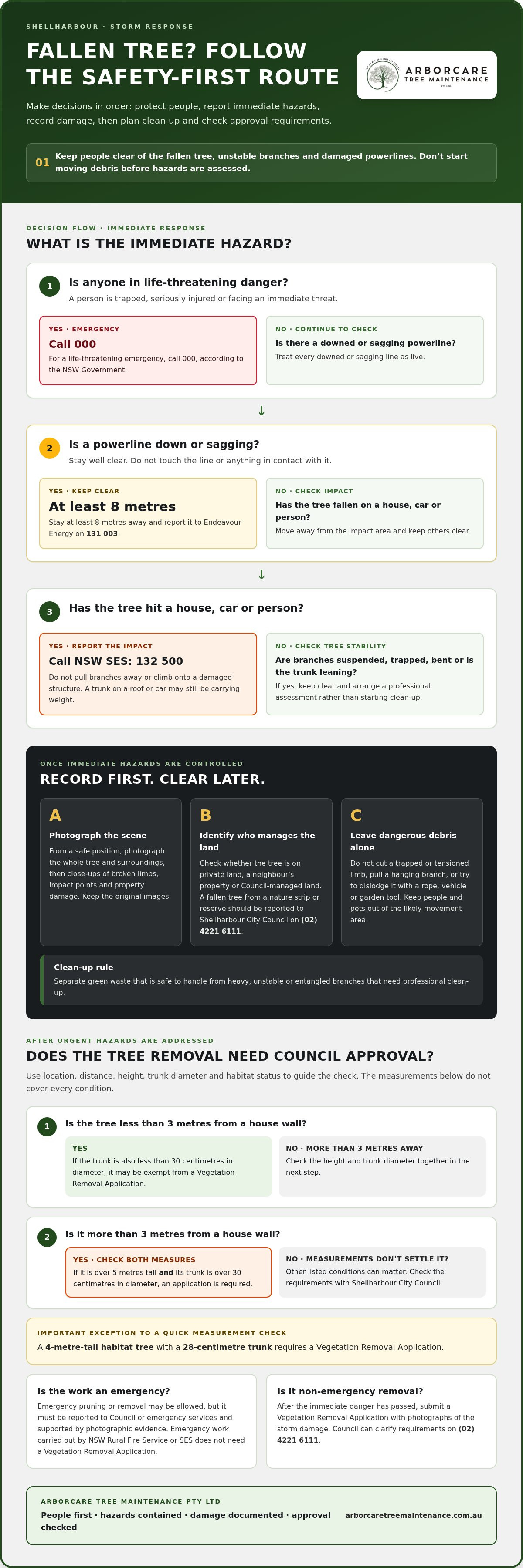
First, keep everyone clear of the fallen tree and any damaged powerlines. For emergency fallen tree clean-up in Shellharbour, stay at least 8 metres from downed or sagging powerlines and report them to Endeavour Energy on 131 003. If a tree has fallen on a house, car or person, call NSW SES on 132 500; for a life-threatening emergency, call 000, according to the NSW Government.
A fallen tree can leave unstable branches, blocked access and damage that’s difficult to assess safely. It’s understandable to want to start clearing the area, but moving debris before hazards are assessed can create further risk. This guide explains what to do first, when urgent tree help is needed, and how to document storm damage, consider Shellharbour Council approval and plan green-waste clean-up. You’ll also learn what to consider when arranging professional help, so you can make a steady, safety-first decision for your property.
Key Takeaways
- Keep clear of unstable trees and debris, and take photographs of storm damage before anything is moved.
- Use the tree’s location, height and trunk diameter to understand whether Shellharbour Council approval may be required before removal.
- Separate safe-to-handle green waste from heavy, unstable or entangled branches that need professional clean-up.
- Arrange urgent tree help when a fallen or damaged tree threatens people, property or safe access.
- Learn how tree removal and related work can help restore safety and order after the immediate hazards are addressed.
Council approval for removing storm-damaged trees
Before arranging tree removal, establish whether the tree is on private land, a neighbour’s property or Council-managed land. The approval pathway can depend on its location, size and condition, and whether the work is urgent. Take clear photographs of the damage before anything is moved. They can document the tree’s condition and support an application after immediate hazards have been addressed.
In Shellharbour, a tree less than 3 metres from a house wall may be exempt from a Vegetation Removal Application when its trunk is less than 30 centimetres in diameter. For a tree more than 3 metres from a house wall, an application is required if it is over 5 metres tall and its trunk is over 30 centimetres in diameter. These measurements help guide the decision, but other listed conditions can also matter.
Some cases show why a quick measurement alone may not settle the issue. A 4-metre-tall habitat tree with a 28-centimetre trunk requires a Vegetation Removal Application. Shellharbour City Council also requires an application for requests to prune, trim or remove vegetation on private property or a neighbour’s property. If your tree crosses a boundary, identify which part of the work affects each property before proceeding.
Storm damage can create an urgent safety issue, but urgency does not remove the need to document the work. Emergency pruning or removal may be allowed, but it must be reported to Council or emergency services and supported by photographic evidence. Emergency works carried out by NSW Rural Fire Service or SES do not need a Vegetation Removal Application. Keep records of the damage and the response.
For non-emergency removal after the immediate danger has passed, submit a Vegetation Removal Application with photographs of the storm damage. Shellharbour residents can contact Shellharbour City Council on (02) 4221 6111 to check requirements for removing a storm-damaged tree. This is particularly useful when the tree’s location, habitat status or measurements make the approval pathway less straightforward.
Don’t cut a fallen limb that remains trapped or bent under tension. It can move suddenly when cut, so keep people clear and leave the cutting to qualified tree professionals. Safe removal may involve controlled cuts to reduce movement and prevent the load shifting towards a house, fence or accessway. Once the tree is removed, stump grinding is a separate part of site clearance, not a substitute for approval to remove the tree.
Emergency response to storm damage and fallen trees
After a storm, deal with immediate hazards before assessing debris or access. Keep people away from damaged trees, unstable branches and powerlines while you document the scene.
Immediate safety precautions
Treat every downed or sagging powerline as live. Stay at least 8 metres away, and report it to Endeavour Energy on 131 003. Don’t pull a hanging limb or bent-over sapling: stored energy can make it spring or swing without warning. Keep children, visitors and pets away from the affected area, including paths, driveways and outdoor living spaces.
If a large limb is caught in another tree, keep clear of its likely movement and close off the area before any cutting begins. Include nearby paths, clotheslines, pool surrounds and neighbouring property in the exclusion zone if the limb could swing there. Don’t try to dislodge it with a rope, vehicle or garden tool. A trapped branch can shift as its weight changes.
Storm and high-wind damage
Wind damage isn’t always obvious from the ground. Even a canopy that has stayed stable for decades can lose limbs when a sudden wind reversal hits Shellharbour. From a safe position, look for split branches, newly exposed cracks, hanging sections and limbs resting against a roof or fence. Don’t walk beneath a damaged canopy to inspect it.
Record the scene before moving branches or other debris. Photograph the whole tree and its surroundings, then take close-up images of broken limbs, impact points and property damage. Shellharbour City Council and insurers may need this evidence. Keep the original images and note which parts of the property were affected. Avoid disturbing the scene until you’ve captured the damage, unless movement is necessary to protect someone from immediate danger.
For a fallen tree from a nature strip or reserve, report it to Shellharbour City Council on (02) 4221 6111. A tree on private property needs a different response from one on Council-managed land. Identify where the trunk and branches are lying, and describe whether they block access or threaten nearby structures when reporting the issue.
Storm-damaged trees can leave secondary hazards after the wind has eased. If branches remain suspended or the trunk is leaning, keep the exclusion area in place and arrange a professional assessment rather than starting clean-up yourself. For help with storm-damaged tree hazards, use a controlled response that prioritises people and property before debris removal.
Emergency response for trees on houses, cars or people
Move away from the impact area and keep others clear. If a fallen tree has caused a life-threatening emergency, call 000, according to the NSW Government; for a tree on a house, car or person in Shellharbour, call NSW SES on 132 500.
Responding to fallen trees on property
If a tree has struck a house, don’t enter rooms beneath damaged branches or a sagging roof. Leave the building if you can do so safely, then keep people outside the impact zone. A trunk resting on a roof or car may still be carrying weight, so don’t pull branches away or climb onto the structure.
Check for immediate danger from a safe position. Look for damaged walls, broken windows, blocked exits and anyone who may be trapped. Tell emergency responders the property address, what the tree has struck and whether anyone needs urgent help. Don’t move a vehicle trapped beneath branches, even if it appears undamaged.
Once people are safe, record visible damage without approaching unstable debris. Photograph the tree, the affected part of the house or car, and any blocked access. Keep the images with your notes about the incident. This creates a clear record before removal changes the scene.
Responding to road and power-line hazards
A tree across a road can expose drivers and pedestrians to falling branches, hidden wires and blocked sightlines. Don’t drive over it, climb across it or attempt to drag it clear. Keep people away from the obstruction and give its location clearly when reporting the hazard. Avoid standing beneath limbs caught above the road.
For a downed or sagging powerline, stay at least 8 metres away and treat it as live. Call Endeavour Energy on 131 003 to report the line. Don’t touch a tree, vehicle, fence or other object that may be in contact with the wire. Warn others from a safe distance, rather than approaching to place a marker.
If the fallen tree blocks access to a property or route, don’t start cutting branches to make a path. The trunk may be supporting other limbs, and cutting can shift the load. Keep emergency access clear where possible without entering the hazard zone. Give responders a precise location and describe any visible powerline involvement.
For a tree on a nature strip or reserve, contact Shellharbour City Council on (02) 4221 6111. For a tree on private property, keep the area isolated until it can be assessed and safely removed. Don’t let unwanted debris clearance become a second emergency by moving heavy or suspended sections yourself.
Storm debris and green waste clean-up
Once immediate hazards are controlled, sort the remaining storm debris by type and condition. Leaves, small twigs, intact branches and large trunk sections need different handling. Keep unstable or suspended material separate from debris that can be moved safely. Sorting helps prevent heavy timber from being mixed with light green waste and keeps access routes usable during clean-up.
Start by identifying what is on the ground, not by cutting into the fallen tree. A branch resting across a fence, for example, may still be under pressure, while loose leaves on a path can be gathered once the area is safe. Don’t drag heavy limbs through garden beds or across driveways. Moving them can shift the load, damage surfaces or expose hidden hazards.
Separate lightweight garden debris from bulky timber where it can be done without entering a hazardous area. Keep branches in a stable, accessible area, away from drains, gates and vehicle paths. Don’t stack material against a fence, wall or vehicle. If a trunk or large limb blocks access, leave it in place until it can be handled safely rather than cutting it into smaller sections yourself.
Consider the intended destination before reducing branches to smaller pieces. Clean, suitable woody material may be processed as mulch, while mixed or contaminated debris may need a different disposal approach. Avoid spreading storm debris across the property to make it look tidy. It can conceal smaller branches, obstruct drainage and make later collection harder.
Include the whole affected area in the clean-up plan. Check garden edges, paths, lawns, driveways and access points for scattered twigs, bark and leaves. Look for debris caught beneath shrubs or against retaining walls, but don’t reach into an area where a branch may be trapped. Small fragments left behind can create trip hazards or obstruct routine access.
Before removal begins, decide what needs to be cleared first. Prioritise debris blocking an entrance, driveway or frequently used path, then organise the remaining material by size and location. Keep a clear route for people and equipment, and tell others which areas must stay closed. For example, a pile of branches beside a garage shouldn’t block the door needed to move equipment.
Some clean-ups involve loose green waste only; others include heavy limbs, a damaged trunk and debris spread across a property. The volume, condition and access to the material shape the removal plan. Once unstable sections have been handled, organise the remaining green waste so it can be collected or processed without leaving further hazards behind.
When to contact an emergency tree service
Contact an emergency tree service when a damaged tree threatens people, a building, vehicle access or nearby property. If there’s immediate danger, contact the relevant emergency authority first.
Finding 24/7 fallen tree removal
For urgent tree removal on private property, contact a qualified emergency tree service that handles fallen and hazardous trees. Don’t treat a tree service as a substitute for emergency responders when someone is trapped or a powerline is involved. For a tree on a public nature strip or reserve, contact Shellharbour City Council rather than a private-property removal service.
The available emergency numbers serve different situations, not general tree clean-up. Call NSW SES on 132 500 for a tree on a house, car or person in Shellharbour. For a life-threatening emergency, call 000. A fallen tree across a private driveway without immediate danger calls for a tree-service response, not an emergency call.
Emergency and electrical hazard contacts
Use the hazard to choose the right contact. Call Endeavour Energy on 131 003 to report a downed or sagging powerline, and stay at least 8 metres away. Call Shellharbour City Council on (02) 4221 6111 about a fallen tree on a nature strip or reserve. For a tree on a house, car or person, call NSW SES on 132 500.
Give the responder the location, what the tree has struck and whether anyone is injured or trapped. If wires are involved, say so immediately and keep people clear. Don’t move a vehicle or cut a branch touching a line. These details help direct the report to the right response and prevent an unsafe attempt to clear the obstruction.
Local arborist response times
There isn’t one response time for every fallen tree. The urgency depends on immediate risks, site access, weather conditions and the equipment needed. A tree blocking a doorway or resting on a roof presents different hazards from loose branches in an open yard. Describe those conditions clearly when seeking help.
While waiting for tree work to begin, keep the affected area closed and avoid disturbing unstable sections. Share the property address, safe access details and photographs taken from a distance. If the hazard changes, such as a limb shifting or a line becoming exposed, update the relevant emergency contact. For a private-property tree hazard, discuss fallen-tree assistance as the next step after immediate dangers are reported.
Removal may be considered when a tree is dead, dying, hazardous, damaging property, obstructing construction or affected by an untreatable disease.
Arborcare Tree Maintenance: Tree Removals
Arborcare Tree Maintenance Pty Ltd provides Tree Removals for damaged or unwanted trees that need professional assessment and removal. Turn to the team once immediate hazards have been addressed and a fallen tree, unstable trunk or remaining stump still needs attention.
Tree removal can be followed by Stump Grinding to clear the remaining stump. For a damaged tree that may need targeted work rather than full removal, Hedging, Pruning & Trimming is also available. Palm Tree Removals and Complex Tree Removals address different tree types and site challenges.
Share the tree’s condition, location and any access concerns when discussing the work. Contact Arborcare Tree Maintenance Pty Ltd to discuss tree removal or related work for your property.
Take the next step towards a safer property
Once urgent hazards are under control, consider what your property needs next: removing a damaged tree, managing nearby growth or clearing a palm. The right work can help restore usable space and make the site easier to maintain. For emergency fallen tree clean-up in Shellharbour, focus first on remaining risks and the practical outcome you want for your property.
Arborcare Tree Maintenance Pty Ltd provides Tree Removals, Hedging, Pruning & Trimming, and Palm Tree Removals. These services address different needs, from removing a tree to managing overgrown branches or taking out a palm. Share what happened and what remains on site so the required work can be discussed clearly.
Take a measured approach, keep clear of any unresolved hazard and plan the next stage around your property’s needs. Contact Arborcare Tree Maintenance Pty Ltd to discuss tree work for your property and move forward with confidence.
Frequently Asked Questions
What should I do first when a tree comes down on my property?
Move people away from the tree and identify immediate dangers from a safe position. For emergency fallen tree clean-up in Shellharbour, call 000 for a life-threatening emergency, NSW SES on 132 500 if a tree has struck a person, house or car, and Endeavour Energy on 131 003 for a downed or sagging powerline. Once people are safe, note what’s blocked and avoid disturbing unstable sections.
Does home insurance cover emergency fallen tree cleanup in Shellharbour?
Insurance cover depends on the wording of your home insurance policy and the circumstances of the damage. Check how it treats storm damage, tree removal, damage to buildings and debris removal, as these may have different terms or exclusions. Keep records of the damage and related work, and compare them with your policy documents when making a claim. Don’t assume green-waste removal is included simply because a tree damaged the property.
Do I need council approval to remove or prune a fallen tree in Shellharbour?
Sometimes. Shellharbour’s rules can depend on the tree’s height, trunk diameter, distance from a house, habitat status and the work proposed. For example, a tree more than 3 metres from a house wall requires a Vegetation Removal Application if it is over 5 metres tall and its trunk is over 30 centimetres in diameter. Emergency work and later removal requests can have different reporting and application steps.
What risks should I avoid when dealing with a fallen or storm-damaged tree?
Don’t climb onto a damaged roof, stand beneath a split canopy or cut a limb trapped between branches. A section that looks settled can shift as its weight changes, while wet ground can make footing unstable around the trunk. Keep children and pets outside the work area, and leave cutting or lifting to qualified, licensed and insured professionals. Avoid moving branches that may conceal sharp debris or affect access around the property.
How do Shellharbour arborists handle tree removal, debris cleanup and green waste disposal?
Arborists assess the tree and site, then plan removal around its condition, nearby structures and safe access. Arborcare Tree Maintenance Pty Ltd provides Tree Removals, Stump Grinding and Mulching to address the tree, remaining stump and suitable green waste. The business serves Shellharbour and the Illawarra, including Dapto, Wollongong, Woonona, Jamberoo, Fairy Meadow and Dombarton. The work required depends on what remains after the storm.


