
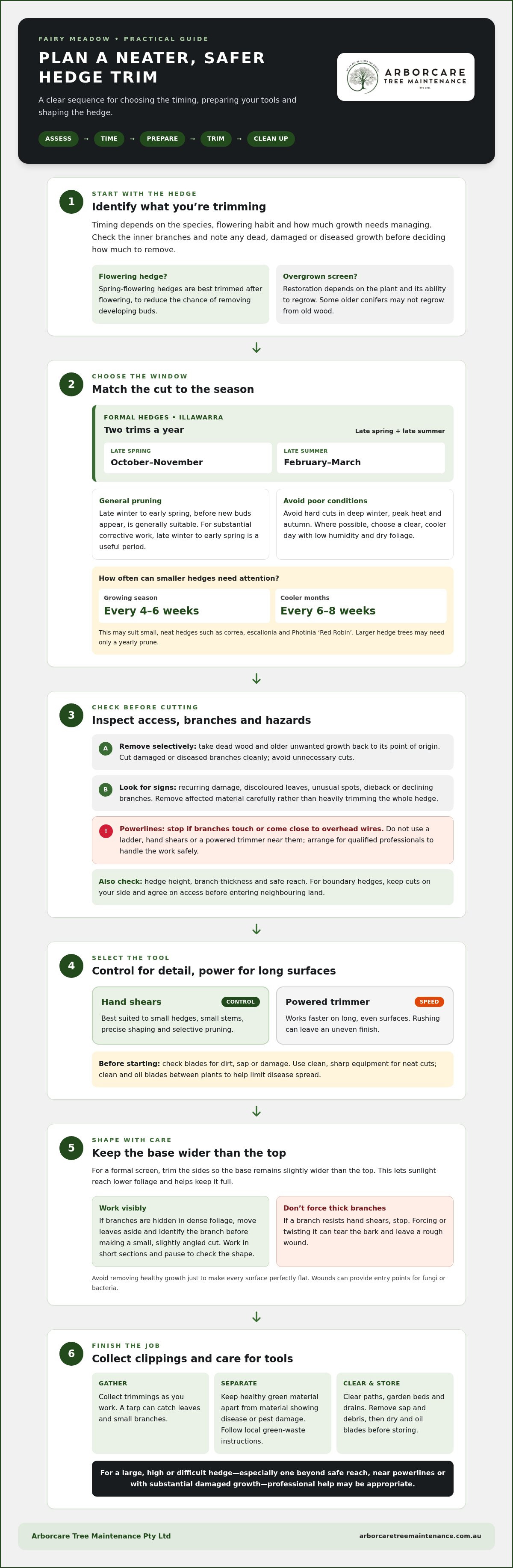
For Fairy Meadow hedge trimming, formal hedges often need two cuts a year, in late spring and late summer. In NSW, October to November and February to March are useful general windows, while spring-flowering hedges should be trimmed after flowering. The right timing depends on the species and how much growth needs managing.
When a hedge starts looking untidy, you may wonder whether hand shears will do the job or a powered trimmer is a better fit. This guide covers how to choose between them, when to trim different hedge types and what to consider before tackling an overgrown screen. You’ll also find practical advice on shaping and restoring growth, so you can plan the work around your hedge and know when professional trimming may help.
Key Takeaways
- Match trimming timing to the hedge species, especially whether it flowers before or after its main growth period.
- Choose hand shears for controlled detail and powered trimmers for larger, even surfaces; clean and oil tools between jobs.
- Restore an overgrown hedge gradually, as some plants may struggle to regrow from old wood.
- Shape formal hedges with sides wider at the base so light can reach lower foliage and help keep it full.
- Assess access, height and branch thickness before starting, and treat tall hedges as a higher-risk job requiring careful planning.
Hand shears or powered trimmers?
Hand shears suit small hedges, precise shaping and selective pruning. Powered trimmers work faster on long, even surfaces, but rushing can leave an uneven finish. Choose the tool that gives you control over the hedge’s shape and growth, and use clean, sharp equipment for neat cuts.
In Australia, late winter to early spring, before new buds appear, is generally suitable for pruning. In the Illawarra, formal hedges are often trimmed twice a year, in late spring and late summer. October to November and February to March are useful seasonal windows. Avoid hard cuts in deep winter, peak heat and autumn, when fungal spores may be more prevalent.
Flowering changes the timing. Prune spring-flowering hedges after they finish flowering, so you’re less likely to remove developing buds. For evergreen hedges, late winter to early spring is a useful general window. Small, neat hedges such as correa, escallonia and Photinia ‘Red Robin’ may need trimming every 4-6 weeks during the growing season, then every 6-8 weeks in cooler months. Larger hedge trees may need only a yearly prune.
Inspect the hedge before shaping it. Remove dead wood and older growth at its point of origin, then make clean cuts to remove damaged or diseased branches. Avoid unnecessary cuts, as wounds can provide entry points for fungi or bacteria. Clean and oil shears or trimmer blades between plants to help limit disease spread. If leaves show unusual spots or dieback, carefully remove affected material rather than heavily trimming the whole hedge.
Pruning can help manage pest and disease problems by removing affected growth and improving the hedge’s shape. It won’t identify the cause on its own: look for recurring damage, discoloured leaves or declining branches before deciding how much to cut. Where possible, trim on a clear, cooler day with low humidity, and avoid working when foliage is wet.
If branches touch or come close to overhead powerlines, stop. Don’t use a ladder, hand shears or a powered trimmer near the wires; arrange for qualified professionals to handle the work safely. At property boundaries, keep cuts to the hedge on your side and agree on access before entering neighbouring land.
For a large, high or difficult hedge, professional hedging, pruning and trimming can handle shaping and branch removal with suitable equipment. In Fairy Meadow, consider professional help if the hedge is beyond safe reach, close to powerlines or has substantial damaged growth.
Hedge trimming questions?
When undertaking Fairy Meadow hedge trimming, follow current local green-waste instructions for collection and disposal. Keep cuttings contained on your property, clear of drains and footpaths, and separate material that cannot go into your usual garden-waste collection.
Clippings removal and clean-up
Collect trimmings as you work instead of leaving piles beneath the hedge. A tarp beside the work area can catch leaves and small branches, making them easier to gather and reducing the chance of clippings being trampled across paths or lawns. Keep access routes clear, especially where people need to pass during trimming and pruning.
Separate healthy green material from branches with obvious signs of disease or pest damage. Do not mix affected material into compost or mulch if that could spread the problem around your garden. Set it aside for disposal according to relevant local green-waste instructions. After cutting, check the hedge base and nearby garden beds, where small clippings can hide among groundcover.
Finish by sweeping paths and collecting material from fences, garden beds and drains. Clean-up matters after spring cutting, when fresh leaves and short offcuts can be easy to miss. Keep piles off neighbouring land, and do not leave loose branches where they could obstruct access or be blown around.
Tools and clean-cut techniques
Use hand shears for small stems and detailed shaping, and a powered trimmer for long, even faces. Before starting, check the blades for dirt, sap or damage. Clean and oil hedge-trimming tools regularly: clean blades make sharper cuts and help reduce the risk of spreading disease between plants.
If branches are hidden inside a dense hedge, do not sweep a powered blade blindly through the foliage. Move the leaves aside and identify the branch before making a small, slightly angled cut. This controlled approach helps prevent accidental damage to nearby growth. If you cannot see the main branches clearly, work in short sections and pause to check the hedge’s shape.
Keep the hedge’s structure in view as you cut. For a formal screen, trim the sides so the base remains slightly wider than the top, allowing sunlight to reach the lower leaves. Do not remove healthy growth just to make every surface perfectly flat. If thick branches resist hand shears, stop rather than forcing the tool or twisting the branch, which can tear the bark and leave a rough wound.
After trimming, remove sap and plant debris from the blades, then dry and oil the tool before storing it. Clean equipment between hedges, particularly if one has spotted leaves or damaged branches. This helps maintain cutting performance and lowers the chance of carrying residue or disease to the next plant. For professional assistance with your property, trust Arborcare Tree Maintenance Pty Ltd to deliver exceptional results.
Can you bring an overgrown hedge back?
Often, but restoration depends on the plant species and how much old wood needs removing. Plan cuts around the hedge’s ability to regrow, not just its current outline.
Planning an overgrown hedge
Start by identifying the hedge plants and inspecting the inner branches. Remove dead wood and the thickest unwanted branches first, cutting them back to their point of origin. This reveals the plant’s structure and helps you judge how much live growth remains. Deciduous hedges can be pruned in late winter while dormant, and late winter to early spring is a useful period for substantial corrective work.
Avoid stripping every side at once. Older conifers may not regrow from old wood, while removing too much old wood from broad-leaved evergreens can impair new growth. If the hedge is badly overgrown, reduce it in stages and assess fresh growth before making further cuts. Summer is better suited to maintenance shaping and height control than major restoration.
Formal shapes and plant types
For a formal hedge, taper the sides so the base is wider than the top. This lets sunlight reach the lower leaves and helps the hedge stay full near the ground. On a chest-high hedge, trim the sides before the top; on a taller hedge, shape the top before working down the sides.
The plant type affects how you prune. Box, privet and viburnum can tolerate extensive late-winter trimming followed by regular maintenance during the growing season. Light trimming can keep viburnum in shape, with heavier pruning in early spring. Don’t assume every hedge will recover in the same way: older conifers and broad-leaved evergreens respond differently to cuts into old wood.
Shaping with string lines
String lines help create a consistent face or top along a long, straight hedge. Position the line along the intended finished edge, then step back to check that it follows the desired shape. Keep it clear of foliage so it doesn’t pull branches into a false line. Trim in short sections, comparing each with the guide before moving along.
For a level top, use the line as a visual guide rather than cutting through it. Take care on uneven ground, where a level line may make the hedge look uneven next to paths or fences. Keep the sides wider at the base, and remove only the growth needed to reach the planned outline.
After each pass, pause to inspect the shape from several viewpoints. If the hedge still has bare patches or exposed old wood, stop heavy cutting and let the remaining foliage develop before reshaping.
Hedge trimming services in Fairy Meadow and the Illawarra
Local hedge work can range from routine shaping to substantial boundary screens. The hedge’s height, length, plant type, access and condition all affect the work involved.
Hedging service prices
Price depends on the hedge’s size, height, length, density, access and the amount of material to remove. It’s given after a quote request, once the work required is clear. A small formal hedge is a different job from a tall boundary screen with thick branches, difficult access or extensive overgrowth.
For a useful comparison, make sure each quote describes the same scope. Check whether it covers trimming the sides and top, removing cuttings, and any additional pruning needed for damaged growth. A hedge that needs careful reduction may require more time than a light shape-up. Fast-growing lilly pilly and murraya screens in the Illawarra may need three trims a year, while native screens usually need trimming every 12 months.
Choosing a reliable local service
For Fairy Meadow hedge trimming, describe the hedge’s location, height, length and condition when requesting a free onsite quote from Arborcare Tree Maintenance. Mention nearby fences and gardens, access limits and any branches close to powerlines. These details help define the work and identify safety concerns before trimming begins.
When reading Illawarra customer reviews, look for practical details, not just star ratings. Relevant comments describe the hedge type, the finished shape, whether the work area was left tidy, and how access or changing conditions were handled. Look for feedback about work similar to yours, such as shaping a lilly pilly screen or pruning a dense boundary hedge.
Ask for a clear description of the proposed work and the material removal arrangements. A reliable service should explain what will be cut, what will remain, and how the finished hedge is intended to look. For hedges taller than 2.5 m, height adds a safety consideration; don’t treat the job as ordinary ground-level trimming.
Related garden tasks can affect how hedge work is planned. Overhanging branches may need pruning alongside the hedge face, while tight garden beds can limit where equipment and cuttings can go. Be specific about the work you need, so hedge shaping doesn’t get confused with unrelated lawn or garden maintenance. If a storm has left broken branches across the hedge, treat that as a separate safety issue from routine trimming.
The season also affects the work plan. A flowering hedge may need trimming after flowering finishes, while late winter is commonly used for heavier pruning. Clear instructions about the desired height, shape and clean-up help ensure the finished result suits the property.
Hedging expert listings in Fairy Meadow
A service listing can help you identify the type of hedge work offered, but the label alone doesn’t describe the job. Match the stated work to your hedge’s height, length, plant type and access. A straight, low Photinia screen needs a different approach from an overgrown boundary hedge or dense screening shrubs.
Start with the outcome you want. A routine trim maintains an existing shape, while corrective pruning removes selected growth to change the hedge’s size or structure. If you need hedge shaping, be clear about your goal, such as lowering a feature hedge or restoring an uneven face. A defined scope helps distinguish hedge work from tree removal or general garden maintenance.
Plant type matters, too. Photinia ‘Red Robin’ can be maintained as a compact, formal screen, while lilly pilly is often used for taller privacy screening. Flowering shrubs may need pruning after flowering, so include the timing in your job description. Name the species or provide a clear photo to show whether the work involves light surface trimming or selective branch removal.
Height and access are practical indicators of complexity. A hedge over 2.5 m requires added safety precautions, particularly where work involves ladders, uneven ground or branches near powerlines. Note gates, sloping garden beds, fences and nearby structures. These details help distinguish a straightforward, ground-level trim from work requiring more careful access planning.
Look for specific task details rather than broad claims in a service description. Useful details include whether both sides and the top need shaping, whether the hedge is flowering, and whether cuttings need removal. For example, “trim the top and sides of a straight photinia screen” gives a clearer picture than “tidy the garden”. Photos of the full hedge and its surroundings can also show its scale and access.
For Fairy Meadow hedge trimming, organise your notes before comparing service descriptions: hedge type, approximate height, length, desired shape and any access constraints. Use the same description each time, so you’re comparing similar work. A clear scope makes it easier to identify relevant hedging expertise and understand what the finished job should include.
The key is to match the work described to the actual hedge, not just the word “hedging”. A straight screen, a flowering feature and a tall boundary hedge each call for different planning, tools and pruning decisions.
Arborcare Tree Maintenance: Tree Removals
Arborcare Tree Maintenance provides Hedging, Pruning & Trimming for hedges that need routine shaping, careful pruning or overgrowth reduction. If a hedge includes a hazardous tree or substantial branches requiring removal, Tree Removals may be more suitable. Palm Tree Removals and Stump Grinding are also available for those specific needs.
When discussing the work with Arborcare, describe the hedge’s location, height, condition and desired shape. Mention nearby structures, fences or restricted access to make the job clear. If the hedge needs trimming, Arborcare can help with the relevant pruning work; explain any separate tree concerns as well.
Contact Arborcare Tree Maintenance for a free onsite quote for hedge trimming or tree removal at your property.
Plan the next cut with confidence
A well-kept hedge starts with a clear goal: decide whether you want to maintain its shape, reduce its spread or address damaged growth. For Fairy Meadow hedge trimming, consider how the hedge fits the garden as it grows, including its screening role, access and proximity to boundaries. A planned approach can help protect the plants while keeping outdoor spaces practical.
Arborcare Tree Maintenance offers Hedging, Pruning & Trimming for hedge maintenance, alongside Tree Removals and Palm Tree Removals for separate tree issues. To discuss the work, describe the hedge’s condition and the result you want. The appropriate service depends on the task and site conditions.
Contact Arborcare Tree Maintenance to discuss your property’s hedge or tree work. A considered next step can make maintaining your outdoor space feel more manageable.
Frequently Asked Questions
When can you trim hedges?
Trim according to the hedge species, flowering cycle and amount of growth. For example, wait until a flowering hedge has finished blooming before shaping it, to avoid removing developing flowers. Handle broken or dead branches separately from routine shaping. Also consider nesting activity and inspect the hedge before cutting, especially where dense foliage could conceal birds or wildlife.
Can you put me on a maintenance schedule?
Base a maintenance plan on how quickly your hedge grows and the shape you want to retain. Record when each trim takes place, and note whether the hedge becomes untidy, blocks a path or loses lower foliage before the next cut. Fast-growing plants may need closer attention than slow-growing screens. Arborcare Tree Maintenance provides Hedging, Pruning & Trimming; discuss the recurring work you need.
Do you take the clippings with you?
Include clippings removal in the job scope so you know how the garden will be left. Before work begins, identify where cuttings can be gathered and whether diseased material needs separate handling. Keep green waste clear of drains, footpaths and neighbouring properties. For local disposal, follow Wollongong Council’s current green-waste collection instructions, including its requirements for presenting garden material.
Looking for hedging services?
Arborcare Tree Maintenance provides Hedging, Pruning & Trimming across the Illawarra. Describe the hedge’s species, height, length and condition, and explain whether you need a tidy-up, shaping or selective branch removal. A clear description helps define the task. For example, mention if a screen has grown across a gate or thick shrubs are blocking driveway access.
When is the right time to prune?
The right time depends on the plant and the work required. For a flowering shrub, plan routine shaping after flowering finishes; for a major reduction, consider the plant’s dormant period and ability to regrow. Don’t cut simply to meet a calendar date if the hedge is stressed or showing signs of disease. Inspect the branches and buds first, then choose the least disruptive timing.
When to cut hedges in Australia?
In Australia, late winter to early spring is generally suitable for pruning before new growth begins, while summer can suit light maintenance trimming. Local weather and plant type matter: a hedge in a hot, dry spot may respond differently from one in a sheltered garden. Before shaping an evergreen through summer, check soil moisture and foliage condition, and avoid trimming a flowering hedge before it blooms.
Why pruning and trimming is important?
Pruning removes selected growth, while trimming maintains a hedge’s outline. Both can help prevent branches from obstructing paths, windows or gates and keep a screen from spreading into usable garden space. Selective cuts let you remove dead or damaged growth without cutting back the entire surface. A careful approach preserves the hedge’s structure and helps avoid exposing bare inner branches unnecessarily.
Hedge trimming service comparison Fairy Meadow reviews and insurance


