
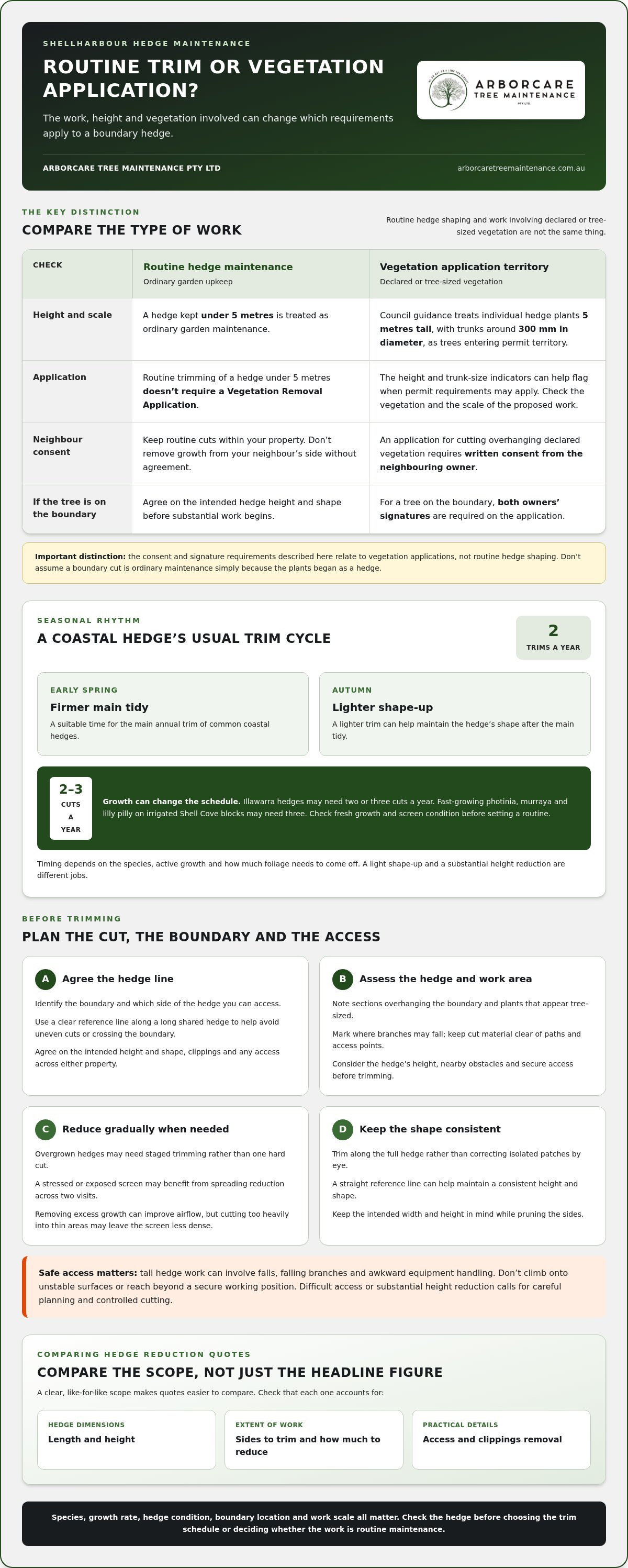
Coastal hedges in Shellharbour are commonly trimmed twice a year: a harder tidy in early spring and a lighter shape-up in autumn. For hedge reduction in Shellharbour, routine trimming of a hedge kept under 5 metres is treated as ordinary garden maintenance and doesn’t require a Vegetation Removal Application. Cutting overhanging declared vegetation is different, and an application requires written consent from the neighbouring owner.
A boundary hedge can provide privacy and define a garden, so it’s understandable to want a neat, even line without creating tension with a neighbour. Before hedge reduction in Shellharbour, distinguish routine maintenance from work that may involve declared vegetation or affect a shared boundary.
This guide explains how often to trim coastal hedges, what to consider before cutting near a boundary, and when damaged or overgrown growth needs more than a light tidy. It also covers hedge and tree work in Shell Cove and Flinders, where fast-growing plants, exposed screens and larger vegetation can call for a considered approach.
Key Takeaways
- Choose trimming times around the hedge’s growth pattern, and adjust the approach as it develops towards its desired size.
- Before cutting along a boundary, distinguish routine maintenance from work involving declared vegetation and consider the neighbour-consent requirements.
- In Shell Cove, fast-growing photinia, murraya and lilly pilly on irrigated blocks may need more frequent attention.
- A stressed or exposed hedge may benefit from a staged reduction rather than a heavy cut in one visit.
- Learn when damaged growth can be pruned and when a hedge’s condition or size points to tree work instead.
How often should a coastal hedge be trimmed?
Most coastal hedges in Shellharbour benefit from two trims a year: a firmer tidy in early spring and a lighter shape-up in autumn. The right routine depends on the species, its growth rate and the hedge’s condition.
Seasonal Timing for Hedge Reduction
For common coastal hedges, early spring suits the main annual tidy, with a lighter trim in autumn. Illawarra hedges may need two or three cuts a year, depending on species and growth rate. Fast-growing photinia, murraya and lilly pilly on irrigated Shell Cove blocks may need three cuts. Check fresh growth and the screen’s condition before setting a schedule.
The best time to reduce a hedge depends on its species, active growth and how much foliage needs to come off. Don’t assume every hedge follows the same calendar: a light shape-up and a substantial height reduction are different jobs.
Trimming Sides and Maintaining Straight Lines
Side trimming controls width, encourages growth along the outer structure and helps maintain a consistent height and shape. Work along the full hedge rather than correcting isolated patches by eye. A straight reference line makes long boundary hedges easier to keep uniform and helps reveal sections that have bulged or receded.
Keep the intended width and height in mind as you prune. Removing excess growth can improve airflow through the hedge, but cutting too heavily into thin areas may leave the screen less dense.
Overgrown hedges often need staged trimming rather than one hard cut. Reduce them gradually to restore the shape while retaining healthy growth. If an exposed screen is stressed, spreading the reduction across two visits can avoid removing too much foliage at once.
Height affects the work involved. A tall hedge may require suitable access equipment and careful control of cut branches. Don’t climb onto unstable surfaces or reach beyond a secure working position. Assess access, the hedge’s height and nearby obstacles before trimming begins.
When comparing hedge reduction quotes in Shellharbour, match the scope: hedge length and height, which sides need trimming, how much to reduce, access, and clippings removal. A clear scope makes quotes easier to compare than headline figures alone.
Cutting a tall hedge can expose workers to falls, falling branches and awkward equipment handling. For difficult access or substantial height reduction, consider getting professional help and planning the work around safe access and controlled cutting.
Can a hedge on the boundary be cut without asking my neighbour?
Routine trimming of a hedge kept under 5 metres is classed as ordinary garden maintenance in Shellharbour and doesn’t require a Vegetation Removal Application. Boundary ownership, declared vegetation and the scale of the work can change what steps apply.
Boundary Hedge Maintenance
Start by identifying the boundary line and which side of the hedge you can access. Keep routine cuts within your property and don’t remove growth from your neighbour’s side without agreement. For a long shared hedge, use a clear reference line to avoid uneven sections or cutting across the boundary.
Hedges can provide privacy and mark a property boundary, so agree on the intended height and shape before substantial work begins. A short conversation can also clarify who will manage the clippings and whether access across either property is needed.
Council Rules for Hedge and Tree Trimming
In Shellharbour, routine trimming of a hedge under 5 metres is ordinary garden maintenance and doesn’t require a Vegetation Removal Application. Shellharbour City Council guidance treats individual hedge plants 5 metres tall with trunks around 300 mm in diameter as trees entering permit territory.
For an application covering overhanging declared vegetation, Shellharbour City Council requires written consent from the neighbouring owner. If a tree stands on the boundary, both owners’ signatures are required on the application. These requirements relate to vegetation applications, not routine hedge shaping.
Before reducing a large hedge, check whether it is still a hedge or has developed into tree-sized vegetation. Shellharbour City Council’s 5-metre height and around-300-mm trunk diameter indicators can help flag when permit requirements may apply. Don’t assume that every boundary cut is ordinary maintenance simply because the plants were originally planted as a hedge.
Coastal properties around Bass Point also need careful planning for tree and garden maintenance. Mark the work area, identify where branches may fall, and keep cut material clear of paths and access points. If a hedge screens the garden from coastal conditions, avoid removing more foliage than needed to restore its shape.
For general garden upkeep, distinguish light shaping from work that changes a hedge’s height, width or structure. Note which sections overhang the boundary, which plants appear tree-sized, and whether the work involves declared vegetation. These details help clarify whether routine trimming or an application process is relevant.
For help keeping a boundary hedge neat, consider professional hedge maintenance after agreeing on the intended cut and access arrangements. A clear scope helps keep the work focused on the agreed hedge line and avoids confusion about neighbouring property.
Hedge and tree work in Shell Cove and Flinders
Shell Cove and Flinders have newer residential areas, where irrigated gardens can support fast hedge growth. Photinia, murraya and lilly pilly may need three cuts a year on irrigated blocks. Regular inspection helps identify shoots extending beyond the intended screen or narrowing garden access.
First identify whether the job involves routine shaping, substantial reduction or tree work. Check the hedge’s height, width, density and condition along its full length. Look for dead or damaged growth, then assess whether the remaining foliage can support the planned shape. Cutting too aggressively can leave a hedge sparse rather than dense.
For an exposed, stressed screen, a staged reduction across two visits can avoid removing too much foliage at once. The first visit can address the most intrusive growth; the later one can refine the height and sides. This suits a hedge that needs gradual reshaping while retaining its screening function.
Some planting has outgrown the original hedge form. A row that has become 8-metre trees is a tree-removal situation, not routine hedge trimming. Likewise, a hedge topped for fifteen years and hollow through its centre may need removal and replanting rather than another maintenance cut. Three dead plants in a run of nine can also signal that routine trimming won’t restore an even screen.
Size can affect whether vegetation is treated as trees for permit purposes. According to Shellharbour City Council guidance, individual hedge plants 5 metres tall with trunks around 300 mm in diameter enter permit territory. Check the plants’ height and trunk size before planning a substantial reduction, especially if the work involves removal rather than shaping.
For larger trees, pruning should preserve sound structure and avoid indiscriminate cuts. Pruning larger trees in Shellharbour is expected to follow Australian Standard AS 4373-2007. That differs from routine hedge shaping, which focuses on maintaining a consistent screen. A qualified assessment helps define the task when tall plants have developed tree-like form.
Shell Cove and Flinders are part of the wider Illawarra maintenance area, alongside Wollongong and Shellharbour. For each property, note irrigation, hedge species, exposure and access before setting a trimming plan. A fast-growing screen beside a driveway may need a different approach from a mature hedge forming a sheltered garden boundary.
Routine hedge trimming may involve removing dead or damaged branches and leaves, while the aim may also be to make the screen denser. Improper trimming can leave it too sparse, so the cut should suit the plant’s condition and intended form. Arborcare’s pruning work also covers flowering plants such as roses, fruit trees, shrubs and small garden trees, beyond hedge-focused maintenance.
Width can be as important as height when deciding whether to keep trimming. The page says a hedge that has grown so wide it has taken a metre of yard on both sides is a removal-and-replant situation, not routine maintenance. The task was listed for a garden size of 150m²-300m², offering a local example of hedge work on a residential property.
What affects the price of hedge reduction in Shellharbour?
The price depends on the hedge’s size, condition, access and the work required. A light shape-up along an accessible garden hedge is different from reducing a tall, dense screen beside a fence. The price depends on the case and is given after a quote request. A useful estimate starts with a clear description of the hedge and the intended result.
Before requesting a quote, note the hedge’s approximate length, height and width. Explain whether the job involves trimming the sides, lowering the top, removing dead growth or reshaping the whole screen. A long hedge needing only a side trim has a different scope from one requiring substantial height reduction.
Access matters too. A hedge beside an open lawn may be straightforward to reach, while one behind a narrow side passage, near a fence or above garden features can require more careful work. Mention gates, steps, slopes and nearby obstacles so the scope reflects the actual working area.
- Size and density: A tall, thick hedge can involve more cutting and handling than a shorter, sparse screen.
- Type of work: Side trimming, height reduction and staged reshaping involve different tasks.
- Access: Restricted entry or obstacles can affect how the work is carried out.
- Condition: Dead, damaged or uneven growth may change the work needed to achieve the intended shape.
- Clippings: State whether green waste collection and removal are part of the requested scope.
Be specific about the finish you want. “Make it smaller” leaves the intended height and width unclear. Instead, describe which sides need attention and whether the screen should retain privacy. Photos from the front, side and access point can help show the hedge’s shape and location.
Ask for the quote to set out the work included, such as which sections will be cut and how clippings will be handled. If the hedge needs staged reduction, distinguish the initial work from any later visit. This helps you compare equivalent scopes instead of treating different levels of cutting as the same job.
For hedge reduction in Shellharbour, clear details connect the result you want with the work involved. Set out the hedge’s dimensions, condition, access and desired finish when requesting a free onsite quote. The work depends on how much material needs cutting, the access and whether the job involves routine trimming or substantial reduction.
Shellharbour hedge reduction services with green waste removal
Hedge reduction can produce a substantial volume of clippings, especially along a long boundary or dense garden screen. Before work begins in Shellharbour, agree on how cut material will be handled and whether collection and removal are included in the scope, particularly for a heavy reduction.
Agree on how cuttings will be handled before work starts. A simple plan helps protect lawns, paths and garden beds during trimming.
- Identify the collection area: Choose a clear spot away from gates, paths and garden beds.
- Keep access open: Move pots and furniture from the route between the hedge and collection point.
- Separate material where useful: Keep larger branches apart from fine leaves and small clippings.
- Confirm the finish: Include sweeping or clearing the work area in the agreed scope.
Clipping volume depends on the hedge’s length, density and how much is removed. A light trim creates less material than lowering a wide, overgrown screen. If the hedge is reduced in stages, agree on how clippings will be handled after each visit.
Consider the property layout, too. A narrow side passage can make it harder to carry cuttings out than an open lawn beside the hedge. Note steps, gates, garden furniture and nearby paths before trimming starts. Keeping a route clear helps minimise disruption to residents and avoid dragging branches across planted areas.
Green waste handling also depends on what is cut. Fine foliage and small twigs are easier to gather than bulky branches from a substantial reduction. Keep piles contained and don’t block drains, driveways or shared access. If the hedge borders a neighbour’s garden, agree where material can be gathered without crossing the boundary.
For a healthier finish, distinguish routine clippings from dead or damaged growth. Those branches may need separate handling, especially if they are large or tangled within the hedge. A dense screen can conceal them, so inspect the cut area as trimming progresses and have material cleared safely from the base.
Some hedges have grown into rows of trees and need a different scope from ordinary hedge maintenance. A row of 8-metre trees is a tree-removal situation, not routine trimming. If cutting exposes tree-sized growth, get help planning tree work suited to the site.
Hedge clippings are typically collected and removed after trimming so the property remains tidy. Before the visit, agree on how that removal will fit the job: whether collection covers the whole trimmed area, where material can be gathered, and how the site should look when work is finished. If the work is being staged, make the same arrangement for each part of the hedge so clippings do not become an uncertain leftover between visits.
Keep the agreed collection route clear and point out any boundary or access limits before trimming begins. This sets a shared expectation for clean-up and lets the trimming plan account for material handling from the outset.
Arborcare Tree Maintenance: Tree Removals
Arborcare Tree Maintenance can help when a hedge has outgrown routine trimming and become a row of trees, or when damaged growth needs a more substantial response. Its Hedging, Pruning & Trimming service suits ongoing hedge care, while Tree Removals are suited to vegetation that needs more than a maintenance trim.
For a palm that needs removing, the team also provides Palm Tree Removals. Stump Grinding can remove the remaining stump after a tree is taken down. Matching the work to the plant’s condition and form helps identify the right next step, rather than treating every overgrown hedge as a simple cut.
Contact Arborcare Tree Maintenance for a free onsite quote on hedge or tree work at your property.
Plan the next step for your hedge
A well-managed hedge can keep its shape without losing the privacy and screening your garden needs. First decide whether the work is routine maintenance, substantial reduction or removal. That distinction helps define the scope and match the approach to the plants’ condition.
For ongoing care, Arborcare Tree Maintenance offers Hedging, Pruning & Trimming. If a hedge has become tree-sized or needs removal, Tree Removals may be more suitable. The team also provides Palm Tree Removals. Choose the service that suits the plants and your property rather than cutting back growth without a clear plan.
Whether you’re planning hedge reduction in Shellharbour or need help deciding what work your garden requires, take the next step with a clear description of the hedge and your preferred outcome. Contact Arborcare Tree Maintenance today to discuss the work. A well-defined plan can help you move forward with confidence and care for your outdoor space.
Frequently Asked Questions
How much can you safely reduce a hedge without damaging it?
There’s no single safe reduction amount for every hedge. The suitable cut depends on the species, its condition and where healthy foliage remains. A hedge with thin or stressed growth needs a more conservative approach than a dense, vigorous screen. Avoid removing so much outer growth that the hedge becomes sparse; assess its structure before deciding how far to reduce it.


