
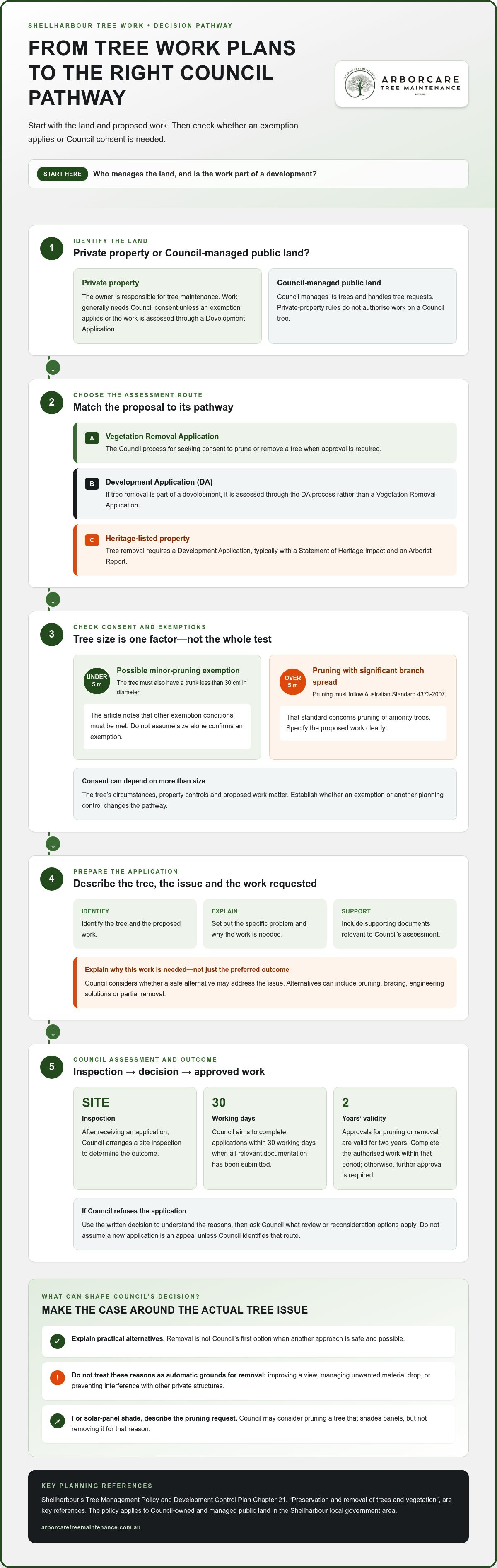
In Shellharbour, pruning or removing a tree on private land generally requires Council consent through a Vegetation Removal Application, unless an exemption applies. Some minor pruning may be exempt for a tree under 5 metres tall with a trunk less than 30 centimetres in diameter, provided the other exemption conditions are met. The rules behind a Shellharbour council tree preservation order depend on the tree and the property.
It can be difficult to tell whether a tree is exempt from approval or whether development or heritage controls change the pathway. This guide explains which rules apply in Shellharbour, when consent may be needed, and what exemptions may cover tree work. It also outlines how to make a submission when Council exhibits a proposed policy, so you can understand the process before deciding what to do.
Key Takeaways
- Find out which Shellharbour planning controls apply to tree work and how the Development Application pathway differs from a Vegetation Removal Application.
- Learn which tree features may mean Council consent is needed, including size, habitat features and heritage status.
- See how exemptions for some pruning and tree species work, and why an exemption may depend on more than the tree’s name or size.
- Understand what to include when making a submission about a proposed Council policy, and the available ways to send it.
- Explore the issues to consider before pruning, removing or damaging a protected tree without approval.
Applicable Shellharbour local environmental plans
The Shellharbour council tree preservation order and related planning controls depend on the land, Council policy and the proposed work. Rules differ for private land, public land and development sites, so establish who manages the property before planning pruning or removal.
Local environmental plan coverage
A local environmental plan sets planning controls for land, while Shellharbour’s tree rules also sit within Council’s policy and Development Control Plan. Council’s Tree Management Policy cites the Shellharbour Local Environmental Plan 2013 and Rural Local Environmental Plan 2004, alongside the State Environmental Planning Policy (Vegetation in Non-Rural Areas) 2017.
Current tree management is governed by the Tree Management Policy and Development Control Plan Chapter 21, Preservation and removal of trees and vegetation. The proposed tree-management DCP applies to the Shellharbour Local Environmental Plan 2013, Shellharbour Local Environmental Plan 2000 and Shellharbour Rural Local Environmental Plan 2004. Council adopted its Tree Management Policy on 23 June 2025. To find the current policy and application forms, look for these named documents and the Vegetation Removal Application in Shellharbour City Council’s planning resources. The policy and DCP are the key references; a planning control applying to a property may affect the pathway.
Vegetation removal application requirements and process
A Vegetation Removal Application is the Council process for seeking consent to prune or remove a tree when approval is required. Trees on private land generally require Council consent unless an exemption applies or the work is assessed through a Development Application. The application should identify the tree and proposed work, with supporting documents relevant to Council’s assessment.
After receiving an application, Council arranges a site inspection to determine the outcome. Council aims to complete applications within 30 working days when all relevant documentation has been submitted. If Council refuses an application, use the written decision to understand its reasons, then ask Council what review or reconsideration options apply. Do not treat a new application as an appeal unless Council identifies that route.
Rules across land types
Tree rules depend in part on who manages the land and whether removal is part of a development. On private property, the owner is responsible for tree maintenance, and work may require consent through a Vegetation Removal Application. The Tree Management Policy applies to Council-owned and managed public land in the Shellharbour local government area, not private trees.
On public land, Council manages its trees and handles tree requests. Private-property rules do not authorise work on a Council tree. If removal is part of a Development Application, it is assessed through the DA process rather than a Vegetation Removal Application. For a heritage-listed property, removal requires a Development Application, typically with a Statement of Heritage Impact and an Arborist Report. The application pathway changes according to the land and proposal.
Penalties for unauthorised tree damage
Removing or damaging a protected tree without required approval may create a compliance issue under the planning controls for that land. The outcome depends on the tree’s status, location, the work carried out and whether consent or an exemption applied. A penalty amount or specific enforcement outcome should not be assumed.
Before work begins, establish whether the tree is on private or Council land and whether the proposal needs a Vegetation Removal Application or a Development Application. Keep the decision and supporting records with the property documents. If damage has already occurred, record the tree’s condition and the work carried out, then contact Council about the appropriate response. Clear records help explain what happened without assuming an exemption or approval covered the work.
Council consent for pruning and tree removal
Consent depends on the proposed work and the tree’s circumstances, not simply the owner’s preference. Shellharbour Council assesses requests case by case, including whether a safe alternative could address the issue without removing the tree.
Removal is not Council’s first option when another approach is safe and possible. Alternatives may include pruning, bracing, engineering solutions or partial removal. Explain the specific problem and why the proposed work is needed. A request based only on a preferred outcome may not address the alternatives Council considers.
Some reasons carry less weight in Council’s decision. Improving a view, managing unwanted material drop or preventing interference with other private structures are not significant considerations. If branches affect a building, describe the issue clearly, but do not assume that interference alone justifies removal.
Solar panels are treated differently from a request to remove a tree. Council may consider pruning a tree that shades panels, but not removing it for that reason. Describe the shading problem and proposed pruning rather than treating solar access as automatic grounds for removal.
Pruning also needs to account for tree size and branch spread. For trees over 5 metres tall with significant branch spread, pruning must follow Australian Standard 4373-2007. That standard concerns pruning of amenity trees. Specifying the work clearly helps distinguish considered pruning from an unnecessarily extensive cut.
Approval has a defined period. According to Shellharbour City Council, approvals for pruning or removal are valid for two years. The approved work must be completed within that period; otherwise, further approval is required. Keep the approval details with the work records and compare the planned scope with what Council authorised.
Storm or high-wind damage may need urgent attention. Emergency pruning or removal may be allowed, but the work must be reported to Council or emergency services and supported by photographic evidence. Where it is safe, photograph the damage before work begins. Emergency work carried out by the NSW Rural Fire Service or SES does not require a Vegetation Removal Application.
For approved work, use a qualified tree professional to carry out the specified pruning safely and consistently with the approval. Professional tree pruning can help put an approved scope into practice without expanding it into unapproved removal.
Declared Vegetation and permit requirements
Shellharbour’s Development Control Plan identifies Declared Vegetation, which requires Council approval before tree work. Size is one indicator, but habitat features, location and heritage status can also affect whether an application is needed.
How a tree may be declared
On private property, a tree is declared if it is 5 metres or more tall, or its trunk diameter is 30 centimetres or more at natural ground level. A tree with cavities in its trunk or branches is also declared when native animals can use them for foraging, shelter, roosting or nesting.
These criteria mean a smaller tree can still need approval. For example, a 4-metre tree with a 28-centimetre trunk requires a Vegetation Removal Application if it is a protected habitat tree. Check for cavities and habitat use, not just height and trunk size.
When an application is required
A tree over 5 metres tall and over 30 centimetres in trunk diameter, more than 3 metres from a house wall, requires an application for pruning or removal. A 10-metre tree with large branches extending across several properties also requires an application if it is neither a threatened species nor in a heritage area.
Location and status can change the outcome. Pruning a declared tree beyond the property boundary requires both a Vegetation Removal Application and neighbour consent. A tree on heritage-listed property follows the separate Development Application pathway described above.
Exemptions and limits
Some work may not need a Vegetation Removal Application, but exemptions have conditions. Routine hedge trimming under 5 metres is exempt if the hedge is not heritage-listed or part of declared vegetation. A tree under 5 metres tall and under 30 centimetres in trunk diameter may also be exempt when it is more than 3 metres from the house wall, and is neither heritage-listed nor threatened.
A tree less than 3 metres from a house wall, measured from the trunk centre at ground level, may not need an application if its trunk is under 30 centimetres in diameter. Minor pruning of a tree under 5 metres tall with a trunk under 30 centimetres may also qualify, provided other exemption conditions are met. These examples are conditional, not blanket permissions.
Species status alone does not settle the question. A 7-metre tree with a 32-centimetre trunk, even if listed as an exempt species in Table 21.1, still requires an application; offset planting will be assessed. The 10/50 Vegetation Clearing Scheme is an additional bushfire-preparation option for people living near bushland in New South Wales, but it should not be treated as general Council consent.
Emergency tree work carried out by the NSW Rural Fire Service or SES does not require a Vegetation Removal Application. For other work, establish whether the tree is declared, whether an exemption’s conditions apply, and whether boundary, habitat or heritage factors are relevant before pruning or removal begins.
Exempt tree species
Shellharbour’s Development Control Plan Section 21.1 covers exempt trees and the conditions for pruning or removal without Council approval. An exemption is conditional, not a blanket permission attached to a species name. Read the relevant entry alongside its conditions, then consider whether another control affects the tree. This distinction matters because species eligibility alone does not establish that proposed work is exempt.
How to read the exempt tree provisions
Start with Section 21.1 and identify the tree species before relying on an exemption. Then match the proposed activity, whether pruning or removal, to the conditions stated for that tree. A condition attached to one type of work should not be treated as permission for another. If the entry does not clearly cover the proposed work, don’t assume the exemption applies.
Table 21.1 is not a stand-alone approval list. Shellharbour’s rules assess the tree and the circumstances around the work, including whether it is declared vegetation or affected by heritage controls. For example, a tree identified as an exempt species can still need an application when its size or status triggers another requirement. The exemption must be read with the wider planning controls, not in isolation.
The size thresholds illustrate why the table needs careful reading. A 7-metre tree with a 32-centimetre trunk diameter still requires a Vegetation Removal Application, even when Table 21.1 lists its species as exempt. Council will assess offset planting. The example shows that species status does not override every other control; the tree’s dimensions and the applicable conditions also matter.
Separate exemptions can apply to routine work, but their conditions remain relevant. Routine hedge trimming under 5 metres does not require an application if the hedge is neither heritage-listed nor part of declared vegetation. A smaller tree may also qualify for an exemption only when the relevant size, distance and status conditions are met. Those criteria concern the particular tree and proposed work, not simply the general appearance of the garden.
Before arranging work, use the exact species identification and the wording in Section 21.1 to assess eligibility. Record which entry applies and compare each condition with the tree’s location and proposed pruning or removal. If a condition does not fit, or another control appears relevant, use the Vegetation Removal Application pathway rather than treating the species name as consent. This approach helps prevent an exemption being stretched beyond its stated scope.
What penalties apply for removing or damaging a protected tree without approval in Shellharbour?
Do not assume that every unauthorised tree removal carries the same penalty. The applicable controls depend on the tree’s status, the land and the work carried out. Shellharbour’s Tree Management Policy cites the Environmental Planning and Assessment Act 1979, the Local Government Act 1993 and the Biodiversity Conservation Act 2016. Those references do not, by themselves, establish a single penalty amount for every case.
Before work starts, establish whether Council consent is required and whether an exemption applies. Record the tree’s location, condition and relevant features, such as habitat cavities or heritage status. Keep the approval, application documents and any arborist material together. These details help distinguish authorised work from work that exceeded an approval or relied on an inapplicable exemption.
The approved scope matters. Consent to prune is not consent to remove, and approval for one tree is not permission to work on another. Compare the planned work with the written decision before work begins. If the scope, tree identification or site conditions have changed, pause and resolve the difference before proceeding.
If damage has already occurred, preserve a clear record rather than assuming the outcome. Note when the work happened, what was done and which tree was affected. Keep photographs and relevant application or approval documents. If storm damage prompted urgent work, retain the photographic evidence and record any report made to Council or emergency services. This information helps explain the circumstances accurately.
Tree work on Council-owned or managed land differs from work on private property. Identify who manages the land before arranging work, and raise concerns about public trees through Council’s request process. On private property, check the relevant planning pathway and approval conditions. Depending on the proposal and site, a Development Application, Vegetation Removal Application or exemption may apply.
Do not guess the consequence based on a tree’s height, species or the fact that damage occurred. Consider the relevant controls and circumstances together. If Council contacts you about suspected unauthorised work, keep the correspondence and provide a factual account supported by records. Avoid further work until the required approval and scope are clear.
Once the required approval is in place, arrange the physical work to match its conditions. For authorised removal, book professional tree removal that follows the approved scope and keeps the site work focused on the tree identified in the decision.
There is no single penalty amount for every case. Possible consequences depend on the tree’s status, the land, the work carried out and the relevant controls and circumstances.
Arborcare Tree Maintenance: Tree Removals
Arborcare Tree Maintenance Pty Ltd carries out tree removals when a tree needs to come down and the required approval is in place. If Council has authorised removal, keep the decision and its conditions available so the work can be planned within the approved scope. For trees that may be retained, Hedging, Pruning & Trimming can address maintenance needs without assuming removal is the only option.
Palm Tree Removals and Stump Grinding are also available for relevant property work. The right service depends on the tree and the approved task. Do not arrange work that conflicts with a Council decision or relies on an exemption that does not apply.
Contact Arborcare Tree Maintenance Pty Ltd to discuss tree work for your property.
Plan the next step with clarity
Before arranging work, turn your tree concern into a clear brief. Identify the tree, note the outcome you need and record site constraints that could affect access or the proposed work. This provides a practical starting point and keeps decisions focused on the property issue, not assumptions about removal.
Understanding how a Shellharbour council tree preservation order applies is part of planning responsibly. Keep the proposed work within the relevant Council decision and retain documents that explain its scope. If circumstances change, pause and review the work plan before proceeding. A considered approach helps protect the property and surrounding landscape. For property owners who also manage broader residential or commercial portfolios, real estate specialists such as arwtrading.com provide comprehensive property management and leasing services.
For help with the physical tree work once your plans are clear, contact Arborcare Tree Maintenance Pty Ltd. A clear brief is a strong first step towards moving forward with confidence.
Frequently Asked Questions
How can I make a submission?
Make a written submission when Shellharbour City Council exhibits a proposed tree policy. For the proposed Tree Management Policy, submissions could be sent to the Chief Executive Officer by post or email, or lodged through the online form. The exhibition ran from 27 March 2025 until 4pm Thursday 24 April 2025. For a future exhibition, state the proposal you’re addressing and explain your specific concern clearly.
Does Shellharbour City Council have a tree preservation order or tree preservation controls?
Shellharbour’s tree controls are set out across Council’s Tree Management Policy and Development Control Plan Chapter 21, rather than being explained only by the phrase “tree preservation order”. The policy also cites state planning instruments and local environmental plans. To understand a particular site, identify the land’s planning controls and whether the proposal is a private tree request, public-land issue or part of a development application.
Which trees are protected under Shellharbour Council rules, including species, size and location?
Declared vegetation can include a private-property tree at least 5 metres tall or with a trunk diameter of 30 centimetres or more at natural ground level. Cavities usable by native animals can also bring a tree under protection. Heritage status and location matter too: for instance, a tree on heritage-listed property follows a Development Application pathway. Public trees are managed separately from trees on private land.
What exemptions allow tree removal or pruning without council approval in Shellharbour?
Some exemptions depend on the tree’s size, distance from a house and status. For example, routine hedge trimming under 5 metres may be exempt if the hedge is neither heritage-listed nor declared vegetation. A species appearing in the exempt-tree table does not automatically qualify: a 7-metre tree with a 32-centimetre trunk still requires an application. Check each condition against the exact tree and proposed work.
How do I apply for a tree removal or pruning permit in Shellharbour?
Use Shellharbour City Council’s Vegetation Removal Application when the proposed work requires consent and is not being assessed through a Development Application. Describe the tree and requested pruning or removal, and include relevant supporting documents. Council arranges a site inspection after receiving the application. If the work is part of a development proposal, include it in the DA process rather than lodging a separate vegetation application.
What documents, arborist reports and fees are required for a Shellharbour tree permit?
Include supporting documents relevant to the tree and proposed work. For removal on a heritage-listed property, a Development Application typically requires a Statement of Heritage Impact and an Arborist Report. Required material depends on the approval pathway, so use Council’s current application requirements when preparing your submission and check the applicable fee before lodging. Heritage documentation is not necessarily required for every vegetation application.
How long does Shellharbour Council take to assess a tree application?
Shellharbour Council aims to complete a Vegetation Removal Application within 30 working days, provided all relevant documentation has been submitted. An incomplete application may not meet that stated timeframe. Council also arranges a site inspection to assess the request. Before lodging, check that the application describes the proposed work clearly and includes the supporting material relevant to the tree and property.
Where can I find Shellharbour Council's current tree preservation policy, application forms and tree register?
Find the current Tree Management Policy and Vegetation Removal Application forms in Shellharbour City Council’s planning resources.


