
A large tree’s height is only one part of the cost. There is no fixed price for cutting down a large tree in the Illawarra: the price varies per job and is set out in a free, on-site quote. Tree condition, access, nearby structures and the work needed to remove and clear the tree all affect the quote.
It’s reasonable to want a clear figure before deciding, particularly when a tree is close to a home, fence or other property. Restricted access or obstacles around a tree can require a different removal approach from an open, straightforward site.
This guide explains the main factors that shape a quote, how site assessments help define the work, and where council permissions or fees may come into play. You’ll have a clearer picture of what to consider when planning a safe, professionally managed removal in the Illawarra.
Key Takeaways
- Tree height is a useful starting point, but species, condition and the scope of removal also shape the quote.
- Restricted access, nearby buildings and other obstacles can affect the equipment and removal approach required.
- A site assessment helps define the work, identify potential hazards and produce a quote suited to the property.
- Large and extra-large trees may need more complex removal planning, particularly near structures or power lines.
- Check whether council approval applies before arranging removal, as requirements and application costs can vary across NSW.
How much will it cost to remove my tree?
If you’re asking how much it costs to cut down a large tree in the Illawarra, there is no fixed price. The price varies per job according to the tree, the property and the work involved. Arborcare Tree Maintenance provides a free, on-site quote for the specific job.
Removal costs by tree size
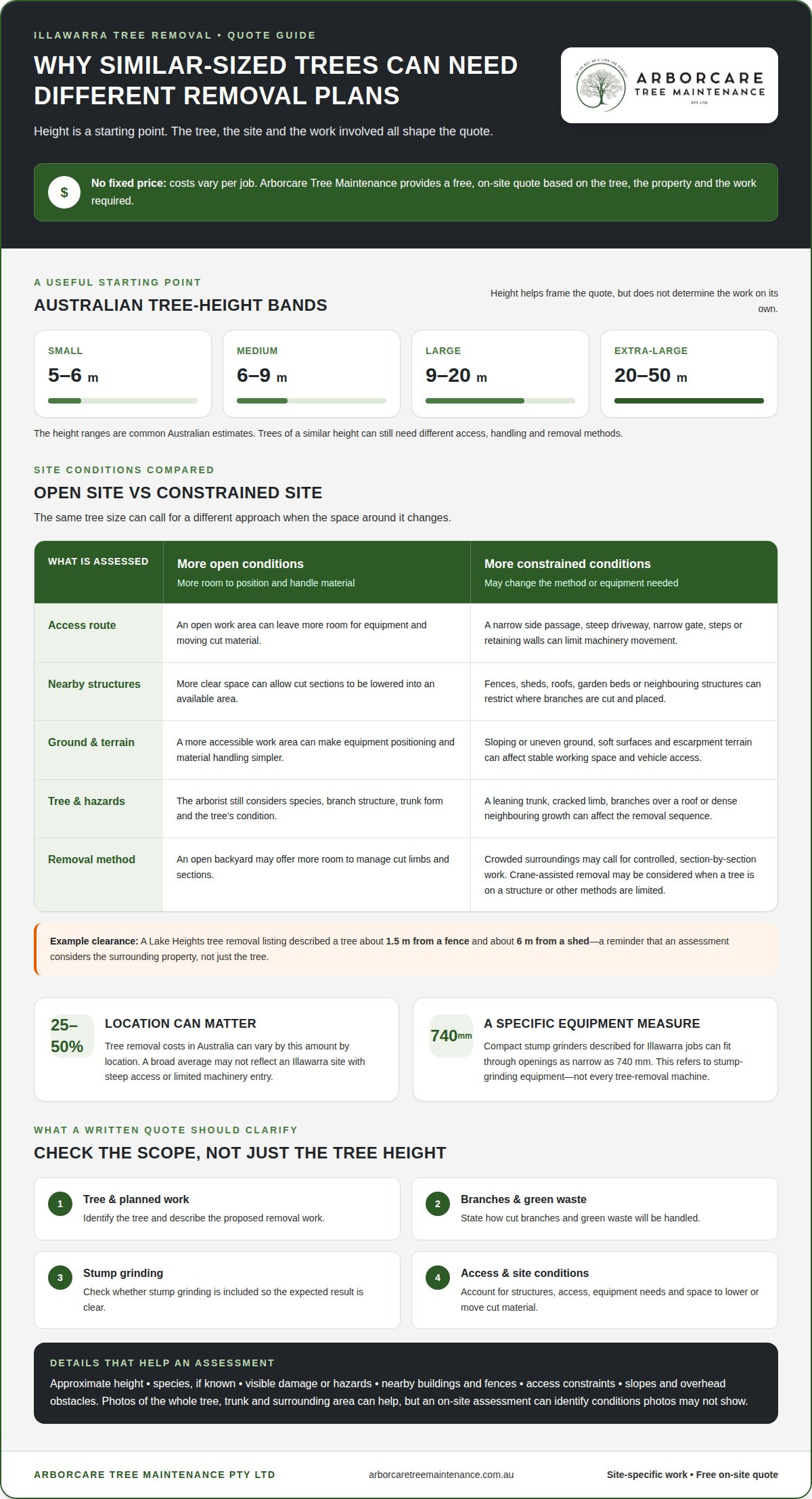
Australian estimates commonly group trees by height: small trees measure around 5-6 metres, medium trees 6-9 metres, large trees 9-20 metres, and extra-large trees 20-50 metres. These bands help frame a removal quote, but height alone doesn’t determine the work. A tall tree in an open backyard can present different access and handling needs from a similar-sized tree close to buildings.
Species matters too. Branch structure, trunk form and the tree’s position affect how it can be removed. Note the approximate height and species, if known, as well as what surrounds the tree. In Wollongong, these details help explain why trees of similar size may need different removal plans.
Written quote inclusions
A written quote should make the proposed scope clear. Check that it identifies the tree, the planned work and how branches and green waste will be handled. It should also state whether stump grinding is included, so you know what result to expect on the property.
The quote should account for site conditions as well. Access, nearby structures and space to lower or move cut material can affect the method and equipment required. A narrow side passage or a shed beside the tree, for example, may change how the work is carried out. Clear inclusions show exactly what the proposed work covers.
Large tree quoting considerations
Large and extra-large trees need careful planning because their size can limit how they’re dismantled. A tree measuring 20 metres or more may require a different approach from one measuring 9-20 metres. The arborist considers the tree’s position, condition and nearby hazards before setting out the removal method.
For homeowners asking how much it costs to cut down a large tree in the Illawarra, the tree’s dimensions are only part of the picture. Crane-assisted removal may be considered when a tree is on a house or another structure, or site constraints limit other methods. The quote should account for the equipment and coordination required for that job. Include the tree’s location, visible hazards and access details in your quote request.
Access and site conditions affecting costs
Access affects how a tree can be dismantled and how equipment can reach the work area. On an Illawarra property, a narrow side passage, steep driveway or nearby structure can limit machinery movement. The removal plan needs to account for the ground, the route in and out, and where cut sections can be lowered safely.
A Lake Heights tree removal listing described a tree about 1.5 metres from a fence and about 6 metres from a shed. Those clearances show why an assessment considers more than the tree itself. A fence, roof, garden bed or neighbouring structure can restrict where branches are cut and placed. In a crowded backyard, controlled sectional work may be needed instead of directing limbs into an open area.
Equipment requirements depend on the access route and work area. Compact stump grinders described for Illawarra jobs can fit through openings as narrow as 740 mm, but that measurement relates to stump-grinding equipment, not every tree-removal machine. A narrow gate may still restrict larger equipment. Steps, retaining walls, soft ground and overhead obstructions can also affect equipment positioning and material handling.
Escarpment terrain can create practical challenges. A sloping block may limit stable working space, while uneven ground can affect vehicle and machinery access. If a tree is above a house or below a steep driveway, the removal sequence may need to account for gravity and limited landing zones. The quote should reflect the terrain and equipment required, rather than assume a flat, open site.
Tree condition and nearby growth also shape the job. Dense neighbouring trees can restrict access to the crown, while branches over a roof may need careful, section-by-section removal. Pruning nearby vegetation may help create working space where appropriate, but it is separate from removing the target tree. Describe fences, sheds, slopes and overhead obstacles so the assessment reflects the actual property conditions.
Location can change tree removal costs in Australia by 25 to 50 per cent. An Australian average may not reflect an Illawarra site with steep access or limited machinery entry. Local conditions and the removal method matter more than a broad average when estimating work at a specific property.
For a complex site, include access constraints and visible obstacles in your quote request. An assessment can account for ground conditions, equipment positioning and safe handling. If the tree’s position makes removal unusually challenging, complex tree removal planning can help clarify the work required.
Arborist site assessments and quotes
An arborist assessment connects the tree’s condition with the work required at your property. Arborcare’s free, on-site quote gives the arborist an opportunity to assess access, damage and hazards that photos may not show.
Free quote and cost calculator
A cost calculator can help organise details such as tree height, species, location and removal scope. It cannot assess whether a cracked limb, leaning trunk or nearby structure changes the cutting method. Treat a calculator result as a general guide, not a site-specific removal plan.
Describe the tree and its setting when requesting a quote. Include its approximate height, visible damage, nearby buildings and access constraints. Photos showing the whole tree, trunk and surrounding area can help the arborist understand the job before an on-site assessment. The price varies per job and is provided in a free, on-site quote based on factors such as tree condition, access and removal scope.
Quote options and turnaround
An arborist may prepare a removal quote after reviewing supplied details or assessing the site. A written quote helps define which tree is included, the planned cutting method, green waste handling and whether stump work forms part of the scope. For more complex sites, an on-site assessment can identify factors that a photo-based estimate cannot capture.
A report is different from a removal quote: it documents arboricultural findings rather than setting out removal work alone. Stump-grinding quote turnaround averages 24 hours, but that figure applies to stump-grinding jobs, not large-tree removal quotes.
During an assessment, the arborist considers the tree’s structure, condition and surroundings. A dead or damaged branch over a roof, for example, may affect how the crown is dismantled. The assessment also considers where branches can be lowered, how equipment can reach the work area and how green waste can be managed without damaging the garden.
Before accepting a written quote, read its scope alongside the site conditions discussed. Confirm that it identifies the tree and removal work, explains green-waste handling, and states whether stump grinding is included. If the assessment identifies damage or a hazard, the written scope should reflect the work required. Clear details make the proposed work easier to understand.
For a large tree near a building, an on-site assessment is especially useful because it connects visible risks with a safe cutting sequence. It also helps distinguish tree removal from other work, such as stump grinding. Providing accurate property details when requesting a quote gives the assessment a practical starting point.
Costs for large and extra-large trees
In New South Wales, each council sets tree-permit criteria in its development control plan, including species, size and location. Wollongong generally requires approval for trees with a trunk diameter over 0.5 metres, measured 1 metre above ground; stated exemptions include trees under 3 metres, dead, dying or dangerous trees, and fruit trees.
For Wollongong, Shellharbour and Kiama, the approval process can add 4 to 8 weeks. Each council’s development control plan sets its own criteria, so a rule applying in Wollongong may not apply in Shellharbour or Kiama.
Removing a large tree can involve more than cutting down the trunk. Council approval is often required for larger trees in Wollongong, and a tree near a house may need staged removal. Stump grinding is a separate consideration: it deals with the remaining stump, not council approval for removing the tree.
Application and assessment costs may form part of the project budget. Depending on council requirements, an application may need an arborist report or other supporting material. Keep these steps separate from the physical removal: the council’s decision and the removal quote cover different parts of the job.
Storm damage can change the removal plan. A split trunk or hanging branches may limit safe access and cutting options, especially in a residential area. Emergency work may also need a different sequence from planned removal because the immediate concern is the tree’s condition and potential damage to nearby homes or property.
Power lines need particular attention in the work plan. If a tree is close to electrical infrastructure, removal may require coordination around the lines, and a power shutdown may involve a separate cost. This is distinct from cutting, green-waste handling or stump grinding, so check that the written quote clearly sets out the work included.
Your price depends on the tree’s size and condition, access, removal method, council requirements and any electrical coordination. Arborcare provides a free, on-site quote that sets out the work and charges for your job.
Before arranging removal, identify the local council and whether the tree falls within an exemption or requires approval. Wollongong’s 10/50 bushfire clearing entitlement is another specific consideration: trees covered by that state entitlement do not require the stated council approval. Don’t assume it applies based on location alone; the entitlement’s conditions determine coverage.
Plan the work in this order: establish which council area the property is in, identify the applicable permit criteria, allow for the approval timeframe, then arrange removal. This helps prevent a delay between the council decision and the work, particularly where a protected tree or storm-damaged tree is involved.
Council permissions and application fees
Removing a protected tree without council approval in the Illawarra can risk a fine. In New South Wales, fines for unauthorised removal can exceed A$3,000, so identify the relevant council controls before work begins.
Each NSW council sets tree-removal permit criteria in its development control plan. For an Illawarra property, identify whether the local municipal authority—such as Shellharbour City Council or Kiama Municipal Council—applies to your land. Then check how that council’s rules treat the tree’s species, size and location. Similar trees may be treated differently between council areas.
Application fees are separate from the removal cost. The amount depends on the council area and the application requirements, which may include supporting arboricultural information. Keep the permit process distinct from the removal quote: one relates to council assessment, while the other describes the physical work, green waste handling and any separately quoted stump removal or grinding.
A clear sequence helps prevent avoidable delays. First, establish the property’s council area. Then identify the tree and its position and determine whether the local development control plan requires consent. If an application is needed, provide the council’s required details and supporting material before scheduling removal. Urgency does not by itself mean approval is unnecessary for an emergency or storm-damaged tree.
Tree height can be relevant, but it is not the only permit consideration. Council controls may also account for species, location and other site circumstances. For example, a large tree near a boundary or within a specially controlled area may need a different assessment from a similar tree elsewhere. A neighbour’s past approval does not prove the same rules apply to your property.
Your tree removal price depends on the tree, site access, work required and any council conditions. Arborcare Tree Maintenance Pty Ltd's free, on-site quote reflects those factors. Keep council application expenses separate when planning the total project budget, and allow for council assessment before setting a removal date.
Before work proceeds, make sure the approval pathway and removal scope are understood. If council requirements apply, follow them before arranging cutting, green waste clearance or stump removal. For help planning tree removal around site and council requirements, request a tree removal quote.
Published fee estimates vary: council applications in Australia usually cost $75–$100 for one to five trees, while additional trees are typically $20–$25 per tree. NSW local council tree removal permits are reported to cost $65–$250, depending on the council area. Other estimates put council permits for tree removal at $100 to $300. Treat these as indicative ranges and confirm the applicable fee with your council.
Arborcare Tree Maintenance
Arborcare Tree Maintenance helps Illawarra property owners plan tree removal around the tree’s condition, position and site requirements. The team handles tree removals, including complex removals where size, nearby structures or restricted access call for careful planning. Arborcare also provides pruning, palm tree removals and stump grinding where these suit the property’s needs.
Arborcare’s free, on-site quote reflects the removal scope and site conditions. Share the tree’s location and any access concerns so the arborist can assess what the job requires. If you’re weighing removal against pruning, contact Arborcare Tree Maintenance to discuss the tree and arrange an on-site quote.
Plan the next step for your property
When considering how much it costs to cut down a large tree in the Illawarra, start by deciding how you want to use the space afterwards. You may need the tree removed, or you may be considering whether pruning can address the issue while retaining it. The right scope depends on the property and the outcome you want.
Arborcare Tree Maintenance provides Tree Removals, Hedging, Pruning & Trimming, and Palm Tree Removals. A clear picture of the tree’s location and your priorities helps frame a practical discussion about the work.
Contact Arborcare Tree Maintenance to discuss the tree and the next step for your property. With the scope clearly considered, you can move ahead with a plan that suits your needs.
Frequently Asked Questions
Do I need to remove the stump as well?
No, stump removal is a separate decision from taking down the tree. You can leave the stump in place if it doesn’t interfere with access, planting or planned landscaping. If it’s in the way of a path, garden bed or future building work, stump grinding may be more suitable. Grinding reduces the stump below ground level, while full extraction involves removing more of the root mass. Tell the arborist how you plan to use the space.
How do tree removal costs vary by tree height, trunk diameter, and species in Illawarra?
Cost varies with the amount of work required, and height, trunk diameter and species each help shape the removal plan. A broad, heavy trunk can require different handling from a smaller tree of similar height, while branching structure affects how the crown can be dismantled. A dense hardwood may also take more cutting than a lighter species. Provide the tree’s approximate dimensions and species, if known, for a more useful assessment in the Illawarra.
Do Illawarra tree removalists charge for quotes or site inspections?
Arborcare Tree Maintenance provides free, on-site quotes. An on-site assessment lets the arborist consider the tree and property directly, including visible defects or constraints that photos may miss. This is useful when a tree is close to a roof, retaining wall or garden structure. Arborcare serves Dapto, Wollongong, Shellharbour, Woonona, Jamberoo, Fairy Meadow, Dombarton and the wider Illawarra.
What should an Illawarra tree removal quote include, and how can I compare quotes?
A quote should make the agreed work and any optional extras clear. Check whether it covers removal, green-waste clean-up, mulching or stump grinding, and whether requested extras are quoted separately. Compare quotes by matching their scope, not just their total: one may include stump grinding, while another covers tree removal alone. Arborcare’s free, on-site quote reflects the job and services included, so you can see what work is planned for your property.


