
A neighbour’s dangerous tree can be harder to deal with than a tree on your own property. Understanding Illawarra council tree regulations starts with local rules: councils generally require a Tree Permit for work on a tree more than 5 metres high, while some species and circumstances may be exempt.
It’s understandable to want to act quickly when a tree looks unsafe or branches affect your home. But removing or pruning a protected tree without the required approval can create further problems. A neighbour’s tree raises separate questions about permission and safety.
This guide explains when tree removal or pruning may need Council approval, which exemptions may apply, and what to do if a neighbour won’t address a dangerous tree. It also covers how to respond to urgent risks and when a professional tree assessment from Arborcare Tree Maintenance Pty Ltd can help clarify the next step.
Key Takeaways
- Find out which tree features and exemptions can affect whether Council approval is needed before arranging removal or pruning.
- Learn how small-branch pruning rules and exempt species lists may apply, and why documenting an exempt tree can be useful.
- If a neighbour’s tree appears dangerous, understand the steps to take before considering work on their property.
- See how protected habitats, land restrictions and the number of trees involved can affect development approval requirements.
- Explore practical options for neighbour disputes and where professional tree removal or pruning may help address a safety concern.
Can I remove a tree on my own property without asking Council?
Sometimes, but it depends on the tree, the proposed work and the local council area. Illawarra council tree regulations are not a single region-wide rulebook. The specific controls discussed here apply to Wollongong City Council.
Exempt tree species and height limits
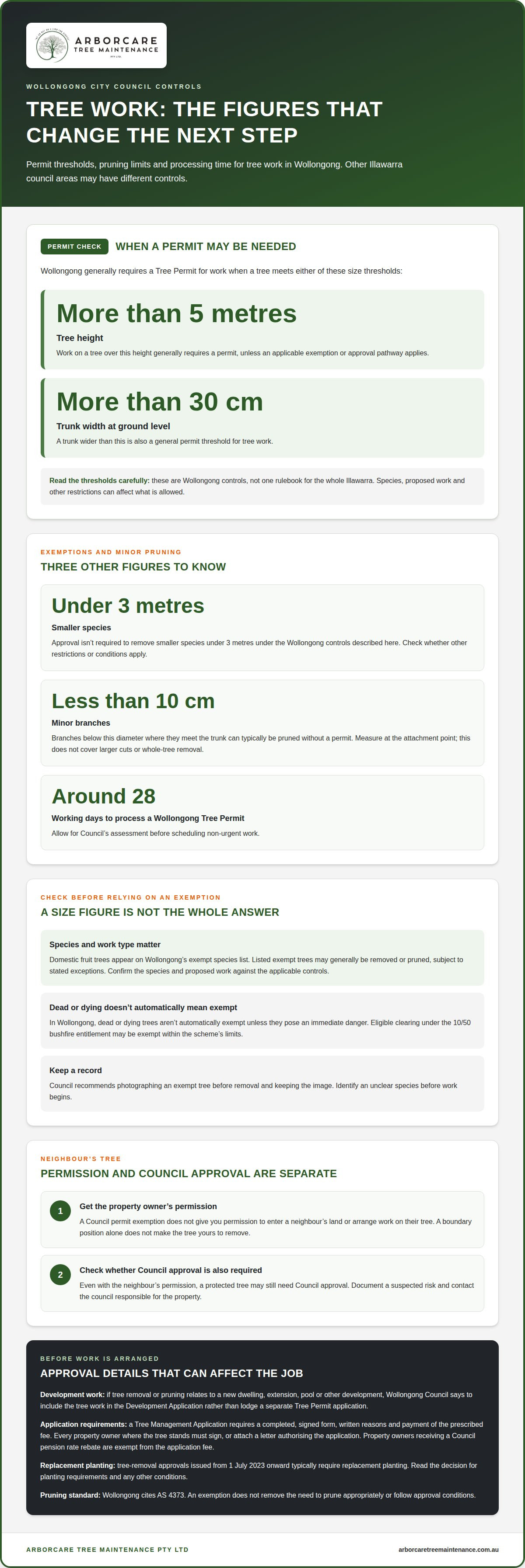
An exempt tree is a species or tree-work case that may not need a Tree Permit under Wollongong’s controls. Domestic fruit trees appear on Council’s exempt species list, and approval isn’t required to remove smaller species under 3 metres.
Those exemptions don’t replace the usual thresholds: Wollongong generally requires a permit for work on a tree more than 5 metres high or with a trunk wider than 30 centimetres at ground level. If you can’t identify the species, Wollongong Council recommends consulting a qualified arborist or horticulturalist before removal or pruning. The Illawarra council tree regulations therefore depend on the relevant council’s controls, not just the tree’s appearance.
Exempt works and minor pruning
Exempt works are specified activities that can proceed without a separate Tree Permit under the applicable controls. In Wollongong, a tree on the exempt species list may generally be removed or pruned, subject to stated exceptions. Removal authorised by an approved Development Consent may also not require a separate permit.
Minor pruning has its own threshold: branches less than 10 centimetres in diameter where they meet the trunk can typically be pruned without a permit. Measure the branch at its attachment point; don’t apply this exemption to larger cuts or whole-tree removal.
Exceptions to exempt tree rules
An exemption doesn’t cancel other restrictions or make every tree safe to remove. Dead or dying trees aren’t automatically exempt in Wollongong unless they pose an immediate danger. Eligible clearing under the 10/50 bushfire entitlement may be exempt within the scheme’s limits.
Wollongong Council recommends photographing an exempt tree before removal and keeping the image for your records. If the species or its status is unclear, identify it before work begins. A protected tree, land restriction or other approval condition may change what is allowed.
Local council rules and appeals
The relevant council is the one responsible for the property’s local government area. The Illawarra spans multiple council areas, and the specific thresholds in this section are Wollongong City Council’s controls. For properties elsewhere in the region, follow the relevant council’s process.
To report suspected unlawful tree removal, contact the council responsible for the property and provide its location and available details. In Wollongong, a review under section 82A of the Environmental Planning and Assessment Act 1979 is one process addressed by the tree controls for reviewing a determination. Keep relevant photographs and correspondence with your report or review request.
Tree species that can be removed or pruned without a permit
A Wollongong exemption is a listed circumstance in which specified tree work may proceed without a separate Tree Permit. The Council’s exempt species list includes domestic fruit trees, but exceptions apply and an exemption does not automatically cover every property or type of work. Check the species and proposed work against the relevant control before relying on an exemption.
A neighbour’s permission gives you authority to enter their land or arrange work on their tree. A Council permit exemption does not give homeowners permission to remove or prune a tree on someone else’s property. Before arranging work across a boundary, obtain the neighbour’s permission and any Council approval required for a protected tree. A tree’s position on the boundary does not, by itself, make it yours to remove.
A Tree Management Application is Wollongong City Council’s process for seeking approval for tree work. It requires a completed, signed form, written reasons for the proposed work and payment of the prescribed application fee. Every property owner on the land where the tree stands must sign, or attach a letter authorising the application. Property owners receiving a Council pension rate rebate are exempt from the application fee.
Processing time is the period Council takes to assess an application, and a Wollongong Tree Permit takes around 28 working days to process. Allow for that assessment before scheduling non-urgent work. Approval may include conditions: tree-removal approvals issued from 1 July 2023 onward typically require replacement planting. Read the decision carefully so the required planting and other conditions are understood before work begins.
A Development Application is the planning application for proposed development and may need to include related tree work. If removal or pruning is connected with a new dwelling, extension, pool or other development, Wollongong Council says to include it in the Development Application rather than lodge a separate Tree Permit application. Tree work assessed through development consent may therefore follow a different approval pathway from standalone maintenance.
For pruning, the applicable standard cited in Wollongong is AS 4373. A listed exemption doesn’t remove the need to carry out pruning appropriately or comply with any approval conditions. For work that requires approval, wait for the decision before proceeding. If the tree needs removal or pruning, arrange suitable tree removal and pruning work after the relevant consent is in place.
My neighbour won't remove a dangerous tree - what can I do?
A dangerous neighbour’s tree needs a safe, lawful response, particularly if branches threaten a home or street. In Wollongong, document the risk and ask Council about the appropriate next step.
Trees in heritage areas and protected habitats
A protected habitat is an area where proposed vegetation work may affect threatened species or their environment. In Wollongong, proposed work may require assessment under section 5A of the Environmental Planning and Assessment Act 1979 if it could affect threatened species, populations, ecological communities or habitat.
For a tree in a heritage area, tell Council the property location and proposed work when seeking guidance. Work involving protected vegetation may need closer assessment than routine pruning. An arborist’s report can describe the tree’s condition and likely impacts. Don’t assume a heritage location automatically permits removal.
Heritage trees and conservation areas
A heritage tree is subject to heritage-related controls or protections that apply to its location. Before planning removal or substantial pruning, establish whether the site has relevant controls and whether the work needs approval. Wollongong’s tree management controls may also require consideration of threatened habitat, so reports should describe both the tree and surrounding vegetation.
An approval may require replacement planting, but planting a new tree does not resolve a neighbour’s safety concern. Keep the Council decision and any planting requirements with the project records. A tree beside a public street may be a Council asset, not one a resident can alter.
Trees on neighbouring properties
A neighbouring tree stands on another property, so establish its location before anyone arranges work. Get the neighbour’s permission and any required Council approval before cutting or pruning it. If the neighbour refuses, contact Wollongong Council first and provide clear details about the risk, property address and any arborist reports.
For a heavily storm-damaged tree, a qualified arborist’s assessment that it presents an imminent danger can support removal without Council approval. Wollongong Council requires residents to photograph the dangerous tree before making it safe without permission and to keep records of the work. Don’t use this urgent pathway unless the tree has been assessed as an imminent danger.
If Council can’t assist with the neighbour dispute, the next step identified for Wollongong is advice from a Certificate 5 arborist. Tree disputes may also be heard by the NSW Land and Environment Court under the Trees (Disputes Between Neighbours) Act 2006. Keep photographs, correspondence and reports together so the tree’s condition and your attempts to resolve the issue are clear.
Development applications and complying development
A Development Application describes proposed building work and its effects, including planned tree removal or vegetation clearing. In Wollongong, the land zone and number of affected trees can change the assessment pathway. Illawarra council tree regulations matter during project planning, not just before work begins.
Tree work within a development application
Tree work included in a Development Application is removal or pruning proposed as part of a building project. Wollongong City Council says work for a new dwelling, extension, pool or other development should be included in the Development Application rather than submitted separately as a Tree Permit.
This lets Council assess the building proposal alongside its tree impacts. Show which trees the project would remove and which it would retain. Include vegetation and branches that construction could affect. Where retained trees may be affected, arboricultural impact and tree protection assessments are commonly prepared in accordance with AS 4970, where applicable. Keeping the tree plan aligned with the project makes the proposed work clearer.
Development applications for tree work
A tree-work Development Application is required for certain proposed tree or vegetation work. In Wollongong, an application is required for work involving eleven (11) or more trees on most land, excluding land zoned E2, E3 or E4. The applicable approval requirements can vary with the land zone and the proposed vegetation work.
An application involving more than five (5) trees or other vegetation requires an arborist report. The land zone and affected-tree count therefore help determine the approval pathway. Native vegetation clearing on land covered by the Native Vegetation Act 2003 also requires development consent under section 12. Section 25 of that Act lists clearing activities exempt from approval under the Act, but separate development consent can still apply.
Habitat and property restrictions can also affect a project. A tree that provides, or may provide, habitat for threatened or vulnerable species under the Biodiversity Conservation Act 2016 or Environment Protection and Biodiversity Conservation Act 1999 may still require a Development Application. A Section 88B restriction requiring retention or protection can also affect approval to remove a tree. Illawarra council tree regulations should be considered alongside these site constraints.
Trees and complying development
Complying development is a planning pathway separate from a Development Application. It does not, by itself, establish that tree removal is exempt from Wollongong’s tree controls. Assess the proposed work against the relevant thresholds, habitat considerations and property restrictions.
For a project connected with a new dwelling, extension, pool or other development, Wollongong City Council directs applicants to include tree work in the Development Application. Where more than five (5) trees or other vegetation are involved in that application, include an arborist report. This lets the development and its tree impacts be assessed together.
Options when a neighbour refuses to remove a dangerous tree
A neighbour tree dispute is a disagreement about work on a tree across a property boundary. In Wollongong, a practical first step is to document the concern and contact Council before arranging any work yourself. A tree that looks unsafe still needs a careful response, not an unauthorised cut.
Start by making a clear record. Photograph the tree and visible damage, note where it could fall, and keep relevant messages. If the neighbour has declined your request to act, record that response too. These details help explain the concern to Wollongong Council and distinguish an observable hazard from a disagreement about shade, leaves or overhanging branches.
For a dangerous-tree dispute in Wollongong, contact Council first. Give the property location, describe the risk and share relevant photographs or arborist reports. Ask about the appropriate next step and the tree’s status under local controls. An exempt species does not give you permission to enter a neighbour’s property or remove their tree. Council permit exemptions and the neighbour’s permission are separate matters.
An arborist’s assessment can clarify the tree’s condition and the nature of the risk. If Wollongong Council can’t assist with the dispute, the stated next option is advice from a Certificate 5 arborist. Their assessment can help distinguish an immediate danger from a tree that needs planned maintenance, while giving the neighbour and Council clearer information than appearance alone.
The NSW Land and Environment Court can hear tree disputes between neighbours under the Trees (Disputes Between Neighbours) Act 2006. This is a formal option where discussion and Council involvement haven’t resolved the issue. Keep the tree photographs, correspondence and reports together to explain the history of the dispute and the work being sought. The Court pathway doesn’t authorise you to remove the tree yourself.
Unauthorised work carries serious consequences if the tree is protected. Courts can impose penalties of up to $1.1 million for unauthorised removal or pruning of a protected tree in Wollongong, and unapproved removal can lead to replacement planting at the owner’s cost. From 1 July 2023 onward, Wollongong removal approvals typically require replacement planting. Don’t cut first and seek approval later.
If Council approval and the neighbour’s permission are in place, arrange the authorised work safely. Arborcare Tree Maintenance Pty Ltd provides tree removal services for approved tree work.
Arborcare Tree Maintenance
Arborcare Tree Maintenance carries out tree work once the required Council approval and property permissions are in place. Services include tree removals, hedging, pruning and trimming, palm tree removals and stump grinding.
If a tree has been approved for removal, or authorised pruning is needed to manage branches, the work must follow the approval’s conditions. For a neighbour’s tree, make sure the owner’s permission is also in place before arranging work. Arborcare Tree Maintenance carries out the relevant work, including complex removals where needed.
For work that fits these services and has the necessary permissions, contact Arborcare Tree Maintenance to discuss the job.
Take the next step with a clear plan
Before arranging tree work, bring the practical and compliance decisions together. Identify the work required, keep relevant approvals and permissions with the job details, and make sure everyone understands what is authorised. A clear plan helps distinguish a safety concern from routine maintenance and work that still needs consent.
Understanding Illawarra council tree regulations is one part of making that plan. The next is arranging appropriate work for the tree and property, with safety in mind from assessment through to completion. Arborcare Tree Maintenance provides tree removal and pruning across Dapto, Wollongong, Shellharbour, Woonona, Jamberoo, Fairy Meadow, Dombarton and the wider Illawarra.
Contact Arborcare Tree Maintenance to discuss the work you need. With the right permissions and a considered plan, you can move forward more confidently.
Frequently Asked Questions
Do You Need Council Approval For Tree Work In Wollongong?
Often, yes, depending on the tree and proposed work. Wollongong generally requires a Tree Permit for work on trees over 5 metres high or with trunks wider than 30 centimetres at ground level. Exempt species, small species under 3 metres and minor branch pruning may fall under different rules. Check the specific exemption and any property restrictions before scheduling work.
Does the 10/50 bushfire rule override Council's tree permit process?
Eligible landowners in a mapped entitlement area may clear certain vegetation under the NSW Rural Fire Service 10/50 Vegetation Clearing Code of Practice. The NSW Rural Fire Service says eligible trees may be cleared within 10 metres of a home without Council or state approval. Underlying vegetation, such as shrubs but not trees, may be cleared within 50 metres, subject to the scheme’s limits.
What happens if I remove a tree without approval?
Unauthorised or non-compliant tree work in Wollongong may lead to a penalty infringement notice or legal action. Courts can impose penalties of up to $1.1 million for unauthorised removal or pruning of a protected tree, and Council may require replacement planting at the owner’s cost. Keep the approval decision and any conditions with the job records before work starts.
Do I need council approval to prune or remove a tree on private property in the Illawarra?
It depends on the local council area, the tree and the proposed work. Wollongong generally requires approval for certain larger trees, while listed exemptions may apply to specific species and work. A Wollongong exemption may not apply elsewhere in the Illawarra. Identify the council responsible for the property, then assess the tree against its controls before arranging pruning or removal.
What tree species, trunk sizes, heights, or other criteria are exempt from approval?
In Wollongong, the exempt species list includes domestic fruit trees, and smaller species under 3 metres may be removed without Council approval. Trees over 5 metres high or with trunks wider than 30 centimetres at ground level generally need a Tree Permit. Branches under 10 centimetres in diameter where they meet the trunk can typically be pruned without one. Listed exceptions and property controls still matter.
Are there exemptions for dead, dangerous, storm-damaged, or nuisance trees?
In Wollongong, dead or dying trees are not automatically exempt unless they pose an immediate danger. A heavily storm-damaged tree assessed by a qualified arborist as an imminent danger can be removed without Council approval. Before making a dangerous tree safe without permission, photograph it and keep records of the work. A nuisance, such as fallen leaves, does not by itself qualify for an exemption.
How do heritage listings, conservation areas, and significant-tree registers affect tree work?
A heritage or conservation status can affect the approval pathway, so don’t assume a tree can be removed because it appears on an exempt species list. In Wollongong, a proposed project may need assessment if it could affect threatened species, ecological communities or habitat. A Section 88B restriction requiring a tree’s retention or protection can also affect removal. Include the site constraints when seeking assessment.
How do I apply for a tree removal or pruning permit, and what documents are required?
For a Wollongong Tree Management Application, provide the completed, signed form, written reasons for the proposed work and the prescribed fee. All owners of the property where the tree stands must sign, or attach a letter authorising the application. Council takes around 28 working days to process a Tree Permit. Property owners receiving a Council pension rate rebate are exempt from the application fee.


