
What makes a large tree difficult to remove is often not its height, but what surrounds it. A tree growing near a house, fence, garden or neighbouring property can make large tree removal feel daunting, especially when it’s unclear whether removal is necessary. A professional assessment considers the tree’s condition alongside its position and the practical constraints of the site.
For property owners in the Illawarra, the right approach depends on the tree and the location. Arborcare Tree Maintenance’s licensed arborists assess the tree and its surroundings, then plan the work with access, nearby structures and site clean-up in mind. The team serves Dapto, Wollongong, Shellharbour, Wonoona, Jamberoo, Fairy Meadow, Dombarton and the wider Illawarra.
This guide explains when removal may be appropriate, how professionals plan complex work, and what to expect during removal and clean-up. It also outlines why local council requirements matter, as rules differ across the Illawarra. If removal is needed, you’ll have a clearer picture of the process, including stump grinding as a possible next step.
Key Takeaways
- Tree height alone doesn’t determine whether removal is needed; condition, lean, access and nearby structures all shape the assessment.
- Arborists consider the site, tree condition, access and hazards to develop a removal plan suited to the property.
- Comparing removal, pruning and continued monitoring can help clarify which option may suit different tree and site conditions.
- Use a practical preparation checklist to discuss access, parking, gates and work-area boundaries before the job.
- Learn what to expect from large tree removal with Arborcare’s licensed arborists across Dapto, Wollongong, Shellharbour and the wider Illawarra.
When does a large tree need removal in the Illawarra?
Large tree removal is the planned dismantling or felling of a substantial tree, with the method shaped by the tree’s condition and the space around it. Size alone doesn’t determine whether removal is necessary or how the work should be planned. A tall, healthy tree in an open area presents different considerations from one with signs of decline, a pronounced lean or branches close to a building.
The decision should balance the tree’s condition and location with potential impacts on people and property. Declining health, instability, restricted space or ongoing damage concerns may prompt an assessment, but they don’t automatically mean the tree must come down. Pruning, other maintenance or continued monitoring may be suitable alternatives.
What makes a tree removal job complex?
Complexity comes from the whole site, not just the trunk. A broad canopy may extend over a house, car park or adjoining property. Narrow side access, garden beds, fences and nearby structures can limit where work can take place and how material can be handled. A home on a compact block in Dapto or Fairy Meadow and a commercial property with active access areas in Wollongong each need a plan suited to their surroundings.
Where the work area is restricted, a controlled, staged approach may be needed to manage the tree in sections rather than bringing it down in one movement. The arborist considers the tree, access and nearby features before deciding how work should proceed. The broad principles of tree care practices include removal alongside ongoing maintenance, but the right choice depends on the individual site.
Could the tree be managed instead of removed?
Yes, in some cases. An arborist considers the tree’s condition, position and the concerns it presents, then weighs whether pruning or other maintenance could address them. If the issue relates to specific branches rather than the whole tree, pruning may be worth considering. If there are concerns about the tree’s overall condition or stability, removal may be appropriate after assessment.
Ask what the assessment found and how each option relates to the site. A clear explanation helps you understand whether the aim is to retain and manage the tree or remove it. For a broader overview of the professional process, see this professional tree removal guide. Arborcare Tree Maintenance’s licensed arborists provide residential and commercial tree removal across Dapto, Wollongong, Shellharbour, Wonoona, Jamberoo, Fairy Meadow, Dombarton and the wider Illawarra.
How Illawarra arborists assess and plan large tree removal
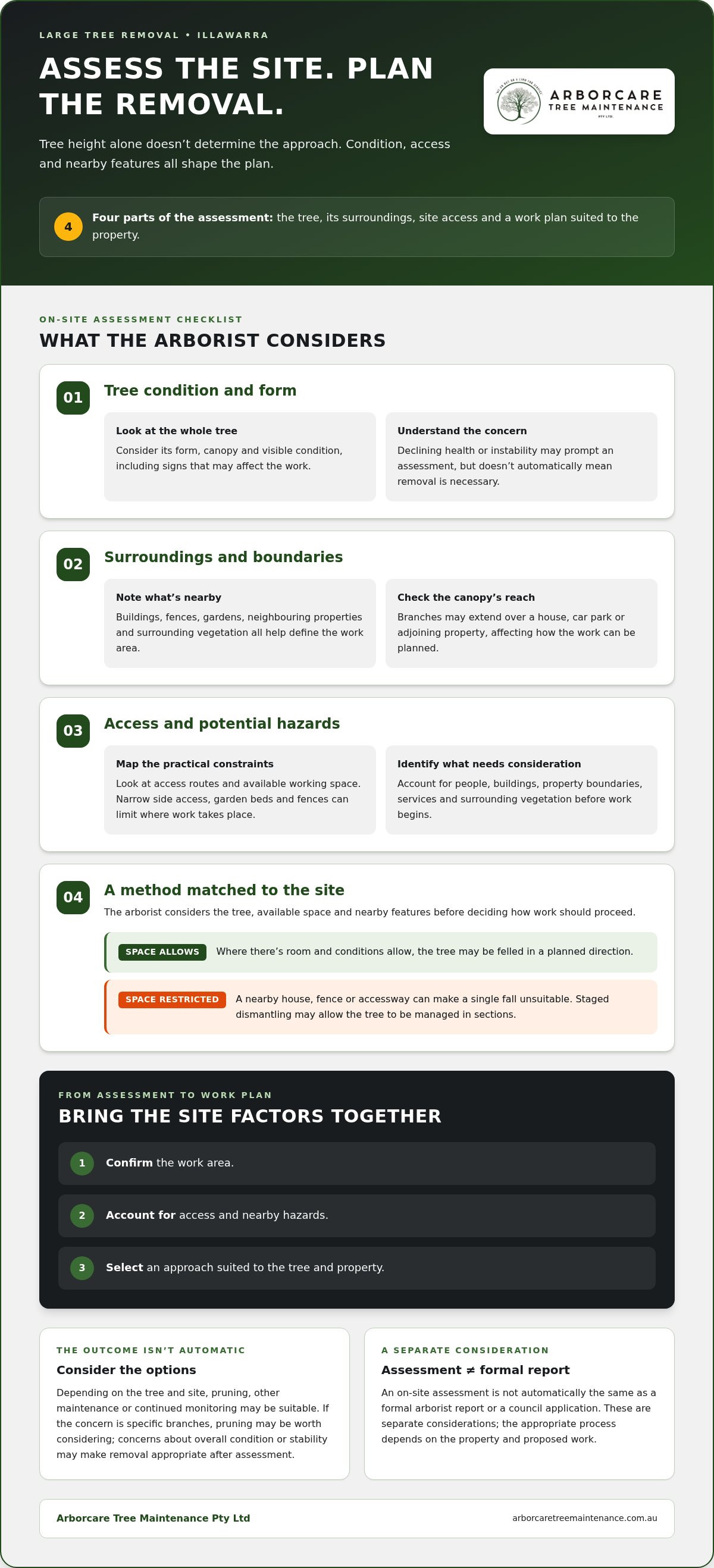
A sound plan starts with the site, not a standard removal method. The arborist builds a picture of the tree and its surroundings, identifies practical constraints, then determines how the work can be carried out at that location. Access, tree condition and nearby obstacles all shape the removal plan. The assessment helps account for potential risks to people, buildings, boundaries, services and surrounding vegetation before work begins.
What does an on-site assessment consider?
The arborist considers the tree’s form and visible condition, including its canopy and any signs that may affect the work. They also look at the work area and access routes, noting fences, buildings, gardens, neighbouring properties and nearby services. These visible site factors help show where space is limited and what needs to be considered in the plan.
An on-site assessment is not automatically the same as a formal arborist report or a council application. Those are separate considerations, and the appropriate process depends on the property and proposed work. For broader background on identifying tree hazards, see Purdue University’s overview of tree risk assessment and management.
Why may a large tree be removed in stages?
Where there’s room and conditions allow, a tree may be felled in a planned direction. But a nearby house, fence, accessway or other obstacle can make a single fall unsuitable. In those situations, staged dismantling may allow the tree to be managed in sections, with the approach selected by trained workers for the assessed site.
There’s no single method that suits every tree. The plan needs to account for the tree’s condition, available working space and features around it. Arborcare Tree Maintenance’s licensed arborists carry out residential and commercial complex removals across Dapto, Wollongong, Shellharbour, Wonoona, Jamberoo, Fairy Meadow, Dombarton and the wider Illawarra. An early discussion about your site can help clarify what the assessment needs to cover. Discuss a tree removal project.
How does the assessment become a work plan?
Once the site factors are understood, the arborist can bring them together into a practical sequence: confirm the work area, account for access and nearby hazards, then select an approach suited to the tree and property. This gives the crew a clearer picture of the job’s constraints before work starts, rather than relying on assumptions about how a large tree should be removed.
- Site context: note property boundaries and surrounding vegetation.
- Tree condition: consider form and visible signs that may affect the work.
- Access and hazards: identify routes, structures, people and services that need consideration.
- Work plan: match the removal approach to the actual site.
Large tree removal versus pruning: choosing the right approach
A large or inconvenient tree doesn’t automatically need to be removed. The right option depends on what’s causing concern, the tree’s condition and how it relates to the property. An arborist can compare removal with pruning or continued monitoring, then explain what each option may address and what it can’t.
| Option | Purpose | May suit when | What the arborist assesses |
|---|---|---|---|
| Removal | Take the tree down when retaining it isn’t suitable. | The tree’s condition, instability or site constraints support removal. | Tree condition, location, surrounding targets, access and work-area constraints. |
| Pruning or maintenance | Manage specific branches or other maintenance needs while retaining the tree. | The concern is limited and appropriate work may address it. | Which parts need attention and whether pruning is suitable for the tree and site. |
| Continued monitoring | Keep the tree and review its condition over time. | No immediate intervention is indicated by the assessment. | Current condition, location and any changes that may warrant another review. |
When might pruning or maintenance be more appropriate?
Targeted pruning may be considered when a concern relates to particular branches or the tree needs routine maintenance. It can help manage specific issues while retaining the tree, but it isn’t a guaranteed fix for structural defects or every safety concern. The arborist assesses whether the proposed work is appropriate rather than assuming that cutting back branches will resolve the problem.
Arborcare Tree Maintenance provides pruning and trimming as well as tree removal, so an assessment can consider a management option alongside removal where appropriate.
When might removal be the more suitable option?
Removal may be considered if an arborist finds the tree is in poor condition, appears unstable, or can’t be suitably managed given its position and surrounding constraints. One symptom alone doesn’t settle the decision. The arborist weighs the tree’s condition against its setting and the potential effects on people and property.
Where buildings, boundaries or limited access make the work more complex, the removal plan needs to account for those site-specific risks. The complex tree removal guide explores considerations for higher-risk properties. For general background on hazards in tree work, the US Occupational Safety and Health Administration’s tree care safety guidance is a useful reference, but local work should follow applicable Australian requirements.
The decision comes from assessment, not assumption. Ask the arborist to explain what they observed, which options they considered and why a particular approach suits the tree and site. That gives you a clearer basis for deciding whether to retain and manage the tree or proceed with large tree removal.
Preparing an Illawarra property for large tree removal
A little preparation can make a planned tree removal easier to coordinate, particularly on a residential block or busy commercial site. Before the job, discuss how the crew will access the work area, where vehicles can park and which parts of the property need to stay clear. The arborist crew will make the tree-specific decisions about work planning and equipment.
Clear access and a clearly excluded work area are essential: move obstacles where practical, keep people and pets away, and follow the crew’s directions.
What should owners organise before work begins?
Walk through the property beforehand and flag practical details that may affect access or coordination. Use this checklist to prepare:
- Access: identify gates, driveways and paths the crew may need to use, and discuss any access restrictions.
- Parking: consider where vehicles can park without blocking entry routes or the work area.
- Property features: point out garden beds, outdoor furniture and other features near the tree, and discuss areas needing protection.
- Work boundaries: clarify which parts of the site will be out of bounds during the job.
- Occupants: arrange access and share relevant instructions with household members, tenants or a site manager.
- Pets and visitors: plan to keep them well clear and follow the crew’s directions while work is under way.
Leave decisions about the removal sequence and equipment to the arborist crew. Weather, access and conditions at the site can affect scheduling or the order of work, so the plan may need to respond to what’s practical and safe on the day.
Site preparation is separate from council approvals. Tree-preservation requirements vary across the Illawarra, so make sure any applicable approval is addressed independently of arrangements for access and parking.
What happens to branches, timber and the remaining stump?
Tree removal produces branches and timber that need to be handled as part of the agreed job scope. Discuss what is planned for the cut material before work begins, so expectations about clearing the site are clear. The amount and type of material can vary with the tree and the work involved.
Removing the tree doesn’t necessarily mean the stump will also be removed. Stump grinding is a separate service and may be considered as a next step if you want the remaining stump dealt with. The stump grinding guide explains what that work involves. Once a tree and stump are removed, property owners often take the opportunity to revamp their outdoor space, where landscape and construction specialists such as Green Earth, LC demonstrate how newly cleared grounds can be repurposed into functional garden living areas.
For planned large tree removal at a residential or commercial property, discuss your tree removal project with Arborcare Tree Maintenance’s licensed arborists, serving Dapto, Wollongong, Shellharbour, Wonoona, Jamberoo, Fairy Meadow, Dombarton and the wider Illawarra.
Arrange professional large tree removal across the Illawarra
If a tree is causing concern or its position makes removal challenging, Arborcare Tree Maintenance can help you understand the next steps. The locally owned team provides licensed arborist services for residential and commercial properties across the Illawarra, including Dapto, Wollongong, Shellharbour, Wonoona, Jamberoo, Fairy Meadow and Dombarton. Share what you’ve noticed and where the tree is located. You don’t need to diagnose the risk yourself.
What information helps start a large-tree enquiry?
A few practical details can help explain the property and why removal is being considered. Include what you know, even if you’re unsure how serious the issue may be. The arborist can assess the tree and site rather than relying on a homeowner’s judgement of the risk.
- Property suburb: note whether the site is in Dapto, Wollongong, Shellharbour or another Illawarra location.
- Tree location: describe where it sits on the property and whether it’s near a building, boundary, driveway or other feature.
- Reason for enquiry: explain what has prompted you to consider removal, such as concerns about its condition, position or impact on the property.
- Access constraints: mention narrow gates, limited space or other factors that could affect access to the tree.
- Nearby structures: flag buildings, fences or adjoining property close to the work area.
These details help start a useful conversation, but they aren’t a substitute for professional assessment. Avoid climbing the tree, testing branches or trying to decide whether it’s safe to remain. Describe what you’ve observed and leave the assessment to an arborist.
How Arborcare supports complex tree removal
Some properties call for more than a straightforward removal. Restricted access, nearby buildings or boundaries can make the work more involved, and Arborcare’s complex tree removal service is suited to challenging site conditions. The licensed arborist team considers the tree and property before planning the work, tailoring the approach to the particular job rather than assuming it in advance.
Arborcare serves homes and commercial properties throughout the Illawarra, from its base in Dapto to Wollongong, Shellharbour, Wonoona, Jamberoo, Fairy Meadow, Dombarton and surrounding areas. Share what is concerning you and any access details that may matter. The arborist will consider these observations when assessing the site and planning the work.
For planned large tree removal, contact Arborcare Tree Maintenance about your property. Provide the suburb, describe the tree’s location and outline your concerns. The team can discuss the assessment and planned removal process with you, helping you understand the job.
Take the next step with confidence
You don’t need to decide on your own whether removal is the right answer. A professional assessment can turn uncertainty into a practical direction, whether that means planning removal or considering another way to manage the tree. For large tree removal, the first conversation is a chance to describe what you’ve noticed and understand what should happen next.
Arborcare Tree Maintenance is a licensed arborist company based in Dapto, providing residential, commercial and complex tree removal across the Illawarra. The team serves Dapto, Wollongong, Shellharbour, Wonoona, Jamberoo, Fairy Meadow and Dombarton, and can consider the tree in the context of your property.
Share the property location, where the tree stands and what has prompted your concern. Clear information gives the assessment a useful starting point, without requiring you to make a safety judgement yourself.
Arrange a professional tree assessment with Arborcare and take a considered next step for your property. Arrange your professional tree assessment.
With the right expertise, you can move forward with greater clarity and confidence.
Frequently Asked Questions
What is considered a large tree for removal?
There isn’t one universal height or trunk measurement that defines a large tree removal job. The term generally describes removal of a substantial tree, where its dimensions and surroundings affect how the work can be planned. A tree may be difficult to remove because its canopy extends over buildings or access is restricted, even if another tree of similar height is in an open space. An arborist can assess the tree in its setting.
How is a large tree removed safely near a house?
An arborist assesses the tree and nearby property before choosing a suitable removal plan. If there isn’t clear space for the tree to fall, the work may be carried out in stages, with the approach based on site conditions. Occupants should stay outside the work area and follow the crew’s directions. Don’t attempt to cut or climb a tree near a house yourself, as its weight and movement can be difficult to judge.
Can a large tree be pruned instead of removed?
Yes, pruning may be an option if the concern relates to particular branches and the tree can otherwise be retained. An arborist considers the tree’s condition, location and the issue you’ve noticed before recommending maintenance or removal. Pruning shouldn’t be assumed to resolve every defect or safety concern. If you’re unsure, describe the problem, such as branches overhanging a roof, and let the arborist assess whether pruning is suitable.
Do I need council approval to remove a large tree in the Illawarra?
Approval may be required, and the rules differ between Wollongong, Shellharbour and Kiama councils. For example, Wollongong’s requirements cover trees above specified height or trunk thresholds, among other cases; Shellharbour has its own criteria, including for trees with nesting hollows. Kiama requires applications for most established backyard trees. Check the current rules with the council responsible for your property before arranging work, as exemptions and requirements vary.
How much does large tree removal cost?
The cost depends on the individual job, so a site assessment is needed for an accurate quote. Factors can include the tree’s size and condition, access to the work area, nearby buildings or boundaries, and the complexity of the planned removal. Stump grinding or handling cut material may also affect the agreed scope. Share the property location and relevant site details to help the arborist understand what the job involves.
What happens to the stump after a large tree is removed?
The stump can remain after the above-ground tree has been removed. Stump grinding is a separate service that can reduce the stump, but it isn’t automatically part of every tree removal job. Discuss what you want done with the stump and cut material as part of agreeing on the work scope. This helps clarify what site clearance will involve and whether further work is needed to suit your plans for the area. If tree removal is part of a broader backyard overhaul—such as undertaking major earthworks or swimming pool removal—contractors such as diamondearthmovers.com.au demonstrate how comprehensive excavation and site clearance are planned.
What should I do if a large tree becomes an immediate danger after a storm?
Keep people and pets well away from the tree and don’t approach it to inspect, cut or move branches. If power lines are involved, contact Endeavour Energy and stay clear of the area. For other emergencies, the NSW State Emergency Service may be involved. Once the immediate danger is addressed, arrange professional advice about the tree and any necessary work. Don’t assume storm damage means the tree can be removed without checking applicable requirements.


