
A well-kept hedge shouldn’t come with guesswork. For hedge trimming in Dapto, a free, no-obligation quote is available within 24 hours, giving you a clear next step before work begins.
Overgrown branches can spoil a hedge’s shape, while an uneven cut may leave it looking worse than before. Careful hedge trimming in Dapto starts with choosing an approach that suits the plants and the space around them.
This guide explains what hedge trimming and pruning can involve, what affects the price, and how to arrange the work. You’ll also learn when routine shaping is suitable and when a hedge needs more considered pruning. With a clear understanding of the job, you can plan the next step for your Dapto property.
Key Takeaways
- A useful quote starts with the hedge’s size, condition, access and the work required, so describe the job clearly when making your request.
- Trimming and pruning serve different purposes; the right approach depends on the hedge’s growth and the result you want.
- Timing depends on the hedge type, its growth and local conditions, rather than one schedule that suits every plant.
- Use the hedge’s growth rate and the shape you want to maintain to plan how often it needs attention.
- When a hedge is difficult to reach or needs more than routine shaping, consider professional help for safer, more controlled work.
Free quotes
A free, no-obligation hedge-trimming quote is available in Dapto within 24 hours. Use the quote process to describe the hedge, clarify the work, and understand the factors affecting the price.
Requesting a Hedge Trimming Quote
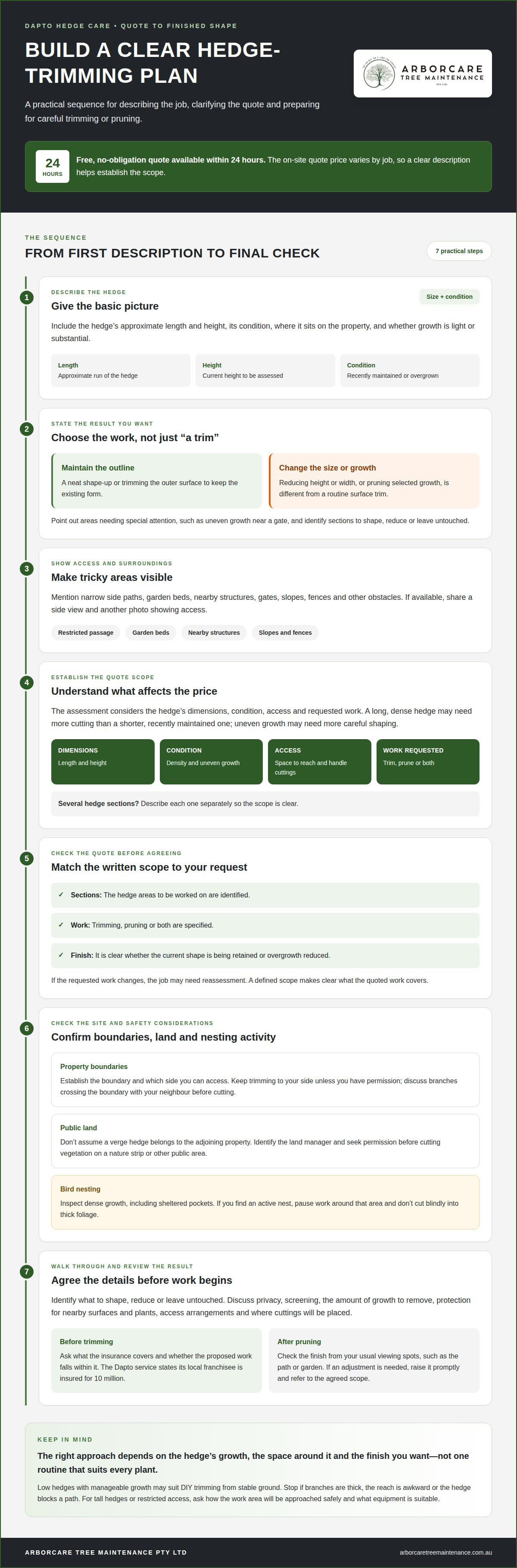
Start by describing where the hedge sits on your property, including its approximate length, height and condition. Explain whether it needs a light shape-up or substantial cutting back. Also mention whether access is straightforward or restricted by a narrow side path, garden beds or nearby structures. These details help define the work.
Next, explain the result you want. A neat, level outline is different from reducing a hedge’s width or height. Point out sections needing particular attention, such as uneven growth near a gate. Photos can show the hedge’s shape and surroundings. If available, include a side view and another showing access.
A free quote for hedge trimming in Dapto is offered within 24 hours, with no obligation to proceed. Keep your request focused on the actual work. Note whether you want trimming, pruning, or both, and identify any separate hedge sections. This gives the quote a clearer scope than a general request for garden work.
Factors Affecting the Quote
Arborcare Tree Maintenance provides a free, on-site quote, and the price varies per job. Hedge length, height, condition, access and the requested work all affect the assessment. A long, dense hedge may need more cutting than a shorter, recently maintained one. Uneven growth may also call for more careful shaping than a straightforward trim.
Access affects how the work is carried out. A hedge beside an open lawn differs from one behind garden beds or along a tight passage. The available space can affect how safely the work area is reached and how cut material is handled. Mention gates, slopes, nearby fences and other obstacles when describing the property.
Be specific about what you want done. Reducing a hedge’s height differs from maintaining its existing outline, and pruning selected growth differs from trimming the outer surface. If several sections need work, describe each one separately. These details help establish a clear scope.
Before accepting a quote, read its scope carefully. Check that it identifies the hedge sections and the requested trimming or pruning. Make sure the intended finish is clear, such as retaining the current shape or reducing overgrowth. If you change the request, the work may need reassessment. A defined scope makes clear what the quoted work covers.
Local hedge trimming and pruning in Dapto
In Dapto, hedge care depends on plant growth, access, boundaries and the finish you want. Check ownership and look for nesting activity before cutting.
DIY trimming suits low hedges with manageable growth. For hedge trimming in Dapto, a small front hedge may need only light shaping from stable ground. A gardener can handle larger or denser growth. Stop if branches are thick, the reach is awkward, or the hedge blocks a path. Choose an approach that suits the hedge and working area.
When choosing a Dapto hedge trimmer, ask about relevant licensing and insurance, and request evidence of current cover. Discuss experience with your hedge type, the intended shape, how much pruning is needed, access and cuttings. For tall hedges or restricted access, ask how the work area will be approached safely and what equipment is suitable.
At NSW property boundaries, establish where the boundary sits and which side you can access. Keep trimming to your side unless you have permission for other work. Don’t reach across a fence without consent. If branches cross the boundary, discuss access with your neighbour before cutting. This helps avoid disputes and damage to fences or garden plants.
Hedges on public land need a different approach. Don’t assume a verge hedge belongs to the adjoining property. Identify the land manager and seek permission before cutting vegetation on a nature strip or other public area. In Dapto, establish whether the hedge is on private property or public land before arranging work.
Trimming during active bird nesting can disturb nests, eggs or young birds. Look through dense growth before starting, especially in sheltered pockets. If you find an active nest, pause work around that area. Don’t cut blindly into thick foliage. Inspect the full section planned for trimming, as birds may use different parts of the hedge.
Before work begins, mark the sections needing attention. Note nearby fences, paths and garden beds. Share these details when arranging hedge trimming in Dapto. If overgrowth or access makes the job difficult, professional hedge trimming and pruning can help with shaping and maintenance.
Before confirming the job, ask the service to explain what its insurance covers and whether the proposed work falls within that cover. The Dapto hedge-trimming service states that its local franchisee is insured for 10 million. You can also clarify who will carry out the work, how access will be managed and where cuttings will be placed. Agreeing these details beforehand can make expectations clearer and help you decide whether the proposed arrangement suits your property.
Walk around the hedge with the person doing the work and identify the areas to shape, reduce or leave untouched. Explain any concerns about privacy, screening or appearance, and discuss how much growth to remove. If you want a particular outline, describe it before trimming starts rather than relying on assumptions. Ask how nearby surfaces and plants will be protected and how cuttings will be handled. After pruning, check the finished hedge from places where you usually view it, such as the path or garden. If the result needs adjustment, raise this promptly and refer to the agreed scope. Keep future maintenance in mind so the chosen shape and level of reduction remain practical for the space.
Hedge trimming quote Dapto what affects the price
Arborcare Tree Maintenance provides a free, on-site quote, and the price varies per job. In Dapto, the main factors are hedge dimensions, growth density, access, requested finish and handling of cut material. Each affects the amount or type of work involved. A useful quote reflects the actual hedge and site conditions, not just its location.
Length affects how much hedge needs attention. A short boundary section differs from one running along an entire driveway. Height matters too, as the top may need separate shaping. Dense growth can require more work than sparse, recently shaped foliage. Describe each hedge section clearly rather than grouping unlike sections together.
The requested result can change the work substantially. A light trim removes outward growth and maintains an existing outline. Reducing width or height requires a different cut and more considered shaping. Corrective pruning may involve selecting particular branches rather than cutting the whole surface. Explain whether you want routine maintenance or a noticeable change.
Access is another practical factor. An open lawn provides a different working area from a narrow passage beside a fence. Steps, garden beds, sloping ground and nearby structures can affect how the hedge is approached. Mention obstacles and restricted entry when describing the property. A clear description helps the quote reflect the site conditions.
Cuttings also affect the scope. Ask whether the requested work includes gathering and removing green waste, or leaving it in an agreed place. A large hedge can produce a different volume of material from a small front boundary. State your preference before the quote is prepared. That prevents different expectations about what the work covers.
To make the quote easier to assess, provide a concise job brief:
- Describe the hedge’s location and approximate dimensions.
- Explain the desired height, width, and finished shape.
- Note dense growth, uneven sections, or difficult access.
- State how you want cut material handled.
When comparing written quotes, review the included tasks, not just the total. Check whether each covers the same hedge sections, finish, access conditions and green-waste handling. A lower figure may describe a narrower scope. Ask for unclear wording to be explained before agreeing, so your decision reflects the work you need.
Changes made after the scope is set can affect the price. Adding a second hedge or requesting substantial height reduction changes the original task. Confirm any additional work and its price before it begins. A clear written scope gives both sides a shared record of the agreed trimming.
Best time to trim hedges in Dapto Illawarra climate
In Dapto, choose timing based on plant growth, weather and the finish required. There isn’t one calendar date for every hedge. Identify the plant first, then consider its flowering pattern and recent growth. A light tidy-up differs from substantial reshaping. This helps avoid removing more foliage than intended.
For routine shaping, trim when new growth begins to soften the hedge’s outline. Inspect the surface from both sides. If shoots extend unevenly, a light cut can restore the chosen shape. Avoid cutting deeply just to make every section identical. Different branches may grow at different rates, particularly along shaded fences.
Flowering hedges need more attention to timing. Note when flowers appear and whether they grow on new or older growth. For a hedge that flowers in spring, trimming beforehand could remove developing buds. In that case, wait until flowering finishes before shaping. The right timing depends on the plant, not simply the season.
Weather matters on the day. Choose a cool, dry period where practical. Avoid trimming in intense heat, when freshly cut foliage may face extra stress. Wet leaves can make the hedge harder to assess and cut evenly. Check the forecast before planning substantial work, especially if rain could interrupt access or clean-up.
Seasonal growth also guides how much work is needed. A fast-growing hedge may need light shaping after a flush of shoots, while a slow-growing hedge may hold its outline longer. Compare the current hedge with its intended boundary. If only a few shoots protrude, selective trimming may be enough. If growth is dense, plan a measured reduction.
Before cutting, walk the full hedge line. Look for bare patches, damaged branches and fresh shoots, and mark sections needing a lighter touch. Check the top from a safe viewing position rather than reaching over unstable ground. These checks help keep the cut consistent from the driveway entrance to the garden corner.
Use this simple timing check before booking or starting:
- Identify the hedge species, if known.
- Check its flowering period and current growth.
- Choose a dry, moderate-weather day.
- Decide between light shaping and heavier pruning.
- Inspect the whole hedge for nests and hazards.
For example, a flowering hedge beside a Dapto driveway may need trimming scheduled after blooms fade. A non-flowering screen may instead need attention when new shoots spoil its outline. Keep notes after each trim, including the season and sections cut. Comparing those observations helps you plan future maintenance around the hedge’s response.
Plan carefully when the work involves dense foliage or difficult access. A controlled cut helps preserve the intended shape and avoid unnecessary removal. Reassess the hedge after trimming, then let new growth guide the next maintenance decision.
How often should common hedges be trimmed in NSW
Common hedges don’t share one trimming schedule. In NSW, growth rate, plant type and desired shape all matter. A formal screen needs a different routine from flowering shrubs. Identify the hedge, then watch how quickly shoots extend. Trim when growth begins to spoil the intended outline, rather than following an arbitrary calendar.
Lilly pilly hedges can produce fresh shoots that soften a neat profile. Inspect the outer surface as growth develops. If new tips extend beyond the line, light shaping may restore its form. Avoid cutting deeply each time. A measured trim helps preserve a dense screen without removing more foliage than needed.
Murraya hedges may be grown for foliage or flowers. Decide which result matters most before trimming. If blooms are important, avoid cutting off developing flower growth. After flowering, assess the outline and remove unruly shoots selectively. This balances appearance with the plant’s flowering cycle, rather than trimming simply because a date has arrived.
Photinia hedges often serve as colourful screens. New growth can change their appearance, so check the outline after a flush. Trim only sections that have grown beyond the desired shape. For a tall boundary screen, assess the top and sides separately to spot uneven growth early.
For viburnum and other broadleaf shrubs, use the hedge’s condition as your guide. Sparse areas need a gentler approach than vigorous, dense sections. Repeated hard cuts can leave an uneven finish. Inspect each section before trimming and remove only the growth needed to maintain the chosen shape. Flowering varieties also need suitable timing to protect blooms.
Use these checks to set a practical routine:
- Identify the species, such as Lilly pilly or Murraya.
- Inspect new growth and compare it with the desired outline.
- Note whether flowers or foliage are the priority.
- Record which sections need shaping after each inspection.
A simple garden note can reveal a hedge’s growth pattern. Record when Lilly pilly shoots begin extending or when Murraya flowers appear. Compare those observations before the next trim. If growth stays compact, wait. If branches repeatedly obstruct a path or obscure a gate, plan maintenance sooner. These visible changes are more useful than applying the same schedule to every hedge.
For Dapto properties, consider the hedge’s purpose too. A privacy screen may need a consistent outline, while an informal shrub border can retain a softer shape. Inspect the whole hedge before deciding. Adjust the next trim to the plant’s response, flowering needs and the finish you want to maintain.
Arborcare Tree Maintenance: Tree Removals
Arborcare Tree Maintenance provides hedge shaping and pruning for routine maintenance that needs a careful, planned approach. If a nearby tree is crowding the hedge or affecting access, its tree removal service may also suit the wider property work. Palm tree removals and stump grinding are available for related tree and stump needs.
Choose the service that matches the task. Hedge trimming focuses on the hedge’s shape and growth, while tree removal addresses a separate tree that needs to be taken down. Describe both issues clearly to help define the work and its scope.
Contact Arborcare Tree Maintenance to discuss hedge or tree work for your property.
Plan your next hedge-care step
A well-maintained hedge can shape the feel of an outdoor space. Decide what matters most: a tidy outline, improved access or a considered change to the hedge’s size. For hedge trimming in Dapto, a clear goal makes it easier to discuss the work and choose an approach that suits your property.
Arborcare Tree Maintenance offers Hedging, Pruning & Trimming, Tree Removals and Palm Tree Removals. These services can address hedge maintenance alongside trees that need attention, without treating every garden issue as the same job.
Before arranging work, note the area involved and the result you want. If a tree or palm is also part of your plans, include it in the discussion. A clear starting point helps keep the next step focused on your property’s needs.
Contact Arborcare Tree Maintenance to discuss your hedge or tree work and move ahead with confidence.
Frequently Asked Questions
What hedge trimming services are available in Dapto, NSW?
Arborcare Tree Maintenance provides hedging, pruning and trimming for residential and commercial properties in Dapto, Wollongong, Shellharbour and the wider Illawarra, including Woonona, Jamberoo, Fairy Meadow and Dombarton. The work can address different needs: a hedge growing across a driveway may need its outline brought back, while uneven or sparse growth may call for selective pruning. Describe the hedge’s condition and the result you want when enquiring. This helps clarify whether routine trimming or more focused pruning suits the job.


