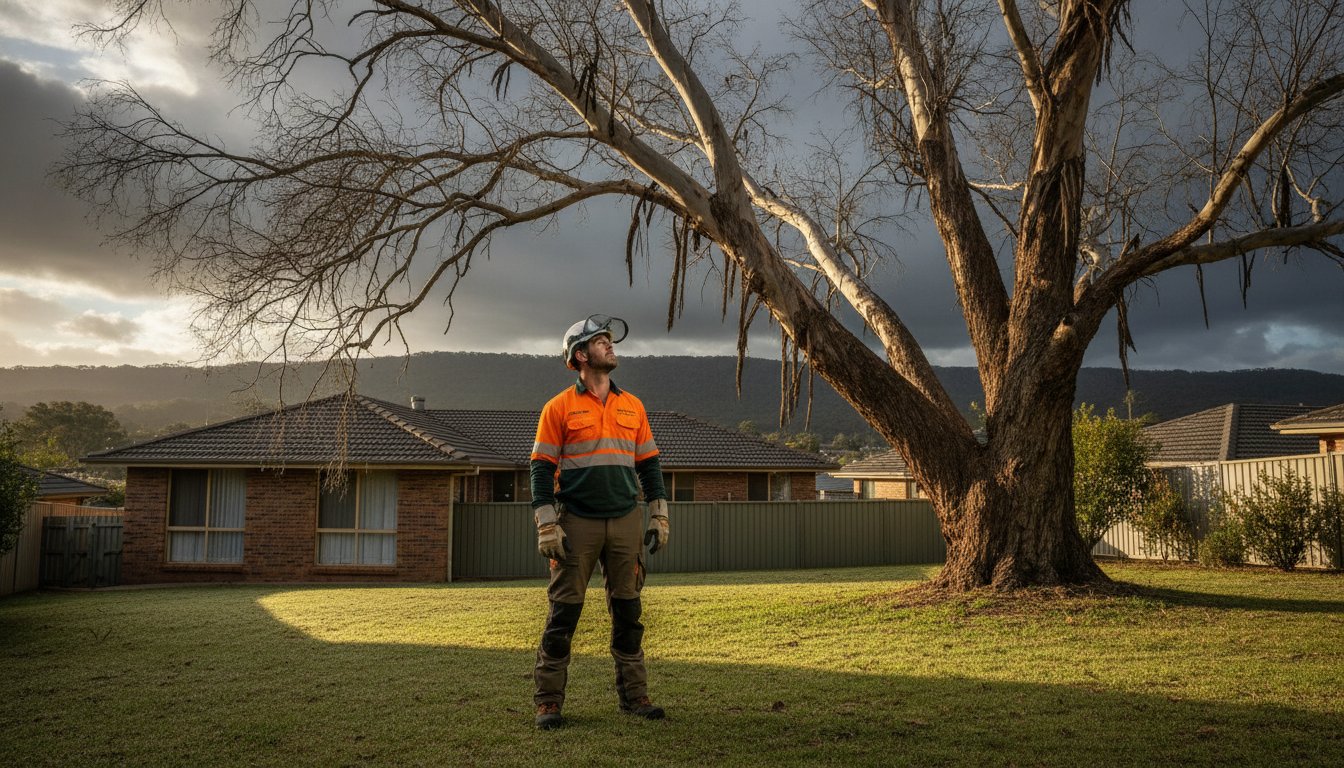
If a severe storm hit the Illawarra tonight, are you certain the towering eucalyptus leaning toward your roofline would stay upright? Identifying the physical signs a tree needs to be removed Wollongong residents should watch for is the first step in protecting your family and your assets. It's common to feel a sense of unease when looking at a hollow trunk or dead branches, especially when you're caught between the fear of property damage and the confusion of local council regulations.
You deserve to feel secure on your own land without the constant worry of falling timber or the anxiety of potential fines. This guide will teach you how to spot critical hazards and navigate the Wollongong City Council permit process with absolute confidence. We'll examine the current 2026 regulations, including the $109 fee for standard applications and the specific species that are exempt from permits, ensuring you have a methodical path toward a safer, compliant property.
Key Takeaways
- Identify the critical physical signs a tree needs to be removed Wollongong residents must monitor, such as visible trunk decay and significant leaning toward powerlines or structures.
- Understand the regulatory differences between a standard Tree Management Permit and a Development Application to ensure your property remains compliant with local council orders.
- Learn how unique Illawarra environmental factors, including escarpment wind tunnels and coastal salt spray, can compromise the stability of specific tree species.
- Follow a methodical five-step application process that begins with verifying the 2026 exempt species list to potentially save time and permit fees.
- Discover why engaging a qualified AQF Level 3 arborist rather than a "tree lopper" is essential for securing professional risk assessments that fast-track council approvals.
Top Physical Signs a Tree Needs to be Removed from Your Wollongong Property
Property owners often overlook subtle changes in their landscape until a storm forces the issue. Recognising the signs a tree needs to be removed Wollongong residents should monitor is a critical safety responsibility. While some trees show obvious distress, others hide internal rot that only a trained eye can detect. Proactive identification prevents property damage and ensures your family remains safe during the Illawarra's unpredictable weather events.
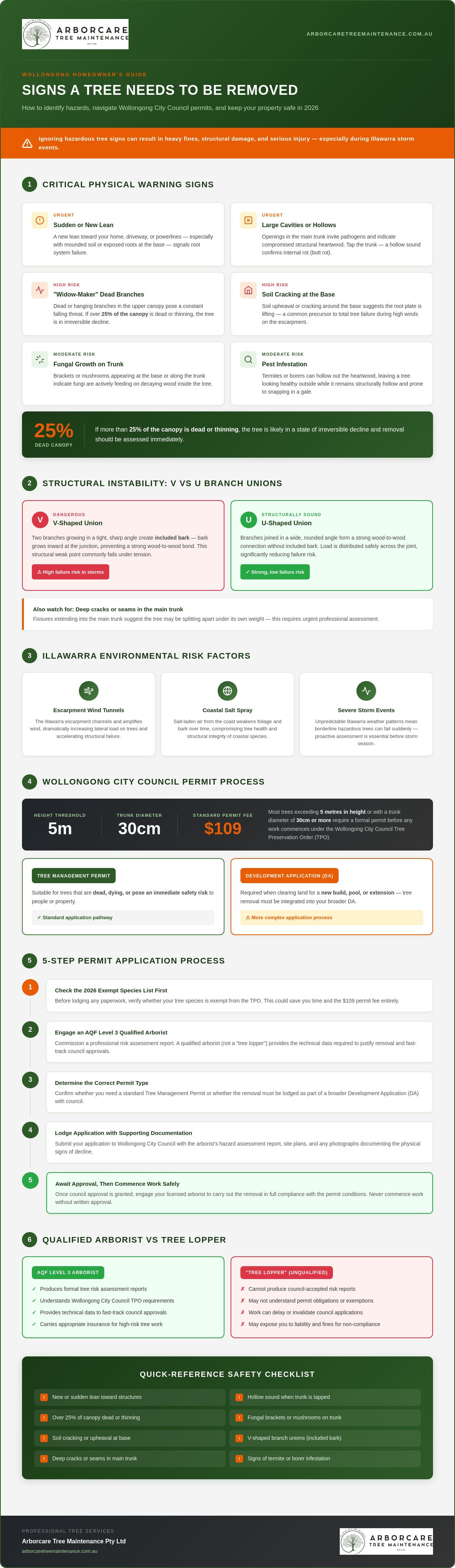
A tree that has suddenly developed a lean, particularly toward your home, driveway, or powerlines, requires immediate attention. While many trees grow at an angle naturally to reach sunlight, a new lean accompanied by mounded soil or exposed roots at the base indicates a failure in the root system. You should also look for large cavities or hollows in the main trunk. These openings often serve as entry points for pathogens and indicate that the structural heartwood may be compromised. If the trunk sounds hollow when tapped or shows significant signs of decay like butt rot, the tree's ability to support its own weight is likely diminished.
Upper canopy health is equally telling. Dead, hanging branches, colloquially known as "widow-makers," pose a constant threat to anyone walking below. If more than 25 percent of the canopy is dead or thinning, the tree is likely in a state of irreversible decline. Additionally, look for soil cracking or upheaval around the base. This often suggests the root plate is lifting, a common precursor to total tree failure during high winds on the escarpment.
Identifying Structural Instability
Structural integrity depends on how a tree's limbs are attached to the main stem. V-shaped unions, where two branches grow tightly together in a sharp angle, are significantly weaker than U-shaped unions. These tight joins often lead to "included bark." Included bark occurs when bark grows inward at the junction of two stems, preventing a strong wood-to-wood connection and creating a structural weak point that often fails under tension. Deep cracks or seams extending into the main trunk are also red flags. These fissures suggest the tree is literally splitting apart under its own weight and may require urgent intervention.
Biological Indicators of Decline
Biological signs often precede structural collapse. Fungal growth, such as brackets or mushrooms appearing at the base or along the trunk, indicates that fungi are feeding on decaying wood inside. A sparse canopy or premature leaf drop, especially when compared to neighbouring Wollongong flora, suggests the tree's vascular system is failing. Finally, keep a close watch for pests like termites or borers. These insects can hollow out the heartwood of a tree, leaving it looking healthy on the outside while it remains a hollow shell prone to snapping in the next gale.
Understanding the Tree Removal Permit Process in Wollongong
Identifying the physical signs a tree needs to be removed Wollongong property owners have noticed is only half the battle. Once a hazard is suspected, you must engage with the legal framework established by the Wollongong City Council. The local Tree Preservation Order (TPO) exists to protect the region's urban forest, meaning most trees over five metres in height or with a trunk diameter of 30 centimetres or more require a formal permit before any work commences. Ignoring these protocols can result in heavy fines, as the NSW government tree removal regulations grant local authorities significant power to penalise unauthorised clearing.
It's vital to distinguish between a Tree Management Permit and a Development Application (DA). A standard permit is suitable for trees that are dead, dying, or pose an immediate risk to safety. If your intent is to clear land for a new build, pool, or extension, the tree removal must be integrated into your broader DA. Before you lodge any paperwork, conducting a hazardous tree removal Wollongong assessment ensures you have the technical data required to justify the removal. If you feel overwhelmed by the paperwork, consulting a professional arborist can help you determine the correct application path and avoid costly administrative delays.
Exempt Trees: When You Do Not Need a Permit
Specific scenarios allow for removal without Council's prior written consent. Environmental weeds, including species like Camphor Laurel, Large-leafed Privet, African Olive, and the Cocos Palm, are generally exempt unless they are heritage-listed or provide essential habitat for threatened species. Dead trees that do not contain hollows for native fauna can also be removed, though it's prudent to keep photographic evidence or an arborist's statement. Furthermore, properties within designated bushfire-prone areas may fall under the 10/50 Vegetation Clearing Scheme, which provides specific allowances for clearing near habitable dwellings.
Criteria for Permit Approval
Council's assessment team focuses on "unacceptable risk" rather than "nuisance" factors. While leaf drop, shade, or minor root lift in a lawn are rarely accepted as valid reasons for removal, structural instability or terminal disease are high priorities. An AQF Level 3 Arborist report is your strongest tool here; it provides a professional risk rating that Council officers trust. As of 2026, the standard application fee for one to two trees is $109.00, and the processing time is approximately 28 working days. Be aware that most approvals now mandate the planting of a replacement tree to maintain the local canopy cover.
Illawarra Environmental Factors: Why Local Context Matters
Wollongong's unique geography, sandwiched between the Pacific Ocean and the steep Illawarra Escarpment, creates environmental pressures that aren't found in inland regions. These conditions directly influence the structural health of your timber. Understanding the local context helps you accurately identify the signs a tree needs to be removed Wollongong residents often encounter after heavy weather. From salt-laden winds to the funnelled gusts of the escarpment, your property's location determines which specimens are most at risk of failure.
In suburbs like Dapto and Woonona, the escarpment acts as a massive wind-funnel. During high-wind events, these "wind tunnels" subject tall trees to immense lateral pressure that can lead to catastrophic trunk failure or root plate heave. This risk is compounded by the region's soil profile. Many Illawarra properties sit on heavy clay that expands and contracts significantly with moisture levels, or sandy coastal soils that offer poor anchorage during the saturated conditions of an East Coast Low. If you notice soil cracking or a slight change in the angle of a trunk after a wet week, the root system may no longer be holding fast.
Coastal salt spray is another silent factor in tree decline. While native species have evolved to handle high salinity, many popular non-native garden trees struggle. Salt spray can desiccate foliage and lead to chronic crown dieback, eventually killing the tree from the top down. As the canopy thins, the tree loses its ability to photosynthesise, making it more susceptible to pests and internal rot. If you see persistent browning of leaves on the seaward side of your property, it's time to assess the tree's long-term viability.
Storm Readiness and High-Risk Trees
Preparing for the Illawarra storm season is a vital part of property maintenance. East Coast Lows bring torrential rain and gale-force winds that quickly expose hidden structural weaknesses. It is far safer to recognize the signs of a hazardous tree before the clouds roll in than to deal with an emergency in the middle of the night. Overhanging branches near gutters and roofs are primary hazards; they can snap under the weight of water or be torn off by gusts, causing thousands in damage. Proactively managing these risks is often more affordable than an emergency call-out, and you can check our guide on tree removal cost Wollongong to plan your storm damage prevention budget.
Native vs. Invasive Species in the Gong
Wollongong City Council places a high value on the local urban canopy, particularly native Eucalypts and Banksias that provide essential habitat. However, many properties are still home to invasive species like Large-leafed Privet or various environmental weeds. These invasive trees often grow rapidly with shallow root systems, making them prone to falling during storms. Balancing the safety of your home with Council's canopy goals requires a nuanced approach. While natives are more protected under the TPO, invasive species are often easier to clear once they show signs a tree needs to be removed Wollongong authorities recognise as a legitimate hazard.
How to Apply for a Tree Removal Permit Wollongong: 5 Steps
Applying for a permit doesn't have to be a bureaucratic nightmare. By following a methodical process, you can ensure your application is processed without unnecessary delays or requests for further information. Documenting the specific signs a tree needs to be removed Wollongong council assessors look for will significantly improve your chances of a quick approval. If you're unsure about the technical requirements, book a professional risk assessment to establish a clear case for removal based on safety.
Step 1: Conduct a preliminary check of the Wollongong Council exempt list. Before spending money on applications, verify if your tree species is exempt. Many environmental weeds or trees under five metres in height don't require formal consent. Step 2: Engage a licensed arborist for a professional risk assessment. An AQF Level 3 arborist will identify structural defects that an untrained eye might miss, providing the expert evidence Council requires. Step 3: Complete the Tree Management Permit application via the Council portal. Use the online "Wollongong City Council Online Services" portal to lodge your request, ensuring all justifications focus on safety or proven structural damage rather than aesthetics.
Step 4: Pay the application fee and schedule a Council officer visit. As of 2026, the standard fee for one to two trees is $109.00. Once paid, a Council officer may visit your property to verify the arborist's findings. Step 5: Receive your permit and hire a tree removal Wollongong specialist. Never start work until you have the written permit in hand. Once approved, engage a qualified team to execute the removal safely and efficiently.
Documentation Requirements
Council requires high-quality evidence to support your claim. You'll need clear photos showing the entire tree as well as close-ups of specific defects, such as fungal brackets or deep trunk cracks. A simple site plan is also mandatory; this should show the tree's location relative to your house, neighbouring boundaries, and any permanent structures like garages or pools. If your project involves the demolition of these older structures, professional asbestos removal Newcastle services provide the necessary surveys to ensure the site remains safe and compliant. Your written justification must be objective, focusing on "unacceptable risk" or "property damage" rather than personal preference.
What Happens After Approval?
Approval usually comes with specific conditions you must follow. Since July 2023, Council generally mandates the planting of a replacement tree to offset the loss of canopy cover. You're responsible for ensuring your chosen arborist is fully insured and qualified before they set foot on your property. Keep a physical or digital copy of the permit on-site during the entire removal process, as Council rangers may perform spot checks to ensure the work being carried out matches the approved application.
Why a Professional Arborist Assessment is Your Best Defence
Hiring an amateur to manage your timber is a high-risk gamble that can lead to property damage, insurance complications, or personal injury. While you might recognise the physical signs a tree needs to be removed Wollongong council requirements necessitate a level of technical evidence that only a qualified arborist can provide. The fundamental difference lies in education; a "tree lopper" often employs indiscriminate cutting techniques that can actually increase a tree's instability, whereas an AQF Level 3 arborist uses scientific principles to assess structural integrity and vascular health.
Professional reports do more than just identify hazards; they act as a bridge between your safety concerns and Council's preservation goals. An arborist's assessment can fast-track approvals because it uses standardised risk ratings that Council officers recognise and trust. Beyond the permit process, engaging a specialist mitigates your legal liability. If an uncertified worker causes damage to a neighbouring property or powerlines, you may find your home insurance claim denied. A professional team carries the necessary public liability and professional indemnity insurance to protect you from these financial catastrophes.
It's also important to remember that removal isn't always the only solution. During a professional assessment, we may identify that selective pruning or weight reduction can mitigate the hazard while preserving the tree's life. This approach maintains your property's value and shade while eliminating the immediate danger. By choosing a methodical evaluation over a quick cut, you ensure the long-term safety and aesthetics of your landscape.
The Arborcare Approach to Safety
Our team prioritises safety through the use of advanced rigging systems and specialised equipment designed for complex removals in tight residential spaces. We don't just cut and drop; we dismantle trees piece by piece to ensure zero impact on your home or garden. Every pruning task we perform is in 100% compliance with Australian Standard AS4373-2007, ensuring the tree's health isn't compromised by poor technique. In the event of a sudden failure, our emergency tree service Illawarra capabilities ensure a rapid response to clear hazards and secure your property after a storm.
Next Steps for Your Property
Protecting your home starts with a simple site inspection from our Dapto-based team. We'll walk your property, identify any signs a tree needs to be removed Wollongong weather might exploit, and provide a clear, honest recommendation. If removal is necessary, we can recycle the timber into high-quality mulch for your garden, returning nutrients to your soil and keeping your landscape healthy. Don't wait for the next East Coast Low to test the strength of your trees. Request a professional tree assessment from Arborcare today and gain the peace of mind that comes with expert property care.
Secure Your Property Before the Next Storm
Maintaining a safe landscape requires a balance of vigilance and professional expertise. By consistently monitoring for the physical signs a tree needs to be removed Wollongong property owners can take decisive action before structural defects lead to costly damage or injury. You now understand the critical importance of the Council permit process, the standard 2026 application fees, and how the unique Illawarra environment places specific stresses on your timber.
Entrusting your tree care to qualified specialists ensures that every removal or pruning task is performed with technical precision and legal compliance. As a local Dapto family owned and operated business, we provide the reassurance of licensed AQF Level 3 Arborists who are fully insured for high-risk removals. We're dedicated to protecting our local community through methodical assessments and disciplined safety protocols. Get a Professional Tree Assessment & Quote in Wollongong to ensure your property remains a secure sanctuary for your family. We're here to help you navigate every step of the process with confidence.
Frequently Asked Questions
Do I need a permit to remove a dead tree in Wollongong?
Yes, you generally require a permit to remove a dead or dying tree if it exceeds five metres in height or has a trunk diameter of 30cm or more. While it may seem redundant, Council needs to verify the tree is truly dead and doesn't provide essential habitat for native fauna. Always take photos or obtain an arborist's statement to support your application before starting any work.
How much does a tree removal permit cost in Wollongong for 2026?
As of July 2026, the standard application fee for a tree removal permit covering one to two trees is $109.00. If you need to remove between three and ten trees, an additional $50.00 is charged for each extra tree after the first two. Eligible pensioners are entitled to a 50% discount on these permit fees, provided they submit valid documentation with their application.
What is the "10/50" rule and does it apply to my Wollongong property?
The 10/50 Vegetation Clearing Scheme allows property owners in designated bushfire-prone areas to clear trees within 10 metres of a home without a permit. It also covers shrubs within 50 metres. You must verify your property's eligibility through the NSW Rural Fire Service online tool before starting work, as heritage and environmental protections can sometimes override this specific scheme.
Can I remove a tree if it is touching my powerlines?
You should never attempt to remove a tree that is touching or within close proximity to powerlines yourself. This is a high-risk task that requires a specialist with specific electrical hazard qualifications. In many cases, you'll need to coordinate with Endeavour Energy or hire an authorised service provider to ensure the power is safely managed or disconnected during the removal process.
How long does it take for Wollongong Council to approve a tree permit?
The standard processing time for a tree permit application with Wollongong City Council is approximately 28 working days. This timeframe allows for an administrative review and a potential site visit by a Council officer. Providing a professional report that details the physical signs a tree needs to be removed Wollongong assessors look for can help prevent unnecessary administrative delays or requests for further information.
What are the fines for removing a tree without a permit in NSW?
Removing a protected tree without a valid permit in New South Wales can lead to significant legal penalties and heavy fines. Fines vary depending on the severity of the clearing and the species involved, but they can reach thousands of dollars for individual property owners. In addition to financial penalties, Council often issues remediation orders requiring the mandatory planting of multiple mature replacement trees.
Does Wollongong Council provide a list of exempt tree species?
Yes, Wollongong Council maintains an extensive list of exempt species that don't require a permit for removal, provided they aren't heritage-listed or providing habitat for threatened species. This list includes environmental weeds such as Camphor Laurel, Large-leafed Privet, African Olive, and various palms like the Cocos Palm. Identifying these signs a tree needs to be removed Wollongong residents should check can save you significant time and permit costs.
Can my neighbour force me to remove a tree on my property?
Your neighbour cannot usually force you to remove a tree simply because it drops leaves or blocks their view. However, if the tree poses a documented safety risk or is causing structural damage to their property, they may seek an order through the Land and Environment Court. In these cases, the Trees (Disputes Between Neighbours) Act 2006 governs the resolution, and a professional risk assessment is essential.


