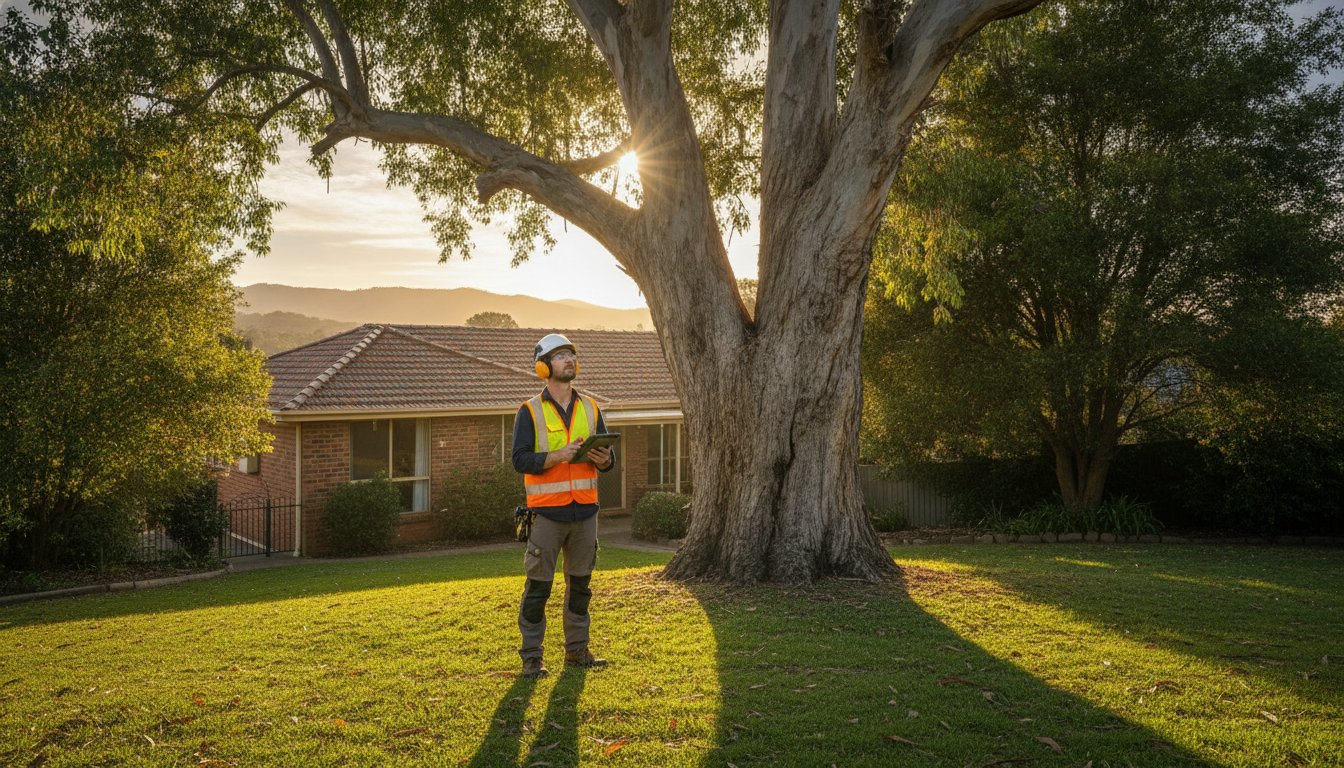
As the wind picks up across the Illawarra, many homeowners find themselves looking out the window at their towering eucalypts with a sense of dread rather than peace. It's a common anxiety during storm season, especially when you're unsure if a heavy branch might fail or if the entire root system is compromised. Securing a professional tree risk assessment Wollongong wide is the most effective way to replace that worry with expert certainty. You deserve to know that your trees are healthy and that your property is protected against the next major weather event.
We understand that dealing with local regulations can be just as stressful as the trees themselves. Whether you're trying to figure out the mandatory replacement tree policy or determining if a trunk meets the 30cm diameter threshold for a Council permit, the rules are often complex. This guide will show you how a qualified arborist identifies hidden hazards and manages the compliance process on your behalf. You'll learn how to mitigate property risks, avoid potential fines, and create a long term plan for a safe, compliant landscape.
Key Takeaways
- Understand why Wollongong’s unique coastal weather patterns and East Coast Lows make regular safety inspections essential for every local property owner.
- Learn the specific technical steps used by Level 5 Arborists during a Visual Tree Assessment to detect structural weaknesses in the canopy and root system.
- Identify the difference between a verbal inspection and a formal consultancy report to ensure you choose the right service for your tree risk assessment Wollongong needs.
- Clarify Wollongong City Council’s definition of a protected tree to ensure your maintenance or removal plans remain fully compliant with local regulations.
- Discover how to prepare your property for an arborist's visit and the best time of year to secure an assessment before storm season begins.
What is a Tree Risk Assessment and Why is it Vital in Wollongong?
A tree risk assessment is a technical safety audit rather than a simple garden check. It involves a systematic process where we identify, analyse, and evaluate potential hazards associated with the trees on your property. This assessment determines the likelihood of a tree or a specific limb failing and the consequences that failure would have on people or structures. By using this structured approach, we can move beyond guesswork and provide a clear, data-driven safety profile for your landscape.
The Illawarra Escarpment creates specific wind tunnels that funnel air toward the coast, putting trees under constant mechanical stress. This geographic feature means a tree risk assessment Wollongong residents book must account for different forces than an assessment in a flat, inland suburb. When an East Coast Low hits, these stresses multiply. A tree that seems stable in a light breeze might have structural flaws that only reveal themselves when pushed by gale-force coastal gusts. Understanding these local environmental pressures is the first step in protecting your home.
It is vital to distinguish between an unhealthy tree and a high-risk tree. An unhealthy tree might have thinning foliage or discoloured leaves but pose little danger if it is small and away from dwellings. Conversely, a magnificent, vibrant tree can be high-risk if it has a compromised root system or a "V-shaped" trunk union overhanging a bedroom. A professional in the practice of arboriculture can see past the green leaves to find the structural cracks or fungal fruiting bodies that signal genuine danger.
The Impact of Illawarra Weather Patterns on Tree Stability
Wollongong's weather is notoriously tough on timber. Heavy rainfall during autumn often saturates the soil, which increases the risk of root plate failure; this occurs when the softened ground can no longer hold the weight of the tree during high winds. In summer, we face "summer branch drop," where Eucalypts shed large limbs unexpectedly to conserve water during heatwaves. Additionally, if you live near the ocean, salt spray can slowly degrade the structural integrity of certain woods, making them more brittle and prone to snapping over time.
Financial and Safety Benefits of Proactive Assessment
Being proactive with your property maintenance saves significant money in the long run. Identifying a split union early allows for targeted weight reduction pruning rather than a full, expensive emergency removal after a storm. The primary benefit, however, is the safety of your family. Knowing that the trees overhanging your kids' play equipment or your driveway have been professionally vetted provides immense peace of mind. Taking action before the NSW storm season begins is the smartest way to manage your property's natural assets and avoid catastrophic damage.
The Professional Process: How Level 5 Arborists Evaluate Your Trees
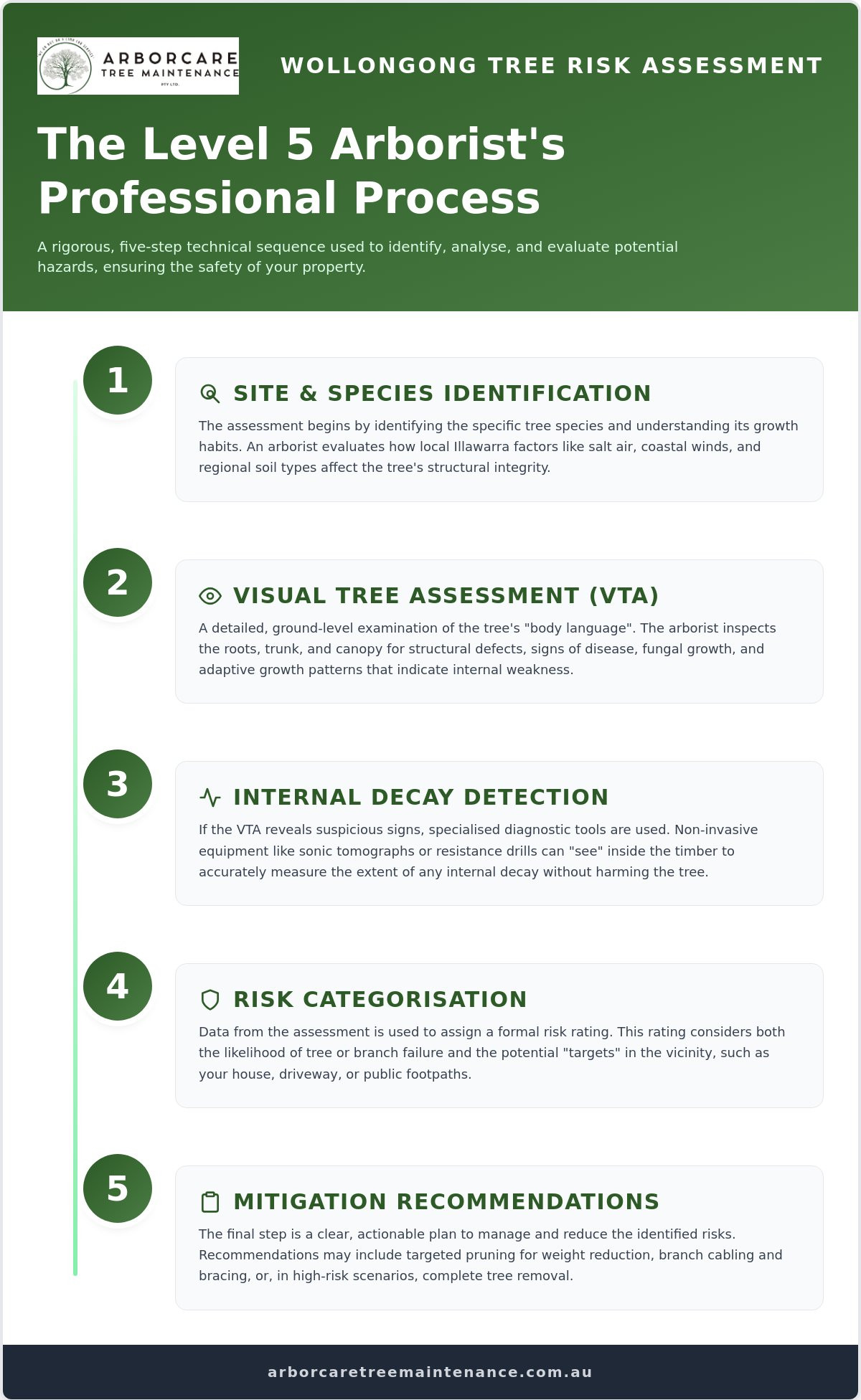
A comprehensive tree risk assessment Wollongong homeowners receive follows a rigorous, five-step technical sequence. It begins with site and species identification. This stage is vital because the growth habits of local Illawarra species, such as the Grey Ironbark or the Illawarra Flame Tree, dictate how they respond to environmental stress. A Level 5 arborist must understand these specific biological traits before moving to the next phase. It's about knowing how a particular species handles the salt air or the specific soil types found in our region.
The second step is the Visual Tree Assessment (VTA). This ground-level examination focuses on the roots, trunk, and canopy to find structural defects. If we find suspicious signs during this phase, we move to step three: internal decay detection. This involves specialised tools like sonic tomographs or resistance drills to "see" inside the timber without harming the tree. Step four is risk categorisation. We assign a formal rating based on the likelihood of a failure and the potential "targets" in the vicinity, such as your house or a public footpath. Finally, we provide mitigation recommendations. These are clear instructions on how to manage the risk, which might involve targeted pruning or, in high-risk cases, a complete removal.
The Visual Tree Assessment (VTA) Methodology
Visual Tree Assessment is the industry standard for non-invasive tree health checks. During this process, we look for the tree's "body language." This includes searching for adaptive growth, which is the tree's way of reinforcing itself against a weakness, along with seams and structural cracks. We also look for fungal fruiting bodies; these mushrooms growing on the trunk or at the base often signal advanced heartwood decay that isn't visible on the surface. Following the formal guidelines for Tree Risk Assessment set by national bodies ensures every inspection is thorough and legally defensible.
Advanced Diagnostic Tools for High-Value Trees
Sometimes a ground-level view isn't enough to guarantee safety. For high-value or significant trees, we may use aerial inspections involving drones or climbing arborists to check the upper canopy for "widow makers" or hidden hollows. In suburbs like Dapto, where heavy clay soils are common, root mapping is another essential tool. This process identifies exactly where roots are growing to protect home foundations from damage. If you're concerned about a large specimen on your land, booking a professional tree risk assessment Wollongong service ensures you have the technical data required by Council for any protected species.
Arborist Reports vs. Visual Inspections: Choosing the Right Service
Choosing between a verbal inspection and a formal report depends entirely on your specific goals. For many, a simple verbal tree risk assessment Wollongong service provides the clarity needed to make a quick decision about a backyard gum tree. This is a cost-effective way to get professional advice without the overhead of a comprehensive document. However, if you're dealing with a local Council requirement or a legal dispute, a formal Level 5 Arborist Report becomes an essential investment. While a visual check identifies the problem, the report provides the documented evidence needed to justify a specific action.
A Level 5 report is a consultancy-grade document. It includes detailed mapping, photographic evidence, and a rigorous analysis of the tree's health and structural integrity. This depth of detail is necessary because these reports often serve as your primary defence in insurance claims or boundary disagreements. Having a professional paper trail proves you've met your legal duty of care as a property owner. It shows you haven't been negligent, which is vital if a tree causes damage during a severe weather event.
The difference in depth between these services is significant. A safety check focuses on immediate hazards, whereas a report looks at long-term health and potential future failures. Documentation is your best protection against the unknown. If a limb falls on a neighbour's fence, being able to produce a recent professional assessment can be the difference between a simple insurance claim and a lengthy legal battle.
When Do You Need a Level 5 Arborist Report?
You'll typically require this formal documentation for any Development Application (DA) involving construction near significant trees. Wollongong City Council requires these reports to ensure that building works don't compromise the root systems of protected species. You also need them for formal disputes with neighbours over overhanging limbs or alleged root damage. For commercial property owners and strata managers in the Illawarra, these reports are often a mandatory part of safety audits to satisfy insurance underwriters.
The Value of a Safety Audit for Residential Properties
A written safety audit is a powerful tool for residential homeowners, particularly during a pre-purchase inspection. Buying a home with a high-risk tree can lead to thousands of dollars in unexpected removal costs. By integrating these audits into your regular tree pruning Illawarra maintenance schedule, you can catch minor structural issues before they escalate. Organising your property records to include these assessments ensures you have a clear history of professional care, which is invaluable if you ever need to apply for a removal permit.
Navigating Wollongong City Council Tree Regulations
Wollongong City Council manages the local environment through a specific set of rules known as the Development Control Plan (DCP). This plan outlines how trees are preserved across the region to maintain the local canopy and protect our unique biodiversity. Understanding these regulations is the only way to ensure your property maintenance stays within the law. A professional tree risk assessment Wollongong based is often the first step in determining whether your tree is legally protected or if it qualifies for removal based on safety concerns.
In the Wollongong LGA, a permit is generally required for any tree that stands taller than 5 metres or has a trunk diameter of 30cm or more when measured at ground level. If your tree meets these criteria, you cannot simply prune or remove it without formal approval. Failing to follow these rules can result in significant fines; unauthorised tree works can lead to penalties ranging from $1,100 to $11,000. It is a serious legal matter that requires a methodical approach to documentation and safety.
The application process involves submitting a Tree Management Permit to Council, which typically takes approximately 28 working days to process. It's important to note that since July 1, 2023, any approval to remove a tree includes a mandatory condition to plant a replacement tree. This policy ensures that the city's urban forest remains sustainable even when hazardous specimens must be cleared for safety reasons. A qualified arborist can help you identify appropriate replacement species that suit your soil type and property size.
Exemptions: When You Don’t Need a Permit
Not every tree requires a formal permit for maintenance or removal. You may be exempt if the tree is an invasive weed or a specific palm species not protected in the Illawarra. There is also a "3-metre rule" where trees located within 3 metres of an approved permanent building, such as a dwelling, may be exempt from certain permit requirements. In suburbs like Fairy Meadow, emergency works can be carried out if a tree poses an immediate danger after a storm. You must still apply for a permit within 72 hours of the work and provide clear evidence, such as photos of the hazard, to justify the emergency intervention.
Working with Council-Approved Arborists
Council specifically requires reports from arborists who hold an AQF Level 5 Diploma of Arboriculture for any formal assessments or development applications. This high level of qualification ensures the data provided is technically sound and meets current Australian Standards. Our team ensures every council tree removal Wollongong assessment aligns perfectly with these local guidelines to protect you from legal complications. If you are unsure about the status of a tree on your property, contact us for a professional tree risk assessment Wollongong to ensure your project is fully compliant and safe.
Securing Your Property: Booking Your Wollongong Tree Assessment
Timing is critical for maintaining property safety in the Illawarra. Scheduling a professional tree risk assessment Wollongong wide is most effective during the calmer months of late summer or early autumn. This window allows our team to identify structural weaknesses and canopy imbalances before the arrival of intense winter East Coast Lows. Proactive scheduling ensures that any necessary mitigation work, such as weight reduction or complex removals, is completed while conditions are stable. Waiting until a gale is blowing often results in emergency call-outs that are far more stressful and expensive.
Preparation on your part helps us provide the most thorough and accurate evaluation possible. Before your arborist arrives, please ensure there is clear, unobstructed access to the trunk and the critical root zone of the trees you want inspected. It is also helpful to gather any historical information you have about the tree. Details regarding previous limb failures, fungal growth, or recent excavation work near the root plate provide vital context for our assessment. Knowing your exact property boundaries is equally important, particularly for trees situated near fence lines where shared responsibility might be a factor.
The Arborcare Difference in the Illawarra
Our team brings a deep, technical understanding of the unique ecosystems found from the escarpment to the coastal plains. We recognise how local soil conditions in suburbs like Dapto affect the root stability of different species differently. This local expertise allows us to move seamlessly from a technical evaluation to practical, safety-first solutions. Whether your assessment leads to routine hedging or a necessary tree removal Wollongong project, we ensure the work is performed to the highest industry standards. Being a locally based team means we are invested in the safety of our community and the health of our urban forest.
Take Action Before the Next Storm
Proactive care is consistently more affordable than reacting to a catastrophe. A single failed branch has the potential to cause significant damage to roofs, vehicles, or boundary fences. By identifying these risks early through a professional audit, you maintain total control over your property's safety and your maintenance budget. Our methodical approach ensures that every recommendation is based on the latest Australian Standards and local Council requirements. Take the uncertainty out of your landscape management and ensure your home is truly storm-ready. Contact Arborcare Tree Maintenance for a professional tree risk assessment today.
Secure Your Property Before Storm Season Arrives
Managing the large trees on your Illawarra property doesn't have to be a source of constant anxiety. By combining a technical understanding of tree health with a clear knowledge of local Council regulations, you can effectively mitigate risks before they escalate. A professional tree risk assessment Wollongong homeowners trust provides the documented evidence needed for both safety and legal compliance. It's about moving from uncertainty to a clear, actionable plan for your landscape.
Our team brings the expertise of licensed and insured Level 5 Arborists to every site, ensuring all work meets rigorous Australian Standards. We maintain a deep understanding of the Wollongong Development Control Plan and offer a 24/7 Emergency Response service for those times when the coastal weather is at its worst. This combination of technical authority and local presence ensures your property remains in expert hands.
Take the first step toward a safer and more resilient landscape. Book Your Professional Tree Risk Assessment with Arborcare and protect your home today. We look forward to helping you maintain a beautiful and secure property for your family to enjoy for years to come.
Frequently Asked Questions
What is the difference between a tree inspection and a risk assessment?
A tree inspection is generally a broad health check that focuses on the vitality and appearance of a specimen. In contrast, a tree risk assessment Wollongong based is a systematic safety audit designed to identify structural defects and the likelihood of failure. This technical process evaluates the potential impact a tree failure would have on "targets" like your home, vehicles, or public footpaths.
Does Wollongong Council require a risk assessment for all tree removals?
Wollongong City Council requires formal justification for the removal of any protected tree, which typically includes those over 5 metres in height. You must provide evidence that the tree is dead, dying, or poses a significant safety risk to the community. A professional risk assessment provides the technical data Council needs to process your permit application and ensures you avoid potential fines for unauthorised works.
How often should I have the trees on my Wollongong property assessed?
We recommend a professional assessment every one to three years for established trees, though this depends on the species and age of your canopy. You should also book an evaluation immediately following severe weather events like an East Coast Low. Regular monitoring allows us to detect subtle structural changes or fungal growth before they develop into high-risk hazards that require emergency intervention.
Can a tree risk assessment save a sick tree from being removed?
Yes, a professional assessment often reveals that a tree can be safely retained through targeted maintenance rather than removal. By identifying the specific source of the risk, we can recommend solutions like weight reduction pruning, cabling, or soil improvements. These professional interventions can often stabilise a specimen and extend its life while ensuring your property remains completely safe.
What happens if a tree on my property is deemed high-risk?
If an arborist identifies a tree as high-risk, we will provide a clear set of mitigation recommendations to address the danger. This may involve pruning hazardous limbs, lopping the canopy to reduce wind resistance, or a complete removal if the tree is structurally unsound. Our goal is to provide a professional resolution that balances property safety with the long-term health of your landscape.
Will my home insurance cover a tree risk assessment?
Standard home insurance policies typically do not cover the cost of preventative maintenance or assessments. However, maintaining a documented tree risk assessment history is vital for your insurance records. It provides proof that you have met your legal "duty of care" as a homeowner, which can be critical if you need to make a claim for storm damage in the future.
How much does a professional arborist report cost in Wollongong?
The cost of an arborist report depends on the complexity of the site and whether you require a basic safety audit or a comprehensive Level 5 consultancy report for a Development Application. Factors such as the number of trees and the need for advanced diagnostic tools will influence the final quote. We provide tailored pricing based on the specific documentation requirements of your project.
Can I perform my own tree risk assessment?
While homeowners can certainly look for obvious signs of distress, a formal tree risk assessment Wollongong authorities and insurers recognise must be conducted by a qualified professional. Level 5 arborists have the specialised training and equipment to detect internal heartwood decay and root plate instability that are not visible from the ground. Professional reports also provide the legal protection you need for Council compliance.


