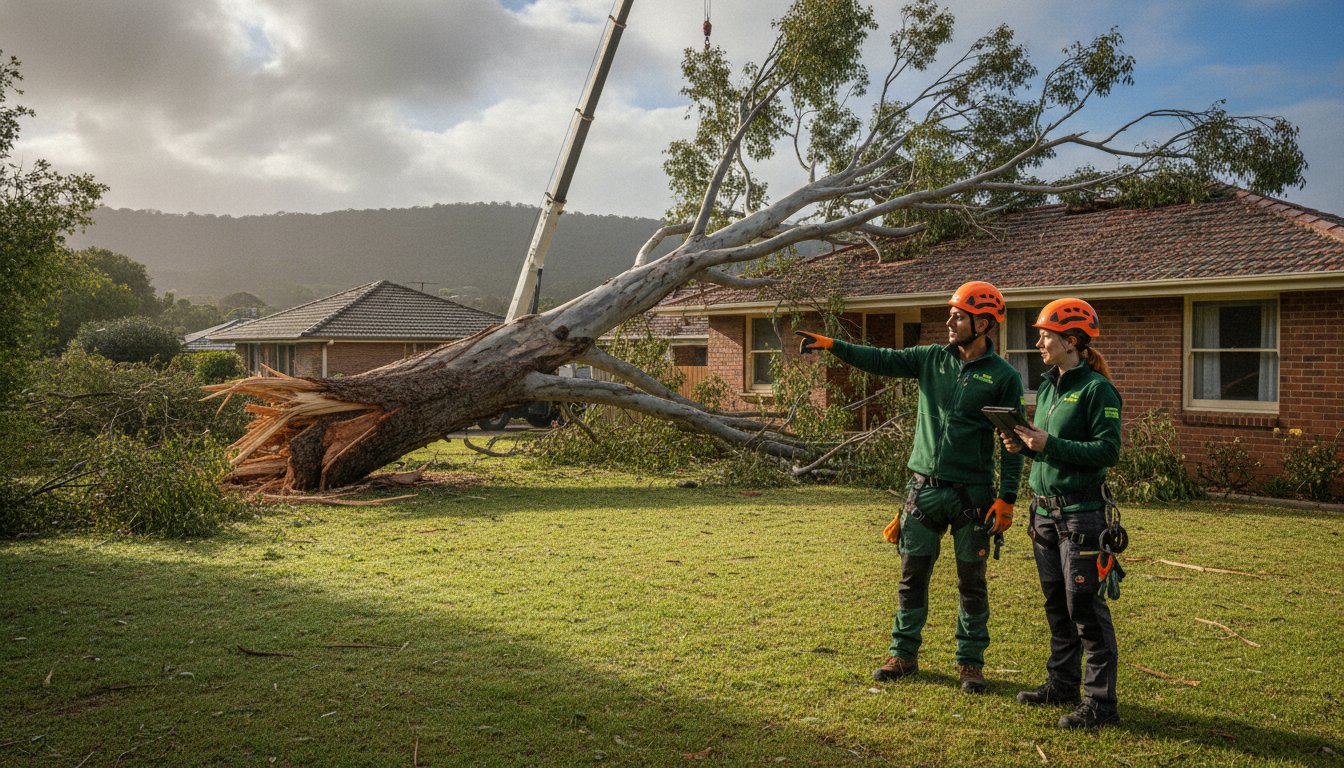
Imagine waking up to the sound of structural timber splintering under the weight of a massive gum tree. With the NSW SES responding to over 2,100 incidents across the Illawarra and South Coast in a single January 2026 weekend, a tree fallen on house Wollongong is a high-stakes emergency that requires immediate, disciplined action. It's an incredibly stressful experience that leaves any homeowner feeling vulnerable, especially when you're worried about family safety and the complexity of insurance claims during a storm surge.
We understand the urgency of securing your property against the next downpour while complying with strict local regulations. This guide provides a professional roadmap to help you manage the crisis, ensuring you meet Wollongong City Council requirements and protect your legal interests. You'll learn the essential safety protocols to follow immediately after impact, how to navigate the 72-hour emergency permit rule, and the best way to engage a qualified arborist to restore safety to your home without risking your insurance coverage.
Key Takeaways
- Prioritise safety by evacuating the immediate area and identifying hazards like live powerlines or gas leaks before assessing property damage.
- Discover how to properly document a tree fallen on house Wollongong to meet insurance claim standards and comply with local council emergency exemptions.
- Understand the complex physics of tension and compression in fallen timber to avoid causing further structural collapse or personal injury.
- Learn to spot early warning signs like "Summer Branch Drop" and fungal growth to mitigate risks before the next Illawarra storm season arrives.
- Verify arborist credentials and local expertise to ensure high-risk removals are performed by a qualified professional with a Certificate III in Arboriculture.
Priority One: Immediate Safety Steps and Emergency Contacts
When a tree fallen on house Wollongong occurs, the initial shock can cloud your judgment. Your first action must be the immediate evacuation of all family members and pets to a safe distance from the structure. Structural damage isn't always visible from the ground; a roof that appears stable could suffer a secondary collapse as the weight of the timber shifts. Once everyone is accounted for, establish a "No-Go Zone" using physical markers or by simply instructing neighbours and onlookers to stay back. This prevents unnecessary risk from falling debris or unstable branches that may still be suspended.
Before you reach for your phone, perform a visual sweep for "live" hazards from a safe distance. Listen for the distinct hiss of escaping gas or the crackle of sparking wires. If you detect any of these, move even further away. In the Illawarra, many older suburbs have overhead utility connections that are easily severed by falling gum trees. Don't attempt to move any branches or enter the home until a professional has cleared the site of electrical and structural dangers.
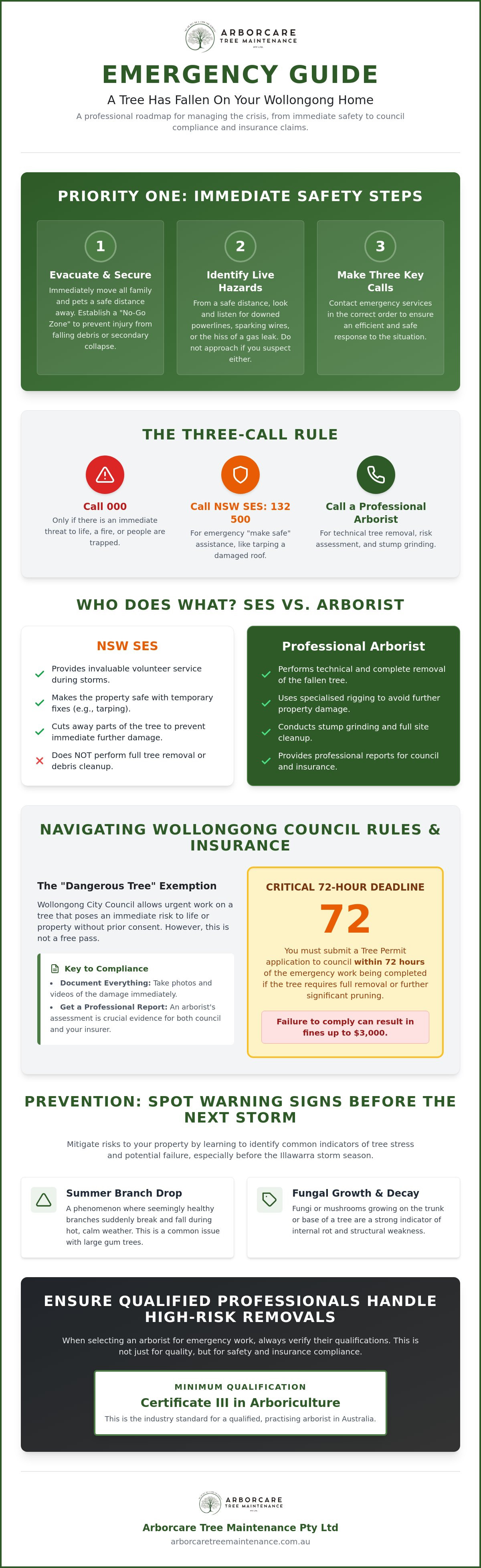
Managing the situation effectively requires following the "Three-Call Rule" to ensure the right resources arrive in the correct order:
- Call 000: Only if there's an immediate threat to life, a fire, or if someone is trapped.
- Call the NSW SES (132 500): For emergency assistance to "make safe" the property, such as tarping a damaged roof.
- Call a Professional Arborist: To organise the technical removal of the tree and conduct a full assessment of the remaining canopy.
SES vs. Professional Arborist: Who does what?
The NSW SES provides an invaluable volunteer service during storm surges, but their remit is strictly limited to temporary safety. They focus on making the site accessible and preventing further immediate damage to your home. It's common for the SES to cut away enough of the tree to secure the roof and then leave the remaining logs and debris on your lawn. A private specialist like Arborcare Tree Maintenance Pty Ltd is required for the final removal, complex rigging, and stump grinding. Understanding the underlying causes of tree damage can also help an expert determine if other trees on your Illawarra property are currently at risk of a similar failure.
Dealing with Powerlines and Endeavour Energy
Never approach a tree that's touching powerlines. The ground around the tree can become electrified through a process known as step potential, which can be fatal. In the Wollongong grid, it's vital to distinguish between "Service Lines" (the wires connecting your house to the street) and "Main Lines" (the high-voltage wires running along the road). If a tree fallen on house Wollongong has compromised any wiring, Endeavour Energy must be notified immediately. The team at Arborcare Tree Maintenance Pty Ltd coordinates directly with energy providers to ensure the site is isolated and safe before we begin our high-risk removal protocols.
Navigating Wollongong Council Rules and Insurance Claims
Dealing with the aftermath of a tree fallen on house Wollongong is stressful enough without the looming threat of council fines or insurance disputes. While Wollongong City Council maintains strict protections for the local canopy, the Wollongong Development Control Plan (DCP) 2009 provides clear pathways for emergency situations. If a tree poses an immediate risk to life or property, the "Dangerous Tree" exemption allows for urgent work to be carried out without prior written consent. However, this is not a legal free-for-all. You must be able to prove the tree was an immediate hazard, which is why documentation is your most powerful tool in the hours following the impact.
The council requires a Tree Permit application to be submitted within 72 hours of the emergency work if the tree needs to be completely removed or if further pruning is required. Failure to comply with these regulations can result in substantial penalties, with fines for illegal tree removal reaching up to $3,000 for individuals. To protect yourself, always ensure you have a professional assessment from a qualified arborist who can provide the necessary reports to justify the emergency intervention to both the council and your insurer.
The "Exempt Trees" List for the Illawarra
Not every tree in Wollongong requires a permit for removal. The council maintains a list of exempt species that can be managed without formal application, even in non-emergency scenarios. This often includes specific environmental weeds or fruit trees. For protected species, the 72-hour emergency rule is your primary legal protection. When documenting the removal, keep a record of the time, the weather conditions, and the specific structural damage caused. If you are unsure about the status of a tree on your property, you can contact the council's tree management team at their Wollongong or Dapto offices for clarification on current DCP requirements.
Insurance Documentation Checklist
Insurance companies often scrutinise tree-related claims to determine if the fall was a genuine "act of God" or the result of property neglect. Claims are frequently knocked back if the insurer finds evidence of pre-existing rot or instability that the homeowner failed to address. To secure your claim, follow this checklist:
- Comprehensive Photography: Capture wide shots of the entire tree and close-ups of the impact point on the roof or walls before any branches are moved.
- Professional Log: Record the arrival and departure times of the SES, electricity providers, and your arborist.
- Maintenance Records: Provide copies of any previous pruning or health checks performed by a licensed arborist to prove you have been proactive in your property maintenance.
- The Arborist Report: A formal post-incident report can verify that the tree's failure was caused by extreme weather rather than long-term decay.
By following these methodical steps, you create a clear evidence trail that satisfies both the local government and your insurance provider. This disciplined approach ensures that your focus remains on repairing your home rather than fighting bureaucratic or financial battles.
The Removal Process: Why Professional Arborists are Essential
Moving a tree that has come to rest on a building is a high-risk technical operation. It isn't simply a matter of starting a chainsaw; it's a precise exercise in managing stored energy. When a tree fallen on house Wollongong happens, the trunk and branches are rarely in a neutral state. They are typically under extreme tension or compression. An arborist must identify "spring poles", which are branches bent under the weight of the trunk that can snap back with lethal force the moment they are cut. This stored energy, if released incorrectly, can turn a piece of timber into a dangerous projectile.
Beyond technical skill, professional reliability is backed by comprehensive insurance. We maintain high-level Public Liability and Professional Indemnity insurance to protect your property and our staff. While Public Liability covers physical damage that might occur during the work, Professional Indemnity ensures that the technical advice and risk assessments we provide are legally sound. Using an uninsured operator puts the homeowner at significant financial risk, as most standard home insurance policies will not cover further damage caused by an unqualified contractor.
Complex Tree Removal Techniques
When a tree is embedded in a roofline, traditional felling is impossible. We utilise specialised cranes to "lift and shift" heavy sections of timber vertically, preventing them from dragging across fragile tiles or gutters. Advanced rigging systems allow us to secure unstable branches overhanging bedrooms or powerlines, lowering them to the ground with centimetre-perfect control. For those dealing with high-risk scenarios, our detailed guide on complex tree removal Illawarra explains these mechanical processes in depth.
Cleaning Up the Aftermath
Once the structural threat is removed, the focus shifts to site restoration. We use high-capacity wood chippers to process debris into mulch, which can be left on-site for your garden or removed entirely. The final stage of reclaiming your property is stump grinding, which eliminates the trip hazard and prevents the root system from interfering with future repairs or landscaping. For a complete overview of what to expect during this stage, refer to our tree removal Wollongong resource. This methodical cleanup ensures your home is safe, clear, and ready for builders to begin their work.
Prevention: Preparing Your Property for the Illawarra Storm Season
The Illawarra Shoalhaven region experienced 18 declared natural disasters between July 2018 and July 2025. Most of these events involved severe storms and flash flooding that put local homes at risk. While you cannot control the weather, you can manage the structural risks on your property. Waiting for a tree fallen on house Wollongong event is a reactive strategy that often leads to avoidable structural damage and insurance complications. A proactive approach involves identifying "Hazard Trees" before the wind picks up, ensuring your property is resilient enough to withstand the next East Coast Low.
One of the most overlooked risks in our region is "Summer Branch Drop", which is particularly common in local Eucalyptus species. This phenomenon occurs when seemingly healthy branches are shed during hot, calm weather due to internal moisture stress. It is a silent hazard that can cause significant roof damage without a single gust of wind. To mitigate this, we recommend scheduling an annual Tree Risk Assessment with a Level 5 Arborist. This formal evaluation identifies internal decay and structural weaknesses that are invisible to the untrained eye, providing a technical roadmap for necessary Pruning & Trimming or removal.
Signs of a Failing Tree
Identifying a dangerous tree begins with examining the "crotches", which are the points where branches meet the trunk. V-shaped crotches are far more likely to split than U-shaped ones because they often contain "included bark", which prevents the wood from bonding strongly. You should also look for deadwood in the upper canopy. These "widow-makers" are often the first things to fly during a storm. At the base of the tree, check for soil heaving or the presence of fungi and mushrooms. These signs indicate root rot and a compromised foundation, which are leading causes of total tree failure during heavy rain.
The Benefits of Regular Maintenance
Professional maintenance is about reducing the "wind sail" effect of a tree. By thinning the canopy, we allow high winds to blow through the branches rather than against them. This significantly reduces the leverage exerted on the root system. We also focus on removing "Co-dominant Stems", which are two main trunks of similar size that compete for space and often split the tree in half during a gale. Beyond cutting, proper mulching and watering improve the overall vitality of the tree, creating a deeper and more stable root network. If you are concerned about the stability of a large gum tree near your roofline, book a professional Tree Risk Assessment today to secure your home before the next storm hits.
Choosing a Reliable 24/7 Emergency Tree Service in the Illawarra
Local knowledge is essential when responding to a tree fallen on house Wollongong. The Illawarra’s unique topography, stretching from the escarpment at Bulli down to the coastal plains of Shellharbour, creates specific micro-climates that dictate how trees fail. Wind tunnels created by the mountains can cause sudden, localised failures in species that might otherwise seem stable. A contractor from outside the region may not understand how the geography of suburbs like Wonoona or Mount Keira affects tree lean and root stability during an East Coast Low. Choosing a local expert ensures the team understands the specific environmental pressures of your neighbourhood.
Technical credentials are the only way to verify that a contractor can handle high-risk removals safely. A Certificate III in Arboriculture is the bare minimum qualification required to operate as a professional arborist in Australia. This certification ensures the individual has been formally trained in aerial rescue, chainsaw operation, and the complex rigging techniques discussed in previous sections. Without this level of education, a worker lacks the technical foundation to manage the dangerous forces found in fallen timber. Always ask to see proof of current qualifications before allowing anyone to begin work on your home.
Severe weather often brings out "Storm Cowboys", who are unlicensed and uninsured operators looking for quick cash after a major blow. These individuals often lack the specialised equipment, such as high-capacity wood chippers or cranes, required for a safe removal. While their lower prices might seem tempting during a crisis, the risk they pose to your property and your insurance claim is immense. If an unlicensed worker causes further damage to your roof, your insurer is likely to deny the claim based on the use of unqualified contractors. Arborcare Tree Maintenance Pty Ltd supports the Dapto and wider Wollongong community by providing a transparent, fully insured service that prioritises structural integrity over speed.
Questions to Ask an Emergency Arborist
Before you sign a contract or allow work to commence, protect your interests by asking these three critical questions:
- "Are you specifically insured for work on residential structures?" Standard public liability isn't always enough; they must be covered for the high-risk nature of trees resting on buildings.
- "Do you provide a written quote and a post-work arborist report for my insurance?" You will need this documentation to justify the costs to your provider.
- "How will you protect my lawn and driveway during the removal?" Professional teams use ground protection mats to prevent heavy machinery from cracking your concrete or destroying your landscaping.
Your Local Illawarra Partners
We're committed to providing rapid response times across the entire region, from the rural properties of Jamberoo to the residential streets of Fairy Meadow. Our team understands that when a tree hits your home, you need more than just a chainsaw; you need a steady hand and expert advice to navigate the safety and legal hurdles that follow. We provide the technical authority required to secure your property and the local dedication to see the job through to a clean, safe conclusion. Contact Arborcare Tree Maintenance Pty Ltd for 24/7 emergency support to ensure your home is handled by qualified professionals who understand the Illawarra landscape.
Securing Your Home and Restoring Safety
Managing a tree fallen on house Wollongong requires a disciplined approach that balances immediate physical safety with long-term legal protection. By prioritising evacuation, documenting the site for insurance before any movement occurs, and following the local emergency permit protocols, you can navigate even the most severe storm event with confidence. The complex physics of fallen timber makes professional intervention a necessity rather than a choice to prevent further structural collapse or personal injury.
The team at Arborcare Tree Maintenance Pty Ltd brings over 10 years of local experience to every high-risk site in the Illawarra. As Licensed and Insured Level 5 Arborists, we provide the technical authority needed to manage structural impacts safely and efficiently. Our 24/7 Rapid Storm Response Team is ready to secure your property and provide the expert documentation required for your insurance claim. We focus on technical precision so you can focus on your family's recovery.
Contact Arborcare Tree Maintenance Pty Ltd for 24/7 Emergency Tree Services to restore safety to your home today. You don't have to face the aftermath of an Illawarra storm alone; we're here to provide the steady, expert hand your property needs.
Frequently Asked Questions
Is a tree fallen on a house considered an emergency in Wollongong?
A tree fallen on house Wollongong is always considered an emergency when it compromises structural integrity or blocks primary entry points. You should immediately contact the NSW SES on 132 500 for assistance in making the site safe. If there is an immediate threat to life or a fire caused by downed powerlines, call 000 without delay to ensure a rapid emergency response.
Will my home insurance cover a fallen tree removal?
Most home insurance policies cover the removal of a tree if it has caused physical damage to a covered structure like your house, fence, or garage. However, insurers often refuse claims for trees that fall in the yard without hitting a building. Claims can also be rejected if there is evidence of long-term neglect, such as obvious rot that was never addressed by a professional arborist.
Do I need Wollongong Council permission to remove a tree that has fallen on my roof?
You don't need prior written consent from Wollongong City Council to remove a tree that is an immediate hazard to your home. The Wollongong Development Control Plan allows for emergency works in these specific high-risk scenarios. You are required to submit a Tree Permit application within 72 hours of the work being completed to document the removal and avoid potential fines for illegal clearing.
What is the difference between the SES and a private arborist?
The NSW SES is a volunteer organisation that focuses on "making safe" by removing immediate hazards or tarping roofs to prevent rain damage. They are not a full-service removal company and will often leave the trunk and debris on your property once the emergency is over. A private arborist provides the technical expertise, heavy machinery, and stump grinding required to completely clear the site.
How much does emergency tree removal cost in the Illawarra?
The cost of emergency tree removal in the Illawarra depends on the size of the tree, its location on the structure, and the equipment required for a safe extraction. Factors such as the need for a crane or the complexity of the rigging will influence the final price. We provide detailed quotes that can be used for your insurance claim documentation to ensure the process remains transparent and professional.
Can I remove a fallen tree myself if I have a chainsaw?
Attempting to remove a fallen tree yourself is extremely dangerous and is not recommended. Trees resting on houses are under immense tension and compression. One wrong cut can cause the trunk to roll or the roof to collapse suddenly. Professional arborists use specialised rigging and safety gear to manage these forces, which prevents further property damage and life-threatening accidents for you and your family.
What should I do if a tree falls on my car in Wollongong?
If a tree falls on your car, your first step is to contact your comprehensive motor vehicle insurer to start the claim process. If the incident occurred on a public road, you should also notify Wollongong City Council on (02) 4227 7111. Avoid trying to drive the vehicle or move the branches yourself, as the weight of the timber could have compromised the car's structural safety or electrical systems.
How can I tell if a tree is likely to fall before the next storm?
Signs of instability include fungi growing at the base, significant leaning, or soil heaving around the root zone. You should also check for dead branches in the canopy or deep cracks in the trunk. Scheduling a professional Tree Risk Assessment is the most reliable way to identify these hazards before a storm hits. This proactive step helps prevent a tree fallen on house Wollongong event from occurring in the future.


