
A single mistake during tree removal near power lines Illawarra can lead to more than just a local blackout; it can result in a life-altering accident or a $1.1 million fine from the council. It's a high-stakes task that leaves many property owners in Wollongong and Shellharbour feeling understandably anxious. You shouldn't have to guess whether a leaning gum tree is your legal responsibility or if Endeavour Energy needs to step in before the next coastal storm hits.
We understand that navigating the overlap between utility safety zones and local tree preservation orders is often overwhelming. You want a safe property free from fire hazards, but the complex red tape makes it difficult to know where to begin. This guide will help you master the regulations and safety protocols required to protect your home while avoiding heavy penalties. We'll provide a clear breakdown of the mandatory three-metre exclusion zones, explain how to verify your eligibility for the 10/50 clearing scheme, and show you how to identify when a professional arborist is legally required to handle high-risk work near live wires.
Key Takeaways
- Identify how the Illawarra’s coastal winds and storm patterns increase the risk of electrical flashovers and line-clash fires on your property.
- Understand the legal hierarchy that allows safety-based tree removal near power lines Illawarra to override standard Council Tree Preservation Orders.
- Recognise the "No-Go Zone" boundaries and the lethal reality of step potential hazards for anyone without specialised electrical hazard training.
- Learn how professional arborists coordinate with Endeavour Energy to organise safety measures like "Tiger Tails" or temporary line de-energisation.
- Differentiate between a general tree lopper and a qualified arborist to ensure your high-risk work is fully compliant and insured.
Why Overgrown Trees Near Illawarra Power Lines Are a Major Risk
The Illawarra escarpment creates a stunning landscape, but it also produces unique weather patterns that turn overgrown vegetation into a serious safety risk. Trees are the leading cause of power outages in our region. When a branch grows within the critical clearance zone, it threatens the stability of the entire local grid. A single failure on a private property in Dapto can leave an entire neighbourhood in the dark, disrupting homes and local businesses alike.
Homeowners often underestimate their legal liability in these scenarios. If a tree on your land damages the public network, you may be held responsible for the repair costs and any resulting damages. Engaging Professional Arborist Services is the most effective way to identify these risks before they escalate. Proper maintenance ensures you meet your duty of care while avoiding the need for emergency tree removal near power lines Illawarra after a disaster has already struck.
The Threat of Electrical Flashovers and Fire
Electrical fires often start without a branch even touching a wire. High-voltage electricity is always seeking the path of least resistance to the ground. If a tree limb gets close enough, the current can "jump" the gap, especially during the humid or misty mornings common in Wollongong.
A flashover is a high-voltage arc through air or vegetation. Many property owners mistakenly believe that dry wood will not conduct electricity. This is a dangerous myth. High-voltage currents possess enough energy to overcome the natural resistance of timber, turning a branch into a literal fuse. Once an arc is established, the intense heat can ignite the foliage instantly; this leads to a fast-moving fire that threatens your home and the surrounding community.
Storm Season Readiness in Wollongong
The geography of the Illawarra adds a layer of complexity to vegetation management. The Great Dividing Range sits close to the coast here, creating wind tunnels that accelerate gusts during storm events. These consistent winds cause vibration damage, where branches repeatedly rub against power lines. This friction wears down protective coatings and weakens the structural integrity of the wires over time.
Preparing your property before the East Coast Lows arrive is a critical safety step. These intense low-pressure systems bring heavy rain and gale-force winds that test the strength of every tree near the network. Proactive tree removal near power lines Illawarra prevents the chaotic and dangerous situation of dealing with fallen timber and live wires in the middle of a storm. It's a methodical approach to property safety that prioritises prevention over reactive, high-risk repairs.
Understanding the Rules: Endeavour Energy and Council Regulations
Property owners in the Illawarra often find themselves caught between two sets of rules. On one hand, Wollongong City Council and Shellharbour Council have strict Tree Preservation Orders (TPOs) to protect the local canopy. On the other, Endeavour Energy enforces safety laws designed to prevent blackouts and fires. Understanding the hierarchy of these regulations is the first step toward a compliant and safe property.
Safety legislation generally overrides local council orders when a tree poses a direct threat to the electrical network. Under the Electricity Supply Act, Endeavour Energy has the authority to trim or remove vegetation that interferes with street mains without seeking council approval. However, the responsibility for tree removal near power lines Illawarra often falls on the homeowner when the tree affects the "service line". This is the specific wire that runs from the street pole directly to your house.
If you're unsure about your legal obligations or current clearance levels, requesting a professional site assessment can provide the clarity you need to avoid heavy fines.
Identifying Your Line Type
Not every wire on a pole carries high-voltage electricity. The distribution lines at the very top of the pole are the most dangerous; these carry high-voltage current through the neighbourhood. Below these, you'll find the low-voltage service drops that connect to individual homes. The lowest wires are usually telecommunications cables for phone and internet services.
While telecommunications lines don't carry the same voltage as power lines, they still require professional clearance. A falling branch can easily rip these cables from your home, leading to expensive repairs and connectivity losses. More importantly, during a storm, a sagging power line can touch a telecom cable. This energises the entire line and creates a lethal hazard for anyone nearby.
The Permit Shortcut: Exemptions for Safety
There are instances where the standard council application process can be bypassed. If a tree is classified as an "imminent hazard", it may be exempt from the usual permit requirements. This typically applies to trees that have already begun to fail or those with heavy branches resting directly on power lines. To qualify for this exemption, you must provide clear documentation, including photos and a report from a qualified arborist, to prove the safety risk to Wollongong or Shellharbour Council.
Navigating these exemptions requires precision. Without the right evidence, you could face penalties of up to $1.1 million for illegal clearing. For a detailed breakdown of the local application process, consult our tree removal permit Wollongong guide to ensure your work remains fully compliant with current 2026 standards.
Assessing the Hazard: Safe Approach Distances and DIY Risks
Managing trees near electrical infrastructure isn't a standard gardening task. It requires a technical understanding of how electricity behaves in an outdoor environment. Many property owners attempt to save money by handling small branches themselves, but the physical risks involved with tree removal near power lines Illawarra are often invisible until it's too late. Beyond the obvious risk of direct contact, there are environmental factors that turn a routine prune into a life-threatening situation.
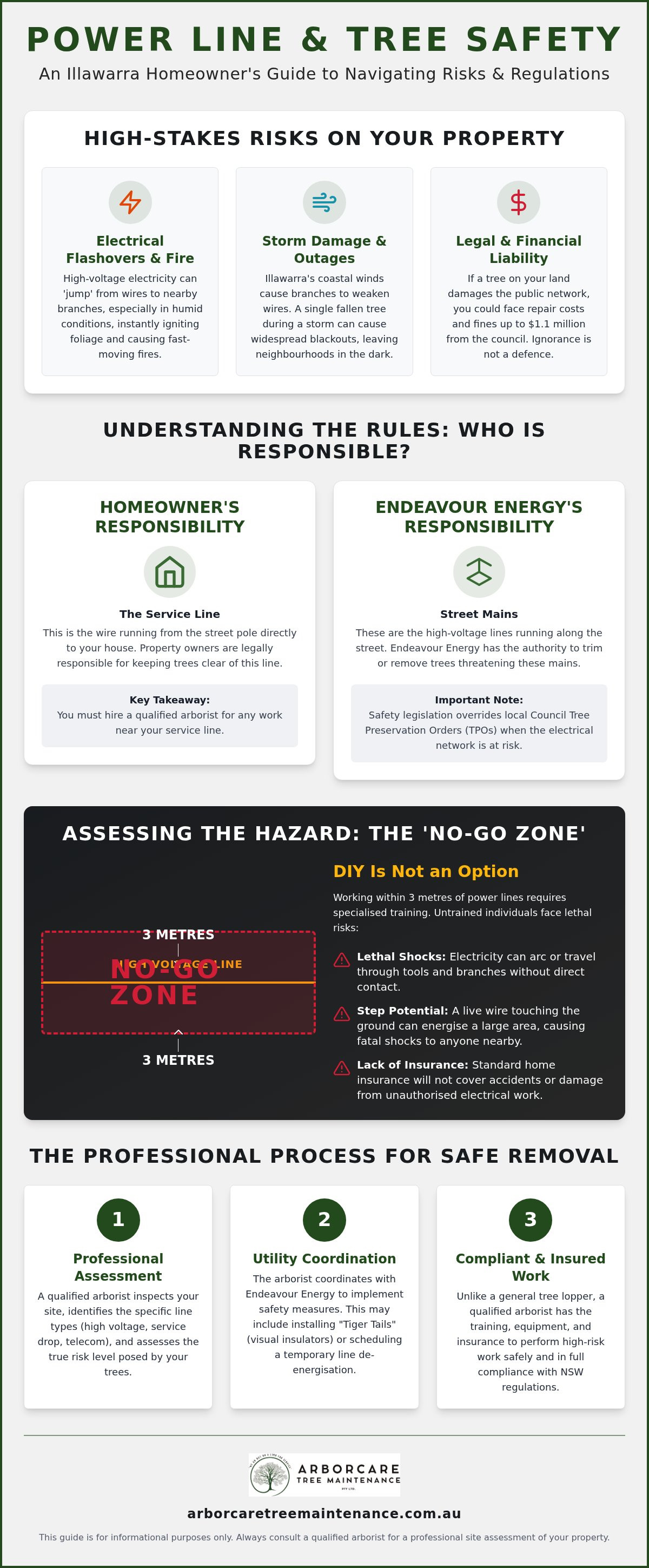
One of the most significant dangers is "step potential". When a live wire touches the ground or a tree, electricity spreads through the soil in concentric circles of decreasing voltage. If you walk toward or away from the contact point, your feet can land in two different voltage zones. This creates a circuit through your body that can be fatal. Similarly, thick canopies often hide secondary wires or "service drops" that have become entangled over years of neglect. Vine growth on poles is another hidden hazard; species like Morning Glory or Ivy can act as a conductive bridge, bringing high-voltage current down to ground level where you least expect it.
The 3-Metre Rule for Homeowners
In New South Wales, safety regulations mandate a minimum safe approach distance of three metres for any person who is not a specifically authorised worker. This "No-Go Zone" isn't just a suggestion; it's a critical buffer designed to prevent induction. Metal ladders, petrol-powered pole saws, and even damp timber can become energised just by entering the electromagnetic field surrounding a high-voltage line. Electricity can "arc" to a person even without direct contact. This means a tool doesn't even have to touch the wire to deliver a lethal shock. If your tree has grown within this three-metre radius, the law requires a specialised professional to perform the work.
Why Lopping is Not the Solution
When faced with encroaching branches, some residents resort to "lopping", which involves the indiscriminate cutting of branches to stubs. This is a dangerous practice for several reasons. Lopping causes extreme stress to the tree, triggering a survival mechanism known as "epicormic growth". These new shoots grow significantly faster than normal branches and are structurally weak. Because they grow rapidly back toward the power lines, lopping actually increases the frequency and cost of maintenance over time.
Professional pruning follows Australian Standards to ensure the tree remains healthy and grows away from the network. Attempting to lop a tree yourself with a chainsaw or long-reach tool significantly increases the chance of a branch falling onto a live wire, which can cause an immediate explosion or fire. To understand the full scope of these risks, read more about The Dangers of DIY Tree Lopping before you pick up any tools. For any tree removal near power lines Illawarra, the only safe option is to engage an expert who understands these biological and electrical complexities.
The Professional Process for Safe Tree Removal Near Live Wires
Professional tree removal near power lines Illawarra is a methodical operation that begins long before a saw is started. Every high-risk job requires a comprehensive Safe Work Method Statement (SWMS). This document identifies specific site hazards, such as uneven ground or the proximity of high-voltage street mains. By documenting these risks, our team ensures that every crew member understands the exact safety protocols for that specific property in Wollongong or Shellharbour. This structured approach is what separates a qualified arborist from a general labourer.
For trees positioned close to infrastructure, we utilise a "sectional removal" technique. Rather than felling a tree in one piece, we dismantle it limb by limb from the top down. Each branch is carefully secured with specialised rigging ropes and lowered slowly to the ground. This level of control prevents branches from swinging into live wires or crashing into your roof. It's a precise, disciplined process that mirrors the steady delivery of high-level technical work.
Specialised Tools for High-Voltage Areas
High-voltage environments demand specialised equipment that standard gardening services don't possess. We use insulated Elevated Work Platforms (EWPs) to provide a stable, non-conductive base for our arborists. These machines allow us to reach over or around wires without making physical contact with the electrical network. It is a critical safety measure that protects both our workers and your property's power supply.
Our rigging systems and climbing gear are made from non-conductive materials to prevent accidental induction. Even our pole saws are fitted with fiberglass shafts to provide an extra layer of protection. While the climber works aloft, our "Groundies" manage the drop zone below. They ensure the site remains clear and that every branch is processed safely as soon as it hits the mulching area. If you're dealing with a hazardous tree, contact our licensed arborist team to arrange a professional site inspection.
Coordinating with Utility Providers
Safety often requires direct intervention from the utility provider. We coordinate with Endeavour Energy to install "Tiger Tails" when necessary. These bright yellow and black pipes are visual markers that provide temporary mechanical protection for the wires. They don't make the lines safe to touch, but they significantly reduce the risk of accidental contact during the work. They are a standard requirement for many complex removals across the Illawarra.
In extreme cases, we may organise a temporary power disconnection or "line de-energisation". This ensures the site is completely safe for the most complex tree removals where clearance distances are impossible to maintain. Arborcare manages the entire liaison process with local authorities and Endeavour Energy. We handle the paperwork and scheduling, taking the administrative burden off your shoulders while ensuring the job is done by the book.
Why Local Expertise Matters: Professional Arborist Services in the Illawarra
High-risk work like tree removal near power lines Illawarra requires more than just a chainsaw and a ladder. It demands a deep understanding of the local environment and the specific safety requirements of the NSW electrical grid. Arborcare Tree Maintenance has a long history of serving the Dapto, Wollongong, and Shellharbour communities. We've built our reputation on professional reliability and a safety-conscious mindset, ensuring that every job is completed without compromising the local network or your property's safety.
Hiring a general "tree lopper" for work near live wires is a significant gamble. A licensed arborist undergoes rigorous formal education to understand tree biology, structural integrity, and electrical hazard awareness. We maintain the specialised insurance and certifications required to operate near high-voltage infrastructure. This provides you with peace of mind, knowing that if an unforeseen event occurs, your property and finances are fully protected by a legitimate, safety-first operation.
Dapto-Based Rapid Response
Being based in Dapto allows us to provide a rapid response when conditions deteriorate across the region. The Illawarra is home to specific species like heavy-limbed Eucalypts and tall Palms that react differently to our unique coastal winds and soil types. We understand how these trees fail and where the specific risks lie during a storm. If a weather event leaves a branch hanging precariously over your service line, our 24/7 Emergency Tree Service Illawarra is ready to stabilise the situation quickly and safely.
A Complete Property Solution
Our service provides a comprehensive resolution for your land. We often combine high-risk tree removal with professional stump grinding to ensure your property is completely clear and safe. This approach removes the tripping hazard and prevents future regrowth that could eventually interfere with the power lines again. It's a methodical way to manage your property's long-term health and safety.
We believe in leaving a site better than we found it. We process the timber and foliage into high-quality mulch, which can be returned to your garden to improve soil health. This recycling process is part of our commitment to sustainable land management in the Illawarra. Establishing a proactive maintenance schedule with a qualified expert is the most effective way to prevent future hazards. It turns a potential electrical emergency into a manageable property maintenance task, keeping your home safe and your garden thriving.
Secure Your Property Against Electrical Hazards
Managing the intersection of council permits and utility safety is a complex task that requires professional intervention. By understanding your responsibilities for the service line and respecting the mandatory three-metre exclusion zone, you protect your home from fire and electrical failure. Professional tree removal near power lines Illawarra isn't just about clearing branches; it's about maintaining the integrity of the local grid and ensuring your property remains a safe environment for your family.
Don't leave your safety to chance during the next coastal storm. Our team consists of licensed Illawarra arborists who are fully insured for high-risk work. We provide 24/7 emergency response across Dapto, Wollongong, and Shellharbour to handle storm-damaged trees before they cause a blackout. Request a Safety Assessment from Arborcare Tree Maintenance today to resolve your property's hazards with technical expertise and local reliability. Taking these proactive steps now ensures you avoid heavy fines and keep your neighbourhood powered and protected.
Frequently Asked Questions
Who is responsible for trees touching power lines in Wollongong?
Responsibility depends on the specific type of electrical line involved. Property owners are legally responsible for maintaining vegetation around the service line, which is the wire connecting your home to the street pole. Endeavour Energy typically manages the main distribution lines on the nature strip. If a tree on your private property interferes with the main network, you may be issued a notice to clear the hazard at your own expense.
Can I trim a tree near a power line myself if I use a wooden ladder?
No, you should never attempt DIY pruning within three metres of any power line. While wood is less conductive than metal, a wooden ladder can still conduct high-voltage electricity, especially if it is damp or contains metal fasteners. Electricity can arc across a gap to your tools or body without direct contact. Only authorised professionals with specialised electrical hazard training are permitted to work within these dangerous exclusion zones.
What are "Tiger Tails" and do I need them for tree removal?
Tiger Tails are yellow and black striped pipes clipped onto power lines to provide a visual warning for workers and temporary mechanical protection. They do not insulate the wire for safe contact. You may need them if your tree removal work occurs close to the network. We coordinate with Endeavour Energy to have these installed before commencing high-risk tasks to ensure maximum visibility and safety for everyone on-site.
How close can a tree be to a power line before it must be removed?
Safety regulations in NSW mandate a three-metre exclusion zone around power lines for non-qualified persons. If any part of your tree is within this distance, or if the tree's structural health suggests it could fall into this zone, it requires professional intervention. Maintaining this buffer is critical for preventing fires and outages. For complex tree removal near power lines Illawarra, we assess the growth rate of specific species to ensure long-term clearance.
Does Endeavour Energy cut trees on private property for free?
Endeavour Energy generally only manages vegetation that interferes with the main street distribution lines to ensure grid reliability. They don't typically provide free trimming for trees affecting the private service line that runs directly to your house. In these cases, the property owner must engage a private, authorised arborist to perform the work. If Endeavour Energy identifies a hazard on your property, they may issue a notice requiring professional clearing.
What happens if a tree on my property knocks down a power line during a storm?
If a tree falls on a line, stay at least eight metres away and call emergency services immediately. You face significant legal and financial liabilities if a tree you neglected damages the public network. Beyond the risk of fire, fallen wires create a "step potential" hazard where the ground itself becomes energised. Our 24/7 emergency team provides rapid response across Wollongong to stabilise these dangerous situations and prevent further property damage.
Do I need a council permit to remove a tree that is touching a power line?
Safety legislation often overrides local Council Tree Preservation Orders when a tree is an imminent hazard to the network. However, you still need to document the risk. Wollongong and Shellharbour Councils usually require an arborist's report or photographic evidence to prove the tree was a genuine threat before exempting you from standard permit requirements. We handle the liaison with local authorities to ensure your removal is legally compliant and documented correctly.
How much does it cost to remove a tree near power lines in the Illawarra?
The cost of tree removal near power lines Illawarra varies significantly based on the tree's size, its proximity to live wires, and the specialised equipment required, such as insulated cherry pickers. High-risk jobs often involve additional coordination with utility providers for line covers or de-energisation. Because every site in the Illawarra has unique access challenges and safety requirements, we provide detailed on-site assessments to give you an accurate and transparent quote.


