
Removing dead timber from your canopy is structural risk prevention, not cosmetic gardening. When brittle, decaying limbs hang above your roof, car, or outdoor living space, unpredictable coastal winds can turn unmaintained branches into an immediate hazard. Securing qualified dead wooding services Illawarra homeowners trust is the safest way to eliminate overhead threats before severe weather hits the South Coast.
If you feel uneasy every time a storm rolls past the escarpment, or confused by the divide between destructive tree lopping and compliant pruning under Australian Standards, you're not alone. Sorting through contractor insurance checks alongside Wollongong and Shellharbour council regulations often feels overwhelming for property owners who simply want their families safe.
This guide cuts through the uncertainty to show you how professional dead wooding protects your property, preserves canopy health, and maintains strict council compliance. We'll walk through arborist qualification checks, safe rigging methodologies, and local preservation rules so you can make informed, safety-first decisions for your home.
Key Takeaways
- Engaging professional dead wooding services Illawarra wide eliminates high-risk overhead timber without destabilising your tree's natural structure or canopy health.
- Verifying compliance with Australian Standard AS 4373-2007 and insisting on minimum AQF Level 3 qualifications ensures safe, precise cuts rather than harmful tree lopping.
- Spotting early indicators such as hollow limbs, fungal conks, and suspended "widow-makers" allows you to resolve hazardous branch failure before coastal storm fronts arrive.
- Understanding specific tree preservation exemptions across Wollongong, Shellharbour, and Kiama councils protects you against costly fines and compliance delays.
- Assessing site accessibility, elevated work requirements, and contractor insurance coverage gives you complete peace of mind throughout the canopy maintenance process.
Understanding Dead Wooding: Essential Canopy Safety for Illawarra Homes
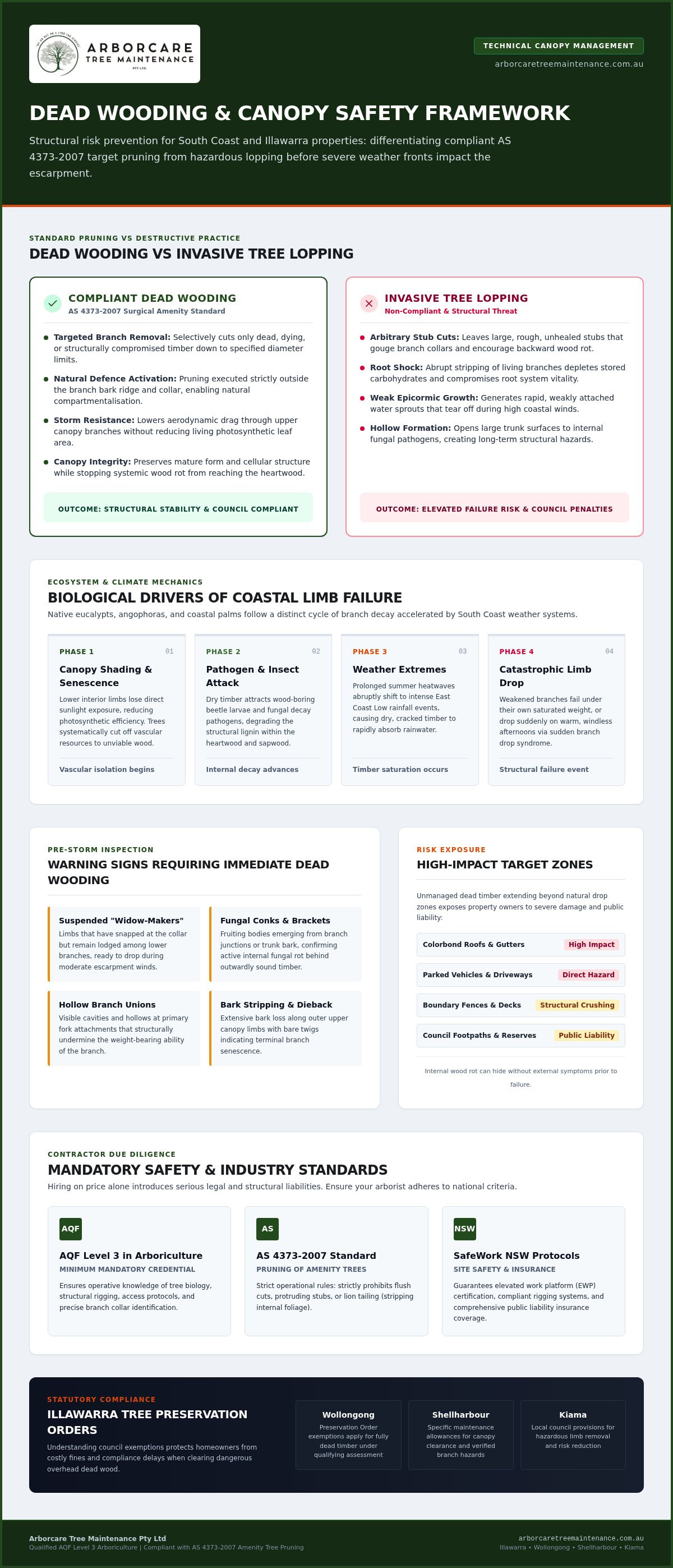
Dead wooding is the surgical removal of dead, dying, or diseased branches from within a mature canopy. Unlike arbitrary garden trimming or odd jobs advertised on community boards, true dead wooding protects structural integrity while leaving healthy living foliage completely untouched. In our coastal climate, engaging professional dead wooding services Illawarra homeowners rely on prevents decaying timber from falling during sudden coastal weather events. Regular canopy hygiene also integrates directly with a proactive emergency tree service Illawarra risk framework, eliminating overhead hazards long before severe weather damages your property.
The Biological Reasons Trees Shed Timber
As native eucalypts, angophoras, and coastal palms mature across the South Coast, lower interior limbs receive less sunlight. Shaded branches lose the capacity to photosynthesise efficiently, triggering natural branch senescence where the tree cuts off vascular resources. Dry timber then attracts wood-boring beetle larvae and fungal decay pathogens. This process accelerates rapidly when prolonged summer heatwaves abruptly give way to intense East Coast Low rain patterns, causing weakened limbs to fail under their own saturated weight.
Property and Personal Safety Hazards
Brittle overhead branches pose continuous structural threats to outdoor living spaces, boundary fences, colorbond roofs, and parked vehicles. When heavy limbs extend beyond property lines, unmanaged dead timber exposes owners to severe public liability issues across council footpaths and neighbouring driveways. More dangerously, internal wood rot frequently hides inside the branch union, leaving zero external clues until sudden branch drop syndrome causes unexpected limb failure on calm, windless afternoons.
Dead Wooding vs Invasive Tree Lopping
Indiscriminate tree lopping inflicts severe damage on amenity trees by leaving large, jagged stubs that cannot heal. This reckless cutting shocks the root system and triggers clusters of weak, rapid epicormic shoots that tear away easily in high winds. Professional arborists use clean target pruning cuts right outside the branch bark ridge and collar. This approach respects the tree's natural defense zones, prevents hollow formation, and ensures long-term canopy health without introducing systemic trunk decay.
- Targeted removal: Takes out only dead or structurally compromised wood down to specified diameter thresholds.
- Natural defence activation: Preserves branch collars so the tree can compartmentalise natural wound tissue safely.
- Storm resistance: Reduces aerodynamic drag through the upper canopy without compromising total leaf area.
Key Buying Criteria: How to Evaluate Illawarra Dead Wooding Providers
Hiring an unvetted contractor on price alone introduces serious legal and structural liabilities. When engaging professional dead wooding services Illawarra property owners must demand proof of formal qualifications and stringent safety compliance. The benchmark credentials you should verify are an Australian Qualifications Framework (AQF) Level 3 in Arboriculture alongside strict operational alignment with the rigorous safety standards expected for tree removal Wollongong projects.
Mandatory Industry Standards: AS 4373-2007
Australian Standard AS 4373-2007 (Pruning of Amenity Trees) dictates how cuts must be executed to safeguard tree health. Reputable arborists never perform flush cuts that gouge the branch collar, nor do they leave protruding stubs that rot backward into the heartwood. They also avoid lion tailing, which strips inner foliage and leaves branches vulnerable to snapping. Qualified teams document precise branch attachment angles and branch diameters before pruning, guaranteeing compliance with local tree management controls.
Essential Insurances and SafeWork NSW Protocols
Engaging uninsured tree workers puts you at direct risk of vicarious liability if an accident occurs on your boundary. A reputable provider must carry between $10M and $20M in public liability insurance, paired with current SafeWork NSW workers compensation cover. For high-risk operations near service drops, private power poles, or escarpment edges, crews must operate under documented safe work method statements (SWMS) to isolate hazards before climbing begins.
Equipment Standards for Tight Illawarra Blocks
Suburban blocks across Dapto, Wonoona, and Fairy Meadow often present tight boundaries, sloped terrain, and limited side clearance. Removing heavy timber safely under these conditions requires specialized lowering gear, friction bollards, and dynamic rigging ropes to guide branches down without impacting fences or garden beds. Elevated work platforms (EWPs) or harness-based aerial rope access techniques allow climbers to reach dangerous upper canopies, while industrial track-chippers convert fallen debris into clean mulch on site.
Before authorising aerial canopy works, always review contractor credentials or book an on-site evaluation with an experienced team like Arborcare Tree Maintenance to verify site safety protocols and council alignment firsthand.
- AQF Level 3 Arborist: Confirms formal technical training in tree anatomy, pest pathology, and aerial pruning techniques.
- Comprehensive Insurance: Ensures complete protection against damage to homes, neighbouring boundary fences, and underground services.
- Calibrated Lowering Systems: Prevents ground-impact damage above paved alfresco areas, retaining walls, and glass balustrades.
Warning Signs Your Illawarra Trees Require Immediate Dead Wooding
Catching canopy deterioration early prevents minor branch defects from turning into dangerous failures. While severe structural issues often demand full removals, timely canopy inspections help homeowners identify failing limbs well before severe storms hit the coast. Engaging experienced dead wooding services Illawarra wide ensures these visual indicators are diagnosed and treated in full alignment with Arboriculture Australia standards.
Visual Indicators in Native Escarpment Eucalypts
Native species like blackbutt and spotted gum frequently display crown dieback when stressed. Inspect upper scaffold limbs for sections devoid of foliage where bark peels away without exposing a green cambium layer beneath. Brackets, conks, and fungal mushrooms sprouting from branch unions indicate advanced internal white or brown rot. Hollowed branch bases housing active carpenter ant or termite colonies represent structurally compromised wood that cannot support dynamic wind loads.
Post-Storm Canopy Damage Across Coastal Suburbs
Sudden coastal storms across Shellharbour and Wollongong regularly produce "widow-makers". These are broken branches that snap cleanly at the collar yet remain caught in lower foliage directly above high-traffic areas. Coastal salt spray also settles into fresh branch tears, fast-tracking internal decay on limbs hanging near power lines. When extensive fractures destabilise major limb frameworks, safe extraction follows the disciplined methodologies established for complex tree removal Illawarra sites require.
Decaying Fronds on Illawarra Palm Varieties
Mature Bangalow and exotic Cocos palms common throughout residential gardens pose distinct hazards. As lower fronds die off, they form dense fibrous skirts that trap moisture, mould, and vermin against the trunk. Dry fronds and heavy seed pods weigh several kilograms; when high winds dislodge them, they drop like heavy projectiles onto glass pool fences, outdoor furniture, and pedestrian pathways.
- Suspended limbs: Snapped branches lodged invisibly within dense canopy foliage.
- Fungal fruiting bodies: Bracket fungi growing at branch collars signaling severe internal wood rot.
- Bark sloughing: Dry, bare timber sections with no active vegetative bud development.
- Dense palm skirting: Heavy rings of decaying fronds resting directly over boundary fences or decks.
Council Regulations and Tree Preservation Orders in the Illawarra
Understanding local council tree management controls protects homeowners from substantial statutory penalties under New South Wales environmental legislation. While councils enforce strict Tree Preservation Orders to preserve local canopy cover, genuine dead wood removal operates under specific exemptions. Securing compliant dead wooding services Illawarra residents rely on ensures your pruning is legally sound, properly documented, and structurally safe.
Wollongong City Council Pruning Rules
Under the Wollongong City Council Development Control Plan (DCP), cutting live branches on protected trees requires a formal application if work exceeds standard maintenance thresholds. Removing completely dead timber is classified as exempt development. Council officers require clear evidence to justify non-permitted pruning. Taking clear, date-stamped photographs of the desiccated, defoliated branches before your arborist begins work provides definitive proof of safety compliance.
Shellharbour and Kiama Council Regulations
Shellharbour City Council and Kiama Municipal Council also allow dead branch removal without requiring a formal Vegetation Removal Application. Special restrictions apply within heritage conservation areas and environmentally sensitive zones across Jamberoo and coastal reserves. In these locations, standard exemptions may be suspended. Arborists must verify property zoning beforehand to confirm whether pre-work notification is mandatory.
Environmental Protection and Habitat Considerations
Dead wood frequently serves as critical nesting infrastructure. Large, decaying branches often develop hollows that house native microbats, hollow-nesting parrots, and small marsupials. Under the NSW Biodiversity Conservation Act 2016, knowingly harming native wildlife or destroying breeding sites carries severe legal consequences. A qualified arborist examines hollows prior to cutting. When a hollow contains active wildlife, crews can shorten the limb to a safe, stable habitat stub, mitigating fall hazards while preserving natural nesting chambers.
To ensure your property maintenance remains fully compliant with municipal preservation orders, schedule a professional canopy assessment with our licensed local team.
- Exempt work verification: Pruning dead branches requires no application provided living bark and collars remain undamaged.
- Documentary evidence: Maintain date-stamped photos showing canopy dieback before work starts.
- Biodiversity safeguards: Active hollows must be protected to prevent statutory breaches under state conservation acts.
What to Expect: The Professional Dead Wooding Process and Pricing Factors
Engaging professional dead wooding services Illawarra homeowners rely on involves a structured, safety-driven workflow. Unlike casual odd-job operations that drop heavy limbs haphazardly, certified arborists manage every cut through controlled rigging systems. This methodical approach ensures your surrounding structures, landscaping, and underground utilities remain completely protected from start to finish.
The Step-by-Step On-Site Service Workflow
Operations begin with an exhaustive pre-work hazard audit on the ground. The crew identifies drop zones, sets exclusion perimeters, and marks underground utilities. Aerial climbers or access platform operators then ascend into the canopy, isolating each dead branch. Riggers secure limbs using friction brakes and lowering ropes, gently lowering heavy timber to ground crews rather than allowing uncontrolled free-falls. Once cutting concludes, teams process branches through commercial wood chippers, rake lawn areas thoroughly, and sweep down hard surfaces.
Factors That Determine Your Investment
Several distinct physical variables govern the scope and pricing of canopy maintenance across South Coast properties:
- Canopy height and spread: Towering eucalypts or spread-out turpentines require complex rope systems or specialized machinery to access high scaffold limbs.
- Ground obstacles: Glass pool surrounds, retaining walls, colorbond fencing, and pergola roofs require delicate multi-point rigging that takes additional operational time.
- Site accessibility: Sloped blocks along the escarpment with narrow side paths prevent direct machinery access, requiring manual timber transfer to street-level processing units.
- Service wire proximity: Working within statutory approach distances of service drops demands specialized insulated tools and documented isolation plans.
Choosing Arborcare for Reliable Illawarra Tree Care
Arborcare Tree Maintenance operates directly out of Dapto, providing dependable, safety-first canopy care from northern Wollongong down through Shellharbour. Our insured crews combine technical rigor under AS 4373-2007 with modern rigging gear and elevated work platforms, handling challenging canopy defects with minimal neighborhood disruption. You receive complete clean-up on every project, with options to retain processed timber as nutrient-dense garden mulch or have it completely removed from your property.
Booking an on-site canopy assessment with our qualified arborists gives you transparent recommendations and structural clarity before dangerous storm fronts arrive.
Secure Your Illawarra Canopy Before the Next Storm
Protecting your home from hazardous overhead timber doesn't require destructive lopping or dangerous DIY efforts. By investing in professional dead wooding services Illawarra homeowners can eliminate falling limb risks, support natural canopy health, and remain fully compliant with Wollongong and Shellharbour council preservation guidelines.
Partnering with certified experts ensures your property is treated with precision and respect. Based in Dapto, Arborcare Tree Maintenance delivers safety-focused tree care across Wollongong, Shellharbour, and the wider region. Our AQF-qualified arborists operate strictly under Australian Standard AS 4373-2007, backed by full public liability insurance coverage and rigorous property protection protocols on every site.
Don't wait for unpredictable coastal squalls to expose structural weaknesses in your trees. Book your expert Illawarra tree inspection with Arborcare Tree Maintenance today and enjoy complete peace of mind through every season.
Frequently Asked Questions
What is dead wooding and how does it differ from ordinary tree pruning?
Dead wooding targets only dead, dying, or diseased limbs without touching healthy living foliage. Ordinary tree pruning often involves canopy thinning, selective shaping, or crown lifting of viable green growth to improve light penetration or clearance. By engaging specialised dead wooding services Illawarra residents ensure decayed wood is cleanly extracted right outside the branch collar, allowing the tree to seal naturally without stimulating weak epicormic growth.
Do I need council approval to remove dead branches in Wollongong or Shellharbour?
In most residential zones across Wollongong and Shellharbour, council approval is not required to remove genuinely dead branches. Both councils classify this maintenance as exempt development, provided healthy bark and structural branch collars remain undamaged. Homeowners should take clear, date-stamped photographs before work begins as proof of the hazard. If your property sits in a designated heritage or environmentally sensitive conservation overlay, check your local planning controls first.
How often should mature trees in the Illawarra undergo professional dead wooding?
Mature native trees across the Illawarra typically benefit from a professional canopy inspection and dead wooding every two to three years. Coastal conditions, salt spray, and fierce westerly winds can speed up branch dieback on species like blackbutt and spotted gum. Conducting canopy audits in autumn or late spring helps detect brittle wood early, ensuring dangerous branches don't fail during intense winter storm squalls or humid summer downpours.
Can dead wooding save a sick or dying tree on my property?
Dead wooding improves overall canopy vitality by removing pathways for wood-boring pests and fungal pathogens, but it won't reverse systemic root disease or extensive trunk rot. Removing rotting timber allows the tree to focus its energy on healthy foliage while lowering wind resistance during coastal storms. If an arborist discovers internal structural decay throughout the main trunk, complex tree removal might be the only safe long-term solution.
What should be included in a professional dead wooding written quote?
A transparent quote should outline the exact scope of works, identifying target trees and minimum branch diameters slated for removal. It must confirm compliance with Australian Standard AS 4373-2007 and verify minimum AQF Level 3 arborist supervision. Ensure the document details comprehensive public liability insurance, SafeWork NSW risk assessments, and complete site clean-up procedures, including on-site chipping, debris removal, or whether wood mulch will be left behind for garden beds.
Can an arborist prune dead branches that overhang from my neighbour’s yard?
Under NSW common law, property owners can prune overhanging branches back to the boundary line, provided the cuts don't compromise the overall health or stability of the neighbour's tree. Communicating with your neighbour before booking work is always best practice. Qualified arborists can inspect the canopy from your property boundary, execute clean target cuts under AS 4373-2007, and return or process the off-cuts in accordance with local neighbourhood agreements.
What happens to the removed dead timber and branches after the service?
Crews process all pruned branches through heavy-duty wood chippers right on site. Homeowners can retain this freshly processed organic mulch to suppress weeds and retain soil moisture across garden beds. Alternatively, the team can haul the chipped green waste away, leaving driveways, lawns, and paths fully cleared and swept. Reputable dead wooding services Illawarra operators guarantee thorough clean-up so you don't have to manage leftover garden refuse yourself.


