
Imagine waking up at 2 am to the sound of a heavy branch snapping against your roof during a coastal gale. You're left staring into the dark, wondering if the rest of the tree will hold or if your home is about to sustain major structural damage. It's a terrifying scenario that many locals faced recently when severe weather triggered thousands of calls for help across our region. When you're standing in the rain, the last thing you want to worry about is a complex permit process or an insurance rejection. You need an emergency tree removal Illawarra specialist who can stabilise the site immediately.
We understand that your primary concern is the safety of your family and the integrity of your property. This guide provides the expert guidance you need to handle dangerous trees and secure your Illawarra home during a storm or structural emergency. We'll preview the essential steps for professional risk assessment, explain the specific emergency exemptions for Wollongong and Shellharbour councils, and show you how to document the damage to ensure your insurance claim stays on track. By following this methodical approach, you can move from a high-risk crisis to a safe, professional resolution.
Key Takeaways
- Learn the immediate safety protocols to follow if a tree fails, including establishing exclusion zones and why DIY removal is never an option for storm-damaged timber.
- Discover how to identify signs of imminent tree failure, such as ground heaving or fresh soil cracks, and when to call for professional emergency tree removal Illawarra services.
- Understand how Level 5 arborists conduct rapid risk assessments and utilise specialised equipment to stabilise your property safely under pressure.
- Navigate the complex world of council exemptions in Wollongong and Shellharbour to ensure your emergency works are compliant and your insurance documentation is airtight.
- Gain insights into proactive tree care, such as regular pruning and pre-storm season assessments, to reduce the risk of future structural emergencies.
Immediate Steps: If a Tree Falls on Your Property
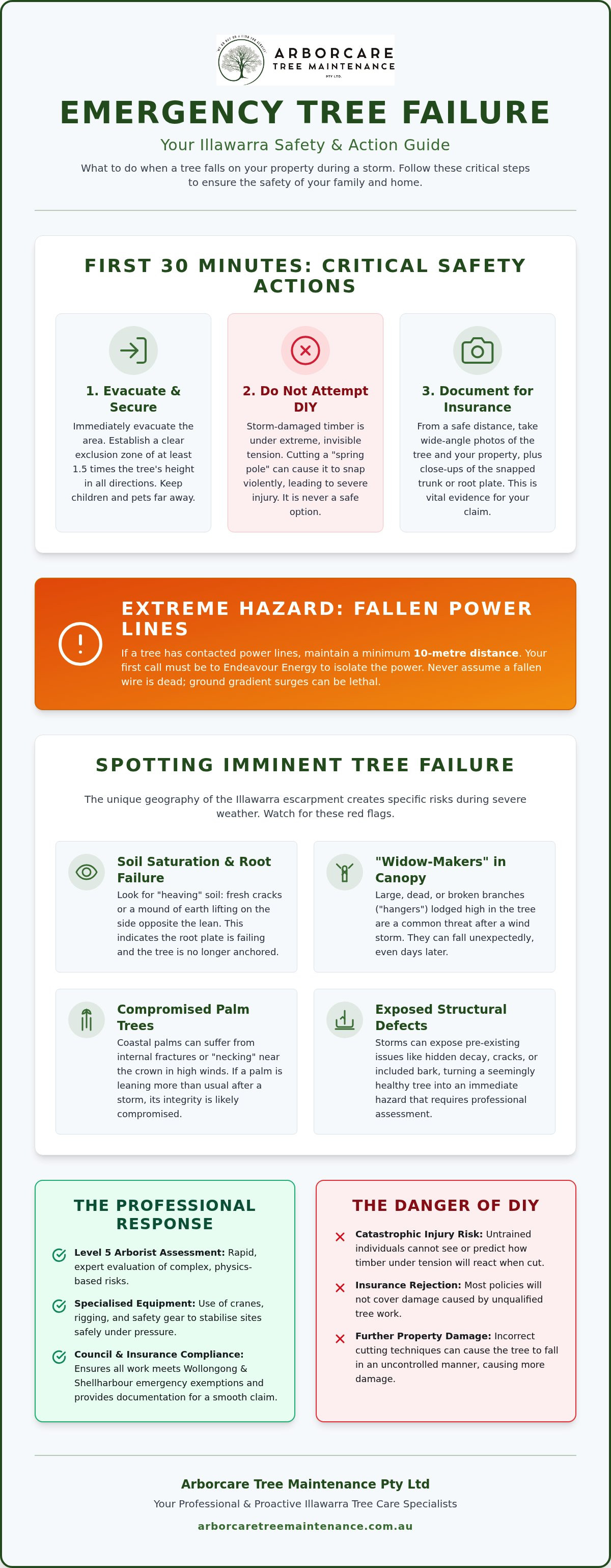
When a tree fails during a storm, the first thirty minutes are critical for life safety. You must evacuate the immediate area and establish a clear exclusion zone. Don't attempt to move debris or assess the damage closely until the site is stabilised. While it's tempting to grab a chainsaw to clear a driveway, storm-damaged timber is often under extreme tension or compression. Cutting into a "spring pole" or a log under pressure can cause it to snap violently, leading to catastrophic injury. Professional emergency tree removal Illawarra services are designed to handle these physics-based risks that are invisible to the untrained eye.
Before any cleanup begins, you need to gather evidence for your insurer. Take wide-angle photos of the tree's position relative to your home and clear close-ups of the root plate or snapped trunk. This documentation is vital for proving the tree was an immediate threat to life or property, which is often a prerequisite for a successful claim. Once you've secured these records from a safe distance, contact a local arborist for site stabilisation. They will provide the necessary technical assessment to secure the area and prevent further structural collapse.
Establishing a Safe Perimeter
Identifying "hangers" is your first priority when surveying the site. These are broken limbs suspended precariously in the upper canopy that can fall without warning, even after the wind has died down. Heavy rain often saturates our local clay soils, meaning leaning trees are far less stable than they appear. Keep children and pets well away from the root plate zone; if the root ball "heaves" or shifts, the entire tree can topple in seconds. A professional exclusion zone should extend at least 1.5 times the height of the tree in all directions.
Power Lines and Electrical Hazards
If a tree or branch has contacted power lines, you must maintain a minimum 10-metre distance. In our region, your first call should be to Endeavour Energy to isolate the power before any arborist can safely commence work. High-level tree care is grounded in the science of arboriculture, which dictates strict safety protocols for high-voltage environments. Ground gradient electrical surges occur when electricity flows into the earth from a fallen wire, creating a dangerous voltage difference between two points on the ground that can electrocute anyone walking in the vicinity. Never assume a fallen wire is "dead" just because it isn't sparking.
Identifying Emergency Hazards: When to Call for Rapid Response
The Illawarra's unique geography, where the steep escarpment meets the coastal plain, creates specific environmental pressures during extreme weather events. East Coast Lows frequently batter our region with high-velocity winds and torrential rain, putting immense strain on native species. Many of our local Eucalypts and Acacias are relatively shallow-rooted. When the ground becomes a saturated slurry, these trees lose their physical anchor in the soil. Identifying these hazards early is the key to preventing property damage. If you notice a tree shifting or leaning during a storm, you likely require emergency tree removal Illawarra to prevent a total failure.
Beyond the roots, the canopy holds its own dangers. "Widow-makers", which are large, dead, or broken branches lodged high in the tree, are the most common threat following a Wollongong wind storm. These can remain balanced for days or weeks before falling unexpectedly. Similarly, our coastal palm trees may appear flexible, but high-velocity winds can cause internal fractures or "necking" near the crown. If a palm is leaning more than usual after a storm, its structural integrity is likely compromised and requires immediate inspection.
Soil Saturation and Root Failure
Illawarra's clay-heavy soils are prone to rapid saturation during flood events. This leads to root plate failure, where the entire root system lifts out of the ground. You should look for "heaving" soil, which appears as fresh cracks or a mound of earth lifting on the side opposite the tree's lean. This is a clear sign the tree is no longer safely anchored. Even seemingly healthy coastal trees can harbour hidden root decay that only becomes apparent when the soil loses its cohesion. If you suspect your trees are unstable after a heavy downpour, a professional risk assessment is the only way to ensure your property remains safe.
Structural Defects Exposed by Storms
Storms often expose structural weaknesses that were previously hidden. Co-dominant stems, where two main trunks grow from the same point in a "V" shape, are particularly vulnerable. These lack the connective wood tissue needed to withstand high-pressure wind events and are prone to splitting down the centre. Tall, isolated trees on Illawarra properties also face a higher risk of lightning strikes, which can boil internal sap and cause the trunk to explode or weaken instantly. Internal rot often remains invisible until the increased weight of rainwater or wind pressure causes a sudden, catastrophic structural collapse.
The Professional Emergency Removal Process
When our team arrives for an emergency tree removal Illawarra call-out, the process begins with a rapid yet methodical risk assessment. A Level 5 arborist evaluates the tree's structural integrity, lean, and surrounding targets under significant pressure. This isn't just about the tree; it's about the physics of the entire site. We identify potential failure points and determine the safest path of extraction. For trees leaning dangerously over homes or power lines, we typically employ a top-down dismantling method. This involves removing the tree in small, controlled sections from the canopy downwards, ensuring no heavy debris impacts the structure below.
Debris management and site safety are handled concurrently. We establish a drop zone and use ground protection mats to prevent damage to your lawn or driveway. Once the hazardous sections are removed, we process the timber and mulch the branches, leaving the site secure and tidy. This disciplined approach ensures that a high-risk situation is resolved without creating secondary damage to your property or the surrounding landscape.
Advanced Rigging and Crane Work
In tight residential blocks across Wollongong and Shellharbour, a crane is often the only safe way to perform a removal. We use specialised rigging systems, including pulleys, high-tensile ropes, and friction devices, to float heavy limbs away from your roof. This level of precision is essential for Complex Tree Removal Illawarra where traditional felling is impossible. Using a crane allows us to lift entire sections vertically, bypassing obstacles like fences, pools, or neighbouring properties that would otherwise be at risk.
Arborist Qualifications: Why Cert V Matters
There's a significant difference between a tree lopper and a qualified AQF Level 5 arborist. While a lopper might own a chainsaw, they often lack the formal education in tree biology and structural mechanics required for high-risk emergency work. Insurance companies frequently demand reports from Level 5 specialists because our assessments are legally defensible and scientifically grounded. At Arborcare, we adhere strictly to the Australian Standards for the Pruning of Amenity Trees (AS4373-2007). This commitment ensures that every cut is made to promote safety while following the highest industry protocols.
Navigating Insurance and Council Requirements in NSW
Managing the legalities of a fallen or failing tree can be just as stressful as the physical hazard itself. In the Illawarra, homeowners often feel caught between the need for urgent action and the fear of breaching local tree preservation orders. However, Wollongong and Shellharbour City Councils provide specific "Emergency Works" exemptions within their Development Control Plans (DCPs). These clauses allow for emergency tree removal Illawarra without a prior permit if the tree poses an immediate threat to life or property. To utilise this exemption, you must provide clear evidence that the situation was a genuine emergency, which is why professional documentation is non-negotiable.
Proving an immediate threat requires more than just a verbal claim. You need a comprehensive trail of evidence, including high-quality photographs and a detailed report from a qualified arborist. This documentation serves two purposes: it protects you from council fines and forms the backbone of your insurance claim. While most insurers will cover the cost of removal if a tree has caused structural damage to a building, they are often more reluctant to pay for preventative removals unless a Level 5 arborist can prove the tree was in a state of imminent failure. Liaising with your insurer early is essential to determine if they will cover the removal costs or only the repairs to the damaged structures.
Council Permits and Emergencies
While standard removals in Wollongong typically require a permit for trees over five metres in height or 30cm in diameter, emergencies bypass the usual 14-day waiting period. It is important to check your property's Section 149 Planning Certificate to see if specific Tree Preservation Orders or heritage overlays apply, as these can influence how the council views emergency interventions. For a deeper dive into the standard regulations, our Tree Removal Wollongong Guide outlines the permit process for non-emergency scenarios. Even in a crisis, the council expects you to act reasonably and retain evidence that the tree was hazardous.
Insurance Claim Documentation
Your arborist must provide a report that specifies the species, the nature of the structural defect, and the immediate risks the tree posed to your home. Insurance claims are frequently denied if the insurer determines the tree fell due to long-term neglect rather than a specific storm event. A homeowner's duty of care involves taking reasonable steps to identify and mitigate known hazards on their property before they cause injury or damage. By engaging a specialist for an insurance-compliant assessment, you significantly increase your chances of a successful claim. Contact our emergency team for a professional assessment and insurance-compliant report to ensure your property and finances are protected.
Preventing the Next Emergency: Proactive Tree Care
Prevention is the most effective way to avoid the stress and cost of emergency tree removal Illawarra homeowners often face after a severe East Coast Low. While we cannot control the weather, we can control the structural resilience of the trees on our property. Most storm-related failures occur in trees that already possessed underlying defects, such as internal decay or poor branch attachments. By identifying these issues early, you can often save the tree through targeted maintenance or remove it under controlled conditions before the next gale arrives.
Regular pruning and hedging are not merely aesthetic choices; they are critical safety measures. Thinning a dense canopy reduces the "wind sail" effect, allowing high-velocity winds to pass through the branches rather than pushing the entire tree over. Managing tall palms is equally vital in our coastal environment. Removing dead fronds before they become airborne projectiles protects your roof and windows during a storm. Partnering with Arborcare for long-term maintenance ensures that your property remains a safe environment for your family and neighbours year-round.
The Tree Risk Assessment Programme
A professional tree risk assessment is a methodical examination of a tree's health, structure, and surroundings. Our Level 5 arborists look for subtle signs of distress that a general gardener might miss, such as fungal fruiting bodies at the base or fine cracks in the trunk. We aim to identify potential "hazard trees" well before the Illawarra storm season hits, providing you with a clear plan for mitigation. If our assessment finds a tree is beyond saving, we can organise a scheduled removal, which is always safer and more cost-effective than a 24/7 Emergency Tree Service Illawarra call-out during a crisis.
Stump Grinding and Land Clearing for Safety
Leaving a stump behind after an emergency removal creates new risks for your property. Stumps can become tripping hazards, attract termites, or even sprout unstable regrowth that is prone to snapping. Professional Stump Grinding Wollongong services remove these obstacles completely, allowing you to replant or landscape safely. Furthermore, strategic land clearing can create a "defendable space" around your home. This reduces the risk of falling limbs impacting your house and provides better access for emergency services if needed. Contact Arborcare for a professional risk assessment today to secure your property against future weather events.
Securing Your Property Against the Next Storm
Dealing with a hazardous tree requires a balance of immediate action and technical precision. You now understand that establishing a safe perimeter and documenting the scene are the first steps to protecting both your family and your insurance claim. Whether you are navigating council exemptions in Wollongong or identifying the signs of root failure after a heavy flood, professional intervention ensures the task is completed safely and legally. These actions move your property from a state of crisis to a position of stability.
When you require emergency tree removal Illawarra, our local Dapto-based team is ready to assist. We provide a 24/7 rapid storm response backed by Level 5 certified arborists who deliver the comprehensive, insurance-compliant reports you need to move forward. As a fully insured firm, we handle the high-risk work so you don't have to face the danger alone. Don't wait for a structural failure to compromise your property's safety or your peace of mind. Take control of your landscape today by prioritising professional risk assessments and regular maintenance. Our experts are here to guide you through every stage of property protection.
Call Arborcare for 24/7 Emergency Tree Service in the Illawarra to secure your home and restore safety to your property.
Frequently Asked Questions
Is a fallen tree considered an emergency in the Illawarra?
A fallen tree is classified as an emergency if it poses an immediate risk to life, property, or essential access. In our region, this includes trees blocking driveways, resting on structural components of a home, or hanging precariously over public footpaths. While a tree fallen in a back corner of a large lot might not be urgent, any situation where structural integrity or human safety is compromised requires a rapid response from a qualified specialist.
How quickly can your emergency tree team arrive in Wollongong or Shellharbour?
We prioritise a rapid response for all urgent calls across Wollongong and Shellharbour. Being based in Dapto allows our team to navigate local roads efficiently, even during severe weather events. While we don't guarantee a specific minute-by-minute arrival time due to varying storm conditions and road closures, our local presence ensures we are among the first responders on-site to stabilise your property and mitigate further damage.
Does insurance cover the cost of emergency tree removal in NSW?
Most insurance policies in NSW cover the cost of removing a tree only if it has caused actual structural damage to your insured property, such as a house or fence. If a tree falls without hitting a building, coverage is often excluded unless it presents an immediate hazard that prevents safe access. You should always check your specific Product Disclosure Statement and ensure your arborist provides a detailed, insurance-compliant report to support your claim.
Do I need council approval to remove a tree that has fallen on my house?
You don't need prior council approval for emergency tree removal Illawarra if the tree is an immediate threat to safety or property. Wollongong and Shellharbour councils allow for "Emergency Works" exemptions under these specific conditions. However, the burden of proof rests with the homeowner. You must keep photographic evidence and obtain a professional arborist's report to justify the removal and avoid potential fines for unauthorised work.
What should I do if a tree is touching power lines after a storm?
If a tree or branch is touching power lines, you must stay at least 10 metres away and treat all wires as live. Your first action should be to contact Endeavour Energy to report the hazard and isolate the power supply. Don't attempt to clear the debris yourself or allow an arborist to start work until the electrical authority has officially declared the site safe for entry and mechanical intervention.
Can I remove a dangerous tree myself if it's on my private property?
Attempting a DIY removal of a storm-damaged or dangerous tree is extremely hazardous and is not recommended. Trees under tension or compression can react unpredictably when cut, often snapping or shifting with lethal force. Professional arborists use specialised rigging, cranes, and safety equipment to manage these complex loads. Entrusting the work to a Level 5 qualified specialist ensures the task is completed without further property damage or personal injury.
What information do I need to provide when calling for an emergency arborist?
When you call for assistance, please provide your exact location and a brief description of the tree's size and species. We need to know if the tree is touching power lines, resting on a structure, or blocking access to your home. Providing clear photos via mobile can help our team prepare the necessary equipment, such as cranes or specialised rigging, before we arrive on-site for the formal risk assessment.
Are your emergency tree services available 24/7 in Dapto and surrounding areas?
Yes, our emergency tree services are available 24 hours a day, 7 days a week, throughout Dapto, Wollongong, and the wider Illawarra region. We understand that storm damage doesn't follow a schedule, so our team remains on standby to provide rapid assistance whenever a structural emergency occurs. This round-the-clock availability ensures that residents in Fairy Meadow, Woonona, and Shellharbour have access to expert care during the most critical times.


