
Imagine waking up at 2 am to the sound of a cracking branch hanging over your roof, only to find yourself more worried about a council fine than the actual danger. It's a common fear in our region, where the complexity of emergency tree removal regulations Illawarra councils enforce can feel like a barrier to your safety. You shouldn't have to choose between a hazardous tree and a massive legal bill during a storm emergency.
We understand that when a tree becomes a threat, you need clear answers rather than bureaucratic jargon. Whether you're dealing with Wollongong's $114 permit fee or Shellharbour’s specific five-metre height thresholds, the rules are designed to manage the urban canopy, not to keep you in harm's way. This 2026 guide provides a clear path to legal removal by explaining how to use local exemptions and the 10/50 clearing code effectively. We'll outline exactly how to document your emergency and when you can act before a permit is even signed, giving you the confidence to secure your home while staying on the right side of the law.
Key Takeaways
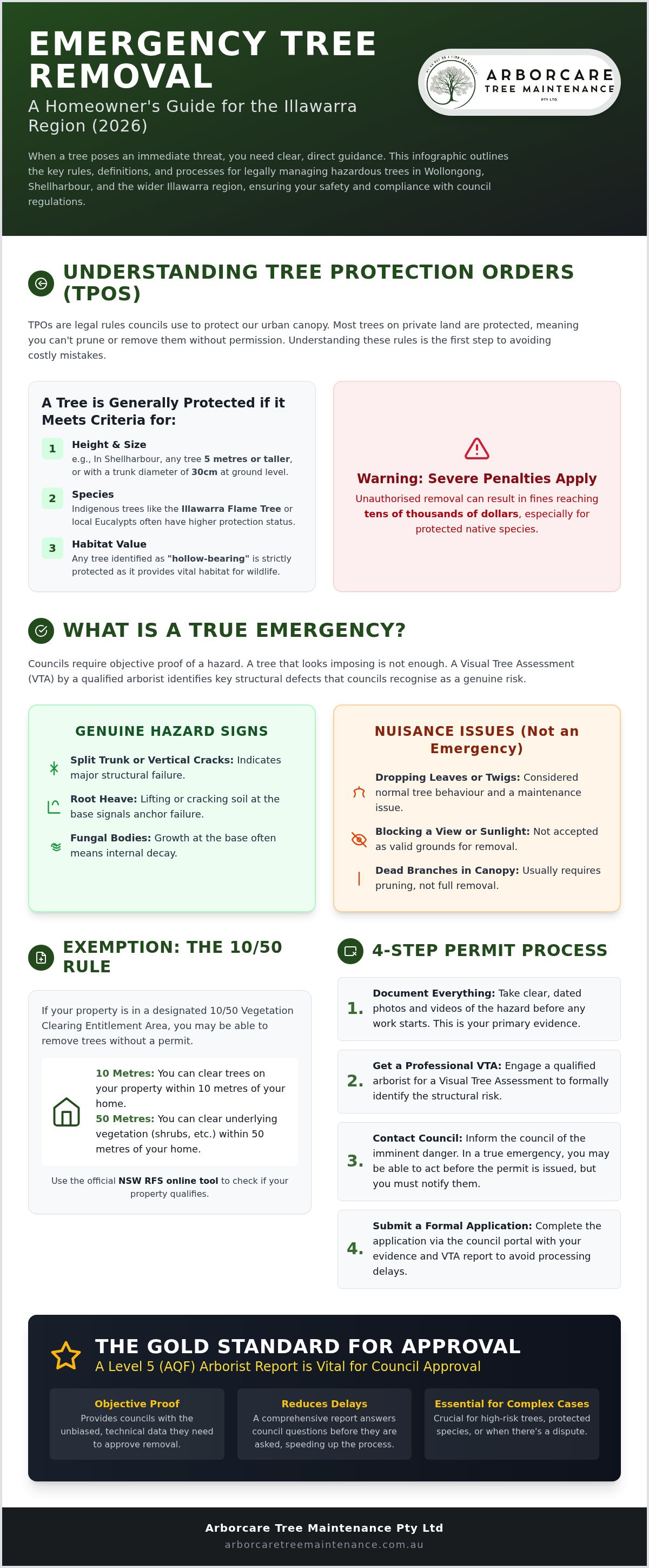
- Understand how Tree Preservation Orders (TPOs) across Wollongong and Shellharbour dictate which species and sizes require formal approval before any work begins.
- Learn how to identify a genuine hazard through a Visual Tree Assessment (VTA) to comply with emergency tree removal regulations Illawarra councils enforce during storm events.
- Discover how to use the NSW 10/50 Vegetation Clearing Code and the RFS online tool to determine if your property is exempt from standard permit requirements.
- Master the 2026 application process by gathering high-quality photographic evidence and navigating council portals to avoid processing delays.
- Understand why a Level 5 (AQF) arborist report is the gold standard for securing council approval for complex or high-risk tree removals.
Understanding Tree Protection Orders in Wollongong and the Illawarra
A Tree Preservation Order (TPO) is a legally binding mechanism used by local councils to manage and protect the region's vegetation. In New South Wales, these orders are established under the Environmental Planning and Assessment Act 1979. They ensure that any significant pruning or removal is justified and performed safely. While local councils manage the day to day permits, these regulations operate within a broader context of federal environmental laws designed to protect Australia's unique natural heritage. For homeowners, this means that most trees on private property are not "yours" to remove at will; they are considered part of the collective urban forest.
Compliance is not optional. If you proceed with work that violates the emergency tree removal regulations Illawarra councils have set for 2026, the financial consequences are severe. Unauthorised removal can result in fines reaching tens of thousands of dollars, particularly if the tree is a protected native species or part of a heritage landscape. The rules vary significantly between neighbouring areas. For instance, permit fees for one or two trees can vary across the Illawarra region; while Shellharbour has its own distinct fee structures and application portals, other local authorities will have different charges. Choosing to work with a qualified arborist, such as Arborcare Tree Maintenance Pty Ltd, ensures you don't accidentally trigger these penalties during a property emergency.
What Makes a Tree Protected?
Council protection usually triggers once a tree reaches a specific size. In Shellharbour, any tree five metres or taller, or with a trunk diameter of 30cm at ground level, requires formal consent. Other local authorities in the Illawarra region may use similar height thresholds but can differ on girth or crown spread measurements. Species origin is equally critical. Indigenous trees like the Illawarra Flame Tree or local Eucalypts often have higher protection status than exotic garden varieties. Additionally, any tree identified as "hollow-bearing" is strictly protected because it provides essential habitat for local bird and marsupial species, regardless of its height.
The Role of the Urban Canopy
The urban canopy is a vital piece of green infrastructure that keeps our suburbs cool and supports local biodiversity. Councils view your backyard as a potential corridor for native fauna, creating a "highway" for animals moving between the escarpment and the coast. This is why councils often deny removal requests for "nuisance" reasons. Dropping leaves, blocking a view, or shedding minor twigs are generally not considered valid grounds for removal under current emergency tree removal regulations Illawarra residents must follow. Approval is typically reserved for trees that are dead, dying, or represent a documented structural risk to people or permanent dwellings.
Defining a Tree Emergency: What Councils Deem Truly Hazardous
In the context of NSW tree removal rules, a "hazard" isn't simply a tree that looks imposing or drops debris. Councils require objective, technical proof before granting an exemption for immediate work. This proof is gathered through a Visual Tree Assessment (VTA), a systematic method used by qualified arborists to identify external signs of internal decay or instability. According to the Australian Standard AS4373-2007 (Pruning of Amenity Trees), a hazardous tree is defined as one with structural defects that indicate a high probability of failure, posing a risk to people or property.
When you are trying to comply with the emergency tree removal regulations Illawarra councils enforce, you must look for specific structural red flags. Vertical cracks in the trunk, "included bark" where two stems join, or fungal fruiting bodies at the base are all major indicators of risk. Root heave, where the soil lifts or cracks as the tree leans, is perhaps the most critical emergency sign. It suggests the tree's structural anchor has already begun to fail. If you notice these symptoms, it's vital to document them with clear, dated photographs before any work begins.
The Threshold for Emergency Removal
Not every damaged tree qualifies for immediate action under council rules. A dead branch hanging in the canopy is often viewed as a maintenance issue, whereas a split main trunk is a structural emergency. During severe Illawarra storm seasons, councils often prioritise assessments based on the proximity of the hazard to "targets" like bedrooms, power lines, or public footpaths. The "immediate threat" clause allows for rapid intervention when a tree is visibly failing and a storm is imminent. In these high-risk moments, our emergency tree service team provides the technical evidence needed to justify the work to council after the danger has been cleared.
Damage to Foundations and Infrastructure
If a tree is impacting your home’s structural integrity, the burden of proof shifts to technical documentation. Councils rarely accept "potential" future damage as a valid reason for removal. You'll need concrete evidence, such as a CCTV plumber’s report showing significant root intrusion in sewer lines or a structural engineer’s assessment of foundation cracking. For trees impacting essential services like underground electricity or water mains, the utility provider’s report becomes your strongest asset. Without this paper trail, councils in Wollongong and Shellharbour are likely to suggest root barriers or pruning rather than full removal.
Exemptions and the 10/50 Rule: When You Can Skip the Permit
Following the emergency tree removal regulations Illawarra councils enforce doesn't always lead to a permit application. In specific circumstances, the law recognises that some trees simply don't warrant the 21 to 30 day waiting period typically required for a standard assessment. One of the most powerful tools for homeowners is the NSW 10/50 Vegetation Clearing Code of Practice. This code allows residents in designated areas to clear trees within 10 metres of an external wall of a permanent dwelling without seeking council approval. It also permits the clearing of underlying vegetation, such as shrubs, within 50 metres of the home.
This scheme operates under the State Environmental Planning Policy, which balances local safety with broader conservation goals. It's vital to remember that the 10/50 rule is specifically for bushfire risk reduction. If you use this code to remove a tree for aesthetic reasons on a property that isn't in a designated zone, you remain liable for significant fines. Verification is the first step. You must use the Rural Fire Service (RFS) online tool on the morning you intend to start work to confirm your property’s eligibility, as these maps are updated frequently to reflect changing environmental risks.
Is Your Property in a 10/50 Clearing Zone?
The 10/50 rule comes with strict geographical limitations that protect the landscape. It does not apply to land with a slope greater than 18 degrees, nor does it allow clearing within 10 metres of a river, lake, or significant watercourse. These restrictions prevent soil erosion and protect local water quality. Because these zones are precisely mapped, clearing even a few metres outside the boundary can result in legal action. Always print or save a PDF of the RFS search result for your address. This provides a dated record of your eligibility, which is your best protection if a neighbour reports the work to council.
Common Local Exemptions
Beyond fire safety, many councils maintain a list of exempt species that can be removed at any time. These are typically invasive weeds that threaten local biodiversity. In the Illawarra, species like Privet, African Olive, and the Coral Tree are often exempt. Shellharbour City Council also provides specific exemptions for trees under five metres in height or those with a trunk diameter of less than 30cm at ground level.
Species identification is key to staying compliant. For example, palm tree removal Illawarra homeowners often find is treated differently; many palm species are considered exotic or invasive, meaning they may not require the same rigorous permit process as a native Eucalypt. Deadwood removal is another common exemption across the region. You can generally prune dead branches from a tree without a permit, provided the work doesn't involve removing live tissue or more than 10% of the live canopy. If you're unsure if your tree is an environmental weed, a quick assessment from a local expert can save you the cost of an unnecessary permit application.
How to Apply for an Emergency Tree Removal Permit in 2026
Applying for a permit under the emergency tree removal regulations Illawarra councils enforce is a methodical process. While a tree posing an immediate threat can sometimes be made safe before a permit is granted, you must still lodge a formal Tree Permit application within 72 hours of that emergency work to remain compliant. For all other removals that don't meet the "immediate danger" threshold, you must navigate the online portals provided by Wollongong, Shellharbour, or Kiama councils. Wollongong City Council currently charges $114.00 for an application covering one or two trees, with an additional $52.00 fee for each tree thereafter. Eligible pensioners are entitled to a 50% concession on these costs.
The waiting period is often the most stressful part for homeowners dealing with a suspect tree. Wollongong typically aims to process applications within 28 working days, while Shellharbour targets 30 working days. Kiama is often slightly faster, aiming for a 21-day turnaround from the date of receipt. Because these timeframes are significant, ensuring your application is complete on the first submission is essential to avoid "stop-the-clock" delays where council requests more information or clearer evidence.
Preparing Your Site Plan and Documentation
Your application's success depends on the quality of your evidence. You must provide a clear site plan that maps every tree on the property relative to permanent structures, fences, and boundaries. Marking the specific trees with a simple ribbon or biodegradable survey tape helps the council inspector identify the correct specimen during their site visit. If you live in a strata-titled complex or a townhouse, you must include written owner’s corporation consent with your lodgement. Without this, the council cannot legally process your request, regardless of the tree's health or structural condition.
What Happens During a Council Inspection?
Once your application is lodged, a council arborist will visit your property to perform an independent assessment. You don't always need to be present for this visit, but you must ensure the inspector has clear access to the yard. Secure any pets and ensure side gates are unlocked. If the inspector refuses the removal, they will typically provide a technical reason, such as the tree being suitable for remedial pruning instead. If they do approve the removal, be aware that Wollongong and Shellharbour now frequently include a mandatory condition to plant a replacement tree to maintain the local urban canopy. In complex cases where a refusal seems unfair, our emergency tree service team can help you review the inspector's notes and determine if an appeal is viable.
Why Professional Arborist Reports are Vital for Council Approval
While any contractor with a chainsaw might call themselves a tree lopper, there is a vast technical and legal gap between basic cutting and professional arboriculture. A tree lopper typically focuses on the physical removal without a deep understanding of tree biology or local legislation. In contrast, a consulting arborist holds formal qualifications, specifically an AQF Level 5 in Arboriculture. This is the standard councils often require for significant or contentious trees. When you're navigating the emergency tree removal regulations Illawarra councils enforce, a Level 5 report acts as your primary legal shield. It provides the scientific evidence needed to justify a removal that might otherwise be refused based on a visual-only inspection by a council officer.
Professional oversight ensures that you aren't just removing a hazard but also protecting yourself from future liability. The long-term benefits of tree removal Wollongong homeowners invest in include a guaranteed paper trail that satisfies both council requirements and insurance providers. If a council initially refuses an application, a detailed arborist report can counter that decision with hard data regarding internal decay or soil instability that isn't visible to the naked eye. This professional intervention transforms a subjective dispute into a fact-based safety discussion.
The Components of a Successful Report
A comprehensive report includes a Safe Useful Life Expectancy (SULE) calculation. This metric tells the council exactly how many years of safe life the tree has left. If the SULE is less than five years, approval for removal is significantly more likely. The report also explores risk mitigation options, such as weight reduction pruning or cabling, to prove that removal is the only safe resolution. This level of detail is critical for ensuring safety during complex tree removal Illawarra residents require on high-risk sites where buildings or power lines are in the drop zone.
Arborcare: Your Local Partner in Compliance
Our Dapto-based team, led by Level 5 qualified arborist Nathan, understands the specific environmental and regulatory landscape of the Illawarra. We don't just perform the physical work; we guide you through the entire application process to ensure your documentation is airtight and compliant with emergency tree removal regulations Illawarra. By leveraging our 24/7 emergency tree service Illawarra, you gain access to immediate response during storms and the technical expertise needed to lodge your emergency 72-hour notification with council correctly. Don't risk heavy fines or property damage by guessing the rules. Your next steps are simple: Request a professional assessment from Arborcare to secure your property today.
Secure Your Property with Professional Guidance
Maintaining a safe property in the Illawarra requires more than just a watchful eye; it demands a clear understanding of the legal landscape. Navigating the emergency tree removal regulations Illawarra councils enforce is a matter of balancing immediate hazard mitigation with detailed documentation. By identifying the specific thresholds for protection and utilising tools like the 10/50 clearing code, you can protect your home without the risk of heavy fines.
A successful outcome relies on professional evidence. Whether you're dealing with a split trunk after a storm or a complex removal near power lines, having a Level 5 arborist report ensures your application meets council standards the first time. As licenced and insured Illawarra arborists with expert knowledge of local council TPOs, we provide the technical authority needed to manage high-risk tasks safely. Our team offers 24/7 emergency storm damage response to give you peace of mind when the weather turns.
Don't wait for a hazardous branch to become a costly emergency. Book a Professional Tree Assessment with Arborcare Today and let us handle the paperwork and the heavy lifting. Taking proactive steps now ensures your property remains safe and compliant for years to come.
Frequently Asked Questions
Do I need a permit for a dead tree on my property in Wollongong?
Yes, you generally need a permit to remove an entire dead tree if it meets the council's size thresholds. While you can prune dead branches without a permit, removing the trunk requires an application to ensure the tree isn't providing essential habitat for local wildlife. Councils often require an arborist to verify the tree is actually dead and doesn't pose an immediate risk before you proceed with the work.
How much does a council tree removal permit cost in 2026?
As of July 2026, Wollongong City Council charges $114.00 for a permit application covering one or two trees. If you need to remove more, each additional tree up to a total of ten costs $52.00. Eligible pensioners are entitled to a 50% discount on these fees. These costs cover the administrative processing and the site visit from a council arborist to assess the vegetation.
Can I remove a tree if it is blocking my solar panels?
No, councils in the Illawarra rarely grant removal permits solely for solar panel efficiency or light access. The urban canopy policy prioritises the environmental and cooling benefits of trees over property aesthetics or minor utility improvements. You may be allowed to perform minor pruning to reduce overshadowing, but this must stay within the 10% live canopy limit and comply with Australian pruning standards.
What is the 10/50 rule for tree removal in NSW?
The 10/50 Vegetation Clearing Code allows residents in designated bushfire zones to clear trees within 10 metres of their home’s external walls without a permit. It also allows for the clearing of shrubs within 50 metres. You must confirm your property is in a designated area using the RFS online tool on the day you start work, as this is a key part of the emergency tree removal regulations Illawarra homeowners must follow.
How long does it take for the council to approve a tree removal application?
Approval times typically range from three to four weeks depending on your local government area. Wollongong City Council usually processes applications within 28 working days, while Shellharbour City Council aims for a 30-day turnaround. Kiama Municipal Council is often the quickest in the region, generally providing a response within 21 days of receiving a completed application.
What happens if I cut down a tree without a permit in the Illawarra?
You face the risk of heavy financial penalties and potential legal action in the Land and Environment Court. Fines for illegal tree removal can reach tens of thousands of dollars per tree, especially for protected native species. Beyond the fines, councils often mandate the planting of multiple replacement trees and may place a restriction on your property title until the new vegetation is established.
Do I need a permit to remove a palm tree in Shellharbour?
It depends entirely on the species and the size of the palm. Many common varieties, such as the Cocos Palm, are classified as environmental weeds and can be removed without a permit in Shellharbour. However, if the palm is a native species and exceeds five metres in height or has a trunk diameter larger than 30cm, you must lodge a Vegetation Removal Application before starting the work.
Can my neighbour force me to remove a tree if they have a permit?
No, a neighbour has no legal power to force you to remove a tree located on your private property. Tree disputes are civil matters, and a permit granted to a neighbour only applies to trees on their own land. While they can apply to prune overhanging branches back to the boundary line, they cannot enter your property or demand a removal without your express written consent or a court order.


