
That iconic coastal silhouette might be doing more damage to your property than you realise. While they define our local landscape, certain problematic palm trees Illawarra homeowners contend with are often invasive species or significant safety hazards waiting for the next big storm. You've likely felt the frustration of clearing away heavy, sodden fronds after a southerly buster or dealing with the persistent mess of rotting fruit that attracts pests like rats and fruit bats to your backyard.
It's a common struggle for residents who want a tidy, safe garden but feel overwhelmed by the height and weight of these palms. This guide will help you identify which species on your block are posing a genuine risk and show you how to manage them effectively. We will look at the specific dangers of structural failure during coastal weather events, navigate the current July 2026 council permit requirements for Wollongong and Shellharbour, and explain exactly when you should call in a qualified arborist for professional maintenance or removal to protect your home.
Key Takeaways
- Identify the specific palm species that thrive too well in the local coastal climate and often become invasive or hazardous.
- Recognise the subtle indicators of trunk decay and instability before they lead to structural failure during high winds.
- Navigate the July 2026 permit requirements and fee structures for Wollongong and Shellharbour City Councils, including current species exemptions.
- Learn why problematic palm trees Illawarra residents manage often require specialised "skinning" or complex removal techniques in tight residential spaces.
- Understand the importance of professional stump grinding to ensure your property remains clear and safe after a tree is removed.
Common Problematic Palm Species in the Illawarra Region
The Illawarra’s humid subtropical climate and salt-laden air provide the perfect conditions for palm trees to flourish. From the leafy foothills of Dapto to the coastal blocks of Woonona, these trees are a defining feature of our local landscape. However, the very conditions that help them grow also mean that certain species can quickly become unmanageable. Many of the problematic palm trees Illawarra residents struggle with are introduced species that lack the natural checks and balances found in their home environments. While our native Illawarra palm (Archontophoenix cunninghamiana), or Bangalow palm, is well-behaved and ecologically beneficial, other varieties pose significant risks to property and personal safety.
The issues with these palms generally fall into two categories: aesthetic nuisances and structural hazards. An unmaintained palm doesn't just look untidy; it becomes a sanctuary for pests and a liability during a southerly buster. Understanding the specific traits of the most common offenders is the first step in deciding whether your tree requires professional pruning or complete removal.
The Cocos Palm (Syagrus romanzoffiana): The #1 Nuisance
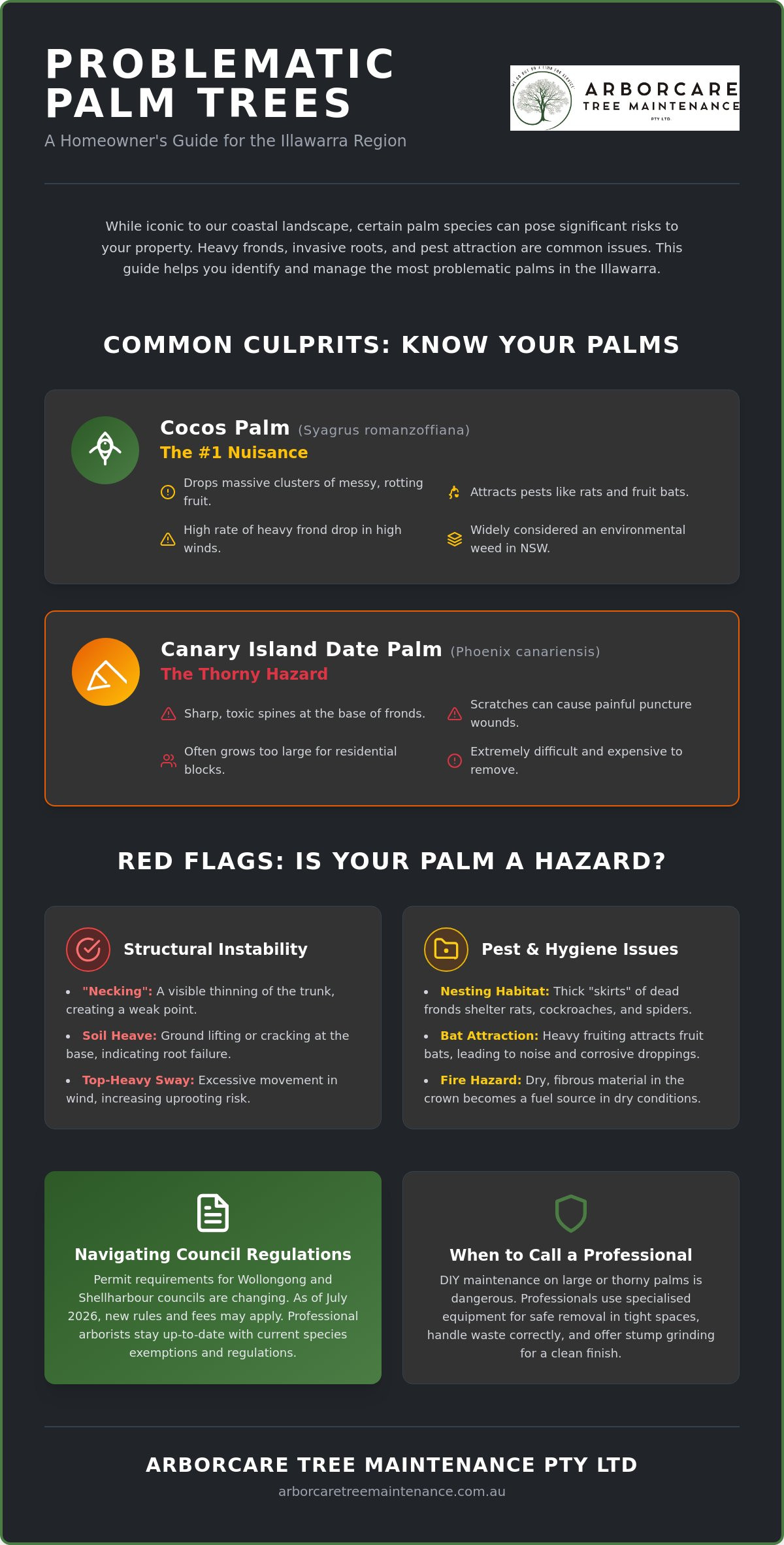
The Cocos palm is widely regarded as a weed throughout New South Wales, and for good reason. It produces massive, heavy clusters of orange fruit that drop onto lawns and driveways, creating a fermented, sticky mess. This fruit is a primary food source for grey-headed fruit bats and rats, often bringing these pests into close proximity with your living spaces. Beyond the mess, Cocos palms have a high "frond drop" rate. During high winds, these large, heavy fronds can easily damage fences, dent cars, or tangle in powerlines, making them one of the most common problematic palm trees Illawarra homeowners need to manage. When dealing with such electrical hazards or planning to enhance your garden's security with professional lighting, Edmund Parks Electrical provides expert guidance for regional residents.
Phoenix Canariensis: The Thorny Hazard
Commonly known as the Canary Island Date Palm, this species is easily identified by its massive, "pineapple-shaped" trunk and sprawling crown. While they look impressive in large parks, they are often too big for standard residential yards. The primary concern with the Phoenix palm is the sharp, toxic spines located at the base of the fronds. A simple scratch can lead to painful puncture wounds and secondary infections, making DIY maintenance extremely dangerous. As these palms mature, their sheer weight and the complexity of handling their spiked fronds make them some of the most difficult and expensive trees to remove. Professional intervention is essential to handle the specialised safety protocols required for these giants.
Warning Signs Your Palm Tree is Becoming a Hazard
Recognising when a tree has transitioned from a garden feature to a liability is critical for property safety. In our region, the combination of high humidity and salt spray can accelerate decay in ways that aren't always obvious to the untrained eye. Many problematic palm trees Illawarra residents overlook are actually showing clear distress signals that precede a total failure. Identifying these indicators early allows for planned maintenance rather than emergency intervention after a storm.
Structural Instability and Coastal Storm Risks
Illawarra East Coast Lows bring intense wind gusts that put immense pressure on tall, slender trunks. One of the most serious warning signs is "necking," where the trunk becomes significantly thinner at a certain point. This indicates a period of severe stress or disease and creates a structural weak point where the palm is likely to snap. You should also inspect the base for soil heave or cracking. If the ground is lifting on one side, the root ball may be pulling free. Because species like the Cocos Palm environmental weed are often top-heavy, they act like a sail in the wind, increasing the risk of uprooting during a coastal gale.
Pest Attraction and Hygiene Issues
Safety isn't just about falling timber; it's also about public health. Thick "skirts" of dead, unpruned fronds provide the perfect nesting habitat for rats, cockroaches, and spiders. If you notice an increase in vermin around your home, your palms might be the source. Additionally, the heavy fruiting cycles of certain species attract large colonies of grey-headed fruit bats. Their droppings are corrosive to car paint and outdoor furniture, while their nocturnal noise can be a major disturbance. To better shield your outdoor spaces from these pests and falling debris, learn more about Awnings And More Inc. and their range of protective screens. In drier periods, the accumulation of dead, fibrous material in the crown also represents a significant fire hazard in suburban backyards.
Beyond the visible crown, the root systems of larger palms can be surprisingly invasive. While they don't usually have the thick, woody roots of a Fig tree, their dense mat of fibrous roots can infiltrate old terracotta pipes or exert pressure on retaining walls and shallow foundations. Regular inspections by a qualified professional can identify these subterranean risks before they lead to expensive plumbing repairs. If you are concerned about the health of your trees, booking a professional Palm Tree Removal or maintenance assessment is the most reliable way to ensure your property remains secure.
Managing Problematic Palms: Maintenance vs. Removal
Deciding whether to retain or remove a palm requires a pragmatic look at both your budget and your property's safety. While a healthy, well-placed tree adds character to your garden, problematic palm trees Illawarra residents often inherit can quickly become a financial and physical liability. Homeowners must weigh the recurring expense of annual pruning against the one-off cost of a permanent removal. This choice often hinges on whether the tree's current state allows for safe, effective maintenance or if it has reached a terminal point of decline where the risk to your home outweighs any aesthetic value.
When Palm Tree Trimming and Skinning is Enough
For many healthy specimens, a professional palm tree trimming Wollongong service is sufficient to mitigate common nuisances. "Skinning" is a particularly effective technique where the rough, fibrous bark is carefully shaved from the trunk. This process removes the primary hiding spots for vermin and gives the tree a clean, sculptural appearance that many homeowners prefer. Regular maintenance also involves the removal of developing seed pods. By cutting these away before they ripen, you prevent the "messy yard" syndrome and stop attracting fruit bats to your property. These proactive steps are a key part of local conservation and palm management efforts, ensuring that kept trees don't negatively impact the surrounding suburban ecosystem or your neighbours' properties.
The Tipping Point for Professional Removal
There are specific scenarios where maintenance is no longer a viable or safe option. If a palm has grown too close to overhead powerlines or is leaning precariously over a dwelling, the risk of structural failure during a storm is simply too high. In these cases, the "tipping point" has been reached. You must also act quickly regarding dead palm tree removal. Unlike hardwood trees that can stand for years after dying, the fibrous interior of a palm rots rapidly from the inside out. A dead palm can collapse without warning, often snapping at the base. Additionally, palms showing signs of infectious diseases like Fusarium wilt must be removed immediately. There is no cure for these fungal pathogens, and leaving a diseased tree in place risks spreading the infection to every other palm in your street. When safety or health is compromised, professional removal is the only responsible course of action for managing problematic palm trees Illawarra properties may host.
Safety Protocols and Local Council Regulations
Navigating the legalities of tree management in the Illawarra requires a clear understanding of local government bylaws. While some problematic palm trees Illawarra residents deal with are considered environmental weeds, others are protected native species. Getting this wrong can lead to significant fines. Under the Environmental Planning and Assessment Act 1979, individuals can face penalties up to $250,000 for illegal tree removal. Beyond the legal risks, hiring unlicensed "loppers" often voids your home insurance policy if property damage occurs during the job. A professional arborist carries the necessary public liability insurance and follows strict Australian Standards for pruning and removal.
Understanding Exempt Species vs. Protected Palms
Wollongong and Shellharbour City Councils maintain specific lists of trees that can be removed without a permit. As of July 2026, the Cocos Palm and the Canary Island Date Palm are generally exempt from permit requirements in Wollongong. However, the native Cabbage Tree Palm (Livistona australis) is highly protected. If you need to remove a non-exempt palm over five metres tall, you must follow the formal palm tree removal Illawarra permit process. This currently involves a $114.00 application fee for one or two trees. In Wollongong, any tree removed under a permit must be replaced with a new planting on the property, a policy in effect since July 2023. An arborist report is often the most effective way to justify a removal and streamline this council application.
The Dangers of DIY Palm Tree Lopping
Attempting to remove a palm yourself is significantly more dangerous than cutting a standard hardwood tree. Palms have a unique "slumping" hazard that many DIYers don't anticipate. If dead fronds are cut incorrectly, they can slide down the trunk in a heavy mass, trapping and suffocating a climber against the tree. Professional arborists use specialised rigging systems to lower heavy trunk sections safely, especially in the tight residential blocks common between Dapto and Woonona. Using a chainsaw at heights without a proper harness and spike system is a recipe for disaster. Our teams use industry-standard safety protocols to manage these high-risk tasks without endangering your home or our staff. If you're unsure about the legal status or safety of your tree, contact Arborcare Tree Maintenance Pty Ltd for a professional site assessment.
Professional Palm Tree Solutions for Illawarra Properties
Managing problematic palm trees Illawarra properties often possess requires more than just a ladder and a hand saw. Our team at Arborcare Tree Maintenance Pty Ltd specialises in complex removals where access is restricted by neighbouring fences, swimming pools, or delicate garden beds. We understand that your home is your most significant investment. That's why we prioritise a methodical, safety-first approach to every job, ensuring that even the tallest palms are handled with precision and care. Professional intervention is the only way to guarantee that a hazardous tree is removed without causing secondary damage to your landscape.
Specialised Equipment for Tight Access Removals
We use specialised aerial buckets and advanced rigging systems to dismantle large palms section by section. This controlled process is essential in urban environments across Wollongong and Shellharbour where there is often no "drop zone" for large fronds or heavy trunk segments. Every piece of the tree is secured and lowered to the ground under tension. This prevents impact damage to your lawn and keeps your structures safe from falling debris. Once the physical removal is complete, we focus on a thorough site cleanup. We remove all fibrous debris and sticky seeds, ensuring your gutters and pool filters aren't clogged by the remains of the work. This attention to detail defines our local service, leaving your property in a tidy, safe condition that is ready for you to enjoy.
Stump Grinding: Reclaiming Your Garden Space
A common mistake homeowners make is leaving the stump behind after the main tree is gone. Unlike many hardwoods, palm stumps are made of dense, fibrous material that resists natural decay. If left in the ground, they can remain for years, becoming a persistent trip hazard or a damp haven for cockroaches and termites. Engaging a professional stump grinding Wollongong service is the only way to fully reclaim your garden space. Grinding the stump below the surface level allows you to replant immediately. This is particularly important for refreshing your landscape with more suitable local species. Our high-capacity mulching equipment handles the tough palm fibres that would clog standard machinery. Standard woodchippers often struggle with the stringy, wet nature of palm trunks, but our industrial-grade gear ensures the material is processed efficiently. This provides a complete solution from crown to root, turning a hazardous tree into useful mulch for your garden beds.
Being proactive with your property maintenance is always more cost-effective than calling for an emergency tree service after a storm has already hit. Regular inspections allow us to identify potential issues before they become dangerous. If you're concerned about the health or stability of a palm on your block, our licensed arborists are ready to provide the professional intervention needed to secure your property and give you peace of mind.
Secure Your Property Against Hazardous Palms
Protecting your home from the risks of unmanaged vegetation starts with early identification and a clear management plan. By recognising the warning signs of decay and understanding which species are exempt from local council permits, you can address potential hazards before the next storm season arrives. Managing problematic palm trees Illawarra homeowners encounter requires a balance of regular maintenance and knowing exactly when a tree has reached its safe limit. Taking action now prevents the mess of fruit drop and the danger of structural failure during coastal gales.
Professional intervention ensures that complex removals are handled without risking your structures or your personal safety. As licensed and insured arborists locally owned in Dapto, we provide the technical expertise and specialised equipment needed for even the most difficult urban tasks. Whether you need routine trimming to reduce pest habitats or a 24/7 emergency storm response, our team is committed to maintaining the safety of your landscape. Don't let a hazardous palm become a costly liability for your property. We're here to help you navigate council requirements and provide a steady, reliable solution for your garden.
Get a Professional Quote for Palm Removal in the Illawarra
Frequently Asked Questions
Is a Cocos palm considered a problematic tree in Wollongong?
Yes, the Cocos palm is officially classified as an environmental weed in New South Wales and is one of the most common problematic palm trees Illawarra homeowners deal with. They produce large quantities of messy fruit that ferment on the ground and attract vermin. Additionally, their heavy fronds pose a risk to property during high winds. Because of their weed status, they are currently exempt from removal permits in the Wollongong area.
Do I need a council permit to remove a palm tree in the Illawarra?
Permit requirements depend on the species and the specific local government area. In Wollongong, you generally don't need a permit for exempt species like Cocos or Canary Island Date palms. However, a permit is mandatory for removing protected native species or any non-exempt tree over five metres in height. As of July 2026, the standard application fee for one or two trees is $114.00, and you must plant a replacement tree on your property.
How much does it typically cost to remove a large palm tree?
The cost of removal depends on several variables, including the tree's height, its proximity to structures, and the ease of access for heavy machinery. Larger palms or those located in tight spaces between buildings require complex rigging and more labour, which influences the final price. Every property is unique, so a site assessment by a licensed arborist is necessary to provide an accurate quote based on the specific safety risks and equipment required for the task.
Can I trim my own palm tree if it is overhanging a powerline?
You should never attempt to trim any tree that is within close proximity to powerlines. Working near live electricity requires specialised training and equipment to prevent fatal shocks or fires. In the Illawarra, only qualified arborists with specific electrical hazard certification are authorised to work near utility lines. If a palm is encroaching on wires, contact your local service provider or a professional arborist to manage the risk safely and legally.
Why do palm trees attract so many fruit bats and rats?
Certain palm species, particularly the Cocos palm, produce heavy clusters of orange fruit that serve as a primary food source for grey-headed fruit bats and rodents. When this fruit drops and rots, it creates a persistent feeding ground for pests. Additionally, the "skirt" of dead fronds that accumulates at the top of an unmaintained palm provides a warm, dry, and protected nesting site for rats and cockroaches, often leading to infestations near the home.
What happens if I leave a dead palm tree on my property?
Leaving a dead palm standing is a significant safety risk because their fibrous trunks rot much faster than traditional timber. Unlike a gum tree that might stay standing for years, a dead palm can lose its structural integrity in a matter of months. They often snap at the base or the neck without warning, especially during a coastal storm. Removing a dead palm promptly is essential to prevent injury or damage to fences and dwellings.
Is stump grinding necessary after a palm tree is removed?
Stump grinding is highly recommended because palm stumps are incredibly dense and don't rot away naturally for a very long time. If left in the ground, they remain a permanent trip hazard and a potential breeding ground for termites. Grinding the stump allows you to reclaim your garden space and prepare the soil for replanting. This is particularly important for meeting council requirements that mandate a replacement tree be planted following a removal.
How often should I have my palm trees professionally trimmed?
Most residential palms benefit from professional trimming once or twice a year, depending on the species and its growth rate. Regular maintenance involves removing developing seed pods before they ripen and drop, which significantly reduces the mess and pest attraction on your property. Routine "skinning" and frond removal also ensure the tree doesn't become top-heavy, which is vital for maintaining structural stability during the high-wind events common in the coastal Illawarra region.


