
Imagine lying awake during a fierce Illawarra storm, listening to the wind howl and wondering if the massive gum tree just metres from your bedroom window will hold firm. It's a common anxiety for many homeowners in Wollongong and Shellharbour, especially when you notice fresh cracks appearing in your driveway or suspicious movement in your brickwork. You know that protecting your family and your biggest asset is the priority, yet the thought of navigating complex council permits or the logistics of a tree too close to house removal often feels like a daunting task.
We understand that you need clear, professional advice to alleviate the stress of property maintenance. This guide will help you identify the specific warning signs of a hazardous tree and explain the professional steps required to manage the situation safely. We'll preview the current permit requirements for Wollongong and Shellharbour councils, explore the 10/50 vegetation clearing rules, and detail how a qualified arborist ensures your home remains protected throughout the entire process. By the end, you'll have a steady plan to restore safety and peace of mind to your property.
Key Takeaways
- Identify structural hazards by understanding the 'Critical Root Zone' and how specific tree species impact your home’s foundation and slab.
- Learn why the Illawarra’s unique wind patterns and bushfire zones make certain mature trees a high-priority safety risk during extreme weather.
- Navigate local government regulations by clarifying the permit thresholds for Wollongong and Shellharbour councils and the NSW 10/50 clearing rule.
- Discover the specialised techniques used in a professional tree too close to house removal, such as sectional felling, to ensure your property remains undamaged.
- Understand the critical insurance and safety implications of hiring licensed experts versus attempting dangerous DIY lopping near structures.
How to Tell if a Tree is Too Close to Your House
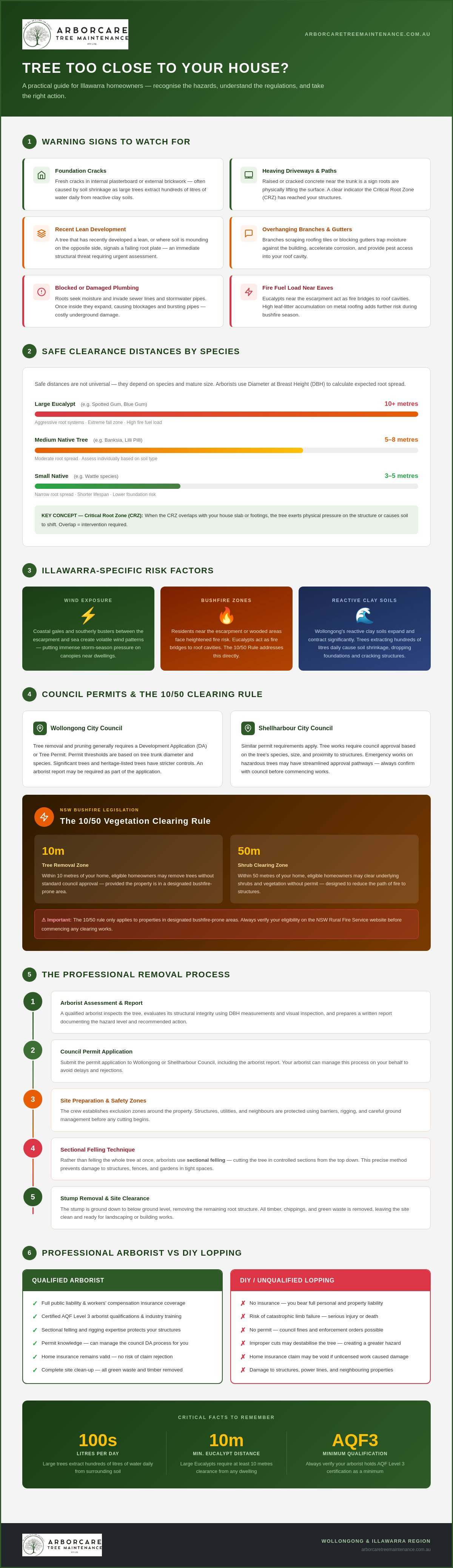
Determining if a tree has become a liability requires more than a casual glance at its height. You must evaluate the relationship between the tree's biological needs and your home's structural footprint. The most critical factor is the Critical Root Zone (CRZ). This is the area of soil around the trunk that contains the roots essential for the tree's stability and health. When the CRZ overlaps with your house slab or footings, the tree can exert physical pressure on the structure or cause the soil to shift. A tree too close to house removal is often the only way to stop progressive damage to a property’s foundation.
Visual cues often provide the first warning signs. Overhanging branches that scrape against roofing tiles or drop leaves into gutters do more than create a maintenance chore; they trap moisture against the building and provide easy access for pests. This excess shade and moisture can also lead to unsightly moss growth on your paths and driveway—to see how to prevent this, click here. You should also perform a "Lean Test." While many trees grow at a natural angle, a tree that has recently developed a lean, or one where the soil is mounding on the side opposite the lean, indicates that the root plate is failing. This makes the tree a structural threat that requires immediate professional assessment.
Measuring the Safe Distance for Different Species
Safe distances are not universal; they depend heavily on the species and its mature size. Large Eucalypts, common across the Illawarra, have aggressive root systems and can reach heights that create a massive fall zone. These typically require at least 10 metres of clearance from a dwelling to be considered safe. In contrast, smaller native species like Wattles have narrower root spreads and shorter lifespans, making them less of a threat to foundations. Arborists use the Diameter at Breast Height (DBH) to calculate the expected root spread. This technical calculation is a standard part of professional tree care and helps determine if the tree's growth will eventually compromise your home.
Signs of Foundation and Structural Interference
Structural interference often manifests in ways that homeowners might initially attribute to general house settling. Look for "heaving" in driveways, garden paths, or patios near the tree trunk, where roots are physically lifting the concrete. Inside the house, keep an eye out for fresh cracks in internal plasterboard or external brickwork. These are often caused by moisture depletion. Large trees can extract hundreds of litres of water daily from the ground. In the reactive clay soils found in parts of Wollongong, this can cause the soil to shrink and the foundation to drop. If you are noticing these signs, a tree too close to house removal assessment is necessary to prevent further costly repairs to your home's skeleton.
The Real Risks of Mature Trees Near Illawarra Homes
While mature trees provide shade and character, their proximity to a dwelling introduces significant liabilities that often outweigh their aesthetic value. In the Illawarra, our unique geography between the escarpment and the sea creates volatile wind patterns. During storm season, coastal gales and southerly busters put immense pressure on canopies. If a tree is structurally unsound or situated too close to a building, the risk of a catastrophic failure increases. A tree too close to house removal is frequently a preventative measure to protect the occupants from falling limbs or a total trunk collapse during these peak weather events.
Bushfire safety is another critical concern for residents near the escarpment or wooded areas. Trees with high fuel loads, such as certain Eucalypt species, can act as a bridge for fire to reach your eaves and roof cavity. The 10/50 Clearing Rule in NSW was established specifically to address this danger, allowing homeowners in designated areas to manage vegetation without the standard lengthy permit process. Beyond fire, the simple accumulation of leaf litter on metal roofing and in guttering leads to accelerated corrosion and blockages; installing a high-quality mesh from Leaf Stopper can mitigate these risks and prevent internal water damage during heavy rain.
Infrastructure damage remains a primary reason for professional intervention. Tree roots are biologically programmed to seek moisture, and they easily find their way into sewer lines and stormwater pipes. Once inside, they expand, causing blockages and eventually bursting the pipes. If you suspect your plumbing is under threat, it's wise to consult a local specialist to assess the risk to your underground assets.
Structural Integrity and Foundation Damage
The Illawarra is known for its reactive clay soils, which expand and contract significantly based on moisture content. Large trees exacerbate this movement by sucking vast amounts of water from the ground, causing the soil to shrink unevenly under your home. Roots don't just push against concrete; they exploit existing micro-cracks in slabs and footings. Over time, this pressure leads to structural shifting and costly repairs. Understanding these specific local conditions is why hazardous tree removal Wollongong residents rely on is considered a vital part of property maintenance.
Storm Vulnerability and Branch Drop
Many Australian species are prone to "Summer Branch Drop," a phenomenon where seemingly healthy limbs are shed unexpectedly during hot, calm weather. This risk is amplified if the tree has co-dominant stems, often called V-forks. These junctions are structurally weaker than a single trunk and are the first points to fail during high winds. Leaving deadwood hanging over a bedroom or lounge area is an unacceptable risk. Identifying these weak points early allows for a controlled tree too close to house removal before the next major storm forces the issue.
Council Permits and the 10/50 Clearing Rule in NSW
Navigating the legalities of a tree too close to house removal requires a clear understanding of local government regulations. In the Illawarra, both Wollongong City Council and Shellharbour City Council have strict Tree Preservation Orders (TPOs) designed to protect the urban canopy. Generally, you need a permit if a tree exceeds 5 metres in height or has a trunk diameter larger than 30 centimetres at ground level. While some homeowners assume that proximity to a building line automatically grants them the right to clear vegetation, this isn't always the case. For instance, Shellharbour Council allows for certain exemptions for trees less than 5 metres tall and under 30 centimetres in diameter, provided they are more than 3 metres from a house wall. However, if the tree is large or a protected species, you must obtain formal approval to avoid significant fines, which can range from $3,000 to over $1.1 million for severe breaches.
Professional arborist reports are often the deciding factor in a successful permit application. These reports provide the technical evidence councils require to justify the removal of a healthy tree, such as proving that the root system is causing irreparable damage to foundations or that the tree's structure has become a liability. Relying on a licensed expert ensures that your application is thorough and addresses the specific criteria set out in the Wollongong Tree Management Policy or Shellharbour’s vegetation removal guidelines. This methodical approach reduces the likelihood of a rejection and ensures all work is performed within the bounds of the law.
Navigating the 10/50 Bush Fire Code
The 10/50 Vegetation Clearing Scheme provides a specific legal pathway for those living in high-risk bushfire areas. If your property is within a designated zone, you can clear trees within 10 metres of a habitable home without a council permit. It's vital to use the NSW Rural Fire Service online tool on the day you plan to start work, as zone boundaries can change. Remember that this rule applies to the tree's trunk location, not just the branches. It's also important to distinguish between clearing for fire safety and removing significant vegetation that might be protected under separate environmental laws. Using this scheme incorrectly can lead to legal pitfalls, so verifying your property’s status is a non-negotiable first step.
Applying for a Tree Removal Permit
When a tree doesn't fall under the 10/50 rule, you'll need to submit a formal application. For Wollongong residents, the 2025-2026 fee for a tree management permit starts at $109.00 for up to two trees. You'll need to provide clear evidence, including photographs and a detailed reason for the request, such as structural damage to foundations or underground services. Consulting our guide on the signs a tree needs to be removed Wollongong residents should monitor can help you gather the necessary documentation. Once submitted, expect a processing time of approximately 28 to 30 working days. This wait time highlights the importance of planning your tree too close to house removal well before storm season begins.
How-To Guide: The Process of Removing a High-Risk Tree
Safe tree removal in confined residential spaces begins long before the first chainsaw starts. We conduct a rigorous site assessment to identify potential hazards, such as overhead powerlines, underground utilities, and the structural integrity of the house itself. This planning stage involves establishing a clear 'drop zone' and determining which assets require physical shielding. We prioritise the protection of your home's roofline and windows by calculating the exact trajectory of every piece of timber. This methodical preparation is what separates a professional operation from a high-risk DIY attempt.
When executing a tree too close to house removal, we utilise sectional felling rather than traditional felling. We never drop a large tree in one piece near a structure; the vibration alone could damage foundations, and the risk of an unpredictable bounce is too high. Instead, our arborists dismantle the canopy from the top down. Using advanced rigging and roping systems, we control the descent of every heavy limb. This roping allows us to 'snub' the weight of the timber, guiding it safely to the ground without it ever making contact with your home or garden features.
Once the main structure is cleared, stump management becomes the final priority. We recommend stump grinding as a standard part of the process. Simply cutting a tree to ground level often leaves the root system alive, which can lead to continued foundation pressure or regrowth. Grinding the stump below the surface effectively kills the root system and prepares the area for future landscaping or turf. If you are concerned about a hazardous trunk, you can book a complex tree removal consultation to ensure every stage is handled with technical precision.
The Equipment Required for Close-Quarters Removal
Complex removals near buildings require specialised machinery. We often deploy Elevating Work Platforms (EWPs), commonly known as cherry pickers, to provide a stable base for our arborists. In areas where machinery cannot reach, our qualified climbing arborists use high-tensile harnesses and spurs to access the canopy. To protect your property, we use ground protection mats that distribute the weight of equipment, preventing ruts in your lawn or cracks in your driveway. We also manage noise and debris by using sharp, well-maintained equipment and high-capacity wood chippers to process waste immediately.
What to Expect on the Day of Removal
On the morning of the job, we ask homeowners to clear the work area by moving cars, outdoor furniture, and pets. A tree too close to house removal can take anywhere from a few hours to a full day, depending on the height and species. Our team works steadily to ensure safety remains the focus over speed. Once the felling is complete, we provide a thorough cleanup. We turn the hazardous branches into useful garden mulch, which can be left on-site for your gardens or removed entirely. You will be left with a clear, safe space and the peace of mind that your home is no longer under threat from falling timber.
Why Professional Arborist Intervention is Non-Negotiable
Attempting a DIY tree too close to house removal is one of the most high-risk tasks a homeowner can undertake. The physics of heavy timber, combined with the proximity of rooflines and powerlines, leaves zero margin for error. Beyond the immediate physical danger, there are significant legal and financial ramifications. Most Australian home insurance policies require that high-risk maintenance be performed by qualified and insured professionals. If an uncertified individual causes damage to your home or a neighbour's property, you may find your claim denied; this leaves you personally liable for the full cost of repairs.
Professional intervention ensures that the task is completed with technical authority and safety-conscious expertise. At Arborcare Tree Maintenance, our Dapto-based team approaches every Illawarra property with a focus on structural protection. We don't just cut down trees; we engineer their removal. This includes managing the debris flow and ensuring that the final site is left clean and ready for its next purpose. Once the hazard is gone, you can reclaim your outdoor space. Whether you choose to replant a more suitable, low-impact native species or extend your landscaping, the removal of a threatening tree provides a fresh start for your property's footprint.
The Risks of Inexperienced Tree Loppers
In professional arboriculture, lopping is considered a dirty word. It refers to the indiscriminate cutting of branches to stubs, which is a practice that creates more problems than it solves. Inexperienced loppers often fail to account for tension wood; this can cause branches to kick back or spring unpredictably when cut. Poor lopping cuts also trigger a stress response in the tree, leading to rapid and weak epicormic regrowth. These new shoots grow faster than original branches but are poorly attached to the trunk, creating a new, even more hazardous situation within just a few seasons. True professional care focuses on the long-term structural health of the landscape, not just a quick fix.
Trusting the Illawarra Experts
Choosing a licensed arborist is about more than just getting the job done; it's about protecting your investment. Our commitment to safety and industry standards means we handle the complex logistics, from council compliance to precision rigging. If you are concerned about the budget, navigating tree removal cost Wollongong residents can expect will help you understand the value of hiring a specialised team for high-risk work. Don't wait for the next storm to test your home's defences. Secure your home today with a professional tree risk assessment and ensure your property remains a safe haven for your family.
Secure Your Property and Restore Peace of Mind
Managing a tree too close to house removal is about more than just clearing space; it's a critical step in preserving your home's structural integrity and ensuring your family's safety during the volatile Illawarra storm season. By identifying the early warning signs of foundation interference and navigating the specific permit requirements of Wollongong or Shellharbour councils, you can address potential hazards before they become costly emergencies. Proactive management allows you to maintain your property's value while eliminating the stress of overhanging timber.
Don't leave your property's safety to chance or risk uncertified work that could void your home insurance. As fully licensed and insured arborists, we provide the technical expertise needed for complex removals, and our service always includes expert stump grinding to ensure root systems are properly managed. We also stand ready with a 24/7 emergency storm service to support our local community when conditions turn dangerous. Request a Professional Tree Risk Assessment from Arborcare today to secure your home and enjoy a safer, clearer landscape.
Frequently Asked Questions
How close to a house can a tree be before it is considered dangerous?
A tree is generally considered a potential threat if it stands within three metres of a building line, though the specific risk depends on the species and mature height. Large Eucalypts often require at least ten metres of clearance to account for their extensive root systems and fall zones. We assess the danger based on the Critical Root Zone and the likelihood of the canopy impacting the structure during high winds.
Does home insurance cover the removal of a tree that is too close to the house?
Standard home insurance policies typically don't cover the preventative removal of a tree, even if it's positioned dangerously close to your dwelling. Insurance is designed to address sudden, accidental damage rather than ongoing property maintenance. You are usually responsible for the costs of a tree too close to house removal to prevent future structural issues or storm damage from occurring.
Can I remove a tree myself if it is touching my roof or gutters?
You should never attempt to remove a tree that is in physical contact with your home. DIY removal carries an extreme risk of the timber kicking back or falling directly onto your roof, which can cause far more damage than the tree itself. Professional arborists use specialised rigging and roping systems to dismantle the canopy safely without the timber ever impacting your building or gutters.
What is the 10/50 rule for tree removal in New South Wales?
The 10/50 rule allows homeowners in designated bushfire-prone areas to clear trees within ten metres of a habitable home without needing a council permit. It also permits the clearing of shrubs and underlying vegetation within 50 metres of the structure. It's vital to verify your property's eligibility on the NSW Rural Fire Service website on the day you plan to start work, as zone boundaries can change.
How do I know if a tree's roots are damaging my home's foundation?
Common indicators of root damage include fresh cracks in external brickwork, concrete heaving in nearby paths, or internal doors that suddenly stick in their frames. These issues are often caused by the roots physically lifting the structure or sucking moisture from the reactive clay soils found in the Illawarra. A licensed arborist can perform a detailed root zone assessment to confirm if the tree is the primary cause of the movement.
Will Wollongong Council let me remove a tree if it’s dropping leaves in my pool?
Wollongong City Council generally won't grant a permit for tree removal based solely on leaf litter or minor maintenance nuisances. You must typically provide evidence that the tree is dead, dying, or posing a significant structural threat to your property or underground services. Issues like leaves in a pool or blocked gutters are usually managed through regular pruning and maintenance rather than total removal of the specimen.
What happens if a tree too close to my house falls during a storm?
If a tree falls and causes damage, your first priority is the safety of the occupants and contacting emergency services if there's an immediate threat to life. Once the situation is stable, you should contact a 24/7 emergency tree service to safely clear the debris from your home. Document the damage thoroughly with photographs for your insurance claim and ensure a licensed professional handles the complex cleanup process.
Do I need a permit to remove a dead tree that is close to my house?
Yes, in many instances, you still require a permit or at least a formal notification to remove a dead or dying tree under current NSW regulations. This prevents the intentional poisoning of healthy trees to bypass local preservation orders. A tree too close to house removal for a dead specimen should always be cleared with Wollongong or Shellharbour councils first to avoid heavy fines for unauthorised work.


