
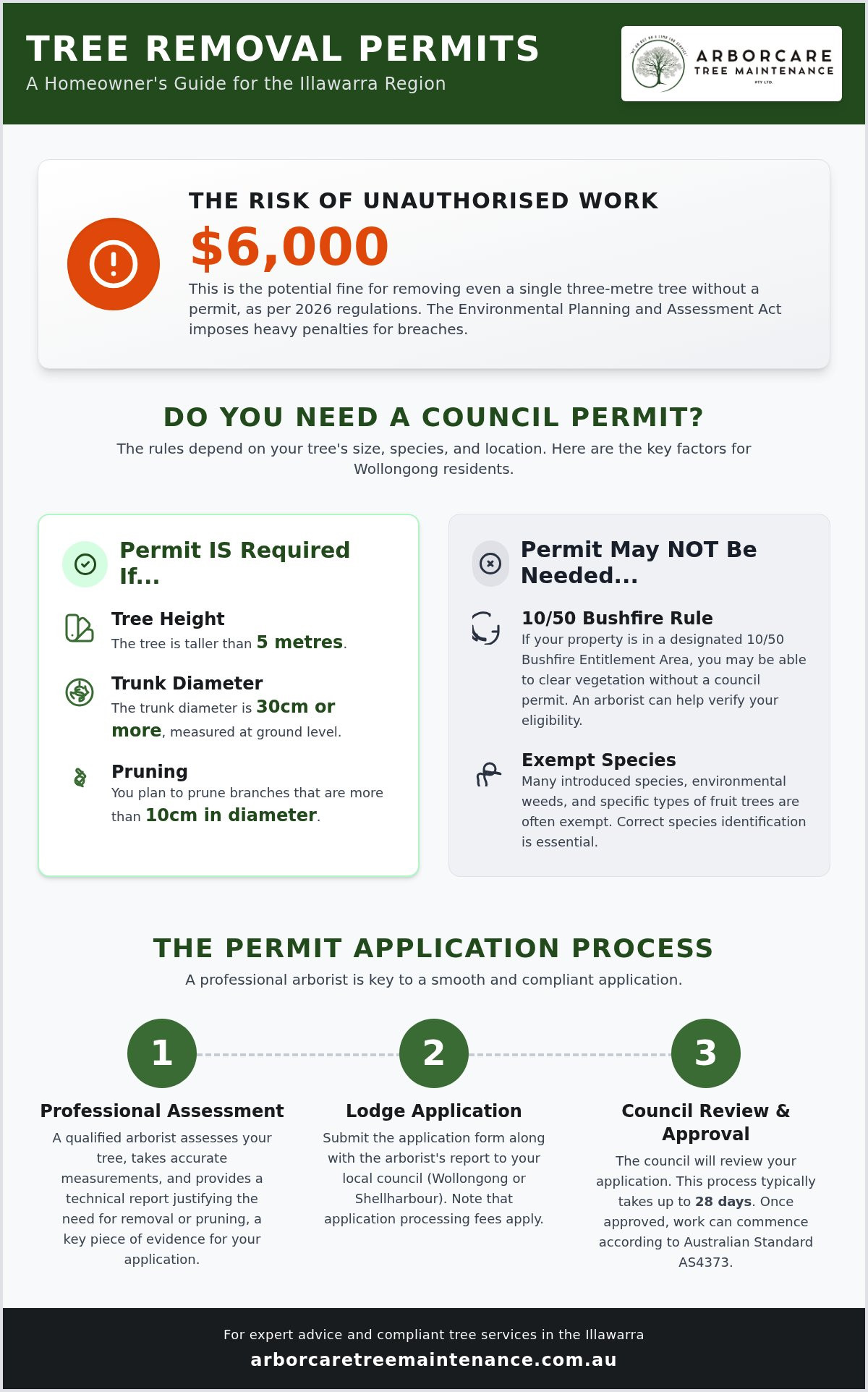
Removing a single three-metre tree from your backyard without the correct paperwork could result in a $6,000 fine from your local government. It's a heavy price to pay for a simple misunderstanding of the current 2026 regulations. Most homeowners in Wollongong and Shellharbour find the council tree removal permit process deeply confusing, especially when faced with varying rules about trunk diameters and the technical requirements of arborist reports. You likely feel the weight of this bureaucracy while trying to manage legitimate safety concerns or property maintenance tasks.
We understand that you want a clear path to a safe property without the risk of legal penalties. This guide is designed to help you master the local permit system, ensuring your tree works remain compliant and professional. You'll learn exactly when a permit is required, the specific application costs involved for Wollongong residents, and how to navigate the 28-day processing period. We also clarify the 10/50 bushfire clearing entitlements and the specific tree height thresholds that determine whether you can proceed or if you need formal intervention from a qualified expert.
Key Takeaways
- Identify whether your vegetation is protected by local Development Control Plans based on specific height and trunk girth thresholds.
- Navigate the application process for a council tree removal permit to avoid heavy fines and ensure your property remains compliant with 2026 regulations.
- Determine if your property falls within a 10/50 Bushfire Entitlement Area, which may allow for clearing without formal council approval.
- Understand how technical arborist reports provide the necessary evidence to justify tree removal or pruning for safety and property protection.
- Recognise the importance of ensuring all tree work meets Australian Standards (AS4373) to maintain the safety and integrity of your landscape.
Understanding the Council Tree Removal Permit in the Illawarra
A council tree removal permit is more than a simple formality. It is a legal document granting formal consent to prune or remove vegetation protected under local government legislation. In the Illawarra, these protections are detailed in the Development Control Plans (DCP) for either Wollongong or Shellharbour. Local authorities prioritise these regulations because the urban canopy provides vital cooling, supports local biodiversity, and maintains soil stability on our coastal slopes. These rules are built upon the legal framework of Tree Preservation Orders, which empower councils to manage and protect the environmental health of their local area.
Wollongong vs. Shellharbour: Who Governs Your Block?
Identifying which set of rules applies to your property starts with your rates notice. If you live in Dapto or Figtree, you'll follow Wollongong City Council guidelines. Residents in Oak Flats or Albion Park fall under the jurisdiction of Shellharbour City Council. While the environmental goals are similar, the specific height, species, and trunk diameter thresholds can vary between these two LGAs. A qualified arborist acts as your technical guide. We interpret the technical language within the relevant DCP to determine if your specific tree meets the criteria for protection or if it qualifies for a known exemption. This clarity is essential before any equipment is started on site.
The Legal Consequences of Unauthorised Tree Works
The Environmental Planning and Assessment Act provides the legal weight for local tree regulations. Unauthorised work is not a minor oversight; it is a breach of state law. Fines for individuals in New South Wales can reach tens of thousands of dollars. Even a single unpermitted removal of a three-metre tree can result in a $6,000 penalty. It's also vital to understand that lopping, which involves the indiscriminate cutting of branches, is often viewed as illegal clearing. This practice can permanently damage a tree's health and structural integrity. Councils now use sophisticated satellite imagery to track canopy loss across the Illawarra. They can easily identify when a significant tree has been removed from a backyard without a valid council tree removal permit. Engaging a professional ensures your property maintenance remains within the law while protecting you from these severe financial and legal risks.
Is Your Tree Protected? Identifying Assessable Vegetation
Determining if your vegetation is assessable is the first step in the compliance process. While NSW government rules on tree removal provide a broad framework, the local council determines the specific thresholds for protection. In the Illawarra, protection status is generally triggered by the physical dimensions and the species of the tree. This is particularly important given that 75% of the local government area is private land, putting significant pressure on our urban canopy. Understanding these metrics is vital for any property owner planning maintenance or clearing work.
Measuring Your Tree: Height and Girth Standards
Councils use standardised measurements to define protected vegetation. In Wollongong, a council tree removal permit is required for any tree exceeding 5 metres in height. Even if the tree is shorter, trunk diameter remains a decisive factor; any tree with a diameter of 30cm or more, measured at ground level, is assessable. It's a common misconception that permits only apply to full removals. Pruning branches that are more than 10cm in diameter also requires formal approval. For clumping trees or those with multiple stems, the measurement process becomes more technical, as the total biomass is considered. Accuracy during this initial measurement phase prevents accidental illegal clearing and the subsequent fines.
Species-Specific Protection and Exemptions
Species identification is a critical part of the assessment. Local native species like the Coastal Banksia or the iconic Illawarra Flame Tree are almost always protected due to their ecological and biodiversity value. Conversely, many introduced species or environmental weeds are often exempt from permit requirements. This list frequently includes specific fruit trees or invasive species that threaten the local ecosystem. Identifying the exact species can be difficult for homeowners, especially with palms. You can refer to our palm tree removal Illawarra guide to help identify which species are exempt on your property.
Beyond standard dimensions, heritage-listed trees and those on the Significant Tree Register carry the highest level of protection. These trees are often chosen for their historical, cultural, or rare botanical value. You should check your property title or the council's online mapping system to see if your land contains any such vegetation. These overlays often remove the standard exemptions allowed for other residential blocks. If you are unsure about the status of a specific tree, we can help determine if a permit is needed during a professional quote on your property.
Common Exemptions: When You Don’t Need a Council Permit
While most significant vegetation in our region is protected, certain legal exemptions allow property owners to act without a formal council tree removal permit. These exceptions typically focus on safety, property protection, and the removal of invasive species. For example, trees located within 3 metres of an approved dwelling or a permanent structural foundation are often exempt from permit requirements. Additionally, councils actively encourage the removal of noxious weeds and environmental pests, such as Large-leaf Privet or Lantana, which can be cleared without application. However, it is vital to confirm the species accurately before you begin, as mistakes can lead to the heavy fines mentioned earlier.
Dead or dying trees also fall under the exempt category, but this requires caution. You cannot simply decide a tree is dead and remove it. Local authorities expect you to maintain evidence, such as a "proof of death" statement from a qualified arborist or clear photographic records, before the work commences. If you remove a tree claiming it was dead and the council later inspects the remaining stump and finds healthy wood, you may be held liable for illegal clearing. We recommend a quick professional assessment to document the tree's health and protect your legal standing.
The 10/50 Bushfire Rule in the Illawarra
The 10/50 Vegetation Clearing Scheme is a state-level entitlement that provides significant exemptions for those living in high-risk bushfire zones. If your property is located within a designated 10/50 area, you may clear trees within 10 metres of your home and underlying vegetation within 50 metres without a permit. You must check the NSW Rural Fire Service (RFS) online map on the day you intend to clear, as these boundaries can change. It is important to note that this rule does not apply to all properties in Wollongong or Shellharbour. Many urban blocks are excluded from this entitlement, making a standard permit the only legal path for removal.
Immediate Danger and Emergency Removals
In situations where a tree poses an immediate threat to life or property, emergency protocols take precedence over standard paperwork. A hazardous tree is defined by visible structural failure, such as a split trunk, uplifted root plate, or hanging limbs over a high-traffic area. If you find yourself in this situation, taking detailed photos and notes of the hazard is essential before our emergency tree service Illawarra team arrives to make the site safe. Once the immediate danger is resolved, you are typically required to notify the council within 48 to 72 hours, providing the evidence you gathered to justify the emergency intervention. This process ensures safety is prioritised while maintaining transparency with local environmental authorities.
How to Apply for a Tree Removal Permit: A Step-by-Step Guide
Applying for a council tree removal permit in the Illawarra is a methodical process that requires technical accuracy to ensure a successful outcome. The process follows a specific sequence of steps designed to balance property safety with environmental protection:
- Step 1: Conduct a preliminary assessment to determine if the tree is protected or exempt.
- Step 2: Engage a qualified arborist to provide an Arboricultural Impact Assessment if required.
- Step 3: Complete the council application form via the Wollongong or Shellharbour online portal.
- Step 4: Pay the application fee and await the council officer’s site visit.
In Wollongong, the 2026 application fee for one or two trees is $114.00, while each additional tree from three to ten costs $52.00. Eligible pensioners can access a 50% rebate on these fees. You should allow approximately 28 working days for the council to process your request and issue a formal decision. It's also vital to prepare for the conditions of approval; councils usually mandate that a replacement tree must be planted to help maintain the local urban canopy.
Gathering Your Evidence and Documentation
The success of your application depends on the quality of your documentation. You need to provide clear photos that show the tree in relation to permanent structures like your house, driveway, or fences. When describing the reason for removal, avoid subjective complaints like "dropping leaves" or "blocking views". Instead, focus on objective safety concerns such as structural damage to foundations, dead wood, or disease. Our tree removal Wollongong guide provides a detailed look at the specific risk factors council officers prioritise during their assessment.
The Role of the Level 5 Arborist Report
In complex cases, a simple permit application isn't enough. If a tree appears healthy but is suspected of causing significant structural damage to a dwelling, the council will require a comprehensive report from a Level 5 Arborist. This report provides a high-level technical analysis of the tree's health, its root system, and its impact on the surrounding environment. The council officer relies on this expertise to justify a removal that might otherwise be rejected. A professional report removes the guesswork and provides the technical evidence needed for a successful council tree removal permit application. If you require assistance with the technical requirements of your application, we can provide the necessary arborist reports and assessments to support your case.
Why Professional Arborists are Essential for Permit Compliance
Securing your council tree removal permit is a significant milestone, but it doesn't mark the end of your legal obligations. Councils in the Illawarra often attach specific conditions to a permit, frequently stating that a qualified arborist with a minimum AQF Level 3 certification must carry out the work. This requirement ensures that the removal or pruning is handled with technical precision, minimising risk to the surrounding environment and public infrastructure. Following these conditions is vital; failing to hire a licensed professional can void your permit and leave you liable for any damage caused during the process.
DIY tree removal is a high-risk activity that carries immense liability. Most residential insurance policies contain clauses that require maintenance to be performed by qualified contractors. If a tree falls onto a neighbour's fence or a powerline during an uncertified removal, your insurance provider may refuse the claim based on a lack of professional oversight. We prioritise safety by following strict industry protocols and maintaining comprehensive insurance coverage, providing you with the reassurance that your property is protected throughout the entire operation.
Compliance with Australian Standards for Tree Work
All professional tree work in Australia must adhere to AS4373-2007: Pruning of Amenity Trees. This standard provides the technical guidelines for making "final cuts" that allow the tree to heal correctly and maintain its structural integrity. Local councils strictly reject "lopping" or "topping" because these practices lead to rapid, weak regrowth and internal decay. When we perform pruning or complex tree removals, every action is designed to meet these legal benchmarks. This disciplined approach prevents the tree from becoming a future hazard and ensures your property remains compliant with the long-term expectations of the Wollongong or Shellharbour Development Control Plans.
From Permit to Stump Grinding: The Full Service
A professional removal isn't truly complete until the site is clear and safe for future use. We recommend including stump grinding Wollongong in your initial council request to ensure the entire structure is legally and physically removed. Leaving a stump behind can create tripping hazards, attract termites, or lead to unwanted suckering that requires further intervention. Our team manages the entire progression from the initial assessment and permit guidance to the final mulch and site cleanup. This methodical flow mirrors the precision of our physical work, ensuring no detail is overlooked. Ready to start? Get a professional tree removal quote from Arborcare today to ensure your project is handled by qualified local experts.
Securing Your Property with Expert Compliance
Navigating the technicalities of local vegetation laws doesn't have to be a source of ongoing stress for homeowners. By understanding the specific height and species thresholds outlined in your local Development Control Plan, you can determine exactly when a council tree removal permit is required for your property. Adhering to the 2026 regulations and the standard 28-day processing period ensures your maintenance projects move forward without the threat of legal penalties or environmental damage. Professional documentation remains the most reliable method for justifying removals near foundations or sensitive structures.
Our team consists of licensed and insured Illawarra arborists with expert knowledge of both Wollongong and Shellharbour Council requirements. We specialise in providing the comprehensive reports necessary for complex applications, ensuring every cut meets rigorous Australian Standards. We handle the technical risks so you don't have to, protecting your property's value and safety. Book a Professional Tree Assessment with Arborcare today to receive a steady and reliable resolution for your tree management needs. We look forward to helping you maintain a safe and beautiful local environment.
Frequently Asked Questions
How much does a council tree removal permit cost in Wollongong?
The standard application fee for a council tree removal permit in Wollongong is $114.00 for one or two trees. If you are applying for more, each additional tree from the third to the tenth costs $52.00. Eligible pensioners can apply for a 50% rebate on these fees. These costs are set by the council to cover the administration and the officer's site inspection required to assess the vegetation's health and structural impact.
How long does it take for the council to approve a tree removal application?
You should expect the approval process to take approximately 28 working days from the date your application is lodged and paid. This timeframe allows the council officer to review your documentation, conduct a site visit, and assess the tree against the local Development Control Plan. While some straightforward cases might be processed slightly faster, complex applications requiring detailed arborist reports may take the full duration to ensure all environmental and safety factors are considered.
Can I remove a tree if it is damaging my pipes or foundations?
Trees causing documented structural damage to foundations or essential services like sewer pipes are often strong candidates for removal approval. However, you must provide technical evidence, such as a plumber's report or a Level 5 arborist assessment, to prove the tree is the primary cause of the damage. Council officers rarely approve removals based on assumptions. Providing clear evidence of the hazard ensures your application for a council tree removal permit is assessed fairly and accurately.
Do I need my neighbour’s permission to prune their overhanging branches?
You generally don't need your neighbour's formal permission to prune branches that overhang your property boundary, but you must comply with local pruning limits. Under most Illawarra regulations, you can prune up to 10% of the canopy without a permit, provided the branches are less than 10cm in diameter. It's always best to discuss the work with your neighbour first to maintain community relations and ensure the tree's health isn't compromised by excessive cutting.
What happens if I remove a tree without a permit in the Illawarra?
Illegal tree removal in the Illawarra carries severe financial penalties. A single unpermitted removal of a tree over three metres can result in a fine of $6,000 for individuals. Councils use satellite imagery and community reporting to monitor canopy changes over time. Beyond the initial fine, you may be legally required to plant replacement semi-mature trees, which adds significant cost and complexity to your property maintenance compared to following the legal permit process.
Are there any tree species in Wollongong that are always exempt from permits?
Several species are exempt from permit requirements because they are classified as environmental weeds or invasive pests. This list includes Large-leaf Privet, Lantana, and certain types of exotic palms that threaten local biodiversity. Some fruit trees are also exempt, provided they aren't part of a heritage-listed landscape. We recommend checking the specific exempt species list in the Wollongong Development Control Plan or consulting with our team to confirm your tree's status before you start.
What is the "3-metre rule" for tree removal near houses?
The "3-metre rule" is a common exemption allowing for the removal of trees located within three metres of an approved dwelling or permanent structural foundation. This distance is measured from the trunk's outer edge to the external wall of the building. While this rule often simplifies property maintenance, it doesn't apply to all species or heritage-protected areas. You should always verify your property's specific zoning and the tree species to ensure you qualify for this exemption.
Does the 10/50 bushfire rule apply to my property in Dapto?
The 10/50 bushfire clearing rule applies to many properties in Dapto, but only those within designated high-risk zones. You can check the NSW Rural Fire Service online map to see if your specific address is eligible. If your property is within the zone, you can clear trees within 10 metres of your home and smaller vegetation within 50 metres without a permit. You must re-verify the map on the day of work, as boundaries can change.


