
Imagine waking at 2 am to the sharp crack of a gum tree limb crashing onto your roof or blocking your driveway during a sudden coastal storm. In these high-pressure moments, the priority shifts instantly from routine maintenance to urgent risk mitigation. When a hazardous tree threatens your family's safety or cuts off access to your home, the situation requires more than just a chainsaw; it demands a tactical response from a qualified specialist who understands the local landscape.
We understand that dealing with storm damage is incredibly stressful, particularly when you are facing blocked roads or potential structural damage. This guide is designed to help you secure the professional emergency tree removal Illawarra property owners need to regain control of their environment. You will learn how to identify immediate hazards, what to expect during a rapid site stabilisation, and how to manage the essential documentation required for insurance claims. By following our 24/7 response protocols, you can ensure that the hazard is removed safely and your property is secured without unnecessary delay.
Key Takeaways
- Learn to identify the critical signs of a tree emergency, including structural defects and the impact of saturated soil during East Coast Lows.
- Understand the essential safety protocols to follow when a tree falls, such as evacuating fall zones and respecting the 10-metre rule for powerlines.
- Discover how professional emergency tree removal Illawarra services use specialised rigging and stabilisation techniques to protect your property from further damage.
- Gain a clear step-by-step plan for managing storm damage, including how to document the site for more efficient insurance claim processing.
- Explore why local expertise and a rapid response from a Dapto-based team are vital for handling high-risk tree removals across the region.
What Constitutes an Emergency Tree Removal in the Illawarra?
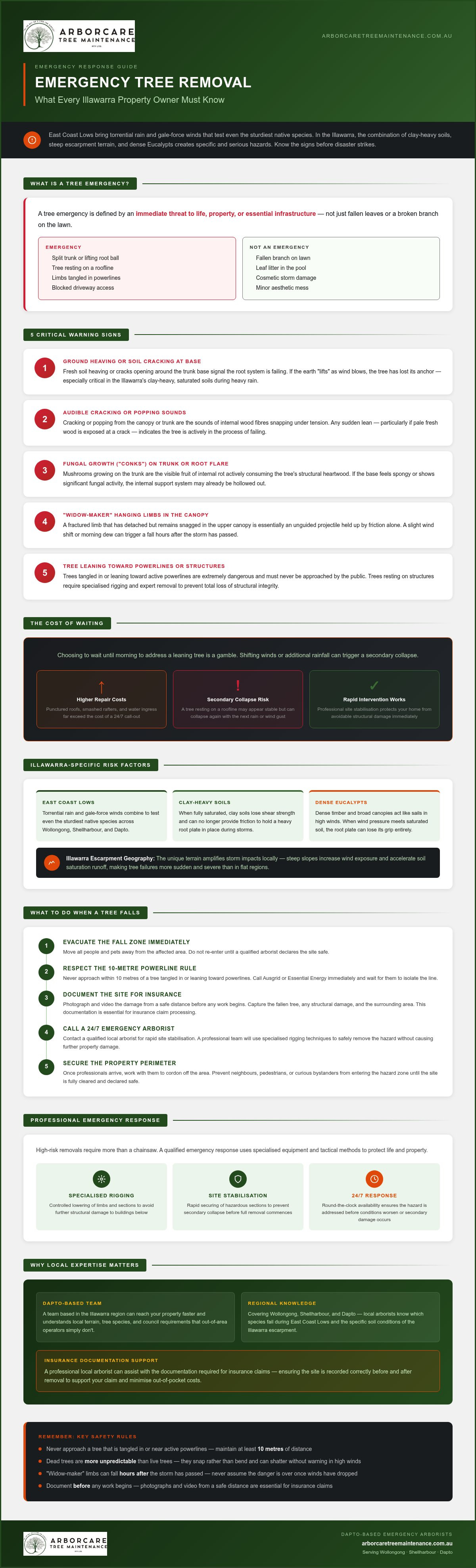
A tree emergency is defined by an immediate threat to life, property, or essential infrastructure. It isn't merely a fallen branch on your lawn or a bit of leaf litter in the pool. Real emergencies involve structural failures where a tree is no longer able to support its own weight or has already caused significant damage. In our region, the unique geography of the Illawarra escarpment creates specific challenges. When East Coast Lows move in, they bring torrential rain and gale-force winds that test the limits of even the sturdiest native species.
The heavy Eucalypts common across Wollongong, Shellharbour, and Dapto are particularly susceptible during these weather events. Their dense timber and broad canopies act like sails in high winds. When this wind pressure combines with saturated soil, the root plate can lose its grip on the earth. Distinguishing between aesthetic damage and structural instability is vital. While a few lost leaves might look messy, a split trunk or a lifting root ball represents a clear and present danger that requires emergency tree removal Illawarra property owners can rely on to prevent further catastrophe.
Choosing to wait until morning to address a leaning tree is a gamble that often results in higher repair costs. A tree resting on a roofline might appear stable, but shifting winds or additional rainfall can cause a secondary collapse. This leads to punctured roofs, smashed rafters, and water ingress that far exceeds the cost of a professional 24/7 call-out. Rapid intervention stabilises the site, protecting your home from avoidable structural damage.
Signs of Imminent Tree Failure
You can often hear or see a tree failing before it completely falls. Fresh soil heaving or cracking around the base of the trunk is a critical warning sign that the root system is failing. If you notice the earth "lifting" as the wind blows, the tree is no longer anchored. Audible cracking or popping sounds coming from the canopy or trunk are the sounds of internal wood fibres snapping under tension. Any sudden lean, especially if you can see fresh pale wood exposed at a crack or the ground buckling, indicates the tree is in the process of falling.
High-Risk Scenarios Requiring Urgent Action
Certain situations demand an immediate professional response to ensure public safety. Trees tangled in or leaning toward active powerlines are extremely dangerous and should never be approached. Large overhanging branches that have snapped but remain caught in the canopy, known as "widow-makers," can drop without warning at any moment. Additionally, if a fallen tree blocks your only driveway or rests directly on a structure, it creates a high-risk environment that necessitates specialised rigging and expert removal to prevent a total loss of property access or structural integrity.
5 Critical Signs You Need Immediate Emergency Tree Services
Early detection is often the only thing standing between a routine maintenance task and a catastrophic property loss. In our region, the combination of clay-heavy soils and steep escarpment terrain creates a specific hazard during the wet season. When the ground reaches a point of total saturation, it loses its shear strength. This means the earth can no longer provide the necessary friction to hold a heavy root plate in place. If you notice the ground "heaving" or see fresh gaps opening in the soil around the base of a trunk, the tree is already in the process of failing. This is a primary reason why emergency tree removal Illawarra residents often require happens during or immediately after a heavy rain event.
Dead trees present an even more unpredictable threat. Unlike live trees, which have a degree of flexibility and hydraulic pressure to withstand wind, dead wood is brittle and prone to "snapping" rather than bending. High winds can cause large sections of a dead tree to shatter without warning. You should also keep a close watch for fungal growth or "conks" appearing on the trunk or at the root flare. These mushrooms are the visible fruit of an internal rot that is actively consuming the tree's structural heartwood. If the base of your tree feels spongy or shows significant fungal activity, its internal support system may already be hollowed out.
The "Widow-Maker" and Hanging Limbs
A "widow-maker" is the industry term for a fractured limb that has detached but remains snagged in the upper canopy. These are incredibly dangerous because they are essentially unguided projectiles held up by nothing more than friction. A slight shift in wind or the added weight of a morning dew can trigger a fall hours after a storm has passed. If you spot a large branch dangling precariously, it is a sign you need to clear the area and seek professional help. For more detailed indicators of tree health, you can read our guide on 5 signs your tree is dangerous.
Trunk Splitting and Co-dominant Stems
Co-dominant stems occur when two main trunks grow from the same point, forming a tight "V" shape. These unions are notorious failure points because of "included bark," where the bark grows inward and prevents the two stems from fusing into a single solid structure. During a storm, the wind acts like a wedge, forcing these two stems apart until the trunk splits down the centre. If you see a vertical crack or light-coloured wood exposed at the junction of two stems, the tree's structural integrity is compromised. Our team of emergency tree service specialists can assess these cracks to determine if the tree can be stabilised or if immediate removal is the only safe option.
The Professional Emergency Response: Equipment and Safety
Standard tree lopping usually involves basic pruning or removal under controlled conditions. When a storm hits, the physics of the job change completely. Professional arborists treat an emergency site like a triage centre. We don't just start cutting. Instead, we use specialised rigging systems to stabilise the tree before the first chainsaw makes contact. This might involve high-tensile ropes and friction pulleys to "catch" heavy limbs, preventing them from crashing into your roof or fence. Every cut is calculated to shift the weight of the tree in a predictable direction.
Managing an emergency tree removal Illawarra property owners face often means working in tight spaces. Many homes in Wollongong and Shellharbour have trees positioned dangerously close to powerlines or neighbouring structures. Our team is fully licenced and insured for high-risk work, which is a non-negotiable requirement for this type of intervention. Uninsured operators put your property at further risk if an accident occurs during the removal process. We provide the technical authority needed to handle these hazards safely.
Specialised Gear for Storm Damage
Rapid site clearing requires heavy-duty machinery that can process debris quickly. We utilise high-capacity wood chippers and mulchers to turn large fallen limbs into manageable mulch on-site. In cases where a tree is "hung" or leaning at an extreme angle over a house, we often deploy cranes or aerial lifts. This equipment allows us to lift sections of the tree vertically, away from the structure, rather than letting them fall. For a deeper look at how we handle these high-stakes jobs, see our guide on Complex Tree Removal Illawarra.
Safety Protocols and Risk Assessment
Safety is our absolute priority. Even in the middle of a midnight storm, we perform a formal Site Safety Audit before any work begins. This process identifies secondary hazards like unstable ground, nearby electrical wires, or compromised structures. In suburban Illawarra streets, managing public safety is also essential. This includes setting up traffic control and exclusion zones to keep pedestrians and motorists away from the fall zone. We ensure the remaining tree structure is stable at every stage of the removal, preventing any sudden shifts that could endanger our crew or your home.
Step-by-Step: What to Do When a Tree Falls on Your Property
When a tree fails on your property, the initial shock can lead to hasty decisions. Your first priority must always be life safety rather than property preservation. This means immediately evacuating the "fall zone." A common mistake is assuming that because a tree has already hit the ground, it is now stable. In reality, shifting root balls or secondary branch failures can cause further movement without warning. If the tree has impacted your home, move all occupants to a safe area, preferably away from the structure until an expert can assess the stability of the roof and walls.
Electrical hazards represent the most significant risk in the aftermath of a storm. If you see fallen powerlines or a tree leaning against wires, stay at least 10 metres away. This "10-metre rule" is vital because electricity can travel through the ground, especially in the wet conditions common during an Illawarra East Coast Low. Never attempt to move branches that are in contact with wires. Instead, contact your local energy provider and a specialist for emergency tree removal Illawarra to coordinate a safe disconnection and removal process.
Documenting the scene for insurance is a necessary step, but it must be done with caution. Use your phone to take photos from a safe distance, capturing the tree's position relative to your house or fence. Don't climb on the fallen trunk or attempt to cut small branches yourself. Insurance companies require proof of the hazard, but they also expect you to act reasonably to prevent further injury. Hiring a qualified arborist ensures you have a professional report and a safe site stabilisation that satisfies claim requirements.
Immediate Safety Actions
Securing the site begins with controlling who has access to the danger zone. Keep children and pets indoors and away from any windows facing the damaged tree. Avoid the temptation to walk under leaning trees or fractured limbs to inspect the damage; these can drop at any second. If a tree has torn the service line from your house, turn off the main power at the switchboard if it is safe to reach. This prevents fire risks from short-circuiting wires inside the wall cavities. Calling a general handyman might seem like a quick fix, but they rarely possess the specialised rigging equipment or the high-risk insurance required for these dangerous tasks.
Preparing for Your Arborist’s Arrival
Once you have contacted a professional, you can take small steps to speed up the recovery process. If it is safe and doesn't require entering the fall zone, clear a path for heavy machinery by moving vehicles from the driveway or opening gates. You should also gather your insurance policy details so you are ready to discuss the claim process. For more advice on managing these situations, read our 24/7 emergency tree service Illawarra guide. If you are currently facing a hazardous tree, contact us immediately for professional emergency tree service to secure your property.
Why Arborcare is the Trusted Emergency Choice in the Illawarra
Arborcare Tree Maintenance acts as a protective guide for the local community, bringing high-level technical authority to every emergency site. Our team understands the specific environmental challenges of the region, from the steep slopes of the escarpment to the heavy Eucalypts that dominate the landscape. When you require emergency tree removal Illawarra property owners can rely on, you need a specialist who knows how regional soil conditions respond to extreme saturation. We operate from a central base in Dapto, which allows our licensed arborists to reach Wollongong, Shellharbour, and surrounding areas with minimal delay. This rapid response is supported by our specialized equipment for land clearing and complex removals, ensuring we can stabilize even the most precarious situations.
Reliability in a crisis is defined by technical competence and safety-conscious expertise. We don't just cut away fallen debris; we provide a methodical resolution that includes complex rigging and professional risk assessment. Because we are fully licensed and insured, we take the legal and physical burden off the homeowner during a stressful storm event. Our serious approach to industry standards provides the reassurance you need when your property is at risk. We prioritize the direct delivery of safety, moving from hazard identification to a professional resolution with a steady, confident pace.
Serving the Entire Illawarra Region
Local expertise across Wollongong, Shellharbour, and the Southern Highlands is essential for navigating more than just the terrain. Each local council has specific Tree Preservation Orders (TPOs) that usually govern tree work. However, in a genuine emergency where there is an immediate threat to life or property, specific exemptions often apply. We understand these local regulations and help you document the hazard to ensure compliance with council rules. Once the immediate danger is cleared, we also provide Stump Grinding Wollongong services to completely remove the footprint of the failed tree and restore your land.
Beyond the Emergency: Long-Term Property Care
Once the immediate hazard is removed, our focus shifts to preventing future storm damage through proactive maintenance. We offer professional hedging, pruning, and trimming to reduce wind resistance in your remaining tree canopies. By thinning out dense foliage, we allow wind to pass through more easily, which significantly reduces the leverage placed on the root system during high-wind events. We also believe in sustainable land management. All waste from our emergency tree removal Illawarra operations is recycled through professional wood chipping and mulching, returning vital nutrients to the soil or providing you with high-quality mulch for your garden beds.
Securing Your Property Against the Next Storm
Managing hazardous trees requires a balance of quick thinking and professional expertise. By identifying structural defects early and respecting safety protocols like the 10-metre rule, you've already taken the first steps toward protecting your home. However, when a tree actually fails, professional intervention remains the only safe way to manage the risk. We provide the technical authority needed to stabilise your site and prevent further structural damage to your property during a crisis.
Our team provides the specialised rigging and rapid response required for effective emergency tree removal Illawarra residents need during extreme weather events. As fully licenced and insured arborists, we are specialists in high-risk removal and maintain a rapid 24/7 response across the entire region. Don't leave your family's safety to chance when the next coastal low hits. If you are facing a dangerous tree right now, contact Arborcare for 24/7 Emergency Tree Services. We are here to help you restore safety and peace of mind to your property today.
Frequently Asked Questions
Does home insurance cover emergency tree removal in the Illawarra?
Most home insurance policies cover the cost of professional removal if the tree has caused documented damage to a fence, roof, or driveway. However, policies often exclude trees that have fallen in open garden space without impacting a permanent structure. You should check your specific Product Disclosure Statement (PDS) to confirm your level of cover. We recommend taking clear photos before work begins to support your claim for emergency tree removal Illawarra services.
What should I do if a tree falls on my neighbour’s property?
If your tree falls onto a neighbour's land, the responsibility for the cleanup and insurance claim usually lies with the person whose property has been damaged. Their insurance provider will typically manage the professional removal process. It's best to maintain open communication with your neighbour and provide them with the contact details of a licensed arborist. This ensures the hazard is cleared safely, preventing further disputes or accidental property damage during the cleanup.
How quickly can Arborcare respond to an emergency tree call-out?
We provide a 24/7 rapid response from our central base in Dapto to ensure we can reach homes across Wollongong and Shellharbour quickly. During major storm events, we prioritise calls based on the level of immediate risk to life and property. Our team is equipped for rapid site stabilisation, meaning we can often be on-site within a short timeframe to secure the area and begin the professional removal process.
Can I remove a fallen tree myself if I have a chainsaw?
Attempting to remove a fallen tree yourself is extremely dangerous and often leads to serious injury. Fallen trees are frequently under immense tension or compression; cutting the wrong limb can cause the trunk to shift or "kick back" violently without warning. Additionally, your home insurance may not cover damages if the work wasn't performed by a licensed professional. It's safer to rely on an arborist who has the correct rigging gear.
Is a council permit required for emergency tree removal after a storm?
A council permit is generally not required if a tree represents an immediate threat to safety or property. Most local councils in the Illawarra provide exemptions for emergency works during or after a significant storm event. However, you must still document the hazard with photos or an arborist's report to prove the tree was dangerous. We can assist you in understanding these local requirements to ensure your emergency tree removal Illawarra remains compliant.
What happens to the wood and debris after an emergency removal?
We use high-capacity wood chippers and mulchers to process the debris immediately after the tree is secured and removed. Most clients choose to keep the resulting mulch for their gardens, as it's an excellent way to recycle the organic material back into the local landscape. If you don't require the mulch, we can transport it away from your property. Our goal is to leave your site clear, safe, and ready for any repairs.
How much does an emergency tree service cost compared to a standard removal?
Emergency call-outs involve higher costs than scheduled maintenance due to the after-hours nature of the work and the increased risk to the crew. The complexity of the task, such as working in active storms or using specialised rigging to protect a compromised structure, also influences the final cost. While prices vary based on the hazard, professional intervention prevents the much higher expenses associated with secondary structural failures or uninsured accident liabilities.
What if a tree is touching powerlines but hasn’t fallen yet?
You must never approach or touch a tree that is in contact with active powerlines. This is a life-threatening situation because the tree can conduct electricity directly to the ground. Your first step must be to contact your local energy distributor to report the hazard. Once the power is isolated or the area is declared safe by the authorities, a qualified arborist can then move in to perform the removal safely.


