
Could your towering Cocos palm withstand the next East Coast Low, or is it a structural hazard waiting for the first gale? Many locals feel a similar anxiety when the wind picks up, particularly when dealing with the constant mess of dropped fruit and heavy, dangerous fronds. A professional palm tree health assessment Illawarra provides the technical clarity you need to move from guesswork to a definite safety plan. It's about protecting your home and family while maintaining the local canopy with confidence.
In this guide, you'll learn how to spot the subtle signs of palm decay before they become emergencies and understand your legal obligations under local regulations. We'll walk you through the diagnostic process for common species and clarify Wollongong City Council permit rules, including the 2023 mandate for replacement trees. You'll gain a clear understanding of when a palm requires a simple trim and when its removal is a necessary safety protocol to avoid the risk of significant fines or property damage. This methodical approach ensures your property remains a safe, compliant, and manageable environment for your family.
Key Takeaways
- Understand why local environmental factors like salt-laden winds and high humidity make a regular palm tree health assessment Illawarra essential for property safety.
- Learn to identify critical warning signs of structural failure, such as "pencil pointing" or deep horizontal trunk cracks, before they lead to a collapse.
- Discover the practical differences between palm skinning, trimming, and total removal to determine the most cost-effective and safe solution for your landscape.
- Master a simple five-minute safety checklist to conduct a preliminary visual inspection of your palms for bleeding sap or wilting crowns.
- Navigate local council permit requirements and learn when a professional arborist's intervention is required to ensure legal compliance and family safety.
Why Palm Tree Health Assessments Matter in the Illawarra
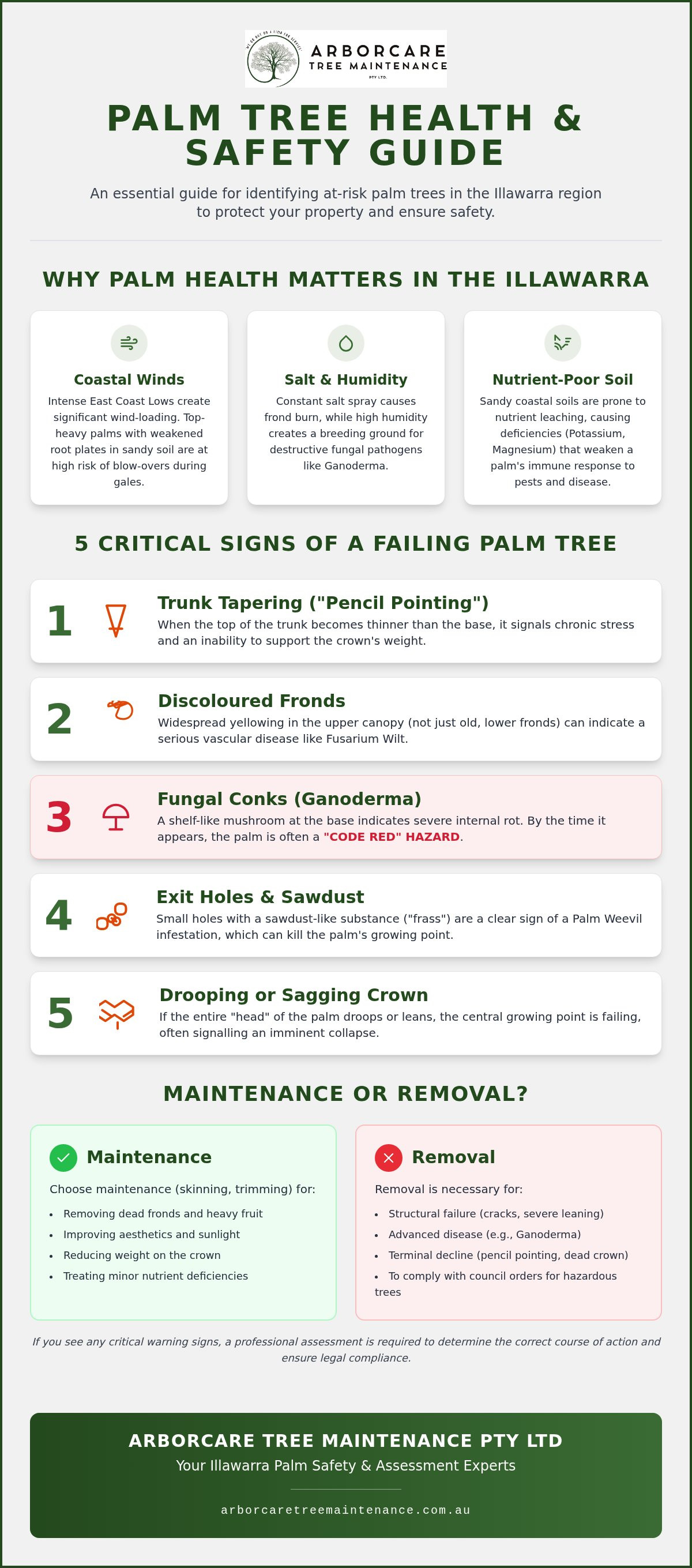
A professional palm tree health assessment Illawarra involves much more than a cursory glance at the fronds. It's a systematic evaluation of a specimen’s structural integrity and biological vigour. Unlike traditional hardwoods, members of the palm tree family are monocots. They grow as single-stemmed biological towers with a unique vascular system. This requires specific weight-distribution checks, as the crown's weight must be perfectly balanced over the central trunk to maintain stability. In our local region, the combination of sandy soils and high humidity creates a breeding ground for pathogens like Ganoderma. Detecting these issues early through a palm tree health assessment Illawarra can prevent the high costs associated with emergency removals after a failure.
The Impact of Coastal Winds on Palm Stability
The Illawarra is notorious for intense East Coast Lows. These weather systems bring sustained gale-force winds that test the limits of any tall specimen. Species like the native Cabbage Tree Palm (Livistona australis) have evolved to be flexible, but urban palms often face different pressures. When a palm becomes top-heavy due to excessive fruit weight or overgrown fronds, its centre of gravity shifts. This increases the wind-loading on the trunk during a storm. If the root plate is weakened by our region's sandy soil, the risk of a total blow-over increases significantly. If you find yourself dealing with a leaning or snapped specimen after a storm, seeking an emergency tree service Illawarra is the safest course of action to secure your property.
Salt Spray and Nutrient Deficiencies
Living near the coast presents specific challenges for palm health. Salt spray can cause salt burn, which many homeowners mistake for a fungal infection. Salt burn typically appears as necrotic tips on the outer edges of the fronds. However, actual fungal issues often thrive in our high-humidity pockets near the escarpment. Distinguishing between these requires technical expertise. Additionally, the sandy soils common in suburbs like Windang or Bulli are prone to nutrient leaching. Palms frequently suffer from Potassium or Magnesium deficiencies, leading to yellowing or spotting that weakens the tree's overall immune response. A comprehensive assessment includes checking for these gaps, often through professional soil testing, to ensure the palm has the resources it needs to stay resilient against local pests like the palm weevil.
5 Critical Signs Your Palm Tree Health is Declining
Recognising the early indicators of decline is the most effective way to prevent property damage. A palm tree health assessment Illawarra often begins with a visual inspection of these five red flags. While some issues are merely aesthetic, others signal that the palm’s structural integrity is failing from the inside out.
- Trunk Tapering (Pencil Pointing): This occurs when the new growth at the top of the trunk is significantly thinner than the base. It indicates chronic stress, often due to nutrient starvation or restricted root space, and suggests the palm is losing the ability to support its own weight.
- Discoloured Fronds: While lower fronds naturally turn brown and die as part of the aging process, widespread yellowing in the upper canopy is a major concern. This can be a symptom of major palm diseases like Fusarium Wilt, which blocks the palm's vascular system.
- Fungal Conks: If you spot a shelf-like mushroom growing at the base of the trunk, it is likely Ganoderma. This fungus rots the lower portion of the trunk internally. By the time the mushroom appears, the palm is often a "code red" hazard.
- Exit Holes and Sawdust: Small, round holes accompanied by "frass" (a sawdust-like substance) indicate an infestation of the Palm Weevil. These pests tunnel through the soft heart of the palm, eventually killing the growing point.
- Crown Sagging: A healthy palm crown should be upright and lush. If the entire "head" of the palm begins to droop or lean to one side, it indicates the apical meristem is failing, which often precedes an imminent collapse.
If you notice any of these red flags on your property, booking a professional tree inspection can clarify whether the palm is salvageable or requires immediate removal.
Identifying Trunk Decay and Hollows
Palms are biologically different from hardwoods because they lack a cambium layer. This means they cannot "heal" or compartmentalise wounds; any damage to the trunk is permanent and provides a direct gateway for decay. Our arborists use a specialised "tap test" with a sounding hammer to identify internal cavities. A hollow, drum-like sound indicates that the internal fibres have rotted away. This poses a high risk of "sudden crown drop," where the heavy top of the palm snaps off without warning, even on a calm day.
Root Zone Inspections
The root system is the anchor of these biological towers. In waterlogged parts of the Illawarra, such as Dapto or Jamberoo, palms are particularly susceptible to root rot. We look for signs of soil heave or "leaning" that suggest the roots are no longer gripping the earth securely. Soil compaction from nearby driveway construction or heavy machinery can also suffocate the roots, leading to a slow decline. A thorough palm tree health assessment Illawarra must include an evaluation of the ground conditions to ensure the tree remains stable during the next high-wind event.
Maintenance vs. Removal: Choosing the Right Path
Deciding whether to invest in ongoing care or proceed with a full extraction is a common dilemma for property owners. A professional palm tree health assessment Illawarra provides the technical data needed to make this choice based on safety and long-term cost efficiency. While regular trimming keeps a palm manageable, there's a clear threshold where a specimen transitions from a landscape feature to a liability. If the biological integrity is compromised beyond repair, removal becomes the only responsible path to protect your home and residents.
For palms that remain structurally sound, an integrated approach to managing palm diseases can often extend the life of the tree. This involves targeted nutrient application and strategic pruning to bolster the palm's natural defences. However, if you determine that the risks outweigh the benefits, our Palm Tree Removal Illawarra guide provides a detailed breakdown of the steps involved in safe extraction.
The Role of Professional Pruning and Skinning
Regular maintenance is about more than just aesthetics. Removing dead or dying fronds reduces the "sail area" of the crown, which significantly lowers wind resistance during coastal storms. We also specialise in "Palm Tree Skinning," a meticulous process where the old, rough leaf bases (boots) are shaved away from the trunk. This results in a smooth, clean appearance that is highly sought after for Illawarra estate properties. Beyond the visual appeal, skinning removes the preferred nesting sites for rats, cockroaches, and spiders. It's vital to avoid the "hurricane cut," where too many green fronds are removed. This common mistake actually weakens the palm, reduces its photosynthetic capacity, and makes it more vulnerable to pests.
When Removal is the Only Safe Option
There are specific scenarios where maintenance is no longer a viable or safe option. A palm tree health assessment Illawarra will identify hazardous thresholds, such as a lean exceeding 45 degrees or a root plate that shows signs of significant movement. Palms positioned near high-voltage powerlines or those overhanging dwellings with signs of internal decay pose an unacceptable risk. In these cases, the structural instability cannot be corrected through pruning. For specimens located in tight suburban blocks or difficult-to-access backyard spaces, we utilise complex tree removal Illawarra techniques. This involves specialised rigging and equipment to dismantle the palm section by section, ensuring no damage occurs to your surrounding property or neighbouring fences.
The Homeowner’s 5-Minute Palm Safety Checklist
While a formal palm tree health assessment Illawarra requires a qualified arborist, you can perform a preliminary check to determine if your palms need urgent attention. This five-step visual inspection helps you monitor changes in your trees, especially after extreme weather events. Early detection allows for proactive maintenance rather than reactive emergency removals.
- Step 1: Visual scan of the crown. A healthy palm should have a lush, full canopy. If the newest leaves are wilting, brown, or emerging in a stunted "frizzle top" shape, the palm is likely suffering from a severe nutrient deficiency or a vascular infection.
- Step 2: Inspect the trunk for bleeding sap. Look for dark, damp patches or "bleeding" sap on the trunk. This is often a sign of internal rot or physical injury that has become infected. Deep horizontal cracks are also a major warning sign of structural instability.
- Step 3: Check the base for sawdust or fungal growth. Inspect the area where the trunk meets the soil. Look for "frass," which resembles coarse sawdust, as this indicates active borer or weevil activity. Small mushrooms or shelf-like fungal conks at the soil line signal that the root plate is decaying.
- Step 4: Monitor the lean. Note the angle of your palm. If the lean has increased or if the soil at the base is lifting after a storm, the root system is failing. A palm that has moved even slightly is a high-risk hazard.
- Step 5: Review local regulations. Determine if your palm is a protected species or an exempt variety. Rules vary between Wollongong and Shellharbour, so knowing your species is the first step in legal compliance.
If your checklist reveals any of these red flags, it is time to organise a professional tree assessment to secure your property and ensure your family's safety.
Understanding Local Council Permit Rules
In the Wollongong City Council area, strict guidelines dictate when you can legally remove a tree. As of 2026, a permit is generally required if a tree is over 5 metres in height or has a trunk diameter of 30cm or more at ground level. However, certain species are exempt. The common Cocos Palm (Syagrus romanzoffiana) is often classified as an environmental weed in the Illawarra and typically doesn't require a permit for removal. It's also important to remember the 2023 mandate: if the council approves a permit for a protected tree's removal, you're now required to plant a replacement tree to maintain the local canopy. A professional palm tree health assessment Illawarra can confirm the species and help you navigate these permit applications with a formal arborist's report.
DIY Safety Warning
Attempting to maintain or remove large palms yourself poses significant risks. Using "spikes" to climb a palm is a common DIY mistake; these spikes create permanent wounds that become entry points for lethal diseases. Furthermore, ladder-based palm trimming is a leading cause of serious garden accidents in NSW due to the unpredictable weight of falling fronds. Palm maintenance at height is a job for licenced professionals with the right safety rigging and aerial equipment. Professional arborists use specialised techniques to ensure fronds and fruit bunches are lowered safely without damaging the tree or the structures below. Trying to save money on a DIY job can lead to thousands of dollars in property damage or, worse, severe personal injury.
Professional Palm Assessments with Arborcare Tree Maintenance
Our approach to a palm tree health assessment Illawarra is methodical and data-driven, ensuring every specimen on your property is evaluated with technical precision. We begin with a comprehensive visual inspection before utilising advanced diagnostic tools to check for internal decay or root plate instability. This thoroughness is essential because palms often hide structural weaknesses until a storm event triggers a failure. As a Dapto-based team, we possess a deep-seated understanding of the Illawarra's unique microclimates, from the salt-heavy air of the coast to the high-humidity pockets along the Escarpment. This local expertise allows us to identify species-specific vulnerabilities that generalists might overlook.
Beyond the initial diagnosis, we provide an integrated suite of services to resolve any identified hazards. If a palm is deemed unsafe, our team manages the entire process from the initial assessment to the final stump grinding Wollongong. This end-to-end service ensures your land is left clear, safe, and ready for replanting. We prioritise safety and compliance, providing the formal documentation required for insurance claims or Wollongong City Council permit applications. Our goal is to alleviate the stress associated with property maintenance through professional reliability.
What to Expect from Our Arborist Report
Our arborist reports provide a clear, professional breakdown of each palm’s biological vigour and structural condition. We don't just identify problems; we provide actionable recommendations, whether that involves specialised pruning, nutrient management, or total removal. Each report includes fixed-price quotes for any necessary work, giving you financial clarity before any maintenance begins. This documentation offers peace of mind, proving you've fulfilled your duty of care as a property owner to maintain a storm-ready environment for your family and neighbours.
Book Your Illawarra Palm Assessment Today
Whether you're managing a residential backyard or a large commercial estate, our licenced arborists are ready to secure your property. We understand that some hazards can't wait, which is why we maintain 24/7 emergency availability for high-risk palms that show signs of imminent failure. For those looking for a broader understanding of tree management in the region, our Tree Removal Wollongong pillar guide offers further insights into our professional standards and safety protocols. Contact Arborcare Tree Maintenance today to schedule your palm tree health assessment Illawarra and protect your home from the next East Coast Low.
Secure Your Property Against the Next Coastal Storm
Maintaining the safety of your landscape requires more than just occasional trimming. By recognising the critical indicators of decline, such as trunk tapering or fungal growth, you can prevent your palms from becoming hazardous liabilities. A comprehensive palm tree health assessment Illawarra ensures your trees remain structurally sound and compliant with local council regulations, including the latest replacement tree mandates.
As a local Illawarra family-owned business, Arborcare Tree Maintenance provides the expertise of fully licenced and insured arborists to guide your property management decisions. We prioritise your safety with a methodical approach to every inspection and offer 24/7 emergency storm response for high-risk situations. Request a Professional Palm Health Assessment from Arborcare to gain complete clarity on the health of your trees. Taking proactive steps today means you can enjoy the aesthetic benefits of your palms with the absolute assurance that your home and family are protected.
Frequently Asked Questions
How can I tell if my palm tree is dying?
Visible indicators like "pencil pointing" at the crown or the presence of fungal conks at the base are clear signs of a dying palm. If the central "spear leaf" can be pulled out easily or the crown displays a permanent sag, the tree's growing point is likely dead. Chronic discolouration in the upper canopy that fails to respond to fertilisers often points to a lethal vascular infection.
Do I need a permit to remove a palm tree in Wollongong?
A permit is mandatory for removing trees over 5 metres in height or with a trunk diameter of 30cm or more in the Wollongong area. Specific species listed as environmental weeds are often exempt from these requirements. Under 2023 council mandates, any approved removal usually requires the planting of a replacement tree to maintain the local urban canopy.
What is palm tree skinning and is it necessary for health?
Palm tree skinning involves the careful removal of old leaf bases to produce a smooth, aesthetically pleasing trunk. While it doesn't directly impact the tree's internal biology, it serves as an important hygiene measure for many homeowners. Removing this fibrous material eliminates habitats for rats and spiders while reducing the potential fuel load on your property during a fire.
Can a sick palm tree be saved?
Recovery is possible if the decline is caused by nutrient gaps or manageable pests identified during a palm tree health assessment Illawarra. However, once fungal rot reaches the central heart or the root system, the specimen is usually beyond saving. Proactive soil management and professional pest control are the most effective ways to preserve a struggling palm before it becomes a hazard.
How much does a professional palm health assessment cost in the Illawarra?
Assessment costs depend on the complexity of the inspection and whether you require a formal written report for legal or insurance reasons. A verbal safety evaluation is a different service level compared to a comprehensive impact assessment. It is best to request a no-obligation quote from a qualified local arborist to get an accurate figure for your specific property requirements.
Are Cocos palms considered weeds in the Illawarra region?
Cocos palms are officially classified as environmental weeds within the Illawarra region. They are notorious for dropping large volumes of sticky fruit that attract bats and vermin while self-seeding aggressively in native bushland. Due to this weed status, they are frequently exempt from the standard tree preservation orders that protect native species like the Cabbage Tree Palm.
How often should I have my palms professionally inspected?
You should arrange for a professional inspection every one to two years to monitor structural integrity. It's also wise to book a check-up following major storm seasons or intense wind events like East Coast Lows. Frequent monitoring allows you to address issues like frond weight or minor pest activity before they escalate into high-risk safety hazards for your family.
What happens if a palm tree falls on my house during a storm?
Your first priority is to ensure everyone is safe and then contact a 24/7 emergency arborist to stabilise the tree. Fallen palms are structurally unstable and require specialised equipment to remove safely without further damaging your roof or walls. Most insurance policies cover the cost of professional removal if the tree has caused property damage during a declared storm event.


